Aporia is a rhetorical device in which a speaker or writer voices real or performed doubt about a question, usually to draw the audience into weighing the problem alongside them. Hamlet’s famous soliloquy, the speech he delivers alone on stage, shows the device at full strength: he asks whether it is nobler to suffer or to act, and the question stays open. Writers reach for aporia when a flat statement would feel too certain for the moment. Readers meet it in speeches, poems, and plays far more often than they hear the word itself in conversation.
What Does Aporia Mean?
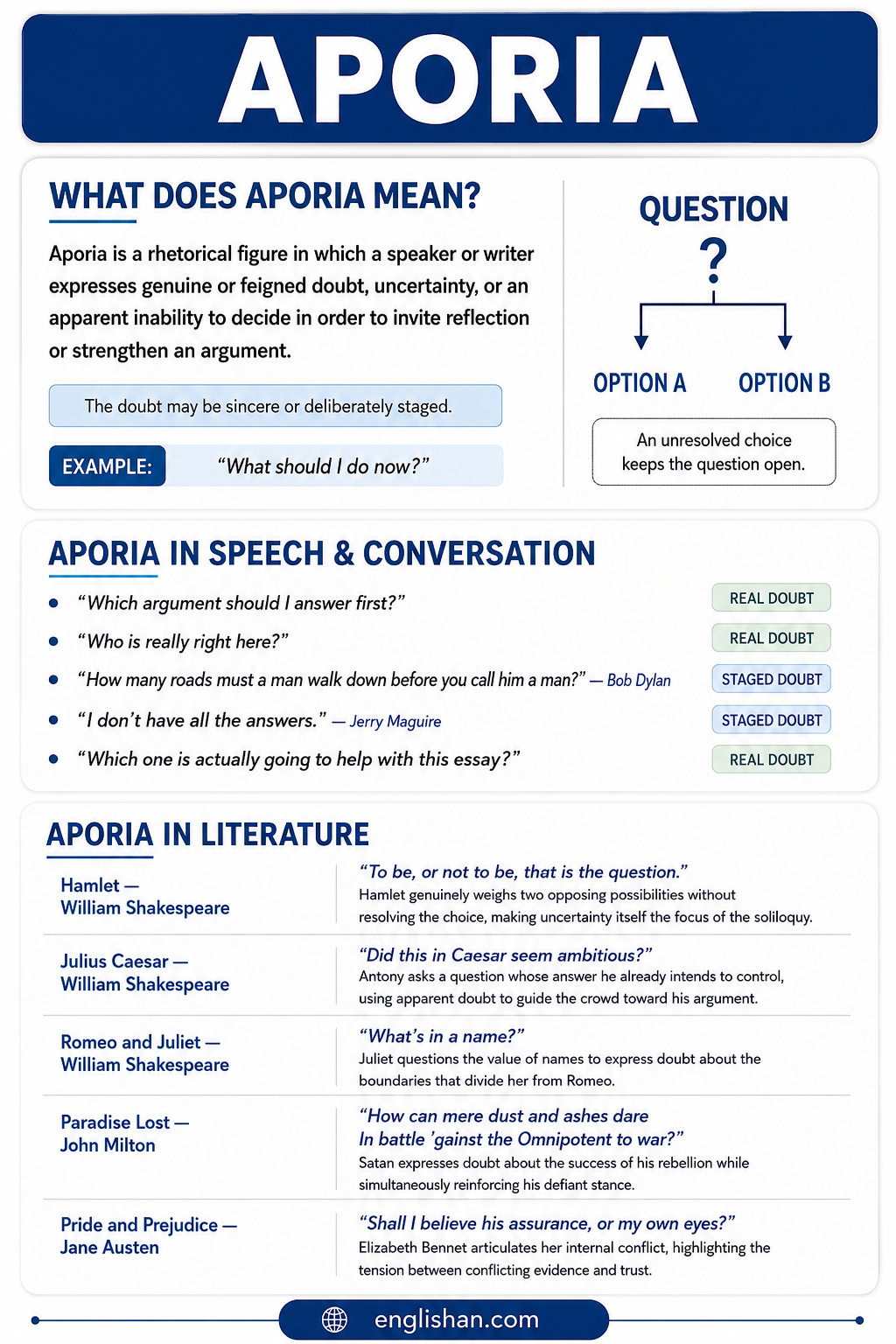
Aporia is a figure of speech in which a speaker raises a question or expresses doubt to make an audience consider a problem rather than accept a ready answer. The doubt can be real, as when a character is honestly unsure what to do next. It can also be feigned, staged for effect while the speaker already knows the point they intend to reach.
That distinction between real and feigned doubt is what separates aporia from an ordinary hesitant sentence. A speaker who genuinely doesn’t know the answer is using aporia sincerely. A politician who asks “who’s right here?” while already steering the audience toward one side is using it as a tool, closer to ambiguity deployed on purpose than to real confusion.
Where Does the Word Aporia Come From?
The word traces back to the Ancient Greek aporia, built from a- (without) and poros (a passage or way through). Together they described something impassable, a road that goes nowhere. Greek philosophers used the term for exactly that feeling: a line of reasoning that leads to a wall rather than a conclusion.
English borrowed the word through French aporie, and Merriam-Webster records its first known use in English around 1550. So the term itself has been naming this kind of stuck, working-it-through moment for close to five centuries. It settled long ago into its current double role as both a rhetorical device and a philosophical one.
Aporia as a Rhetorical Device
As a device, aporia belongs to the same classical family of figures as chiasmus and asyndeton. The ancient Greeks named and taught these figures because they noticed how often good speakers used them without a name for it. What sets aporia apart is its function: the speaker performs doubt out loud instead of asserting a conclusion.
A speaker gains two advantages by doing this. First, raising a doubt and working through it shows the audience that competing views were actually considered, which establishes ethos, the credibility that comes from appearing thorough rather than one-sided. Second, an audience that watches a question get weighed tends to arrive at the conclusion feeling like they reasoned their way there themselves, rather than being told.
Rhetoricians sometimes split the device into two working styles, though neither needs its own name to matter in practice. Argumentative aporia raises a doubt the audience is likely already holding, so the speaker can address it directly before it becomes an objection. Tonal aporia softens a claim on a sensitive subject by phrasing a position as an open question rather than a flat assertion. That softness is why it shows up so often in speeches about ethics, religion, and grief.
Aporia in Literature
Drama and poetry supply the best-known examples of aporia, since an entire scene can turn on a single unresolved question.
Hamlet, William Shakespeare: To be, or not to be, that is the question.
Hamlet is not performing doubt for an audience within the play. He is alone, genuinely weighing whether to endure his suffering or end it. The line is built from two mirrored, parallel structure phrases that place existence against its opposite without settling which one wins. The whole soliloquy that follows is Hamlet working through that unresolved dichotomy, a choice split between two opposites, in real time.
Julius Caesar, William Shakespeare: Did this in Caesar seem ambitious?
Mark Antony asks this during his funeral speech, then answers his own question by listing Caesar’s refusals of the crown and his gifts to the poor. The doubt is feigned. Antony already knows what he wants the crowd to conclude, and the question sets up a sharp juxtaposition between the ambition Brutus accused Caesar of and the generosity Antony describes instead.
Romeo and Juliet, William Shakespeare: What’s in a name? That which we call a rose by any other name would smell as sweet.
Juliet’s question sounds rhetorical, but it drives real reasoning: she is trying to convince herself that a name, specifically the name Montague, shouldn’t matter as much as it does. The doubt is genuine even though the scene is fiction.
Sonnet 43, Elizabeth Barrett Browning: How do I love thee? Let me count the ways.
The speaker opens by admitting she isn’t sure how to measure something as large as her love, then spends the rest of the sonnet trying anyway. The opening question is doubt about scale, not doubt about the feeling itself.
The Love Song of J. Alfred Prufrock, T.S. Eliot: Do I dare disturb the universe?
Prufrock’s poem circles the same unresolved question across dozens of lines, never landing on an answer. The repetition is the point: aporia here isn’t a single moment of hesitation but the entire condition of the speaker, a man who cannot stop questioning long enough to act.
The Unnamable, Samuel Beckett: Where now? Who now? When now?
Beckett opens the novel with three questions in a row and never fully resolves any of them. The narrator’s identity, location, and moment in time all stay genuinely uncertain, which makes this one of the purest examples of real, not performed, aporia in modern fiction.
Aporia in Speeches and Everyday Conversation
Aporia has been a persuasive tool in oratory since before Shakespeare wrote a word. The Athenian orator Demosthenes used it in his speech On the Crown. He paused to question where he should even begin answering his accusers, a move that framed the scale of the case before he answered any of it. Roman orators taught the same technique under the Latin name dubitatio, meaning staged doubt, and performed uncertainty about which of several charges to address first.
The device survives in far less formal settings, too. Bob Dylan’s folk song Blowin’ in the Wind opens with How many roads must a man walk down before you call him a man? The song never answers the question directly, leaving the listener to sit with it. Film dialogue uses it the same way. In Jerry Maguire, the title character admits mid-speech, I don’t have all the answers, staging his own uncertainty to make the audience trust the ones he does offer.
Everyday speakers use a smaller version of the same move. A student staring at two library books might ask aloud, Which one is actually going to help with this essay? That question is real aporia: a genuine, momentary impasse, voiced because talking a problem through settles it faster than silent worry.
Aporia in Philosophy
Long before it became a rhetorical device, aporia was a philosophical one, and the two senses share more than a name.
Socrates made it the goal of his way of teaching by questions, now called the Socratic method. In Plato’s dialogues, he would ask the person he was questioning to define an everyday concept, like courage or virtue. He then tested each answer until the person’s confidence collapsed into open confusion. The dialogue Meno ends this way: a character who began the conversation certain he understood virtue admits by the end that he no longer knows what it is at all. Socrates treated that admitted confusion as progress, not failure, since a person who knows they don’t understand something is finally in a position to learn it.
Aristotle formalized the idea further. In the Metaphysics, he opens his inquiry by cataloguing the aporiai, his term for the field’s hardest unresolved puzzles, before attempting to answer any of them. He treated the puzzles themselves as the necessary starting point for careful logos, reasoned argument developed step by step rather than asserted outright.
The term reappeared in the twentieth century in the work of Jacques Derrida. He used aporia to describe a point inside a text where its own logic runs into a contradiction that cannot be resolved. The text cannot argue its way past that passage, no matter how it is read. For Derrida, finding that impasse wasn’t a flaw in the text. It was the moment the text revealed something about language that a smooth, contradiction-free reading would have hidden.
How Aporia Differs From Similar Devices
Aporia is often confused with two other devices. Telling them apart comes down to what the doubt is actually doing.
A rhetorical question already contains its answer, and the speaker never intends to weigh the question seriously. Aporia can be phrased as a question too, but the weighing has to feel real, even when it’s staged, or the line collapses into a plain rhetorical question instead.
A paradox is a statement that seems to contradict itself on the surface but turns out to reveal something true underneath, like saying less is more. Aporia is not a contradictory statement at all. It’s the state of standing at an impasse, unable to move forward, which a paradox can sometimes produce but doesn’t have to.
A non sequitur breaks logic by accident, offering a conclusion that does not follow from what came before it. With aporia, the speaker interrupts the reasoning on purpose and invites the audience to notice the gap rather than stumble into it unnoticed.
How to Use Aporia in Your Own Writing
Aporia works best when the doubt sounds like it belongs to a real person thinking, not like a rehearsed pause inserted for effect.
- I don’t know if this was the right choice, but I made it anyway. ✅ The doubt belongs to a real decision the writer already made, which keeps it honest rather than performed for sympathy.
- I don’t know, what do you guys think, I don’t know, right? ❌ Repeating the hesitation without adding any new thought reads as filler, not aporia. The device needs the doubt to be doing something, not just marking time.
Three habits keep the device working rather than wearing thin. Ask the question before you already sound certain of the answer, since the effect depends on the audience believing the weighing is genuine. Keep to one question per passage rather than raising several doubts at once, which reads as indecision. And decide on purpose whether to resolve the doubt afterward, the way Antony does, or leave it open, the way Prufrock does. Both choices are valid, but they create very different endings for a reader.
FAQs
The best-known example is Hamlet’s line “To be, or not to be, that is the question.” Shakespeare’s character genuinely weighs whether to endure his suffering or end it, and the outcome stays open at the moment he asks.
Not quite, though the two overlap. A rhetorical question already assumes its answer and isn’t meant to be weighed, while aporia has to feel like a real question being worked through, even when the speaker is only performing that uncertainty.
In philosophy, aporia names a genuine logical impasse, a point where reasoning about a concept runs into contradiction rather than a settled answer. Socrates used it as a teaching method in Plato’s dialogues, and Jacques Derrida later used it to describe a contradiction built into a text itself.
Use it by voicing a real or staged question about how to proceed, such as “I still can’t decide if leaving was the right choice.” The sentence qualifies as aporia because it names a genuine, unresolved doubt rather than stating a settled conclusion.
The word comes from Ancient Greek philosophy, where Socrates and Aristotle both used the concept. Socrates reached it through his method of questioning in Plato’s dialogues, while Aristotle catalogued the aporiai, or puzzles, in the Metaphysics. The rhetorical use of the term in English dates to around 1550.
Aporia is pronounced uh-POR-ee-uh (ə-ˈpȯr-ē-ə), with the stress on the second syllable. Say the four syllables slowly and the Greek roots become audible: a-POR-i-a, without-a-passage, spoken almost like the impasse it describes.