Aristotle named logos as one of three modes of persuasion in his treatise Rhetoric, composed around 350 BCE. The word comes from the Greek λόγος, meaning word, reason, or account, and it names the strategy of persuading an audience through logic rather than personality or emotion.
A courtroom argument grounded in evidence and a political speech backed by statistics both depend on this kind of reasoning. The audience then reaches agreement rather than sympathy. Alongside ethos and pathos, logos completes Aristotle’s rhetorical triangle, the three appeals a speaker or writer combines in a persuasive case. That same triangle underlies the wider catalog of rhetorical devices that extend it.
What Is Logos in Rhetoric
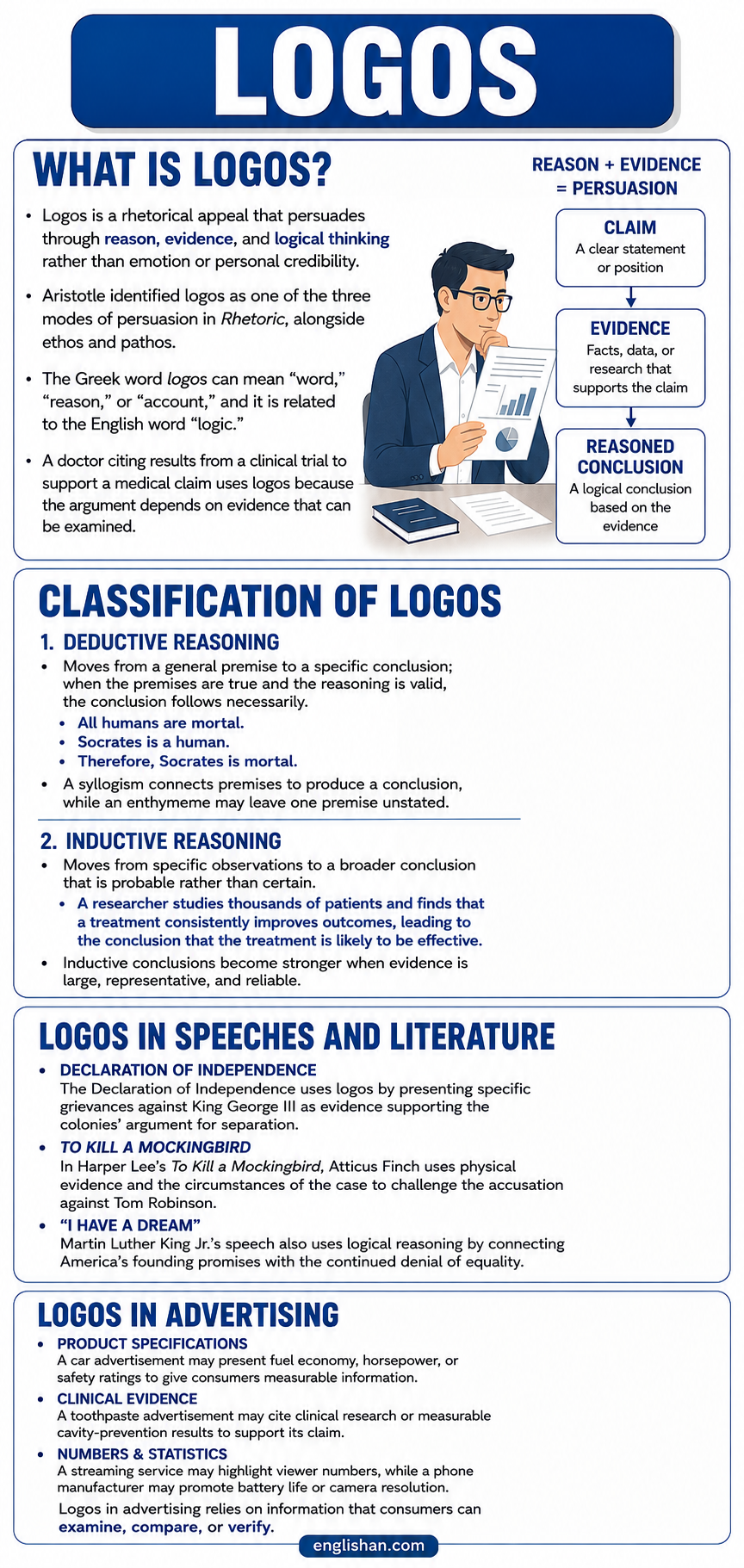
Logos names an argument’s appeal to reason: the facts, statistics, examples, and logical structure a speaker offers so an audience reaches a conclusion through thought rather than feeling.
Aristotle set out the idea in Book I of Rhetoric. There he named three technical means of persuasion available to any speaker. Ethos persuades through character, pathos through emotion, and logos through the argument itself. The Greek term literally means word or reason, and the English word logic comes from the same root.
A writer using logos backs a claim with verifiable support: a fact that can be checked, a number that can be traced, a pattern that survives close examination. The appeal persuades because an audience accepts sound reasoning on its own terms, without needing to trust the speaker or feel a particular emotion first.
Logos vs Ethos vs Pathos
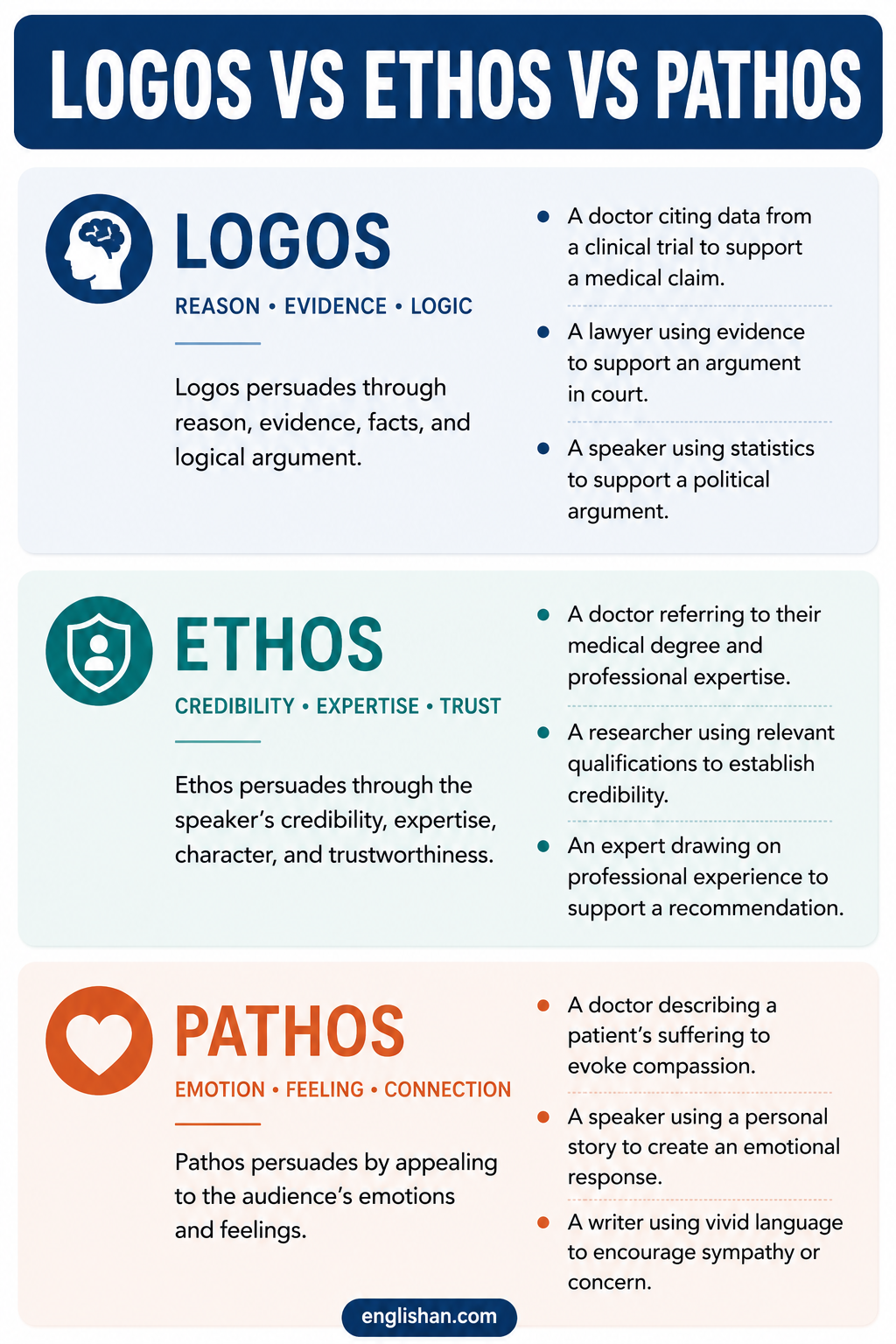
The three appeals rarely work alone. A strong argument relies most heavily on one while the other two support it, and knowing which is which sharpens both reading and writing.
| Appeal | Appeals To | Built From | Example |
|---|---|---|---|
| Logos | The audience’s reason | Facts, statistics, evidence, logical structure | A doctor citing data from a clinical trial |
| Ethos | The audience’s trust | The speaker’s credibility, expertise, character | A doctor citing their own medical degree |
| Pathos | The audience’s emotion | Vivid imagery, personal stories, emotional language | A doctor describing a patient’s suffering |
Logos differs from the other two by setting the messenger aside. Ethos asks the audience to trust who is speaking, and pathos asks them to feel something the speaker wants them to feel. Logos asks for neither: the audience receives the reasoning itself, and that reasoning, not the messenger, persuades.
That does not make it the strongest appeal by default. A logically sound argument delivered by an untrustworthy source, or one that leaves an audience cold, frequently persuades less than a weaker argument paired with credibility and feeling. The three appeals persuade in combination, not in isolation.
How Logos Works in an Argument
A logic-based argument is only as strong as the reasoning that connects its evidence to its conclusion. Deductive and inductive reasoning form those connections in most arguments, and a writer who knows the difference builds, or spots, a sharper case.
Deductive Reasoning
Deductive reasoning moves from a general premise, a starting statement taken as true, to a specific conclusion. It only works when every step follows necessarily from the one before it.
Aristotle’s own example remains the classic illustration of the form, called a syllogism: All men are mortal. Socrates is a man. Therefore, Socrates is mortal. Each line depends on the one before it, and if both premises are true, the conclusion cannot be false.
Most real arguments compress this structure into an enthymeme, a syllogism with one premise left unstated because the audience is expected to supply it. A campaign speech runs the same kind of syllogism when it argues a candidate deserves re-election because the local economy has grown under her leadership. Its middle premise, that leaders who grow local economies deserve re-election, stays implied rather than spoken.
Inductive Reasoning
Inductive reasoning runs the other direction: it gathers specific observations and moves toward a general conclusion. For example, a researcher reasons inductively by tracking recovery rates across ten thousand patients and concluding that a treatment works. In marketing, the same reasoning appears when survey data from a thousand customers backs the claim that a product performs well.
Unlike a valid syllogism, an inductive argument never reaches certainty. It reaches only probability, and the strength of that probability rises with the quality and size of the evidence behind it. A single testimonial proves far less than a controlled study of a thousand cases. That gap is why reasoning-driven writing depends on the largest and most credible sample of evidence available, not the most convenient one.
Logos rarely works apart from the sentence-level choices that shape it. A writer who restates a sequence of reasons using parallel structure lets the reader track each step in a chain of evidence. Matching grammar shows that each clause contributes equally to the conclusion. By a different route, an analogy translates an unfamiliar statistic into a comparison the audience already understands.
An allusion supports a claim without repeating the reasoning behind it, as when a writer points to a recognized precedent, a court ruling, or a historical event. Precise diction keeps an argument’s logic from blurring at the edges. A term chosen for its exact meaning leaves less room for a reader to misread the connection between claim and evidence.
Examples of Logos in Speeches and Literature
Logos appears wherever an argument needs to survive scrutiny rather than win applause. The Declaration of Independence argues its case for separation from Britain through evidence rather than sentiment. Point by point, it lists specific grievances against King George III. Each one supports the document’s claim that “a long train of abuses and usurpations” justified the colonies’ decision.
Harper Lee’s Atticus Finch argues the same way in his closing statement in To Kill a Mockingbird. Rather than asking the jury to feel sympathy for his client, he walks them through physical evidence. The bruises on Mayella Ewell’s face suggest an attacker who led with the left hand, a detail that matches her father rather than the disabled Tom Robinson.
Martin Luther King Jr.’s “I Have a Dream” speech draws heavily on ethos and pathos, but its central metaphor is an appeal to logic in disguise. King argues that Black Americans were handed a “promissory note” by the founding documents of the nation, one the country had failed to honor. That structure leads listeners to a conclusion built on premises that survive examination: a promise made and a promise broken.
Each case follows the same pattern: state a claim, supply evidence a skeptical audience can verify, and let the conclusion follow from the connection between the two.
Logos in Advertising
Advertising uses logos whenever a brand argues on specification rather than desire. A car commercial states a vehicle’s fuel economy in miles per gallon, its horsepower, or its five-star safety rating. That is data for the audience to weigh, not a lifestyle to imagine. In the same spirit, a toothpaste ad cites the percentage of dentists who recommend a formula, or the number of cavities prevented in clinical trials.
Streaming services display a show’s viewer count in its first week. Phone manufacturers list battery life in hours and camera resolution in megapixels. In every case, the audience receives a number and nothing more, and the figure itself makes the argument. The appeal works in advertising for the same reason it works anywhere else. A claim backed by a checkable figure survives a skeptical audience’s scrutiny better than one that only sounds appealing.
Logical Fallacies That Weaken Logos
An argument that only sounds logical is not the same as one that is. Several errors in reasoning, called logical fallacies, resemble sound logic while lacking its substance. A writer who can name them avoids weakening an otherwise solid case.
- Non sequitur: A conclusion that does not follow from its premises, even when each premise is true. Claiming a candidate deserves the presidency because she dresses sharply is a non sequitur; nothing about her wardrobe supports the conclusion.
- False dichotomy: Reducing a question to only two options when more exist. “Either we cut the education budget or the economy collapses” ignores every option between those two extremes. That narrowing turns a genuine dichotomy into a false one.
- Hasty generalization: Drawing a broad conclusion from a sample too small to support it. Sound inductive reasoning uses a large, representative sample; a hasty generalization skips that step and guesses instead. One disappointing experience with a product does not establish that an entire product line fails.
- Circular reasoning: Using the conclusion as its own premise. “This law is just because it is the law” assumes the very point it claims to prove.
- Correlation mistaken for causation: Treating two events that occurred together as though one caused the other. Ice cream sales and drowning rates both rise in summer, but neither causes the other; heat drives both.
A real logical argument and a fallacy that imitates one look alike at a glance, until the evidence behind each is checked.
- This diet works because a celebrity lost twenty pounds on it. ❌ The claim depends on a single unverified case, not evidence a skeptical reader can trace back to its source.
- This diet works because a controlled trial of two thousand participants showed measurable weight loss over six months. ✅ The claim states a sample size and a method, which is what separates real reasoning from its imitation.
FAQs
Q1. What does logos mean in rhetoric?
It names the appeal to logic and reason in a persuasive argument, one of the three modes of persuasion Aristotle identified in Rhetoric alongside ethos and pathos. It relies on the facts, evidence, and logical structure a speaker or writer offers so an audience reaches a conclusion through reasoning rather than trust or emotion.
Q2. What is an example of logos in everyday life?
A nutrition label serves as a routine example: it lists calories, sugar, and protein, checkable numbers a shopper weighs before a decision. A weather forecast that cites a seventy percent chance of rain, based on atmospheric data, works the same way.
Q3. What is the difference between logos, ethos, and pathos?
Logos persuades through evidence and reasoning. Ethos persuades through the speaker’s credibility and character, while pathos persuades through emotion. A single argument frequently uses two or three of the appeals together, but each one reaches the audience through a different channel.
Q4. Is logos more persuasive than ethos or pathos?
No single appeal outperforms the other two on its own. A logically sound argument delivered by a speaker the audience distrusts persuades less than expected, and so does one that never engages the audience’s feelings. A weaker argument paired with credibility and feeling frequently wins instead, and the strongest arguments combine all three.
Q5. How can I use logos in my own writing or speech?
Support each claim with verifiable evidence: a statistic with its source, a documented fact, or an explicit logical connection between a premise and a conclusion. Avoid the fallacies that only imitate logic, and let the strongest evidence, not the loudest claim, decide the argument.