

An analogy is a comparison between two unlike subjects that explains one of them by showing how it works like the other. English speakers use analogies constantly, in classrooms, courtrooms, and casual conversation. The human eye works like a camera. Arguing without evidence is like building a house without a foundation. Both examples use a familiar image to explain a harder idea.
What Is an Analogy?
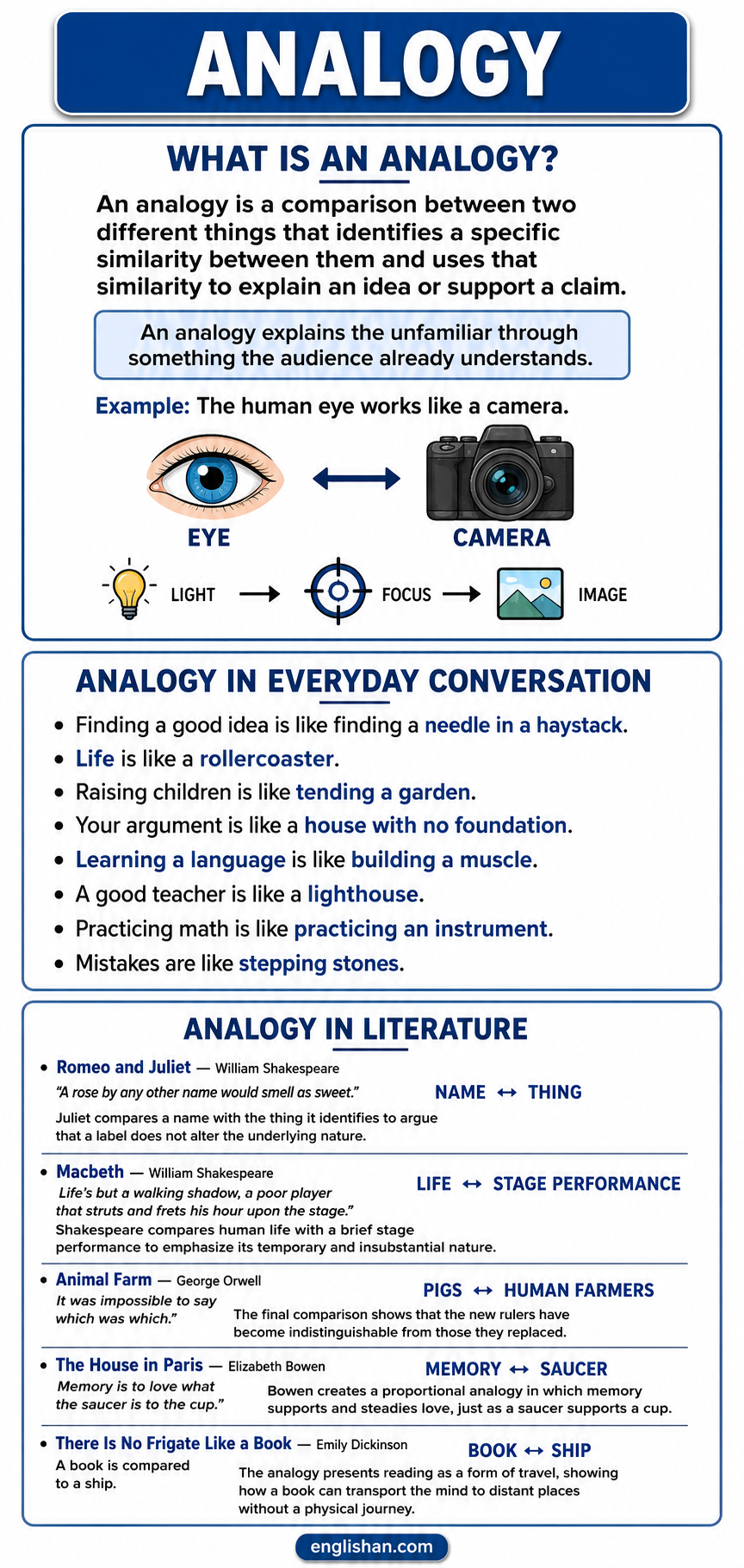
An analogy names the two halves being compared and the one specific way they are alike. It then uses that likeness to explain a point or support a claim. The word comes from the Greek analogia, meaning proportion or matching relationship. That sense of a matching relationship still separates a real analogy from a random comparison.
Two questions identify an analogy in a sentence. First, ask what two halves are set side by side. Second, ask what particular similarity connects them. In “the human eye works like a camera,” the two halves are the eye and the camera. The similarity is the way light gets focused onto a surface to form a picture. Drop that shared function and the comparison stops being an analogy, since nothing is actually being explained anymore.
Every analogy depends on something the reader already understands to explain something they do not. The familiar half does the explaining. A weak or unfamiliar comparison explains nothing, however clever it sounds.
Types of Analogies
Analogies take three common forms in English. Knowing which one is being used lets a reader judge whether the comparison is fair or only persuasive.
Literal Analogy
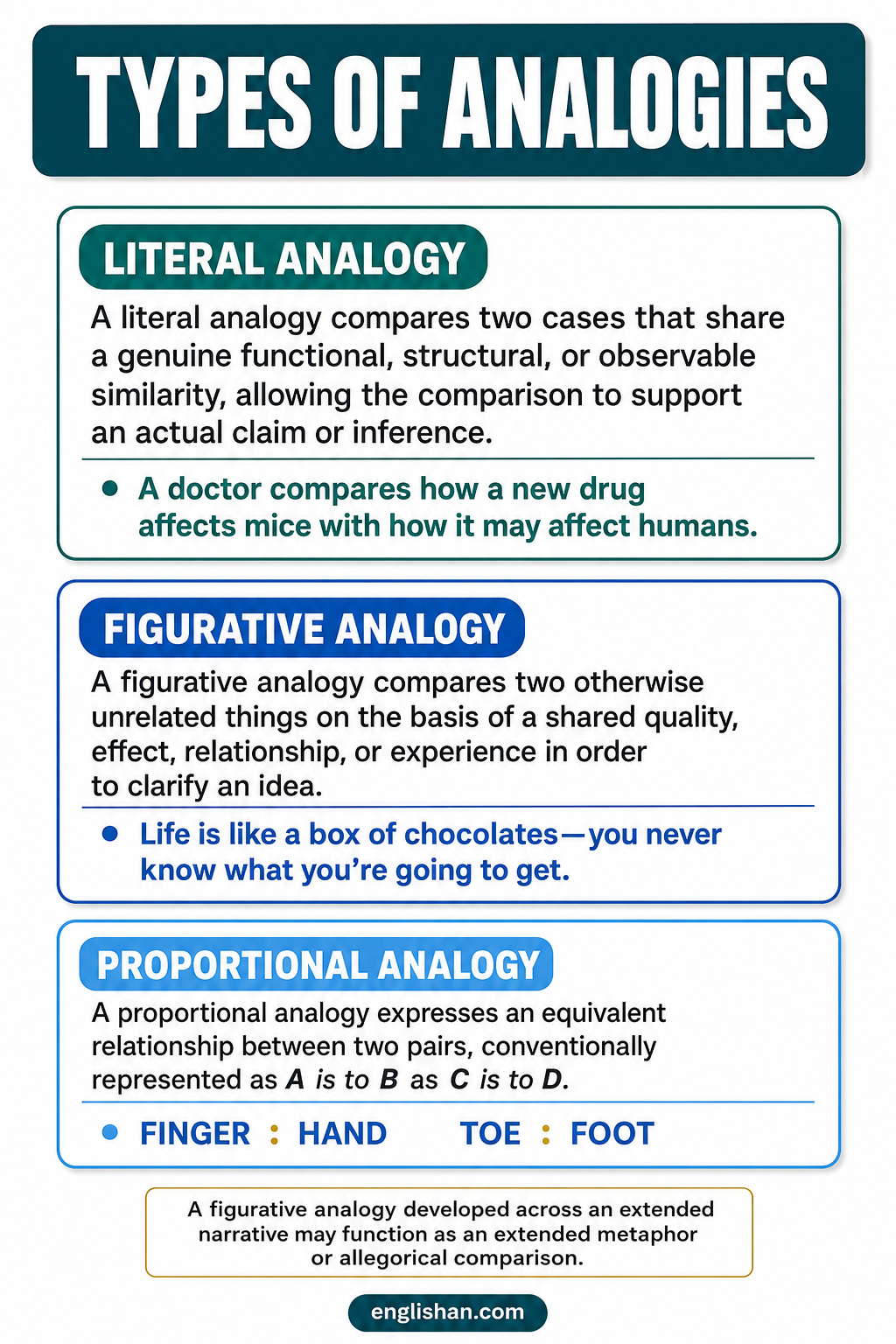
A literal analogy compares two cases that are genuinely similar in a functional or structural way, not just similar in feeling. Scientists and doctors use them constantly. A researcher compares a new drug’s effect on mice to its expected effect on humans. An engineer compares electricity flowing through a wire to water flowing through a pipe. Because the similarity is real and measurable, a literal analogy can support an actual argument, not just a picture.
Figurative Analogy
A figurative analogy links two halves that share no real physical connection but share a single feeling or function. Figurative here means the opposite of literal: the comparison is not factually true, only true in effect. “Life is like a box of chocolates, you never know what you’re gonna get” links two unrelated halves, life and candy, through the shared feeling of unpredictability. This is the type most readers picture first, since it needs no scientific or measurable link between the two halves, only a shared feeling.
Proportional Analogy
A proportional analogy states that one pair of words relates to each other the same way a second pair does. It is written as A is to B as C is to D. “Finger is to hand as toe is to foot” follows this pattern, and so does “puppy is to dog as kitten is to cat.” Vocabulary tests and reasoning exercises use this exact format, trimmed down to single word pairs for speed.
A figurative analogy stretched across an entire narrative becomes an extended metaphor, a single comparison developed over many lines. Plato’s Cave describes prisoners who mistake shadows on a wall for reality itself. It began as this type of extended comparison and is now studied mainly as an allegory in its own right.
Analogy vs Simile vs Metaphor
Analogy overlaps with two other devices closely enough that the three get confused. All three are forms of figurative language, wording that means more than its literal sense. Each one does a different job in a sentence.
| Device | What It Does | Example |
|---|---|---|
| Analogy | Extends a comparison across several sentences to explain or argue a claim | Raising a child is like tending a garden: both need patience and years before the results show |
| Simile | States a resemblance between two examples in one line, using like or as | Her smile was as bright as the sun |
| Metaphor | States that one thing is another, without like or as | Her smile was sunshine |
A simile or a metaphor can open an analogy as the sentence that states the comparison. An analogy continues past that first line, since its purpose is to prove a claim rather than only to show a likeness. A single simile stops at the resemblance. An analogy uses the resemblance to support an explanation or an argument.
Related:
Examples of Analogy in Everyday Conversation
Everyday speech is full of analogies. Speakers pick them up from parents, teachers, and friends long before reading any literature, because comparison explains something fast.
- As light as a feather: describes something that weighs far less than expected.
- Finding a good idea is like finding a needle in a haystack: describes a search that is technically possible but exhausting.
- Life is a rollercoaster: a run of good and bad luck follows its own unpredictable rhythm, the same way a rollercoaster climbs, drops, and turns without warning.
- Raising children is like tending a garden: both need patience, the right conditions, and years before the results show.
- Your argument is like a house with no foundation: it looks fine on the surface until it collapses under the first hard question.
- Learning a language is like building a muscle: progress depends on regular use, not one long session.
- The brain works like a filing cabinet: it stores information in categories so it can be pulled out again when needed.
- A good teacher is like a lighthouse: the teacher stays steady and visible so students can find their way, even from a distance.
- Practicing math is like practicing an instrument: the skill fades quickly once regular practice stops.
- A strong paragraph is like a sandwich: the first and last sentences frame the middle, and the middle contains the main content.
- Rules in a classroom are like traffic lights: they only work if everyone agrees to follow them at the same time.
- Mistakes are like stepping stones: each one gives the next step somewhere solid to land.
Examples of Analogy in Literature
Writers use analogies to give abstract feelings a physical shape. English literature is full of comparisons made for exactly that purpose.
- William Shakespeare, Romeo and Juliet: Juliet argues that “a rose by any other name would smell as sweet.” She compares Romeo’s name to a flower’s name to argue that a label never changes the thing itself.
- William Shakespeare, Macbeth: life is compared to “a walking shadow, a poor player that struts and frets his hour upon the stage.” A lifetime becomes a brief, forgettable stage performance.
- George Orwell, Animal Farm: the final scene compares the pigs and the farmers until “it was impossible to say which was which.” The comparison shows that the new rulers had become exactly what they replaced.
- Forrest Gump, 1994 film: “life is like a box of chocolates, you never know what you’re gonna get.” An unpredictable life becomes an assortment of candy with no label on each piece.
- Elizabeth Bowen, The House in Paris: “memory is to love what the saucer is to the cup.” This proportional analogy compares the steadying effect memory has on love to the way a saucer steadies the cup resting on it.
- Dylan Thomas, Do Not Go Gentle Into That Good Night: “blind eyes could blaze like meteors and be gay.” A final burst of resistance is compared to a meteor’s brief, brilliant streak of light.
- Emily Dickinson, There Is No Frigate Like a Book: a book is compared to a ship. Both are capable of carrying a reader’s mind to distant places without the cost or danger of a real voyage.
- John Donne, The Flea: the poem compares a flea bite, which mixes the blood of two people, to the far greater joining of marriage. The speaker uses the small event to argue for the larger one.
- Robert Frost, Nothing Gold Can Stay: new leaves are compared to flowers. The poem argues that anything born perfect, a leaf, a season, an age, fades the same way.
How to Write a Good Analogy
A strong analogy is planned, not accidental. Four checks separate one that explains from one that only confuses.
- Name what needs explaining: identify exactly what is hard to picture, whether it is a process, a feeling, or a relationship between two halves.
- Find something familiar with the same relationship: the comparison only works if the familiar half shares the actual relationship, not just a surface feeling.
- Match it side by side: compare both halves point by point and check that each part still matches. The analogy breaks at the point where the match stops.
- Trim it to the relationship that counts most: cut any detail from the familiar half that does not map onto the original claim.
Take the claim that short-term memory has a limited capacity. A shopping basket holds only so many items before something has to be set back down. Short-term memory works the same way: once it fills up, adding a new fact pushes an old one out. That comparison passes the side-by-side test because both halves share the same real limit.
Why Do Writers Use Analogies?
Writers use analogies for three main reasons, and decoration is not one of them. Each reason appears throughout writing and speech.
- They make abstract feelings physical: an analogy describes a shapeless feeling or process through something the reader can already picture.
- They support an argument: a logos appeal argues from logic rather than emotion. An analogy makes such a claim feel reasonable before a single fact is presented.
- They add emotional weight: comparing grief to a wound that never fully closes expresses a depth of feeling that a flat definition of grief cannot.
What Is a False Analogy?
A false analogy treats two situations as alike when they differ in the way that matters. It counts as a logical fallacy, an error in reasoning rather than only weak style. The similarity that actually connects the two situations is too small, or too far from the point, to support the conclusion being drawn.
Saying that banning a single book is exactly like burning every book in a library treats a narrow decision and a total one as the same size. That difference in scale is exactly what the argument ignores. The comparison sounds dramatic, but its premise, the starting claim that the two acts are alike, is too weak for the conclusion to follow. Like a non sequitur, a false analogy draws a conclusion that does not follow from its starting claim. Every analogy is worth checking for the size and relevance of its similarity before trusting its conclusion.
Analogy in Word Puzzles and Tests
Vocabulary tests and reasoning exercises use a stripped-down version of the proportional analogy covered earlier. Test writers call this format a word analogy. It is written as A is to B as C is to D.
- Sun is to day as moon is to night: each half pairs a light source with the time it is associated with.
- Kitten is to cat as puppy is to dog: each half pairs a young animal with the adult it grows into.
- Author is to book as composer is to symphony: each half pairs a creator with the work that creator produces.
Solving a word analogy means naming the exact relationship in the first pair, then searching for a second pair that repeats it. That step is an inference, a conclusion drawn from evidence rather than from a feeling of similarity.
FAQs
The difference is length and purpose: a metaphor states that one thing is another in a single line, while an analogy extends the comparison to explain or argue a claim. Both can share the same image, but a metaphor stops at the statement and an analogy develops it further.
Yes, a simile can open an analogy when the comparison it introduces gets developed further instead of standing alone. A simile that remains one short line, with no explanation attached, is not yet an analogy.
No, a figurative analogy only has to make its point, since it expresses a feeling rather than claiming a literal fact. A literal analogy, by contrast, must stay accurate as a genuine, checkable similarity. It supports a real argument, not only a vivid picture of its subject.
Analogy is pronounced uh-NAL-uh-jee, with the stress on the second syllable, written in phonetic script as /əˈnælədʒi/.
Comparison and parallel are the closest everyday substitutes for analogy in most sentences. Neither one expresses the exact sense of one half explaining another through a shared relationship.
Analogy follows a verb such as draw, make, or use in the sentence that introduces it. “The teacher drew an analogy between the water cycle and a delivery route” shows the word introducing the comparison rather than standing alone as the comparison itself.
Plato’s Cave describes prisoners who have spent their whole lives facing a wall, mistaking shadows cast by a fire behind them for reality itself. Plato uses the comparison to argue that most people mistake appearances for genuine knowledge in the same way. It began as an extended analogy and is studied today mainly as an allegory, since the comparison runs the length of a whole story rather than one sentence.