Imagery is descriptive language that appeals to the senses. A shrieking gate is auditory imagery. A cold doorknob is tactile imagery. Sight has no privilege here, though the word image suggests pictures, and pictures are one type of seven. The seven follow the seven senses a reader has.
Imagery Is Not Only Visual
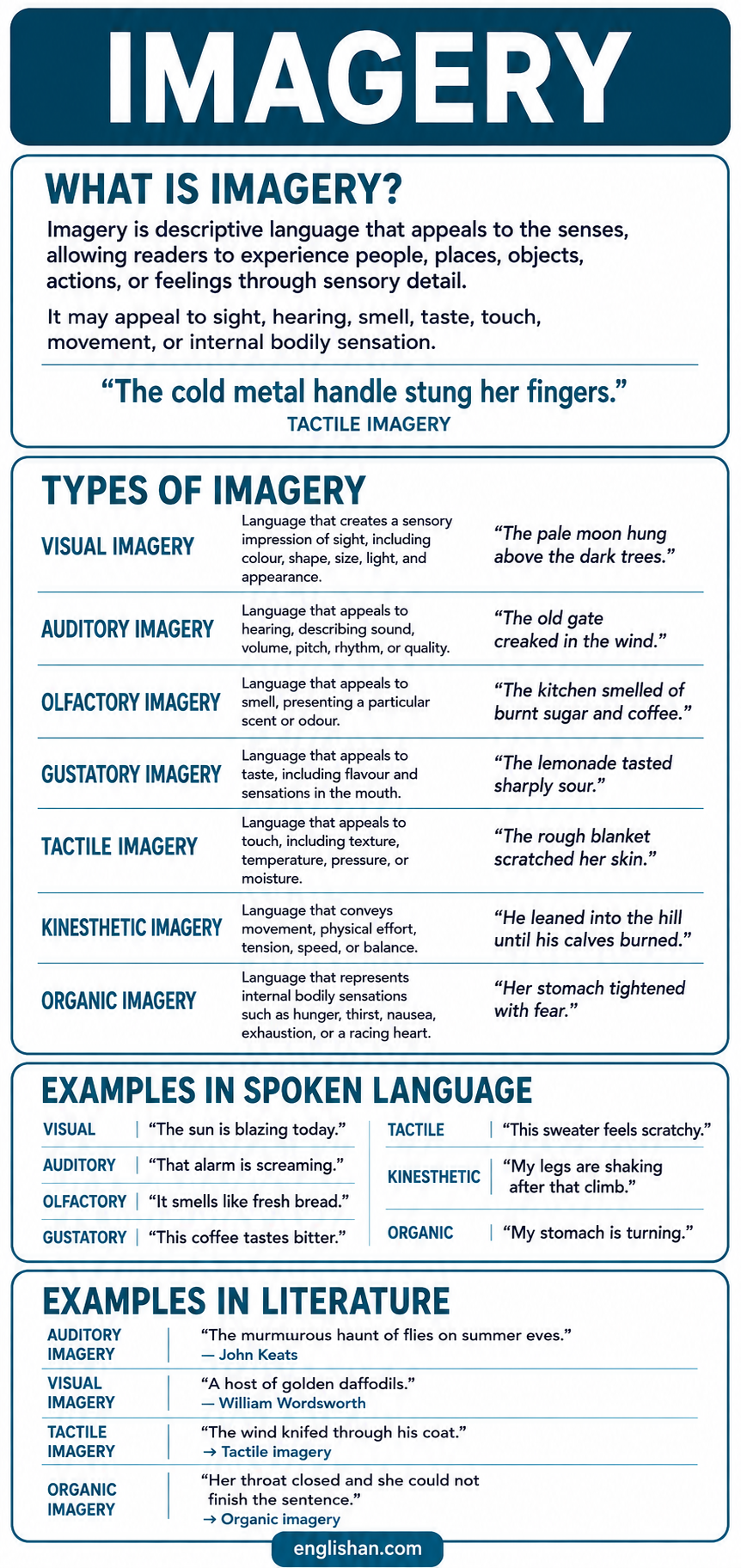
Imagery shares a root with image, and the shared root misleads. Sight is one of the seven senses imagery appeals to, not the whole of them.
Keats shows this in a single line of Ode to a Nightingale: the murmurous haunt of flies on summer eves. Nothing in the line can be seen. It works through hearing alone, and it is imagery of the fullest kind.
The visual reading comes from what published fiction actually does. A novel reports what a character sees far more than what a character smells, so visual detail is what a student meets first on almost any page. That describes novels rather than imagery.
A writer can reach any of the seven senses, and sight has no first claim on the word.
Imagery Types Are Named After the Senses
Imagery is visual when it appeals to sight, auditory when it appeals to hearing, and so on through the seven. The figure of speech a writer uses makes no difference to that.
A metaphor is imagery. So is a bare noun, and so is a word that imitates a sound. Each of them reaches a sense, and that is all imagery asks.
Two lines can put the same smell in a reader’s nose by completely different means.
- The bread had come out of the oven an hour before, and the kitchen still held the yeast. ✅
- The kitchen breathed yeast. ✅ Personification puts that same smell under that same nose, so the imagery stays olfactory and only the technique has changed.
Sight, hearing, smell, taste, touch, movement and interior sensation between them take in everything a reader can be made to feel, and the seven types follow from that.
How to Tell Sensory Language from Abstract Words
Take the phrase a terrifying storm and look for the sense that would receive the word terrifying. Nothing receives it, because the word passes a verdict rather than appealing to a sense, and the storm arrives as an opinion instead of as weather. Swap in the rain came sideways and stung, and the skin receives it at once.
Ask the same of any phrase: which sense would pick these words up?
Which sense does this detail appeal to? Sight, hearing, smell, taste, touch, the muscles and joints, or the body’s own interior.
If a sense picks it up, the phrase is imagery of that sense. If none does, the phrase is a claim, a judgement or an abstraction, and an abstraction flattens the line however forceful the words read.
Most students go wrong on abstract judgement words. Words such as beautiful, disgusting and terrifying draw their force from connotation rather than from denotation, so they feel sensory. Feeling is not sensation, and a page stacked with such words leaves every sense idle.
- The meal was disgusting. ❌
- The gravy had set into a skin, and it broke under the spoon. ✅
One sense per type: each of the seven appeals to one sense, and that sense gives the type its name.
The 7 Types of Imagery
The four senses with an organ in the head: sight, hearing, smell and taste each have one, and four types of imagery answer to them. They differ in reach. Sight and hearing carry across a room, so writers set scenes with them. Smell fades with distance, and taste needs contact, so imagery built on either is closer and more private.
Visual Imagery
Visual imagery is language that appeals to the sense of sight: light, colour, shape, size, position and movement watched from outside. The barn had gone grey and one door hung open appeals to sight through colour, position and stillness at once.
A bare noun supplies none of it. Naming a concrete object is not the same as describing its appearance, and the error catches careful students.
- There was a tree in the yard. ❌ The noun identifies an object and stops, so the eye sees no colour, no shape and no light.
- A bare plum tree leaned over the fence. ✅
Naming one part can imply a whole scene, and there synecdoche and visual imagery overlap. Forty pairs of boots crossed the yard names only the boots, and a reader pictures an army. Metonymy is the neighbouring figure, naming an associated object rather than a part, so the crown appeals to sight through a gold circle.
Auditory Imagery
Auditory imagery is language that appeals to the sense of hearing, and the ear separates sounds by pitch, volume, rhythm, texture or abruptness. Any one of those five is enough to render a sound.
Onomatopoeia is auditory imagery at word level, because the word imitates the sound it denotes. They reach the ear before the sentence finishes: hiss, clatter and thud.
Alliteration and assonance reach the same sense from a different direction. Repeated consonants or vowels give the line a sound of its own, on top of whatever the words describe.
- The room was noisy. ❌
- Chairs scraped, and somewhere behind them a kettle would not stop whistling. ✅
Olfactory Imagery
Olfactory imagery is language that appeals to the sense of smell.
A smell reaches the nose only with a source or a quality attached to it. Compare the room smelled with the room smelled of wet wool and paraffin. The first reports that smelling happened. The second puts wet wool and paraffin in the reader’s nose, so the imagery belongs to the wool rather than to the smelling.
The room smelled names the sense and sends nothing to it, which is the commonest false positive on this device.
- The kitchen had a strong smell. ❌ A reader learns that the character smelled something and smells nothing through their own nose.
- Burnt sugar and lighter fluid hung over the counter. ✅
Gustatory Imagery
Gustatory imagery is language that appeals to the sense of taste, and the tongue reports sweetness, salt, sourness, bitterness and the texture of food in the mouth.
Mentioning food is not gustatory imagery. A character eating a peach mentions food and leaves the tongue idle, and the line turns gustatory only once a flavour or a texture reaches the mouth.
Beyond the plate the tongue tastes blood, seawater, medicine and metal, which is where a writer goes when a meal would break the scene.
- She ate the soup. ❌
- The soup had gone lukewarm and tasted mostly of salt. ✅ Temperature and a dominant flavour both reach the tongue, so a reader tastes the meal the character did.
The three senses inside the body: the last three have no organ in the face, and students collapse all three into touch for that reason. Tactile imagery belongs to the skin, kinesthetic imagery to the muscles and joints, and organic imagery to the body’s interior.
Tactile Imagery
Tactile imagery is language that appeals to touch, and the skin registers four qualities: texture, temperature, pressure and moisture. One of the four is enough on its own, and two together build a stronger line than any adjective of approval.
Those four qualities collapse easily into the word touch, which names the sense and describes nothing.
- The blanket felt nice. ❌
- The blanket scratched, and it held the cold from the hallway. ✅
Kinesthetic Imagery
Kinesthetic imagery is language that appeals to the sense of movement, and the muscles and joints register tension, effort, balance and position. She took the stairs two at a time appeals to that sense, whether a reader feels the effort from inside the body or observes it from outside.
Movement alone is not enough, though. A verb of motion never makes a line kinesthetic on its own. It has to read as effort, strain, speed or balance somewhere a muscle would feel it.
- The car drove past. ❌ Something moves and no muscle anywhere senses the moving, so the line stays visual at best.
- He leaned into the hill until his calves burned. ✅
Organic Imagery
Organic imagery is language that appeals to the sensations of the body’s own interior organs: hunger, thirst, nausea, exhaustion, a racing heart, a tight chest and shortness of breath. They register under the skin rather than on it, and nothing outside the body sets them off.
Those interior sensations sit close to the feelings behind them, and students tag emotion words as organic imagery constantly. Organic imagery is language for the physical sensation itself, never for the feeling that caused it.
- She was sad. ❌
- Her throat closed and she could not finish the sentence. ✅
Kinesthetic Imagery and Organic Imagery
Both her stomach dropped and she took the stairs two at a time report from the body, and students call both kinesthetic. Doing so loses the distinction the two types exist to draw. In one the body moves; in the other the body’s interior changes on its own.
Ask what the body did. Did the character move, or did something shift inside a character who stayed still?
Movement marks kinesthetic imagery, and the muscles and joints register it. A change inside marks organic imagery, and it needs no movement at all.
- She took the stairs two at a time. ✅ Legs and lungs strain against gravity, so muscle and joint register the line as kinesthetic.
- Her stomach dropped. ✅ Nothing about her moved, and something inside her did, so the line is organic.
One sentence can reach both senses at once. He ran until his chest burned sends effort to the muscles and burning to the chest, so it is kinesthetic and organic at once.
Telling the pair apart: kinesthetic is movement perceived, and organic is the body’s own interior reporting in.
The Difference Between Imagery and Description
Description and imagery overlap so heavily that students treat the two words as one, and the sensory appeal separates them.
Description states the properties of a thing. Imagery renders those properties for a sense.
A sentence can list properties at length while no sense receives anything. The house had been built in 1890, had four bedrooms and stood on a large plot describes it accurately, and every sense stays idle. Such facts reach a reader’s memory and no sense at all.
Imagery always describes something, while plenty of description sends nothing sensory anywhere. It therefore belongs inside description rather than beside it.
- The apartment measured forty square metres and rented for eight hundred a month. ❌
- The radiator ticked all night and the window let in the smell of the bakery downstairs. ✅
Literal Imagery and Figurative Imagery
Does a line need a figure of speech before it is imagery? No.
Take the tea had gone cold. No metaphor, no simile, and the tongue and the hand both notice the change. The sensory appeal is there in literal statement, because the type follows the appeal and never the technique.
Two definitions of imagery circulate, and the tea line divides them. Under the narrower one, only figurative language is imagery; under the wider one, any line a sense receives is imagery.
Work from the sense, because a sense either receives the detail or it does not. A reader’s nose cannot tell whether a metaphor or a plain sentence put the smell there, so the figure of speech cannot be what names the type.
Literal imagery has one advantage figurative imagery lacks. Its sensory detail comes with no second meaning attached, so a reader stays inside the hospital corridor instead of inside a comparison.
Synesthesia: Imagery That Crosses the Senses
Synesthesia is imagery that describes one sense in the vocabulary of another, and that vocabulary travels in either direction. A loud shirt appeals to sight in a word taken from hearing, and a sweet melody appeals to hearing in a word taken from taste.
British criticism spells the device synaesthesia, and the analysis is identical. Both stay imagery of the sense that receives them, so loud shirt is visual imagery worded in auditory terms. Writers cross the senses where one sense alone would leave the detail flat, and the borrowed word adds a second sensory quality at no extra length.
Imagery and Figurative Language
Metaphor, simile, personification and pathetic fallacy are figures of speech. Imagery is the sense they reach. The two belong to different levels of description, so one line can be both and a reader never has to choose.
Take the wind knifed through his coat. No knife exists anywhere in the scene, which makes the line a metaphor. It also registers a thin sharp cold on the skin, which makes it tactile imagery as well. Both hold at once, and a strong answer states both.
You go wrong only by treating the two as rivals. The figure of speech is how the writer built the line. The imagery is the sense it reaches. A line can carry sensory appeal and no technique at all. Literal imagery is exactly that.
Imagery Is Not Symbolism
Symbolism and imagery describe different properties of one sentence, and confusing the two is behind most essay errors on both devices. Imagery concerns the sense a detail appeals to. Symbolism concerns what the detail stands for beyond itself.
The green light at the end of Daisy’s dock catches the eye, which makes it visual imagery. It also stands for a future Gatsby cannot have, which makes it a symbol. Neither reading cancels the other, and a strong essay names both and then keeps them apart. T.S. Eliot called an image chosen to carry a precise emotion an objective correlative, and the green light works exactly that way.
That light earns its second meaning from the novel around it, never from repeated use. Repetition alone never makes an image a symbol, and a detail that returns across a text without standing for anything is a motif. Allegory extends the same second meaning across a whole work, where a symbol holds it in a single detail. Rain in four chapters stays a motif until the novel gives it something to mean.
- The knife lay on the counter where she had left it. ✅
- He had carried his father’s knife for thirty years and never once used it. ✅ The eye still catches a knife, and the knife now stands for an inheritance he refuses, so imagery and symbolism operate together.
The three borders: description lists properties, a figure of speech is how a line is written, a symbol carries a second meaning, and imagery appeals to a sense.
How to Identify Imagery in a Passage
Which lines in a passage appeal to a sense? Ask that, and you find imagery faster than by hunting adjectives, which returns wrong answers on most texts.
Read an unfamiliar passage in three passes.
The first pass underlines every concrete noun and verb a sense receives, and ignores the modifiers entirely. The second marks the sense each underline appeals to: sight, hearing, smell, taste, touch, muscle or interior. The third counts the senses and picks out the one the writer favoured.
Mood and atmosphere follow from that count. A passage weighted toward smell and taste puts the reader inside a body, and one weighted toward sight keeps the reader outside it.
Adjectives will pull you off that count, because most of them announce a verdict. Abstract words such as beautiful, horrible and lovely appeal to the reader’s judgement instead of to a sense. They read as descriptive while they render no sensory detail at all.
How to Write Imagery
Told to write imagery, most students pile adjectives in front of a noun and stop there. The adjective pile ranks as the commonest failure in ESL and first-language writing alike, and it renders less sensory detail than a single well-chosen verb.
- The beautiful, gorgeous, stunning sunset was amazing. ❌
- The sun went down behind the grain silo and the whole street turned orange. ✅ The eye gets a shape, a movement and a colour, so it builds the sunset without help from a single adjective of praise.
Imagism made that revision its founding principle. Ezra Pound’s In a Station of the Metro runs to fourteen words. It gives the eye faces in a crowd and petals on a wet black bough, with no adjective of praise anywhere.
The revision runs in one direction every time, from the modifier toward the concrete noun and the verb. That change is one of diction: walked becomes shuffled, and cold becomes stinging. Each swap moves the line closer to a sense, and a swap that reaches no sense has gained nothing.
Too little sensory detail is one failure, and too much is the other. Imagery pushed past what a scene supports becomes hyperbole, and a reader who stops believing the sensation stops receiving it. Sensation delivered three times across a page outperforms sensation named twelve times.
Frequently Asked Questions
Q1. What is the difference between imagery and symbolism?
Imagery and symbolism describe different properties of one sentence. Imagery concerns the sense a detail appeals to, and symbolism concerns what that detail stands for beyond itself. One sentence can answer both, so a green light appeals to sight as visual imagery and stands for an unreachable future as a symbol. Naming both and keeping them apart is the stronger essay answer.
Q2. Does imagery have to be figurative language?
No. Imagery takes its name from the sense that received the detail, never from the figure of speech that carried it, so plain description counts whenever a sense picks something up. Literal lines qualify constantly: the tea had gone cold uses no figure of speech and the tongue and the hand still notice it. That stays true under a narrower definition, one admitting only figurative language and no literal statement.
Q3. How is imagery different from description?
Imagery belongs inside description rather than beside it. Description states the properties of a thing; imagery is descriptive language that appeals to the senses. Description of a house by its build date and room count leaves every sense idle, while a ticking radiator in the same house sounds in the ear. Both turn on the sense the line reaches.
Q4. How many types of imagery are there?
Seven types appear in the fullest counts: visual, auditory, olfactory, gustatory, tactile, kinesthetic and organic. Shorter counts stop at five, treating the five senses alone and folding kinesthetic and organic into touch. The two counts agree on everything except that fold, and the seven keep kinesthetic and organic apart where a reader needs the difference.
Q5. What is the difference between kinesthetic and organic imagery?
The difference lies in where the sensation arises. Sensation from movement, effort, tension or balance belongs to kinesthetic imagery, and the muscles and joints register it. Organic imagery is language for an interior state such as hunger, nausea or a tight chest, and it needs no movement at all. Her stomach dropped belongs to organic, and she took the stairs two at a time to kinesthetic.