Assonance is the repetition of a vowel sound inside nearby words: the rain in Spain stays mainly in the plain rings because one long a returns five times through five different spellings. Where alliteration works at the front of words, this one works in their middles, which makes it the quietest of the sound devices and the one readers feel without naming. The Latin behind the word says as much: assonare, to answer with the same sound.
What Is Assonance
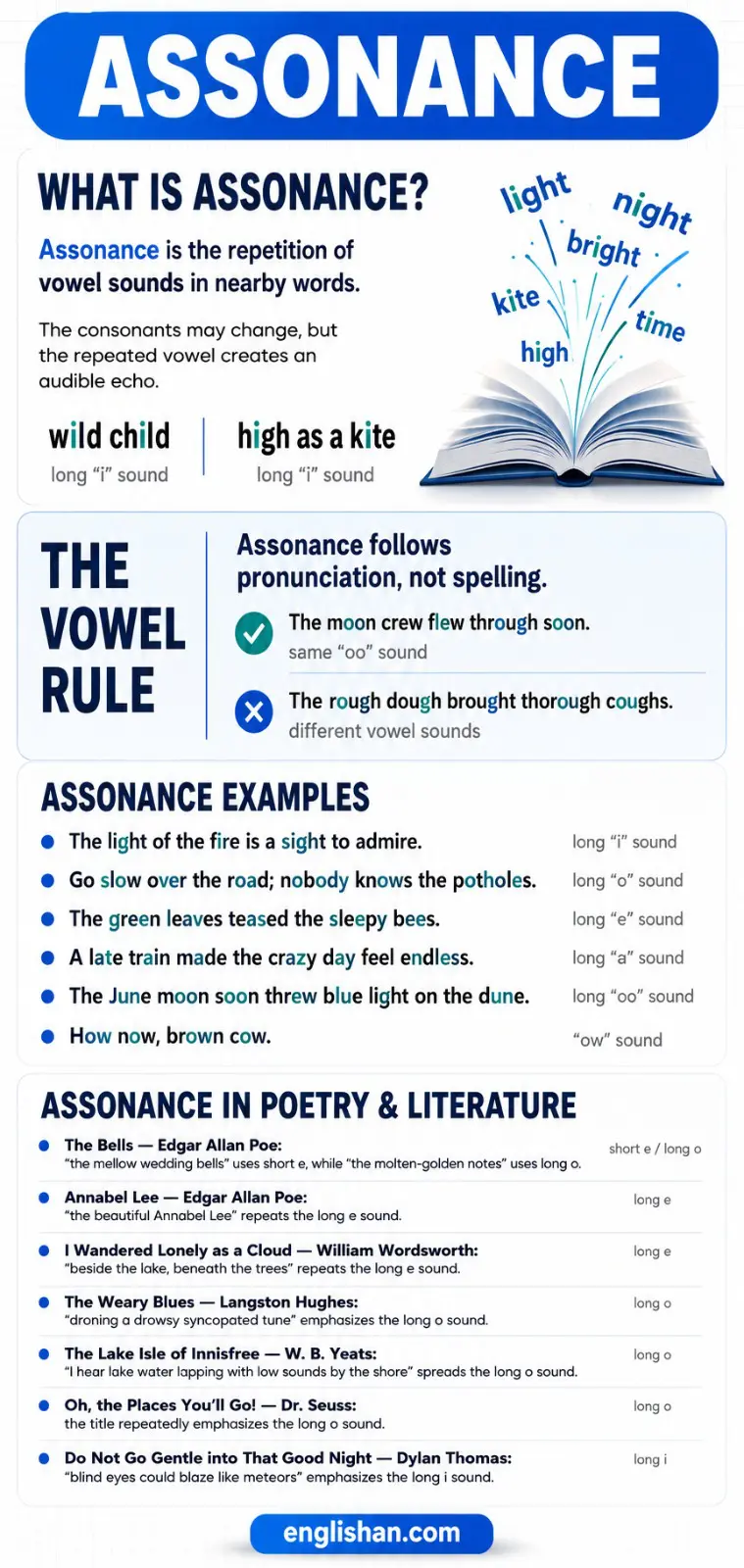
Assonance is the repetition of the same vowel sound in nearby words whose surrounding consonants differ, as in the rain in Spain.
Say it AS-uh-nuhns, three syllables with the stress on the first. English borrowed it from French in 1727, and Latin built it from ad- plus sonare, to sound. Two words that assonate are assonant, and the verb is assonate. Poetry Foundation gives a second name for it, vowel rhyme, which is accurate and misleading at once: the effect resembles rhyme, and the mechanism is nothing like rhyme.
Two conditions apply. The words need proximity, because a vowel echoes only while the ear still remembers the last one, so a repetition four lines apart does nothing. And the sound must repeat at least twice, though poets go far beyond two.
Say wild child or high as a kite and the shared vowel does the binding while the consonants around it change freely. That freedom is the whole point, and it is what separates the device from rhyme.
The Vowel Rule In Assonance
The device follows the ear and ignores the spelling. English orthography and English pronunciation parted company centuries ago, so a vowel counts when it sounds the same, never when it merely looks the same.
Moon, crew, flew and through share one oo sound across four spellings, and together they assonate perfectly. The reverse trap is harder to spot, because identical letters routinely refuse to share a sound.
The rough dough brought thorough coughs. ❌
The moon crew flew through the gloom. ✅
The first line repeats ough four times and produces four different vowel sounds, so the eye sees a pattern the ear never hears. The second changes its spelling in every word and delivers one unbroken oo. Read any candidate aloud and the rule settles it.
Stress decides which vowels count: a vowel echoes only when its syllable is stressed. Take banana, which has three written a’s and assonates with nothing. The first and third are unstressed schwas, reduced almost to silence, and only the middle one has weight. The same reduction kills sofa and China as an assonant pair. Before naming a vowel echo, check that the syllables are stressed, because unstressed vowels collapse toward the same neutral sound and stop being distinct enough to repeat.
Assonance Examples
Start with the fixed phrases English already has, because these are the ones you use without noticing. Each one names the vowel doing the work, so the pattern is visible as well as audible.
- No pain, no gain: long a in pain and gain
- Wild child: long i twice, one syllable apart
- High as a kite: long i across three words
- Make or break: long a through two different spellings
- Deep sleep: long e twice
- Chips and dips: short i twice
- Surf and turf: the er sound twice
- Wear and tear: the air sound twice
- A stitch in time saves nine: long i closing the proverb
- The squeaky wheel gets the grease: long e three times through three spellings
Verse and lyric use the same mechanism with more room to work in.
Assonance Examples In Poetry And Prose
Poets choose the vowel first and the words second, and four familiar passages show what that choice does to a line.
Edgar Allan Poe, The Bells
Poe retunes the vowel to retune the mood. “Hear the mellow wedding bells” keeps to short e and stays light. Two stanzas later “the molten-golden notes” shifts to long o and the poem turns solemn. Same device, opposite effect, and the only variable is which vowel he chose.
William Wordsworth, I Wandered Lonely as a Cloud
“Beside the lake, beneath the trees” pairs long e in beneath and trees, repeated twice and no more, which settles the line into calm without drawing attention to itself.
Dylan Thomas, Do Not Go Gentle into That Good Night
“Blind eyes could blaze like meteors” repeats long i three times in blind, eyes and like. Thomas built the whole poem on that vowel, and the defiance in it is partly the vowel’s doing.
Langston Hughes, The Weary Blues
“He did a lazy sway” repeats long a across lazy and sway, and the repetition itself performs the swaying the line describes.
Prose uses the device more quietly. Cormac McCarthy and James Joyce both write paragraphs whose rhythm depends on repeated vowels rather than on sentence length, and the effect registers as pace rather than as pattern. In prose the working rule is restraint: a vowel echo the reader notices in a novel has gone too far.
Assonance Examples In Songs And Slogans
Music depends on vowels because a vowel is what a singer sustains. A voice can stretch ah or oh across four beats, and nobody stretches a t.
Eminem, Lose Yourself
“Palms are sweaty… arms are heavy… mom’s spaghetti” chains short e through sweaty, heavy and spaghetti, and that chain is why a stadium shouts it back. The knees weak in the same run is a separate long e pair, which shows two vowel patterns working in one breath.
My Fair Lady
The rain in Spain stays mainly in the plain was written as an elocution drill, so it isolates one long a more cleanly than any line a poet would produce.
Advertising built a century of recall on the same trick.
- Beanz Meanz Heinz: three long e sounds and three different spellings, which is the vowel rule doing sales work
- The Quicker Picker Upper: short i twice, and the tempo lifts to match the claim
- Snap Crackle Pop: short a twice before the o lands the ending
For several hundred more across sentences, poems, songs and idioms, work through this collection of assonance examples.
Why Writers Use Assonance
Having heard the device in verse, lyric and slogan, the reason it keeps turning up in all three becomes plain. It does four jobs, and most lines use more than one of them.
Tempo: vowels have length, so they set pace the way note values set pace in music. Long vowels slow a line and suit grief, calm and awe: the old ghost rode alone. Short vowels quicken it and suit action and wit: the quick tick of it.
Mood: the vowel a writer repeats colours the whole passage, which is why laments fill with o sounds and comic verse skips along on short i sounds.
Cohesion: a repeated vowel ties a phrase into one unit, so the reader takes it in as a single move rather than as separate words.
Memory: slogans and proverbs survive on it. A phrase with an internal vowel echo is recalled more readily than the same idea phrased flat, which is why advertising has used the device for a century.
The device rarely works alone. It combines with consonance, with alliteration and with onomatopoeia, and dense verse threads several patterns through one line, which is why identifying it needs a method rather than an ear alone.
How To Find Assonance In A Poem
Four steps, run in order, on any line.
1. Read it aloud: not silently. Spelling misleads the eye and the ear corrects it, so a device defined by sound has to be tested by sound.
2. Mark the stressed syllables: only stressed vowels count, so anything unstressed drops out before the comparison starts.
3. Group the stressed vowels by sound: ignore how each is spelled. Two or more matching sounds close together is assonance.
4. Check what follows each vowel: if the sounds after the matching vowel also agree, the label is rhyme rather than assonance.
Run it on Hughes: “Droning a drowsy syncopated tune.” Read aloud, droning has long o while drowsy has the ow diphthong, so the two do not match. What actually repeats is the dr consonant cluster, which makes the line consonance. That line is quoted as a vowel echo in plenty of teaching material, and four steps show why it is not.
Step two and step three do most of the work, and both depend on telling assonance from the three devices standing nearest to it. Each one differs in a different way.
Assonance vs Alliteration
Alliteration and assonance both repeat a sound. They differ on which sound and where in the word.
Alliteration repeats a consonant sound at the openings of words: Peter Piper picked. Assonance repeats a vowel sound anywhere inside them: the rain in Spain. Position and sound type separate them completely, and neither label ever replaces the other.
A single line can run both at once, which is where students lose the thread. The lake lapped low alliterates on l and assonates on nothing much; add slow and the same line now does both. Naming one does not rule out the other, so read for each separately rather than deciding a line “is” one device.
For a fuller set of consonant-opening patterns, work through these alliteration examples.
Assonance vs Consonance
Consonance repeats a consonant sound, and unlike alliteration it can fall anywhere in the word rather than only at the front. Pitter-patter and lumpy bumpy are consonance. Deep sleep is assonance.
| Device | Sound repeated | Position |
|---|---|---|
| Assonance | Vowel | Anywhere in the word |
| Alliteration | Consonant | Word openings only |
| Consonance | Consonant | Anywhere in the word |
| Sibilance | The s and sh sounds | Anywhere, as a subtype of consonance |
One honest note on the boundary. Modern American and British usage restricts assonance to vowels, and Merriam-Webster, Britannica and Poetry Foundation all define it that way, so the vowels-only rule is what an examiner will mark. An older and broader sense of the term took in repeated consonant sounds as well. That sense survives in some teaching material, which is why a few reference pages still list consonant echoes under the same heading. Use the vowels-only rule and recognise the older sense when it turns up rather than assuming the source is wrong.
Assonance vs Rhyme
Rhyme is assonance plus everything after it.
Two words rhyme when the final stressed vowel matches and every sound following it matches: light and night. Assonance asks for the vowel and nothing more: light and mine share long i and agree on nothing else, so they assonate without rhyming.
This is why the vowel match is the working ingredient in slant rhyme, also called half rhyme or near rhyme. A songwriter who wants the pull of rhyme without its click matches the vowels and lets the consonants drift.
The trap runs the other way too, and Poe supplies it. In Annabel Lee, the words Lee, sea and me all end on long e with nothing after the vowel, so they do not merely assonate. They rhyme. When the matching vowel falls at the end of a word with no consonant behind it, the correct label is rhyme, and calling it assonance loses marks.
Mistakes To Avoid With Assonance
Trusting the spelling: the commonest error and the one the vowel rule exists to prevent.
Tough and though assonate, because both use ough. ❌
Tough and rough assonate, because both use short u. ✅
Counting unstressed vowels: a schwa is not a vowel sound for these purposes.
Sofa and China assonate on the final a. ❌
Sofa and China both end in an unstressed schwa, so neither one assonates. ✅
Calling consonance assonance: a repeated consonant is never assonance, whatever the word looks like.
Pitter-patter is assonance, because a sound repeats. ❌
Pitter-patter is consonance, because the repeated sound is a consonant. ✅
Overloading the line: two or three repetitions tune a sentence. Six turn it into a vocal warm-up, and the reader starts hearing the technique instead of the meaning.
Related:
How To Use Assonance In Writing
Reading the device accurately is one skill. Placing it in your own sentences is a harder one, and it starts with the same question a poet answers first.
Choose the vowel for the pace you want, then place it on words the reader will stress. A vowel echo landing on unstressed syllables does nothing, because those syllables reduce and the pattern disappears.
Keep each pattern inside one or two sentences. A vowel that drones on past that point stops being music and becomes a chant, and prose that chants loses the reader faster than flat prose ever does.
One more failure worth naming: a vowel pattern that fights the sense of the sentence. Long o slows a line down, so pairing it with a sentence about urgency works against the meaning. Match the tempo of the vowel to the tempo of the idea, and when the two disagree, change the words rather than the idea.
Assonance In Old French And Spanish Verse
The half-rhymed quality of the device in English has a historical cause. Assonance is older than rhyme in European poetry, and for a long stretch it did rhyme’s job.
La Chanson de Roland and most French verse before the twelfth century bound their line endings with a repeated vowel rather than a full rhyme. Britannica dates the arrival of pure rhyme as a later development that displaced the older technique. Spanish and Portuguese poetry never made that switch completely. Asonancia remains a standard binding device there, and whole stanzas stay bound by one repeated vowel while the consonants after it change from line to line.
That history explains something about English verse. The device in English reads as a modern, loose, half-rhymed effect, and it is in fact the older method surviving underneath the newer one.
Practice Finding The Vowel Echo
Name the device in each line: assonance, alliteration, consonance or rhyme. Answers follow.
- The green leaves teased the sleepy bees.
- Peter Piper picked a peck of pickled peppers.
- Light and night.
- The clown found the crowd downtown.
- A blunt front runner.
- Sofa and China.
- Deep sleep frees the weary teacher.
- Light and mine.
Answers: 1 assonance, long e four times. 2 alliteration, p at the front of five words. 3 rhyme, since the vowel and everything after it match. 4 assonance, the ow diphthong three times. 5 consonance, the nt cluster repeating inside the words. 6 neither, because both a sounds are unstressed schwas. 7 assonance, long e four times. 8 assonance, long i with different consonants following.
FAQs
Assonance is the repetition of the same vowel sound in nearby words while the consonants differ. The light of the fire is a sight to admire repeats long i four times, and that repeated vowel, rather than any rhyme, gives the line its ring.
Sound type and position separate them. Alliteration repeats a consonant sound at the openings of words, as in Peter Piper picked. Assonance repeats a vowel sound anywhere inside nearby words, as in the rain in Spain. One line can run both at once.
Rhyme matches the final stressed vowel and every sound after it, as in light and night. Assonance matches only the vowel, as in light and mine. Every rhyme therefore has assonance inside it, though the vowel match alone never completes a rhyme.
No, consonant repetition is consonance rather than assonance, and at word openings it is alliteration. The device is vowels only in modern usage, though an older broader sense of the term did cover consonants, which is why a few reference pages still list them together.
Yes, and it is the textbook case. One long a repeats through rain, Spain, stays, mainly and plain across five different spellings. Lerner and Loewe wrote the line as an elocution drill for My Fair Lady in 1956, which is why it isolates the vowel so cleanly.
Repeated vowels set tempo, colour mood, bind a phrase into one unit and make it easier to remember. Long vowels slow a line and suit grief or awe. Short vowels quicken it and suit action, which is why laments fill with o sounds and comic verse skips on short i.
Say AS-uh-nuhns, three syllables with the stress falling on the first. The adjective is assonant and the verb is assonate, as in two words that assonate on long e.
No dictionary or poetry authority recognises a fixed set of types, so any list claiming six or seven categories has invented them. Two real distinctions do the work: which vowel sound repeats, and where in the line the repetition falls.
No, it works in prose, song lyrics, advertising and everyday speech. Novelists use it to control the pace of a paragraph, and advertisers use it because a phrase with a vowel echo survives in memory longer than a flat one.
Eminem’s Lose Yourself chains short e through sweaty, heavy and spaghetti, which is why the opening is so quick to shout back. Rap uses assonance more heavily than any other current form, because a matched vowel lets a line land on the beat without the closure that full rhyme forces.