
Alliteration is the repetition of the same initial consonant sound across two or more nearby words. Silly Sally sang softly repeats the S sound four times, and your ear catches the pattern before you finish the line. Advertisers, poets, and comedians all use it, though the alliteration examples you meet most come from ordinary speech, in phrases such as busy bee.
Alliteration Examples
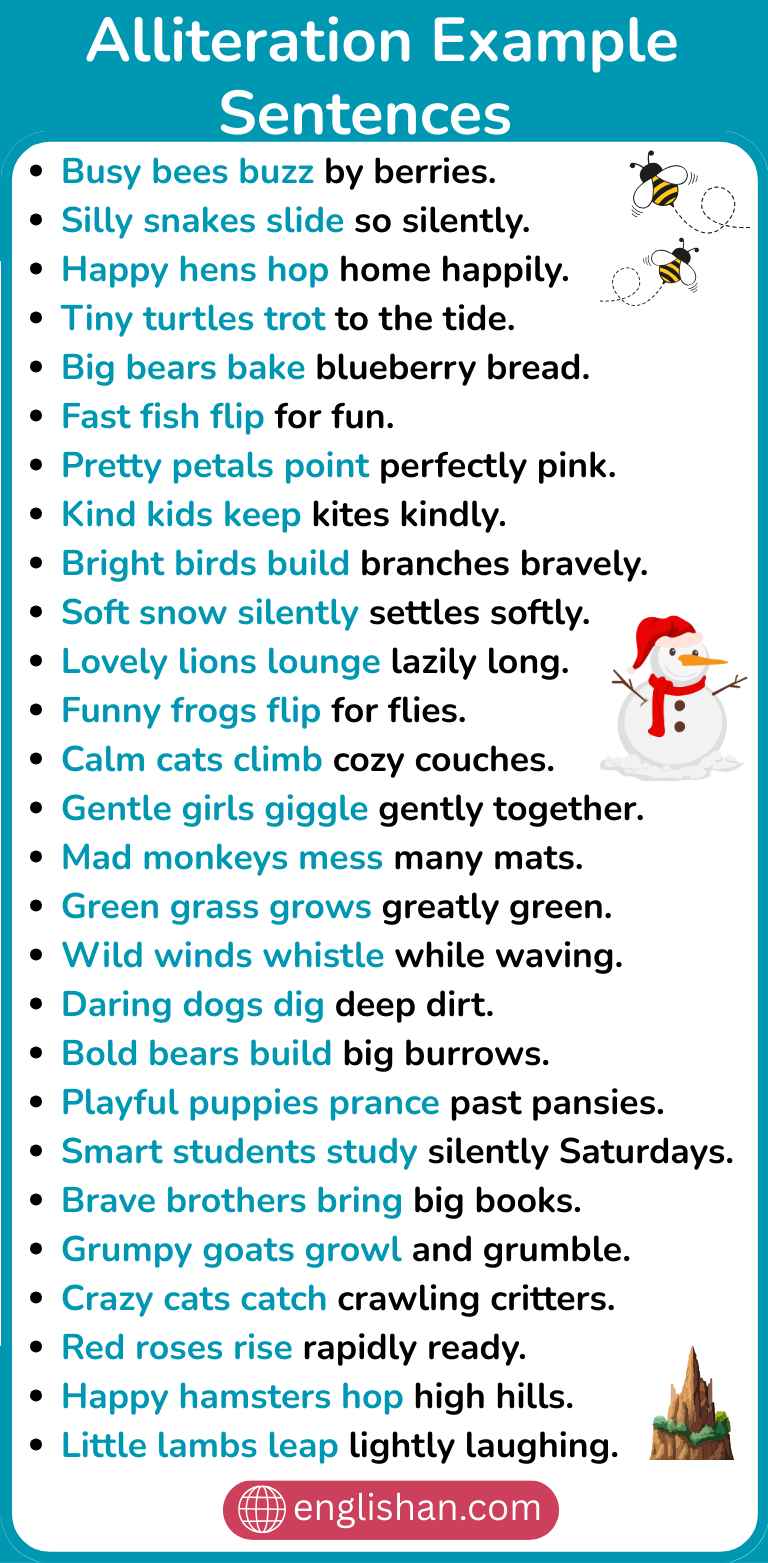
These twenty alliteration examples use everyday names, places, and objects. Each one repeats a single consonant sound across three or more words.
- The busy bee buzzed by the back door.
- She sells sweets on Sunday.
- Mike made a mess in the morning.
- Danny danced down the driveway.
- The wild wind whipped the washing.
- Fred found four flat tyres.
- Katie kept a key in her coat.
- Ronnie ran round the roundabout.
- Terry told ten terrible tales.
- Laura left her laptop at the library.
- Peter packed a picnic on Preston Pier.
- Gary gave Grace a green gift.
- Nina noticed nine new neighbours.
- Harry hurried home through heavy hail.
- Molly makes marmalade most mornings.
- Sam sold six silver spoons.
- Dave drove down to Dover on Thursday.
- Bella bought bread and butter.
- Tom took two trays to the table.
- Wendy waited by the window all week.
What Is Alliteration In English
Alliteration is a sound device in which the same initial consonant sound repeats across two or more words positioned close together.
The working minimum is two words, though three or more makes the pattern obvious to a listener. Big bear alliterates. Big brown bear alliterates harder, and big brown bears bounce is what you notice without being told.
Spelling never decides it: two words sharing a letter fail the test when that letter spells two different sounds. Two words with different letters pass when the sound matches.
Carol chose a cake. ❌
Carol kept a kitten. ✅
Alliteration Examples By Letter Sound
Taking the consonant sounds one at a time shows which letters repeat cleanly and which ones split. These alliteration examples give you one working sentence per sound. The D sound pairs well with a wider set of verbs starting with D, since a strong verb gives the sentence somewhere to go.
- B sound: Brave Ben baked brown bread before breakfast.
- C sound, hard: Carla caught a cold in cold Colorado.
- CH sound: Charlie chose cheap cheese and chatted cheerfully.
- D sound: Danny drove down the dusty desert road.
- F sound: Fiona fried four fresh fish on Friday.
- G sound: Gary grabbed green grapes from the garden.
- H sound: Hannah hung her heavy hat on the hook.
- J sound: Jenny juggled jam jars in January.
- K sound: Kevin kept a kite in the kitchen.
- L sound: Lucy lit a lamp in the long library.
- M sound: Marcus mended my mother’s metal mailbox.
- N sound: Nina needed nine new notebooks.
- P sound: Paul painted a purple pot on the porch.
- Q sound: Quiet Quentin questioned the quiz quickly.
- R sound: Rachel raced round the rocky ridge.
- S sound: Simon sipped soup on a snowy Sunday.
- SH sound: Sharon shopped for shoes and shiny shirts.
- ST sound: Steven stacked stones on the steep steps.
- T sound: Tara took ten tiny turtles to town.
- TH sound: Theo thought through three thorny theories.
- V sound: Vera visited a village in the valley.
- W sound: Warren watched wild waves wash the wall.
- Y sound: Yasmin yelled at the yellow yacht.
- Z sound: Zara zipped her jacket at the zoo.
Short Alliteration Sentences
Four or five words already give enough repetition to be noticed. Short sentences make the pattern louder because nothing else competes for attention. Each of these fifteen repeats one sound across every word.
- Big brown bears bounce.
- Silly snakes slither slowly.
- Wild wolves wander west.
- Six swans swim south.
- Tiny turtles trot together.
- Cool cats climb curtains.
- Frantic frogs flip forward.
- Merry mice munch muffins.
- Purple parrots preen proudly.
- Lazy lions laze longer.
- Nine nurses nod nervously.
- Green grass grows greener.
- Dark ducks dive down.
- Happy hens hop home.
- Bright bulbs burn blue.
Alliteration Examples For Kids
Children hear alliteration long before anyone names it, in nursery rhymes and cartoon characters. These fifteen use primary-classroom vocabulary and keep every sentence to one repeated sound. That makes them workable for a spelling lesson or a reading warm-up.
- My messy monkey munches mangoes.
- Ben’s blue ball bounced away.
- Tilly the tiger takes tiny steps.
- Dad drew a dinosaur on Danny’s door.
- Five funny frogs found a flag.
- Katie’s kitten knocked the cup.
- Sam saw seven silly seals.
- Milly made a mud pie on Monday.
- Pip the puppy played in the puddle.
- Grandma grows green grapes.
- Robbie rode a red rocket.
- Wendy’s white rabbit ran away.
- Harry hid his homework in the hall.
- Lucy loves lemon lollipops.
- Toby took the toy train to Tim.
Funny Alliteration Sentences
Comic alliteration works when the repeated sound arrives on an absurd noun rather than an ordinary one. A barber and a bun share the B sound, and the joke depends on two nouns that belong nowhere near each other.
- Barry the barber burned the bride’s big bouncy bun.
- Cranky Carl complained about the cat’s cold coffee.
- Doris the dentist dropped dentures down the drain.
- Fifty flustered farmers fought over one flat field.
- Gordon’s grumpy goat gatecrashed the garden party.
- Harold hiccupped through his own hilarious hospital visit.
- Jolly Jenny juggled jelly at the jumble sale.
- Larry the llama licked the lawnmower and left.
- Mabel’s mother mistook the mayor for a magician.
- Norman’s nosy neighbour named his nine noisy nephews.
- Percy the parrot proposed to a pineapple.
- Rita the referee refereed a race between two rocks.
- Sid the snail sprinted and shocked the whole street.
- Terry’s tortoise texted him from the tumble dryer.
- Wanda’s walrus won the waltzing competition in Wales.
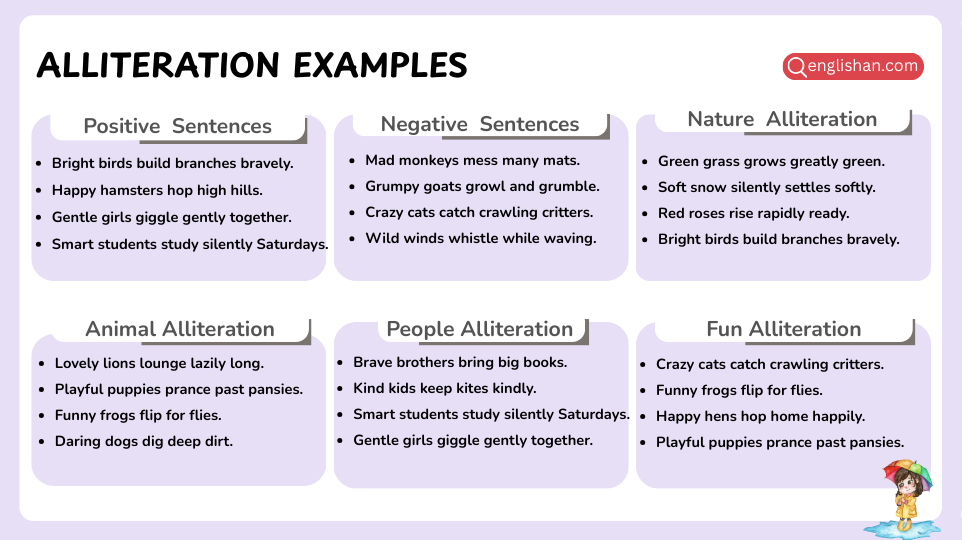
Alliteration Examples About Animals
Animal names give alliteration more starting sounds than any other set of nouns in English. Nursery rhymes and children’s books use them first for that reason. Pair these with a wider set of animal names when you want to build your own.
- Brown bears bathe beside the broad brook.
- Cheeky chimpanzees chatter in the chestnut tree.
- Dolphins dive deep down for dinner.
- Fifty flamingos flock to the flooded field.
- Grey geese gather on the green.
- Hungry hedgehogs hunt for hidden beetles.
- Jackals jog across the jagged rocks.
- Kangaroos kick up dust in the Kimberley.
- Lazy lizards lie on the limestone ledge.
- Magpies make mischief in the morning.
- Nervous newts nest near the narrow stream.
- Playful puffins perch on the pier.
- Roaring rhinos rush across the ridge.
- Squirrels store seeds in the September sun.
- Wolves wander westward when winter comes.
Related:
Alliteration Sentences About Nature
Where the animal sentences name a creature, these name a place or a condition. The repeated sound falls on landscape nouns and weather verbs instead. Poets take most of their alliteration from exactly this vocabulary.
- Bluebells bloom beside the bubbling brook.
- Falling leaves float on the flat lake.
- Golden grass grows along the gravel path.
- Mist moves across the mountain meadow.
- Pine pollen powders the pond at dawn.
- Rivers run round the red rocks.
- Silver streams sparkle in the setting sun.
- Tall trees tremble in the twilight.
- Wild wheat waves in the warm wind.
- Dewy daisies droop in the drought.
- Cliffs crumble into the cold Cornish sea.
- Ferns flourish in the forest’s furthest corner.
Alliteration Sentences About Food
Menus and food advertising use alliteration because a repeated sound makes a dish easier to remember. These twelve alliteration examples keep the repetition on the food itself rather than the person eating it.
- Betty baked buttery biscuits before breakfast.
- Crispy carrots crunch between your teeth.
- Dan dipped doughnuts in dark chocolate.
- Fresh figs fill the fruit bowl on Friday.
- Grandad grills garlic mushrooms on the grate.
- Hot honey hardens on the hob.
- Mum melted marshmallows in mugs of milk.
- Peppery pasta pleased the whole party.
- Rich raspberry ripple runs down the cone.
- Sam serves salted seaweed with the sushi.
- Toasted teacakes taste better with tea.
- Warm waffles disappear under whipped cream.
Alliteration Sentences About School
Classroom nouns repeat a handful of sounds heavily, so school sentences almost write themselves once you pick a letter. Every one of these ten names something a student handles in a normal week.
- Bella borrowed a blue biro from Ben.
- Clara counted the clock’s clicks during class.
- Daniel drew diagrams during double maths.
- Miss Fletcher forgot the French folder on Friday.
- Harry handed his homework in halfway through.
- Lucy lost her lunchbox in the locker room.
- Mr Morgan marked me down for messy margins.
- Priya practised her presentation in the playground.
- Sixty students sat silently in the science lab.
- Tom took the test twice on Tuesday.
Alliteration Sentences About Weather
Weather verbs already imitate the sounds they describe, so alliteration doubles an effect the vocabulary supplies on its own. Hail hammered lands twice before the sentence finishes.
- Bitter breezes blew across the bay.
- Dense drizzle dampened the doorstep.
- Fog filled the fields by five.
- Heavy hail hammered the henhouse.
- Lightning lit the lane like lanterns.
- Rain rattled the roof all night.
- Snow settled on the silent street.
- Thunder thumped through the thick clouds.
- Warm winds whistled through the willows.
- Sunshine soaked the southern slopes.
Positive Alliteration Sentences
Praise gains force from repetition. Greeting cards and school reports use alliteration far more heavily than ordinary writing does. Building these gets easier once you have a stock of synonyms for beautiful starting with different sounds.
- Beth brought brilliant news on Boxing Day.
- Charlie’s cheerful chatter changed the whole class.
- Daisy dances with delightful energy.
- Fiona’s fresh flowers filled the flat.
- Grace grew a gorgeous garden.
- Happy hearts handle hard days better.
- Katie’s kindness kept the class calm.
- Lovely light lifts a long afternoon.
- Molly’s music made the morning brighter.
- Peter’s patience proved priceless.
- Sam’s steady support saved the season.
- Warm words work wonders on a bad day.
Negative Alliteration Sentences
The same repetition that sweetens praise sharpens complaint, and headline writers use it for exactly that reason. Notice how the harder consonants (B, C, G, T) outwork the softer ones in this group.
- Bitter bickering broke up the band.
- Cold criticism crushed his confidence.
- Dreadful drizzle dampened the whole day.
- Frank’s foolish forecast fooled fifty farmers.
- Grim gossip grew around the group.
- Harsh headlines hurt her hardest.
- Lazy lies lost him the lease.
- Miserable mornings make Monday worse.
- Nagging noise never stops next door.
- Petty problems pile up on Peter.
- Sour silence separated the sisters.
- Tiresome traffic troubled the tired travellers.
Alliteration Examples In Question Form
Questions take alliteration well because the auxiliary verb at the front gives the repeated sound a running start. Teachers and parents produce these without planning them, and a child remembers them longer than a plain statement.
- Did Danny drop the dusty dictionary?
- Have you heard how Harry hurt his hand?
- Can Carla count the cold coins?
- Will Wendy wait by the west window?
- Should Sam sell his silver saxophone?
- Why worry when winter is warm?
- Where were the wild white wolves?
- Must Molly mow the muddy meadow?
- Does Dad drive down that dirt road?
- Has Peter packed the picnic properly?
- Are two tourists trapped by the tide?
- Can Kevin keep the kitten quiet?
Alliteration Sentences About People
Pairing an adjective with a name that shares its opening sound is the oldest trick in character naming. Comic writers have used it for centuries. Each of these ten describes a person through one repeated consonant.
- Bashful Brian barely broke his silence.
- Clever Clara collects china cups.
- Determined Dana dug the ditch alone.
- Generous Jenny joined the jury.
- Honest Henry helps his neighbours.
- Loyal Lucy listens longer than anyone.
- Modest Martin mentions his medals rarely.
- Patient Priya practises piano at midnight.
- Restless Ryan rarely relaxes.
- Stubborn Sophie stayed silent for a season.
Famous Alliteration Tongue Twisters
Tongue twisters push alliteration past the point of comfort, which defeats the tongue rather than the ear. Each of these ten names the sound doing the damage.
- P sound: Peter Piper picked a peck of pickled peppers.
- S sound: She sells seashells by the seashore.
- W sound: How much wood would a woodchuck chuck?
- B sound: Betty Botter bought some butter.
- F sound: Four fine fresh fish for you.
- R sound: Round the rugged rock the ragged rascal ran.
- T sound: Two tiny tigers took two taxis to town.
- SH sound: Shy Shelly says she shall sew sheets.
- N sound: Nine nimble noblemen nibbling nuts.
- C sound: Can you can a can as a canner can can a can?
Alliteration Examples In Brand Names
Marketing departments choose alliterative names because a repeated sound survives being heard once on the radio. Every brand here trades today, and the third column names the repeating sound rather than the letter.
| Brand | Repeated sound | What repeats |
|---|---|---|
| Best Buy | B | Two hard B openings |
| PayPal | P | Two P openings inside one word |
| Coca-Cola | K | C spells the K sound twice |
| Dunkin’ Donuts | D | Two D openings |
| Krispy Kreme | K | K spelled with K both times |
| Bed Bath and Beyond | B | Three B openings |
| Range Rover | R | Two R openings |
| Weight Watchers | W | Two W openings |
| Chuck E. Cheese | CH | CH spells one sound twice |
| Rolls-Royce | R | Two R openings |
| Kit Kat | K | Two K openings |
| Tic Tac | T | Two T openings |
Alliteration Examples In Poetry
Poets use alliteration to slow a line down or speed it up, and English verse was built on it long before rhyme arrived. It works alongside the other literary devices that shape how a line sounds rather than what it means.
Edgar Allan Poe, “The Raven”: “And the silken, sad, uncertain rustling of each purple curtain” repeats the S sound across three words. The repetition slows the line to the pace of the rustling it describes.
Samuel Taylor Coleridge, “The Rime of the Ancient Mariner”: “The fair breeze blew, the white foam flew” runs two patterns at once. The B sound joins breeze and blew, then F takes foam and flew.
William Shakespeare, Romeo and Juliet: “From forth the fatal loins of these two foes” repeats F four times. Shakespeare places it in the Prologue, before the audience meets a single character.
John Milton, Paradise Lost: “Behemoth, biggest born of earth” stacks three B openings on one creature. The repeated stop makes the beast sound as heavy as Milton describes.
William Blake, “The Tyger”: “Tyger Tyger, burning bright” pairs B with the repeated name, and the two together give the poem its drumbeat.
Alfred Lord Tennyson, “The Princess”: “The murmuring of innumerable bees” repeats the M sound three times in six words. Read it aloud and the line hums.
Robert Frost, “Stopping by Woods on a Snowy Evening”: “Whose woods these are I think I know” opens on a soft W pair. That softness makes the first line sound like thinking rather than speech.
Percy Bysshe Shelley, “Ozymandias”: “The lone and level sands stretch far away” repeats L across the flattest part of the poem. The sound matches the desert it describes.
Gerard Manley Hopkins, “The Windhover”: “dapple-dawn-drawn Falcon” packs three D openings into one compound, which is Hopkins at his densest.
Anonymous, Beowulf: Old English verse used alliteration where later poetry used rhyme. Every line of Beowulf joins its two halves by a repeated opening sound rather than a matching ending.
FAQs
The device is called alliteration, provided the words share the same opening sound rather than only the same letter. Where the repeated sound is a vowel, the usual terms are vowel alliteration or assonance. Where it repeats in the middle or at the end of words, the term is consonance.
No, and this is where the spelling misleads. Kevin’s clever cat alliterates on the K sound across three different spellings. Carol chose a cake shares the letter C but produces two separate sounds, so it does not alliterate at all.
The difference is which sound repeats and where. Alliteration repeats a consonant sound at the start of nearby words, as in wild wind. Assonance repeats a vowel sound anywhere inside them, as in the rain in Spain.
Alliteration makes a phrase easier to remember and quicker to say, which is why advertising slogans, brand names, and nursery rhymes use it heavily. In poetry it also controls pace, since repeated hard consonants speed a line up and repeated soft ones slow it down.
Symmetrical alliteration repeats sounds in a mirrored order around a central word. In rust brown blazers rule the pattern runs R, B, B, R. Advertising and deliberately crafted verse use the form; ordinary speech does not.
You May Also Like