A literary device is a technique a writer uses to produce an effect that a plain statement would not achieve. Her voice was a warm blanket over the whole room says nothing literal about blankets, and the reader still knows exactly how the room felt. Twenty-two devices do most of the work in English writing, and the literary devices examples that follow give usable sentences for every one of them.
Literary Devices Examples
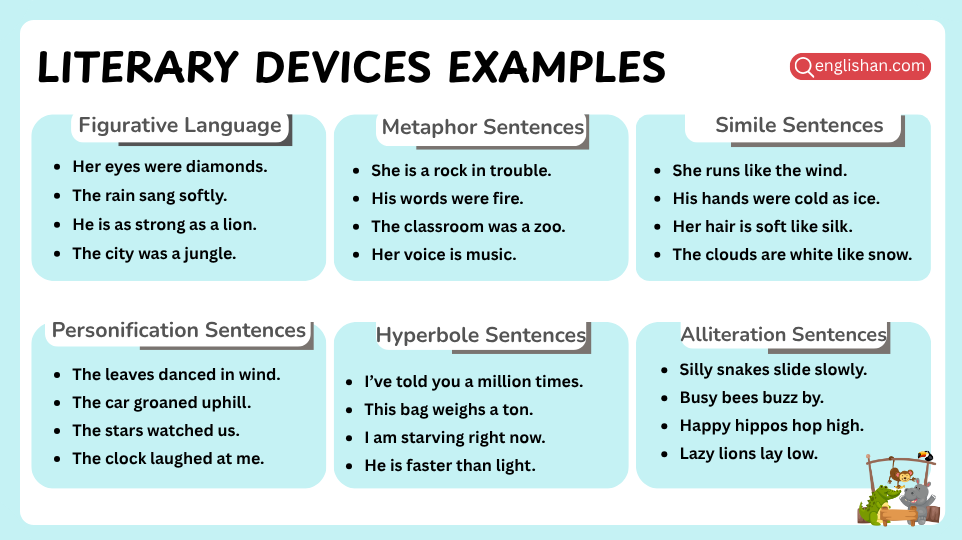
These literary devices examples give one sentence for each of the twenty-two devices, with the device named first.
- Metaphor: Her voice was a warm blanket over the whole room.
- Simile: The hall fell quiet as a church.
- Personification: The old radiator groaned all through January.
- Hyperbole: I have told you a thousand times to close the gate.
- Alliteration: Six sleepy swans slid past the summer house.
- Onomatopoeia: The gate creaked and the letterbox snapped shut.
- Imagery: Wet leaves stuck to the pavement and the air smelled of smoke.
- Symbolism: She kept her grandmother’s key long after the house was sold.
- Irony: The fire station burned down on a Tuesday.
- Oxymoron: The silence after the verdict was deafening.
- Paradox: The more he explained, the less anyone understood.
- Idiom: He let the cat out of the bag at dinner.
- Euphemism: Her grandfather passed away in the spring.
- Allusion: He called the paperwork his own personal Everest.
- Assonance: The rain in the lane stayed all day.
- Consonance: The black rocks cracked under the truck.
- Repetition: I called and called and called before anyone answered.
- Antithesis: She spoke softly and acted fiercely.
- Metonymy: The crown refused to sign the treaty.
- Synecdoche: We need three more hands in the kitchen.
- Understatement: The hurricane caused a bit of damage to the roof.
- Pun: The baker went back to work because he kneaded the money.
What Are Literary Devices
A literary device is a technique a writer chooses in order to create meaning, sound, or effect beyond the literal words on the line. Each device has a name, a recognizable pattern, and a job it does inside a sentence.
The twenty-two devices split into four working families.
| Family | What these devices do | Named devices |
|---|---|---|
| Figurative | Say one thing and mean another | Metaphor, simile, personification, hyperbole |
| Sound | Work through how the words are heard | Alliteration, assonance, consonance, onomatopoeia |
| Meaning | Turn meaning sideways or against itself | Irony, paradox, oxymoron, metonymy, synecdoche |
| Structural | Set words in a deliberate pattern | Repetition, antithesis, allusion, symbolism |
One distinction settles most of the confusion around the term. A device is something a writer decides to use. A literary element is part of every story whether the writer thinks about it or not, meaning plot, setting, character, and theme.
The plot of the novel is a literary device. ❌
The foreshadowing in the novel is a literary device. ✅
Every device that follows opens with one line naming what it does, and the literary devices examples beneath it demonstrate exactly that.
Metaphor Examples In Sentences
A metaphor states that one thing is another, with no comparing word between them.
- Her voice was a warm blanket over the whole room.
- The classroom was a zoo by the last period on Friday.
- My uncle is a walking encyclopedia of local history.
- Grief is a room you keep finding yourself in.
- The city was a furnace by two in the afternoon.
- His memory is a sieve after eight in the evening.
- That contract is a trap with a nice cover on it.
- Time was a thief that year, and nobody noticed until December.
- The old dog is a rug with opinions.
- Her patience is a thin wire by the end of term.
- The internet is a market that never closes.
- Fear was a hand on the back of his neck.
- Their friendship is a bridge that has held for forty years.
- The meeting was a swamp and nobody came out clean.
- Winter is a landlord who never fixes anything.
For better understanding, read more: Metaphor Examples
Simile Examples In Sentences
A simile draws a comparison using like or as, so both sides of it stay visible on the surface.
- The hall fell quiet as a church.
- He drives like a man who has never been fined.
- Her handwriting looks like a seismograph in a storm.
- The soup was as thin as rainwater.
- The queue moved like treacle in January.
- She sings like the radio was left on in another room.
- My phone battery drains like a bath with no plug.
- The room smelled as sharp as a hospital corridor.
- He argues like a lawyer with nothing left to lose.
- The road was as straight as a ruled line.
- Her laugh carried like a bell across the field.
- The bread came out as hard as a paving stone.
- He waited like a man expecting bad news.
- The sky turned as grey as wet cement.
- They packed the car like a puzzle with one piece too many.
For better understanding, read more: Simile Examples
Personification In Sentences
Personification gives human action or feeling to something that is not human.
- The old radiator groaned all through January.
- The wind argued with the shutters until dawn.
- My laptop decided it had done enough for one day.
- The kettle complained loudly and then gave up.
- Dawn crept over the rooftops without waking anyone.
- The empty house watched the street through dusty windows.
- The tide swallowed the sandcastle in three minutes.
- His car coughed twice and refused to start.
- The candle flame danced every time the door opened.
- Autumn stripped the lane bare by the second week.
- The clock on the wall bullied everyone in the exam room.
- Frost gripped the windscreen and would not let go.
- The photocopier sulked for the whole afternoon.
- The river shouldered its way through the village.
- Silence sat down between them and stayed there.
Hyperbole Examples In Sentences
Hyperbole exaggerates far past the literal truth, with no expectation that anyone will believe it.
- I have told you a thousand times to close the gate.
- This bag weighs more than the car.
- She has been on that phone call since the Middle Ages.
- I could sleep for a hundred years after this week.
- The queue stretched from here to the coast.
- He eats enough for a small army at breakfast.
- My feet are killing me after four minutes of shopping.
- That lecture lasted a geological age.
- I have a million things to finish before Friday.
- The kitchen is so cold you could hang meat in it.
- She laughed so hard the neighbours filed a complaint.
- This coffee could strip paint off a door.
- He apologises about once a decade.
- The traffic has not moved since the last general election.
- I have read that email nine hundred times.
For better understanding, read more: Hyperbole Examples
Alliteration In Sentences
Alliteration repeats the same opening consonant sound across nearby words.
- Six sleepy swans slid past the summer house.
- Brave Ben baked brown bread before breakfast.
- Cold coffee cooled quickly on the kitchen counter.
- Dark, damp days drag on until March.
- Freddie found four fresh figs in the fruit bowl.
- Great green grasshoppers gathered on the gate.
- Happy hikers hurried home before the hail.
- Little Lucy lost her lunch on the last bus.
- Marta mended my missing button on Monday.
- Peter picked purple plums from the top branch.
- Round rocks rolled down the ridge after the rain.
- Sam sold seven silver spoons at the Saturday stall.
- Ten tired teachers took the train to Turin.
- Wet weather wrecked the whole weekend.
- Quiet queues quickly quadrupled at the quay.
For better understanding, read more: Alliteration Examples
Onomatopoeia Examples In Sentences
Onomatopoeia names a sound with a word that imitates it.
- The gate creaked and the letterbox snapped shut.
- Bacon sizzled in the pan while the kettle hissed.
- Thunder rumbled somewhere behind the hills.
- The bees buzzed around the lavender all afternoon.
- Gravel crunched under the postman’s boots.
- The balloon popped and the whole room jumped.
- Rain pattered against the skylight for hours.
- His keys jangled as he searched every pocket.
- The floorboard squeaked and gave him away.
- Wind whooshed through the broken window frame.
- The old clock ticked and then clunked at the hour.
- She slurped her tea and pretended not to notice.
- The wooden gate banged twice in the night.
- Leaves rustled as the fox slipped through the hedge.
- The engine spluttered, coughed, then died.
For better understanding, read more: Onomatopoeia Examples
Imagery In Sentences
Imagery describes through the senses, so the reader sees, hears, smells, tastes, or feels the scene.
- Wet leaves stuck to the pavement and the air smelled of smoke.
- Steam rose off the tea and fogged the cold window.
- The sand burned through her thin canvas shoes.
- Sour lemon cut through the sweetness of the icing.
- Rough bark scraped his palms as he climbed.
- The market smelled of cardamom, diesel, and wet cardboard.
- Frost crackled under every step across the field.
- Orange light spilled from the chip shop onto the wet road.
- The wool jumper itched at the back of her neck all day.
- Salt dried white on the windows of the seafront houses.
- Bread came out of the oven and filled the whole flat.
- Cold water numbed his fingers within seconds.
- The corridor echoed with wet shoes and slammed lockers.
- Ripe mangoes sat sticky and heavy in the crate.
- Woodsmoke hung low over the village until midnight.
Symbolism Examples In Sentences
Symbolism uses a concrete object to represent an abstract idea.
- She kept her grandmother’s key long after the house was sold.
- A single white feather lay on the doorstep that morning.
- He wore his father’s watch to every interview.
- The broken clock in the hallway had stopped at four.
- They planted an olive tree the week the fighting ended.
- Her wedding ring sat in a drawer for eleven years.
- The empty chair at the table said more than anyone did.
- A caged bird hung in the window of the corner shop.
- He burned the letters in the garden on New Year’s Eve.
- The lighthouse still turned, though no ships came now.
- She wore red the day she handed in her notice.
- The cracked mirror stayed on the wall for decades.
- Rain fell steadily through the whole funeral.
- A locked gate stood at the end of the lane.
- The old flag faded on the pole outside the school.
Irony In Sentences
Irony sets what is said or expected against what is actually true. English recognizes three named types.
Verbal irony: the speaker says the opposite of what is meant.
- Lovely weather for a garden party, he said, wringing out his sleeve.
- What a brilliant idea to paint the ceiling before the wedding.
- She called the four-hour delay a real treat.
- Wonderful, another meeting that could have been an email.
- He thanked the driver warmly for the third missed stop.
Situational irony: the outcome reverses what anyone expected.
- The fire station burned down on a Tuesday.
- The marriage counsellor filed for divorce in June.
- She won the lottery the week after selling her house to pay debts.
- The safety inspector tripped over a loose cable.
- A pickpocket had his own wallet lifted at the fair.
Dramatic irony: the audience knows something a character does not.
- He praised his loyal deputy while the letters sat in the drawer.
- She packed for the surprise party she thought she was missing.
- The hero drank from the cup his enemy had prepared.
- He locked the door against a danger already inside the house.
- She wrote to an address the family had left months earlier.
For better understanding, read more: Irony Examples
Oxymoron Examples In Sentences
An oxymoron places two contradictory words side by side in one phrase.
- The silence after the verdict was deafening.
- She gave him a bittersweet smile at the gate.
- The room was an organized chaos of boxes and tape.
- His act of kindness was a cruel mercy in the end.
- They agreed on an open secret nobody would name.
- The film was seriously funny from the first minute.
- He answered with a deafening whisper across the table.
- The old rivalry was a friendly war every December.
- She called it a minor crisis and poured the tea.
- The plan was clearly confusing to everyone in the room.
For better understanding, read more: Oxymoron Examples
Paradox In Sentences
A paradox makes a statement that contradicts itself and still turns out to be true.
- The more he explained, the less anyone understood.
- The only constant in that office is change.
- She is a stranger to everyone who thinks they know her.
- Saying nothing was the loudest thing he did that night.
- You have to spend money to save money on the heating.
- The faster the team worked, the further behind they fell.
- He found the crowd the loneliest place in the city.
- The rule exists so that nobody has to follow it.
- Standing still is the quickest way through this queue.
- Nobody goes to that restaurant now because it is too busy.
Idiom Examples In Sentences
An idiom is a fixed phrase whose meaning cannot be worked out from its individual words.
- He let the cat out of the bag at dinner.
- She passed the exam by the skin of her teeth.
- The whole project went south in the second month.
- They were pulling my leg about the parking fine.
- He has been under the weather since the weekend.
- We will have to bite the bullet and replace the boiler.
- She hit the nail on the head in the first meeting.
- The new manager rubbed everyone up the wrong way.
- He spilled the beans before the announcement went out.
- They gave her the cold shoulder for a fortnight.
Euphemism In Sentences
A euphemism replaces a harsh or blunt term with a gentler one.
- Her grandfather passed away in the spring.
- Marcus was let go three weeks after the merger.
- The company is restructuring its northern operations.
- He is between jobs at the moment.
- The dog was put to sleep on Thursday morning.
- She is expecting again in the autumn.
- The hotel described the room as cosy.
- He is a senior citizen with a very fast bicycle.
- The report mentioned collateral damage in one line.
- They are going through a difficult patch this year.
For better understanding, read more: Euphemism Examples
Allusion Examples In Sentences
An allusion refers to a well-known person, work, or event without explaining the reference.
- He called the paperwork his own personal Everest.
- She had the patience of Job with that class.
- The whole scheme was his Achilles heel from the start.
- Their break-up was pure Romeo and Juliet without the poison.
- He plays the Scrooge every December without fail.
- The new manager arrived like a Trojan horse.
- She opened a Pandora’s box at that committee meeting.
- The town felt like Sleepy Hollow after ten at night.
- He has a Midas touch with second-hand furniture.
- That garden is his own Garden of Eden behind the shed.
Assonance In Sentences
Assonance repeats the same vowel sound across nearby words.
- The rain in the lane stayed all day.
- A fleet of green trees leaned east.
- The old boat floated home alone.
- Light strikes the high white sky.
- The cool blue pool drew a crowd.
- Sad Ann packed her bags and ran.
- The bright light died behind the pines.
- He rode the slow road home.
- Deep sleep keeps the fever weak.
- Loud crowds shout around the ground.
For better understanding, read more: Assonance Examples
Consonance Examples In Sentences
Consonance repeats the same consonant sound inside or at the end of nearby words.
- The black rocks cracked under the truck.
- Pitter patter went the batter on the platter.
- She struck the clock and shook the block.
- The lumpy camper stumbled past the temple.
- Milk spilled on the silk and killed the shine.
- A sudden thud shook the wooden shed.
- The pink drink sank into the sink.
- Bold hands held the cold gold band.
- The tall bell fell into the hall.
- Grim gremlins grumbled in the dim room.
Repetition In Sentences
Repetition reuses a word or phrase on purpose so the listener stays on it.
- I called and called and called before anyone answered.
- Never, never, never give up on the second attempt.
- It rained all morning, rained all afternoon, rained through dinner.
- Nobody moved. Nobody spoke. Nobody wanted to go first.
- She wanted the job, wanted it badly, wanted it more than she admitted.
- Enough is enough, and last night was enough.
- Money comes, money goes, and nobody remembers where.
- We waited, and waited, and waited some more.
- He said sorry, but sorry does not fix a broken window.
- Slowly, slowly, the old gate opened.
For better understanding, read more:
Antithesis Examples In Sentences
Antithesis sets two opposing statements against each other in matching grammatical form.
- She spoke softly and acted fiercely.
- He works quickly at home and slowly at the office.
- The rich complain about taxes and the poor about rent.
- Give me liberty or give me a quiet life.
- Speech is silver and silence is gold.
- He builds houses by day and tears up drafts by night.
- Many are called, few are chosen for the second round.
- The film flopped in cinemas and thrived on streaming.
- She saves every receipt and loses every umbrella.
- Summer brings tourists and winter brings quiet.
Metonymy In Sentences
Metonymy names something by a term closely associated with it rather than by its own name.
- The crown refused to sign the treaty.
- Downing Street issued a statement before noon.
- The pen is mightier than the sword in a long argument.
- Hollywood spent three years arguing over the rights.
- The stage lost one of its finest performers this week.
- Silicon Valley has priced out the teachers who live there.
- He has a good ear for languages and no head for numbers.
- The suits arrived at nine and left before lunch.
- Wall Street reacted badly to the announcement.
- She reads Dickens on the train every morning.
For better understanding, read more: Metonymy Examples
Synecdoche Examples In Sentences
Synecdoche names a whole by one of its parts, or a part by the whole.
- We need three more hands in the kitchen tonight.
- He bought a new set of wheels in the spring.
- The village turned out for the funeral.
- She counted forty head of cattle in the far field.
- Nice threads, he said, nodding at the jacket.
- England lost by two runs on the final afternoon.
- Every boot on the ground was soaked by midnight.
- He earns his bread teaching evening classes.
- The company added fifty new faces this quarter.
- Give me a hand with the boxes before it rains.
Understatement In Sentences
Understatement describes something as far smaller or milder than it actually is.
- The hurricane caused a bit of damage to the roof.
- Losing the whole harvest was rather inconvenient.
- He mentioned in passing that the engine had exploded.
- The exam was not entirely straightforward, she said afterwards.
- Breaking both legs slowed him down slightly.
- The bill came to a modest four thousand pounds.
- She called the twelve-hour delay a small hold-up.
- Their argument was a touch heated by the end.
- The flood left the cellar somewhat damp.
- He described the shipwreck as a difficult crossing.
Pun Examples In Sentences
A pun plays on a word with two meanings, or on two words that sound alike.
- The baker went back to work because he kneaded the money.
- A boiled egg every morning is hard to beat.
- The electrician was shocked by the size of the bill.
- She wrote a book on antigravity and nobody could put it down.
- The farmer was outstanding in his field all afternoon.
- A bicycle cannot stand alone because it is two tired.
- The tailor felt his career was hanging by a thread.
- He lost his job at the calendar factory for taking a day off.
- Time flies like an arrow and fruit flies like a banana.
- The gardener quit because he had had enough of the daily grind.
Short Literary Devices Examples
Every sentence runs under eight words, and each one still works a named device into that space.
- Time is a thief.
- Quiet as snow.
- The wind sighed.
- I waited forever.
- Bitter sweetness filled the room.
- Buzz, buzz, went the fly.
- Cold coffee, colder company.
- The crown decided.
- She sang, and she soared.
- Deafening silence followed.
- Lend me a hand.
- Wet weather wrecked Wednesday.
- Less is more.
- He passed away quietly.
- Slow and steady.
Literary Devices In Question Form
Literary devices examples work inside questions as readily as inside statements, and the device behaves the same way in both.
- Is your bedroom a warzone again?
- Why does the wind always argue with that window?
- Have you been on that call since the Ice Age?
- Did you hear the gate creak just now?
- Is the crown expected to comment on this?
- Can you lend me a hand with the crates?
- Was the exam a walk in the park or not?
- Why is the silence in here so deafening?
- Shall we bite the bullet and call the plumber?
- Has she passed away, or is she only sleeping late?
- Do the bees still buzz around your lavender?
- Are those new wheels parked outside your flat?
- Is this coffee strong enough to strip paint?
- Why does the more you explain make less sense?
- Did Peter really pick a peck of pickled peppers?
Literary Devices Examples For Kids
Short clauses and familiar words let a young reader hear the device straight away.
- Simile: The kitten is as soft as a cloud.
- Metaphor: My little brother is a monkey at bedtime.
- Personification: The sun smiled down on the playground.
- Alliteration: Big brown bears bounce on the bed.
- Onomatopoeia: The duck went quack and the frog went splash.
- Hyperbole: My schoolbag weighs a hundred kilos today.
- Imagery: The ice cream was cold, sweet, and sticky on my chin.
- Repetition: Jump, jump, jump like a frog.
- Idiom: It is raining cats and dogs outside.
- Assonance: The cat sat on the mat and had a nap.
- Symbolism: Grandma’s red scarf still hangs by the door.
- Oxymoron: The tiny giant lives in my storybook.
Poetic Devices Examples In Sentences
Poetry uses the whole set, though sound and pattern devices take on the heaviest work in verse.
- Refrain: And miles to go before I sleep, and miles to go before I sleep.
- Anaphora: We shall fight on the beaches, we shall fight in the fields.
- Assonance: The low moan of the old stone road.
- Consonance: The mist hissed past the wet stones.
- Alliteration: Whispering willows wait by the water.
- Enjambment: The heron lifted from the reeds and turned toward the hill without a sound.
- Personification: Evening drew its long grey coat across the valley.
- Apostrophe: O winter, you came early and stayed too long.
- Metaphor: Sleep is the small death we practise nightly.
- Onomatopoeia: Rooks caw above the ploughed field.
- Imagery: Salt wind, torn nets, and a sky the colour of slate.
- Antithesis: The tide gives at dawn and takes at dusk.
FAQs
The most common are metaphor, simile, personification, hyperbole, alliteration, onomatopoeia, imagery, symbolism, and irony. These nine appear in almost every school syllabus and in most published prose, which is why literary devices examples nearly always start with them.
The difference is choice. A literary device is a technique a writer decides to use, for instance a metaphor or a moment of foreshadowing. A literary element is present in every story regardless of intention, meaning plot, setting, character, point of view, and theme.
A figure of speech is one category inside the wider set of literary devices. Metaphor, simile, hyperbole, and metonymy are figures of speech because each one bends literal meaning. Foreshadowing, flashback, and symbolism are literary devices that work through structure rather than through word meaning.
Reference works name between one hundred and two hundred, though the count depends on how finely the categories are split. Around twenty-five account for the great majority of what school texts, exam papers, and everyday published writing actually use.
Start by asking whether the sentence means exactly what it says. If it does not, look for a comparison (metaphor, simile), an exaggeration (hyperbole, understatement), or a reversal (irony, paradox). If the meaning is literal but the sentence still feels marked, the effect is coming from sound or pattern, so check for repeated letters, repeated words, or balanced opposites.
Poetry uses every device available to prose, and most literary devices examples drawn from verse come out of the sound and pattern group: alliteration, assonance, consonance, refrain, anaphora, and enjambment. Metaphor, imagery, and personification do most of the meaning work, while apostrophe and antithesis shape individual lines.