Hyperbole is deliberate exaggeration, stated with no expectation that anyone will believe it. Nobody who hears I have a million things to do checks the arithmetic, and nobody is meant to: the words claim something impossible so the listener understands the feeling instead. Shakespeare wrote some of the sharpest hyperbole examples in English, advertisers sell with them, comedians build whole routines on them, and the version you hear most starts at the breakfast table.
Hyperbole Examples
Hyperbole is a figure of speech that overstates something far beyond the literal truth so the listener registers the emphasis rather than the claim. This bag weighs a ton claims a weight no shopping bag reaches, though the speaker only means the bag hurts to lift. The exaggerated number is what emphasises the complaint, and the listener discounts it without thinking about it.
These twenty hyperbole examples are the ones you will hear in a kitchen, an office, or a bus queue, each paired with the claim the speaker is actually making.
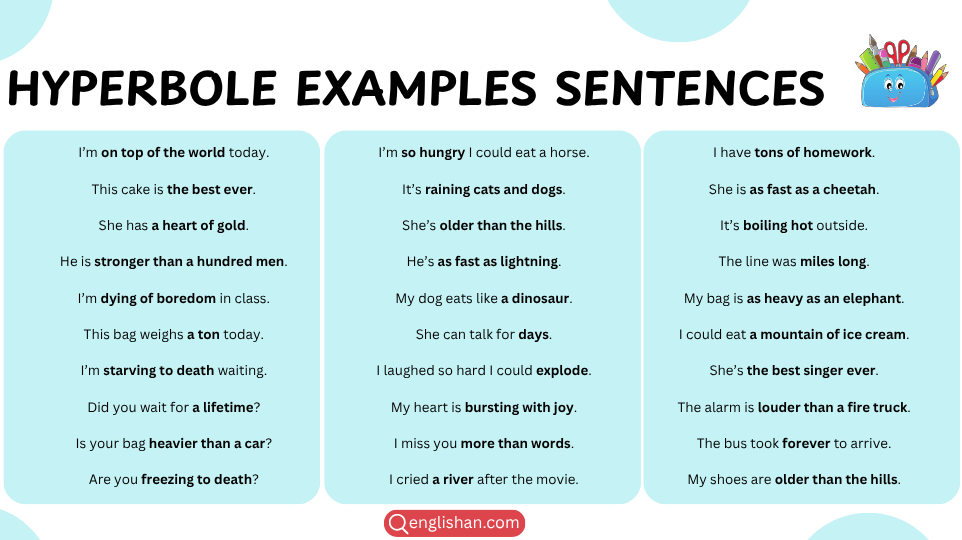
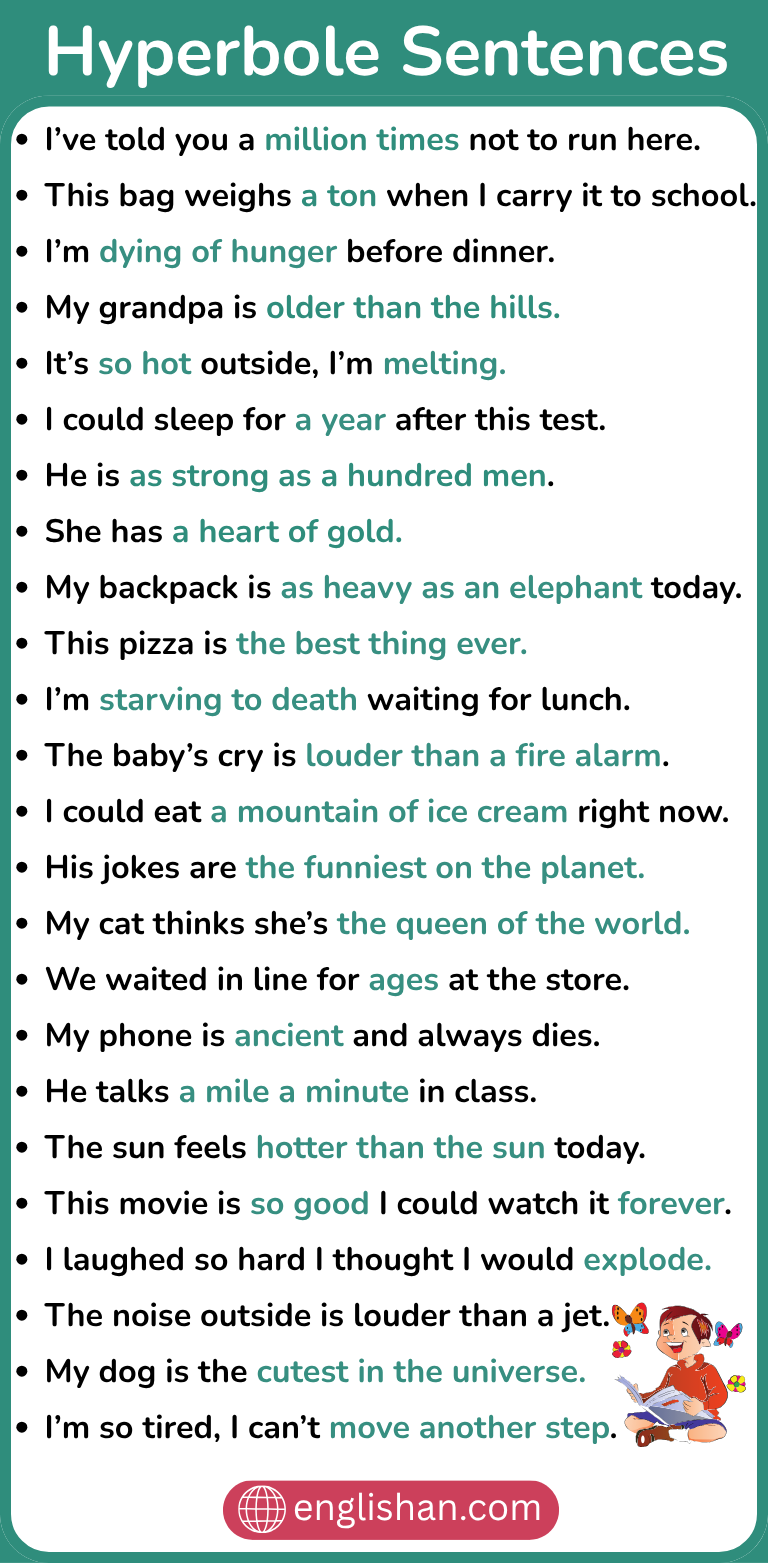
- I have a million things to do today. Nobody counts the tasks, and the number marks a workload the speaker cannot finish.
- This bag weighs a ton. The complaint is about strain, not weight, and the exaggerated figure justifies putting the bag down.
- I’ve told you a thousand times. Repetition is the grievance here, and the round number reports frustration at not being heard rather than a real count.
- I’m so hungry I could eat a horse. The speaker compares hunger to an animal nobody eats, and that impossibility is what signals the exaggeration.
- My feet are killing me. The verb killing gives the pain an intention it does not have, so an ache is described as an assault.
- That meeting lasted forever. The exaggeration stretches the clock, and the speaker means the meeting outlasted its usefulness.
- He’s older than the hills. Comparing a person’s age to hills puts that age beyond ordinary counting.
- This laptop cost me an arm and a leg. Naming the price in body parts reports a loss rather than a number.
- I nearly died of embarrassment. Died replaces blushed, and the size of the word matches the size of the feeling.
- She talks a mile a minute. A motorway speed describes speech instead of traffic, and the point is that nobody gets a chance to interrupt.
- My phone battery lasts about five minutes. The figure is far too low to be true, and everyone understands it as a complaint about the phone.
- I’ve been standing in this queue since last Tuesday. Backdating the wait by a week converts boredom into something visible.
- He eats like he hasn’t seen food in a month. The sentence describes ordinary appetite as starvation, and that mismatch is what makes it funny.
- I could sleep for a year. Tiredness gets a duration no human body would survive.
- Their dog barks loud enough to wake the dead. The sentence measures volume against the one audience sound cannot reach.
- That exam went on for a lifetime. Two hours become a life span, which is precisely how they felt.
- My inbox has more unread mail than the post office. The comparison sets one person’s inbox against a national institution.
- It took me forever to find a parking space. Forever is the most worn hyperbole in English and still the most used.
- She owns every pair of shoes ever made. Every replaces a number, which is the fastest way to say the collection is large.
- I have zero energy left in my body. Zero is an absolute, and absolutes are exaggeration in their most compact form.
What Is Hyperbole In English
Hyperbole is a figure of speech that overstates something far beyond the literal truth so the listener registers the emphasis rather than the claim.
Pronunciation: four syllables, hy-PUR-buh-lee, with the stress on the second. The spelling misleads people into saying hyper-bowl, which is the one pronunciation to avoid.
Hyperbole is not lying, and the difference is intent. A liar wants belief. Someone using hyperbole expects none, because both speaker and listener recognise the overstatement at the moment it is spoken. That shared recognition is what separates I’ve told you a thousand times from a false statement, and it is why nobody corrects the number.
Funny Hyperbole Examples
Comic hyperbole follows one rule: the absurdity has to be specific. He snores loudly raises no laugh, while a snore measured on a seismograph does, because you picture the needle moving. Each of these fifteen attaches the exaggeration to an object you can see.
- My grandmother drives so slowly that snails overtake her on the motorway.
- He snores loud enough to register on a seismograph.
- Our neighbour’s lawn grew so tall we lost a postman in it.
- She packed for a weekend and brought nine suitcases and a wardrobe.
- That coffee was strong enough to wake a statue.
- My brother’s bedroom got so untidy the council declared it a landfill.
- He talks so much his tongue needs a rest day.
- Her perfume arrives ten minutes before she does.
- The cat grew so fat he qualifies for his own postcode.
- That joke was so old it came over with the Romans.
- My uncle’s chilli set off the smoke alarm two houses away.
- He texts so slowly that autumn turned to winter mid-message.
- This sofa has swallowed more remote controls than a black hole.
- My hair took so long to dry that I aged a decade.
- He ate so much at dinner that the table apologised.
Short Hyperbole Sentences
Short hyperbole works because the listener understands the exaggeration before the sentence finishes. Three to six words is the whole form, which is why speakers keep these fifteen intact and cut longer exaggerations down to this size.
- I’m dying of thirst.
- It’s boiling in here.
- I’m freezing to death.
- This is taking centuries.
- She never stops talking.
- I’m buried in homework.
- This queue is endless.
- I have zero patience left.
- He’s a million miles away.
- My head is exploding.
- I’ve aged a century.
- He runs at light speed.
- This weighs nothing at all.
- I’m starving to death.
- She cried an ocean.
Hyperbole Examples For Kids
Children exaggerate long before anyone teaches them the word, and they exaggerate whatever is in front of them: schoolbags, homework, pets, and waiting. These fifteen use the vocabulary a primary classroom already knows, which makes them the right starting set for a lesson on figurative language. They pair well with a lesson on action words, since a strong verb does more for a child’s exaggeration than a bigger number does.
- My schoolbag weighs more than an elephant.
- I have a mountain of homework tonight.
- My little sister screams louder than a fire engine.
- Our dog eats faster than a vacuum cleaner.
- I waited a hundred years for my turn on the swing.
- Dad’s jokes are older than dinosaurs.
- This spelling test has a million words on it.
- My bedroom is so messy you need a map.
- Grandpa’s stories last all week.
- I ran so fast I beat the wind.
- That ice cream was as big as my head.
- My teacher has eyes in the back of her head.
- The school bus took forever to arrive.
- I laughed so hard my sides split.
- My tooth hurt more than anything in the world.
Positive Hyperbole Sentences
Praise becomes hyperbole the moment it uses a superlative nobody measured. The best on the planet has no evidence behind it, and none is expected, because the speaker is reporting warmth rather than ranking.
- Your cooking is the best on the planet.
- That performance deserves every award ever made.
- She has the biggest heart in the world.
- This is the greatest news anyone has ever heard.
- He would move mountains for his family.
- Your kindness made my entire year.
- That view is worth crossing an ocean for.
- She smiled and the whole room lit up.
- This cake is pure heaven on a plate.
- He works harder than anyone alive.
- Your garden deserves a museum wing.
- That was the fastest hour of my life.
Negative Hyperbole Sentences
Complaints exaggerate faster than praise does, and the effect depends on the comparison being unfair. Continental drift moves at roughly two centimetres a year, which is why measuring a waiter against it works.
- This is the worst day in recorded history.
- That meeting drained every ounce of life from me.
- His excuse was thinner than paper.
- The service here moves slower than continental drift.
- I would rather walk barefoot across broken glass.
- That film wasted two years of my life.
- Their music sounds like a car crash set to a beat.
- This soup has less flavour than tap water.
- He apologised about as sincerely as a parking ticket.
- The room smelled bad enough to strip paint.
- Nothing on that menu is worth a single penny.
- I have never been so bored in my entire existence.
Emotional Hyperbole Sentences
Literal description is too small for strong feeling, so speakers describe impossible physical damage instead. A shattered heart, frozen blood, and a thousand years of winter all name a bodily event that never happened, and that mismatch is what registers as intensity.
- My heart shattered into a million pieces.
- I cried enough tears to fill a swimming pool.
- Missing her felt like a thousand years of winter.
- I was so nervous my heart tried to leave my chest.
- Fear froze every drop of blood in me.
- Losing him took the air out of the world.
- I have never wanted anything so much in my life.
- Her words cut deeper than any blade.
- Joy poured out of me for weeks afterwards.
- I would give up everything I own for one more day.
- The silence in that house grew louder than shouting.
- I have loved you since before time started.
Hyperbole Examples In Question Form
A rhetorical question asks nothing and expects no reply, so pairing it with exaggeration produces the sharpest form of the device in everyday speech. The question form converts a complaint into an accusation, which is why parents and teachers use it constantly. Nobody answering Do you think money grows on trees? is meant to describe agriculture.
- Do you think money grows on trees?
- How many times do I have to tell you?
- Are you planning to sleep all century?
- Did you buy the entire supermarket?
- Must you talk every second of the day?
- Have you been living under a rock?
- Is that suitcase full of bricks?
- Do you own every jacket ever made?
- Would it kill you to answer a text?
- Are we walking to the ends of the earth?
- How long does one email take, a decade?
- Did this queue start last year?
Hyperbole Sentences About Food And Hunger
Hunger produces more exaggeration than any other everyday feeling, which is why I could eat a horse survived long enough to become a cliché. These twelve stay away from that one and exaggerate quantity, heat, size, and price instead.
- I’m so hungry I could eat the whole menu.
- That pizza was the size of a car tyre.
- He drank the entire ocean at dinner.
- This chilli is hotter than the sun.
- My mum cooked enough rice to feed an army.
- I have not eaten in about a hundred years.
- That slice of cake weighed more than a brick.
- He piled a mountain of chips onto one plate.
- The bread was so stale it could break a window.
- I ate so much my stomach begged for mercy.
- This coffee costs more than my rent.
- She keeps a lifetime supply of chocolate in that drawer.
Hyperbole Examples About Time And Waiting
Waiting invites exaggeration because the feeling and the clock disagree, so the speaker reports the feeling and lets the clock lose. Each of these twelve stretches or compresses a duration past anything a watch would show.
- The film went on for three lifetimes.
- I have been on hold since the last ice age.
- This lecture will finish next century.
- He got ready in half a second flat.
- The doctor’s waiting room ate my entire youth.
- That bus is a hundred years late.
- I finished the whole book in a heartbeat.
- Monday mornings last longer than the rest of the year.
- She has been getting ready since Christmas.
- The kettle boiled at the speed of a glacier.
- I aged twenty years in that queue.
- His reply arrived a decade after my message.
Hyperbole Sentences About Hot And Cold
Weather exaggeration uses a temperature you would not survive, and the more precise the physical detail, the stronger the sentence. Very hot says nothing; an egg frying on the pavement gives you a picture.
- It is hot enough to fry an egg on the pavement.
- My fingers froze solid the second I left the house.
- This room is hotter than the surface of the sun.
- The wind cut straight through my bones.
- I could melt into a puddle out here.
- That water was cold enough to stop my heart.
- The pavement is boiling the soles off my shoes.
- My teeth chattered loud enough to wake the neighbours.
- The heater turned my flat into a furnace.
- It is so cold my breath froze in mid-air.
- Snow buried the car up to the roof aerial.
- This tea is lava in a cup.
Hyperbole Sentences About Work And School
Deadlines, meetings, and homework generate exaggeration all day, and the numbers involved are the first thing to go. These twelve inflate workload, machinery, and the length of an ordinary Tuesday.
- My boss sent a thousand emails before lunch.
- This homework will take the rest of my life.
- The photocopier has broken a million times this month.
- I have a paper stack taller than the building.
- That teacher assigns enough reading to fill a library.
- My laptop takes a week to start up.
- The staff meeting drained a year off my life.
- I answered every phone call in the country today.
- This exam has more questions than the internet.
- He has been in that job since the dawn of time.
- My desk is buried under an avalanche of paperwork.
- The office printer breaks every single morning without fail.
Hyperbole Examples In Literature
Writers choose hyperbole when a plain statement would understate the feeling, and the ten hyperbole examples below are the ones anthologies return to. Each names its author and work, with the claim the exaggeration is actually making.
William Shakespeare, Macbeth: “Will all great Neptune’s ocean wash this blood / Clean from my hand?” Macbeth measures his guilt against an entire ocean and finds the ocean too small, which tells you more than any confession would.
William Shakespeare, Hamlet: “I loved Ophelia. Forty thousand brothers / Could not with all their quantity of love / Make up my sum.” Hamlet quantifies grief in brothers, a unit nobody uses, so the number reads as devastation rather than arithmetic.
William Shakespeare, Romeo and Juliet: “The brightness of her cheek would shame those stars / As daylight doth a lamp.” Juliet outshines the night sky, which is Romeo reporting infatuation rather than astronomy.
Robert Burns, “A Red, Red Rose”: “And I will luve thee still, my dear, / Till a’ the seas gang dry.” Love gets a deadline set at the evaporation of every ocean, making the promise unbreakable by design.
W. H. Auden, “As I Walked Out One Evening”: “I’ll love you, dear, I’ll love you / Till China and Africa meet, / And the river jumps over the mountain / And the salmon sing in the street.” Auden stacks four impossibilities, and the excess is the point, since the poem later undercuts the promise entirely.
Harper Lee, To Kill a Mockingbird: “A day was twenty-four hours long but seemed longer.” The exaggeration is quiet rather than loud, which is how Lee gives Maycomb its heat and its boredom in one line.
Gabriel García Márquez, Living to Tell the Tale: Bogotá is described as a city where an insomniac rain had been falling since the beginning of the sixteenth century. Four hundred years of continuous rain reports a mood, not a climate.
Carl Sandburg, “The People, Yes”: Sandburg’s tall-tale tellers speak of a skyscraper so tall that hinges were fitted to the top two storeys to let the moon pass. American folk hyperbole works by building the absurdity out in engineering detail.
J. D. Salinger, The Catcher in the Rye: “I’m the most terrific liar you ever saw in your life.” Holden overstates his own dishonesty, and the boast doubles as a warning about everything he narrates.
Shel Silverstein, “Sick”: Little Peggy Ann McKay reports measles, mumps, a gash, a rash and purple bumps, all to avoid one school day. Every line of the poem exaggerates, which is why the poem teaches the device to children faster than a definition does.
Hyperbole In Songs And Advertising
Songwriters and advertisers exaggerate for the same reason: a claim nobody believes is remembered longer than a claim nobody disputes. Advertising regulators treat such overstatement as puffery, meaning a claim so obviously exaggerated that no reasonable buyer reads it as a factual promise.
| Line | Source | The exaggeration |
|---|---|---|
| I would walk 500 miles | The Proclaimers | Devotion measured in distance nobody walks |
| I’d catch a grenade for ya | Bruno Mars | Death offered as proof of love |
| I would do anything for love | Meat Loaf | Totality, then immediately qualified by the song |
| Red Bull gives you wings | Red Bull | An impossible physical outcome as a slogan |
| The best a man can get | Gillette | An unmeasurable superlative |
| Nothing outlasts the Energizer | Energizer | An absolute claim covering every rival product |
| The world’s favourite airline | British Airways | A global preference nobody polled |
Types Of Hyperbole With Examples
Naming the type makes hyperbole faster to spot in a sentence. These seven types cover every one of the hyperbole examples above, and they overlap with the wider family of literary devices that work by breaking the literal meaning.
- Quantity hyperbole: a count pushed past the possible, as in I’ve told you a thousand times.
- Size and weight hyperbole: physical scale inflated, as in this bag weighs a ton.
- Time hyperbole: a duration stretched, as in we waited an eternity.
- Impossible comparison: the standard of comparison rules the claim out, as in he runs faster than light.
- Absolute hyperbole: words admitting no exception, as in nobody ever listens to me, built on always, never, everyone, and nothing.
- Comic hyperbole: the absurdity is built for laughter, as in he snores loud enough to register on a seismograph.
- Rhetorical hyperbole: overstatement in argument or advertising, as in the best a man can get, which nobody is expected to verify.
Hyperbole vs Metaphor And Simile
| Device | What it does | Example |
|---|---|---|
| Hyperbole | Overstates a real quality far past the truth | This bag weighs a ton |
| Metaphor | States that one thing is another | Her voice was velvet |
| Simile | Compares two unlike nouns using like or as | He eats like a wolf |
| Understatement | Downplays something far below the truth | The hurricane caused a bit of damage |
Hyperbole exaggerates a quality that genuinely exists, while a metaphor supplies one that never did. The bag really does have weight, and a ton inflates it. Her voice has no velvet in it at all, which is why the second line is metaphor. For a fuller set of comparisons, study these metaphor sentences beside the hyperbole examples above.
A simile marks its comparison with like or as, so a sentence containing either word is a simile first, whatever else it does. The two overlap when a simile exaggerates, as in he eats like he hasn’t seen food in a month, which is a simile in structure and hyperbole in effect.
She is as tall as a giraffe. ❌
She is so tall she has to duck through doorways. ✅
Related:
FAQs
Hyperbole takes four syllables and sounds like hy-PUR-buh-lee, with the stress on the second syllable. People who go by the spelling say hyper-bowl, which is the one pronunciation to avoid, and the final syllable sounds like the ly in lovely rather than like hole.
The difference is intent. A liar wants the listener to believe a false statement, while someone using hyperbole expects nobody to believe it: both speaker and listener recognise I’ve told you a thousand times as overstatement the moment it is spoken, so nothing is being concealed.
Academic and technical writing rules it out, since every claim there must survive a literal reading. Persuasive formal writing such as a speech, an editorial, or a closing argument does take hyperbole, provided the exaggeration reads as deliberate rather than as a factual error.
Overstatement is the closest synonym, followed by exaggeration and, in older rhetorical usage, magnification. Each names the same move of pushing a claim past the literal truth for effect, though only hyperbole names the figure of speech itself.
Understatement is the opposite, and its formal name is litotes when the understatement works through a negative, as in not bad meaning excellent. Where hyperbole inflates a claim past belief, understatement deflates it below the truth, and both draw attention by refusing to state the thing plainly.
You May Also Like