
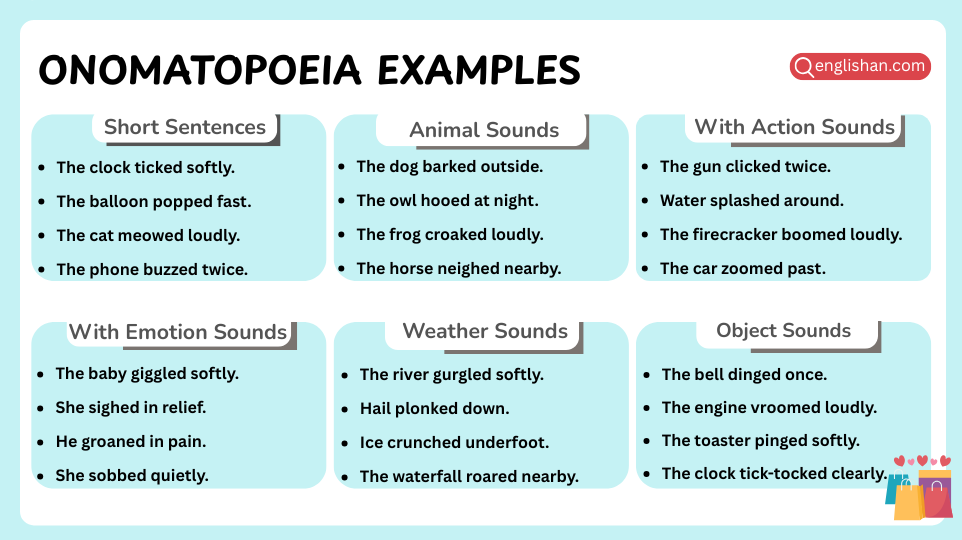
Onomatopoeia is a word that imitates the sound it names, so saying buzz out loud reproduces the noise a bee makes. English has hundreds of these sound words, and they name the noises made by animals, machines, weather, and people. The onomatopoeia examples that follow give a working sentence for each one, with the sound word marked so you can see which part does the imitating.
Onomatopoeia Examples
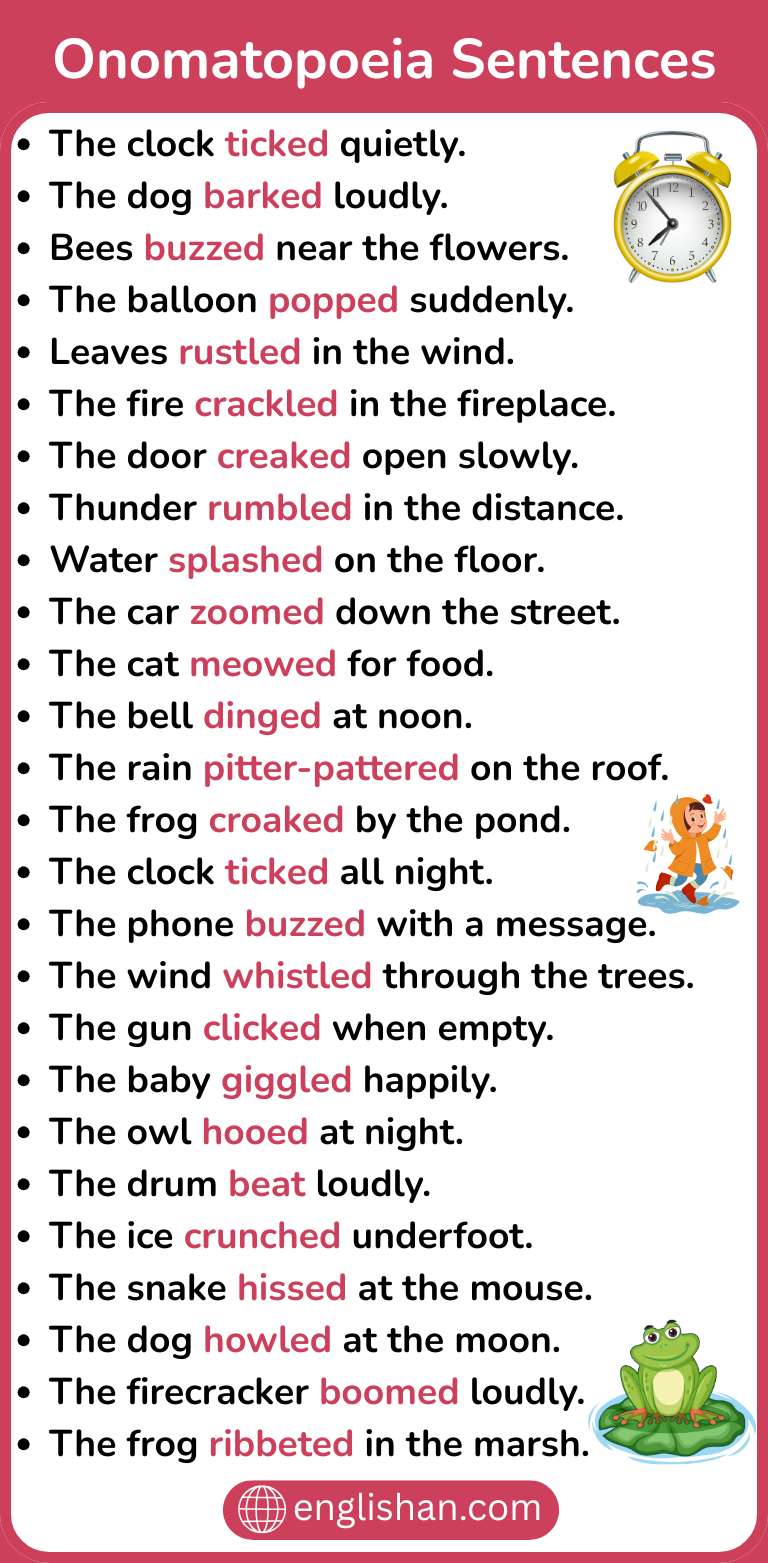
The sound word is bold in every sentence, and each one names a different noise.
- The door slammed with a bang that shook the window frame.
- A single wasp began to buzz against the glass.
- The cork came out with a satisfying pop.
- Rain hit the puddle with a heavy splash.
- Gravel gave a dry crunch under the tyres.
- Onions started to sizzle the moment they touched the pan.
- The floorboards creak every time somebody crosses the landing.
- His bag landed on the desk with a thud.
- The train went past with a long whoosh of air.
- Keys jingle in his pocket the whole way down the corridor.
- Steam began to hiss from the radiator valve.
- Plates clatter in the kitchen at seven every morning.
- Water started to gurgle somewhere under the floor.
- The twig gave a sharp snap when he stepped on it.
- Dry leaves rustle across the pavement in October.
- The children giggle through the whole assembly.
- A tap left running will drip all night.
- The gate shut with a metallic clang.
- Somebody upstairs walks with a heavy thump.
- The arrow flew past with a quiet swoosh.
What Is Onomatopoeia
Onomatopoeia is a word whose pronunciation imitates the sound it refers to. The term came into English from Greek, and it applies whenever the spoken word reproduces a real noise instead of merely naming one.
English recognizes two working kinds.
Direct onomatopoeia: the word reproduces the sound almost exactly, as in buzz, hiss, cuckoo, and bang.
Indirect onomatopoeia: the word suggests the sound through the feel of its consonants and vowels rather than copying it, as in slither, glimmer, and murmur.
One boundary trips up more readers than any other. A sound word imitates a noise. An interjection expresses a feeling and imitates nothing, so it does not qualify however sound-like it looks in writing.
Ugh is onomatopoeia because it expresses disgust. ❌
Achoo is onomatopoeia because it imitates a sneeze. ✅
Sound words also change across languages, which shows how much convention is involved. An English dog says woof, a Japanese dog says wan-wan, and a Korean dog says meong-meong, though all three describe the same bark.
For better understanding, read:
Onomatopoeia Examples With Animal Sounds
Animals give English more sound words than any other source, and most of them work as both noun and verb.
- The neighbour’s dog will woof at anything that moves.
- Foxes bark across the field at two in the morning.
- Cattle moo steadily whenever the feed truck arrives.
- Pigs oink their way along the fence line.
- The lambs baa until their mothers answer.
- Horses neigh when the stable door opens.
- The old mare gave a soft whinny of recognition.
- A donkey began to bray on the far side of the hill.
- The dog started to growl at the postman’s shadow.
- Wolves snarl before they ever move forward.
- Our cat will purr for anyone with a warm lap.
- The puppy gave a sharp yelp and hid under the sofa.
- Coyotes howl across the canyon after dark.
- Lions roar loudest just before dawn.
- Goats bleat whenever the gate is left open.
- The pig gave a low grunt and rolled over.
- Mice squeak behind the skirting board at night.
- Frogs ribbit all through the summer evenings.
- Toads croak from the ditch beside the lane.
- The kitten began to mew for its mother.
- A wild boar gave one warning snort.
- Monkeys chatter the whole way along the treeline.
For better understanding, read:
Bird Sounds In Sentences
Birds have their own set of sound words, and most English birds are named for the noise they make.
- Sparrows tweet outside the window from first light.
- Finches chirp in the hedge all afternoon.
- Crows caw from the top of the church tower.
- An owl began to hoot somewhere in the woods.
- Pigeons coo on the ledge above the shop.
- Ducks quack whenever anyone opens a paper bag.
- Hens cluck around the yard after feeding.
- Parrots squawk the moment a stranger walks in.
- The chicks cheep inside the incubator.
- Blackbirds warble from the chimney pot at dusk.
- A skylark began to trill high over the field.
- Roosters crow long before the alarm goes off.
- Newly hatched chicks peep almost continuously.
- Geese honk as they cross the estuary.
For better understanding, read:
Onomatopoeia Examples With Water Sounds
Water produces a wide range of noises depending on how much of it moves and how fast.
- A stone landed in the pond with a soft plop.
- Milk began to glug out of the narrow bottle.
- Meltwater started to trickle down the gutter.
- Coffee began to slosh over the rim of the cup.
- Hot fat will splatter if the pan is too dry.
- Fine rain started to spray across the windscreen.
- Water began to squirt from the cracked hose.
- Bubbles bubble up whenever the pump restarts.
- The fish gave a quick swish of its tail.
- The bucket went in with a heavy sploosh.
- Condensation began to dribble down the tiles.
- Floodwater started to gush through the broken wall.
- Blood began to spurt from the cut on his thumb.
- Small waves lap against the harbour steps.
- The wake started to ripple out toward the bank.
- Raindrops splish into the flooded lane.
- Coins went into the fountain with a small plink.
- The stream will babble all the way down the valley.
Weather And Nature Sound Words
Weather sounds fill the space between a whisper and a crash, and English has a word for every stage.
- Rain began its steady pitter-patter on the conservatory roof.
- Thunder started to rumble somewhere behind the hills.
- Frost made the branches crackle underfoot.
- The wind began to whistle through the letterbox.
- A clap of thunder gave one enormous boom.
- Hail started to patter against the skylight.
- Pines murmur whenever the wind turns south.
- Reeds whisper along the edge of the lake.
- The whole valley fell into a deep hush after the storm.
- Dead leaves began to swirl around the gatepost.
- Rain started to lash the windows on the seaward side.
- A wave hit the sea wall with a heavy crash.
- Icicles tinkle as they break off the guttering.
- Distant thunder began to drum across the moor.
- Wind through the firs makes a long low sough.
- Dust started to whirl across the empty field.
Onomatopoeia Examples With Human Sounds
The human body produces its own catalogue of noises, and every one of them has a word.
- She let out a loud achoo in the middle of the lecture.
- He began to cough halfway through his answer.
- The baby started to hiccup after her bottle.
- Someone behind me began to sniff every thirty seconds.
- My grandfather can snore through a thunderstorm.
- He tried not to burp at the table.
- She had to gulp the water down before she could speak.
- The old dog began to wheeze on the stairs.
- Runners pant for a full minute after the finish line.
- He started to splutter on his first sip of tea.
- She let out a long groan at the mention of homework.
- The whole audience began to gasp at once.
- He gave a heavy sigh and picked up the phone.
- She began to hum without noticing she was doing it.
- The child started to snuffle into her sleeve.
- My aunt will tut at anything she disapproves of.
- He gave a short puff and lifted the box again.
- The patient began to retch before the nurse arrived.
For better understanding, read:
Voice And Speech Sounds In English
Speech has its own sound words, and each one names a different way of getting words out.
- He began to mumble into his collar.
- She could hear them mutter on the other side of the door.
- The toddler started to blabber happily to the cat.
- Two students jabber through the whole announcement.
- He began to stammer as soon as the camera turned on.
- She used to stutter on words starting with P.
- Somebody let out a shriek in the row behind us.
- The brakes made her screech with fright.
- He had to holler across the yard to be heard.
- The sergeant began to bellow at the back rank.
- A child started to wail in the next carriage.
- The puppy began to whine at the front door.
- She let out a delighted squeal at the surprise.
- He would croon to the baby until she slept.
Onomatopoeia Examples With Impact Sounds
Impact words register the whole force of a collision, and the vowel tells you how hard it was.
- The ball hit the window with a flat smack.
- He gave the table a frustrated slap.
- She hit the ball with a satisfying whack.
- The bat met the wood with a solid thwack.
- The ice gave a loud crack under his boot.
- Two cars met with a sickening smash at the junction.
- The lid came down with a heavy clunk.
- He caught his head a sharp bonk on the low beam.
- The suitcase hit the floor with a dull thunk.
- Somebody began to rap on the office door.
- She heard a gentle tap at the window.
- Nobody answered the first knock.
- The trolley gave the shelf a small bump.
- Cymbals meet with a bright clash at the end.
- Glasses clink across the whole table.
- The keyboard makes a hollow clack all evening.
- A pebble hit the roof with a single plunk.
- The wave gave the pier a real wallop.
- Falling masonry landed with a muffled crump.
- The bullet hit the sign with a metallic ping.
Machine And Vehicle Sound Words
Engines and machines produce steady, repeating noises, which is why so many of their sound words double themselves.
- Motorbikes vroom past the café every Sunday.
- He began to rev the engine at the lights.
- The old tractor will chug up the hill in first gear.
- Cooling fans whir behind the server rack.
- Chains clank as the drawbridge rises.
- The mill began to grind at six in the morning.
- Loose bolts rattle the whole way down the track.
- The mower started to putter and then stopped.
- The engine began to sputter on the last of the fuel.
- Reversing lorries beep all through the night shift.
- A tugboat began to toot in the harbour.
- Sports cars zoom along the bypass after midnight.
- The generator started to throb under the floor.
- The washing machine began to judder on its spin cycle.
- Sirens whoop twice before the ambulance turns.
- The concrete mixer will churn for another hour.
- Turbines thrum steadily across the whole field.
- Traffic began to drone somewhere beyond the hedge.
Onomatopoeia Examples With Movement Sounds
Movement words name both the speed and the surface, so the same action changes word depending on what it crosses.
- The email will zip across in under a second.
- Cyclists whizz down the hill without braking.
- Pigeons flap noisily off the station roof.
- Moths flutter around the porch light all evening.
- New shoes scuff on the polished floor.
- He began to shuffle toward the kitchen in his slippers.
- Chairs scrape as the whole class stands up.
- The grass snake began to slither into the long grass.
- Tyres skid on the wet cobbles every winter.
- The old man began to plod up the last flight.
- Children stomp through every puddle on the walk home.
- Boots tromp across the hallway at half past six.
- Horses clip-clop along the seafront on Sundays.
- She began to flick through the pages impatiently.
- The fish began to flop about in the bottom of the boat.
- Walkers trudge the last mile in silence.
Food And Eating Sounds In Sentences
Kitchens and dinner tables produce a sound vocabulary of their own, most of it built from short sharp consonants.
- He will slurp his soup however often he is told not to.
- The children munch their way through a whole bag.
- Puppies chomp on anything left at floor level.
- She began to nibble at the edge of the biscuit.
- The dog started to gnaw on the bone under the table.
- He tends to guzzle the whole bottle at once.
- She took a long swig straight from the flask.
- Bubbles fizz the moment the cap comes off.
- Fresh apples scrunch when you bite into them.
- He began to whisk the eggs with real determination.
- The camel will spit at anyone who comes too close.
- Wet dough landed on the board with a soft glop.
- Mud began to squelch under their wellingtons.
- Turkeys gobble their feed within seconds.
Onomatopoeia Examples With Household Sounds
Ordinary rooms are full of small repeating noises, and English names almost all of them.
- The kettle switch gave a decisive click.
- The hall clock will tick through the whole night.
- Each second ends on a hollow tock.
- The microwave gave a single ding.
- The church bell struck one heavy dong.
- The doorbell will chime twice and then stop.
- The old cistern began to flush on its own again.
- Somebody let the front door slam behind them.
- Coat hangers jangle every time the wardrobe opens.
- The drawer began to rasp on its broken runner.
- Mice scritch behind the kitchen units after dark.
- The lid went back on with a solid clonk.
- The mattress hit the floor with a dull whump.
- The old alarm clock still gives a metallic brrring.
Electrical And Electronic Sound Words
Electricity produces a small set of sound words, most of them coined in the last century.
- A loose wire will zap anyone who touches it.
- The bulb began to fizzle and then went dark.
- Hospital monitors bleep at regular intervals.
- The cursor gave one small blip and vanished.
- The console makes a cheerful boop on startup.
- Old strip lights zizz for a minute before they settle.
- The radar screen gave a faint pip every few seconds.
Onomatopoeia Examples With Musical Sounds
Instruments are named for their noises just as animals are, and the sound word names the playing technique too.
- He began to strum the same three chords again.
- The loose string gave a flat twang.
- The tuba let out an unexpected parp.
- The village band began to oompah down the high street.
- The snare drum kept up a steady rat-a-tat.
- The triangle gave one bright ting.
- Trumpets blare across the whole parade ground.
- She began to pluck the harp strings one at a time.
- The recorder gave a thin tootle at the back of the hall.
- The chorus went into a long doo-wop behind the singer.
Comic Book Sound Effects
Comics turned onomatopoeia into lettering, and many of these words exist only because artists needed something to draw.
- The hero’s punch landed with a full-page pow.
- The explosion filled the panel with kapow.
- The villain went down on a single bam.
- The door came off its hinges with a wham.
- The robot dropped with a heavy zonk.
- The whole warehouse went up in a kablam.
- The spring mattress sent him up with a boing.
- The pie hit his face with a wet splat.
- The web line shot out with a thwip.
- The uppercut connected with a clean biff.
- The jaw took the punch with a loud sock.
- The fuel tank went off with a kaboom.
- The blast knocked him back with a zowie.
- The cash register closed on a ka-ching.
Emotion Sound Words In English
Crying and laughing both produce imitative words, and English names five grades of each.
- The child began to boo-hoo the moment the balloon burst.
- She started to sob into the phone.
- He began to sniffle through the last ten minutes.
- The audience started to chuckle at the second joke.
- Two boys began to snicker in the back row.
- Her uncle let out a great guffaw at his own story.
- The girls began to titter behind their hands.
- The witch began to cackle in the pantomime.
- The puppy started to whimper at the vet’s door.
- He would snivel whenever the argument turned against him.
Short Onomatopoeia Sentences
Every sentence runs under seven words, and each still names a distinct sound.
- Mud went squish underfoot.
- Sparrows twitter at dawn.
- The fox gave a yip.
- Cats yowl at midnight.
- Squirrels chitter overhead.
- He landed with an oof.
- A quick rat-tat followed.
- Rain made a soft pit-pat.
- The stone went ker-plunk.
- The cape went fwoosh.
- Kittens mewl for milk.
- The pony began to whicker.
- She said brr and shivered.
- The teacher said shush.
Onomatopoeia Examples For Kids
Short clauses and familiar noises let a young reader hear the word straight away.
- The bee goes buzz around the flowers.
- The cow says moo in the field.
- The dog says woof at the gate.
- The cat says meow by the door.
- The duck says quack in the pond.
- The pig says oink in the mud.
- The sheep says baa on the hill.
- The clock goes tick-tock all day.
- The train goes choo-choo down the track.
- The drum goes bang at the party.
- The balloon goes pop in the sun.
- My boots go splash in the puddle.
- The crisps go crunch in my mouth.
- The car horn goes beep outside.
For better understanding, read:
Onomatopoeia In Poetry
Poets built whole stanzas out of sound words, and these are the passages most frequently set for study.
- Edgar Allan Poe, The Bells: the poem invents tintinnabulation for the ringing of the sledge bells.
- Edgar Allan Poe, The Bells: the second stanza runs on the jingling and the tinkling of the wedding bells.
- Edgar Allan Poe, The Raven: the visitor is heard rapping, gently rapping at the chamber door.
- Edgar Allan Poe, The Raven: the same line pairs it with tapping to double the beat.
- Alfred Tennyson, Crossing the Bar: the sea is described with moaning of the bar.
- Alfred Tennyson, Come Down O Maid: the closing lines give the murmuring of innumerable bees.
- Emily Dickinson: her poem opens on a fly that begins to buzz as the speaker dies.
For better understanding, read:
Onomatopoeia In Famous Books
Novelists invent sound words when the existing ones fall short, and a number of coinages entered English this way.
- Lewis Carroll, Jabberwocky: the blade goes snicker-snack through the monster.
- Lewis Carroll, Jabberwocky: the creature comes whiffling through the wood.
- Lewis Carroll, Jabberwocky: the Jabberwock burbled as it came.
- Lewis Carroll, Jabberwocky: the hero goes galumphing back with the head.
- Roald Dahl, The BFG: the giant’s word for a downward bang is whizzpopping.
- Dr. Seuss, Mr. Brown Can Moo! Can You?: the whole book is built on sound words, opening on moo and buzz.
Sound Word Bank From A To Z
Each letter brings its own sound words, listed here for quick reference.
| Letter | Sound words |
|---|---|
| A | Argh, arf, atishoo |
| B | Blip-blip, bonk, brrr, bzzt, blare |
| C | Clatter-bang, clonk, clop, chink, chirrup |
| D | Ding-a-ling, dink, ding-dong, drip-drop |
| F | Flick-flack, flump, fizzle-pop, frrp |
| G | Glub, gong, gargle, grate |
| H | Ha-ha, hee-hee, hubbub, huff |
| J | Jangle-jangle, judder-judder |
| K | Ker-thump, klaxon, kerching |
| M | Meep, mumble-jumble, moo-moo |
| N | Nicker, natter |
| P | Peal, pfft, plish, prattle, ptoo |
| R | Rat-a-tat-tat, rustle-rustle, rip, roll |
| S | Swish-swash, sizzle-sizzle, slurp-slurp, squelch, shush |
| T | Ta-da, thwump, tinkle-tinkle, twitter-twitter |
| V | Varoom, vroom-vroom |
| W | Wham-bam, whee, wallop-wallop, wubba |
| Y | Yak-yak, yoo-hoo, yikes |
| Z | Zing, zoom-zoom, zzz |
FAQs
The word is pronounced on-uh-mat-uh-PEE-uh, with five syllables before the stressed one and the emphasis landing on PEE. British and American speakers agree on the stress, though British English shortens the opening vowel.
The difference is imitation. Onomatopoeia reproduces a real sound, as achoo reproduces a sneeze and hiss reproduces escaping steam. An interjection expresses a feeling without imitating anything, which is the case with ugh, aha, and oh dear. A word qualifies as both only when the feeling comes out as an actual noise.
Direct onomatopoeia copies the sound almost exactly, as cuckoo copies the bird and bang copies an impact. Indirect onomatopoeia suggests a sound through the feel of its consonants and vowels rather than copying it, which is how slither, glimmer, and murmur work.
No, and the differences are larger than most speakers expect. An English dog says woof, a Japanese dog says wan-wan, and a Korean dog says meong-meong, all for the same bark. Each language builds its sound words from the consonants and vowels it already uses, so the same noise comes out differently.
Advertisers use it constantly because a sound word is easier to remember than a description. Rice Krispies built a whole campaign on snap, crackle and pop, Alka-Seltzer used plop plop fizz fizz, and Mazda ran on zoom-zoom for a decade.
You May Also Like