An oxymoron is a pairing of two words whose ordinary meanings contradict each other. Juliet calls parting a sweet sorrow, and the contradiction is complete inside those two words. Two senses of oxymoron circulate: one names the figure of speech Shakespeare writes on purpose, and the other names the joke that calls military intelligence a contradiction. Only one of the two follows a rule that holds for any phrase.
What an Oxymoron Is
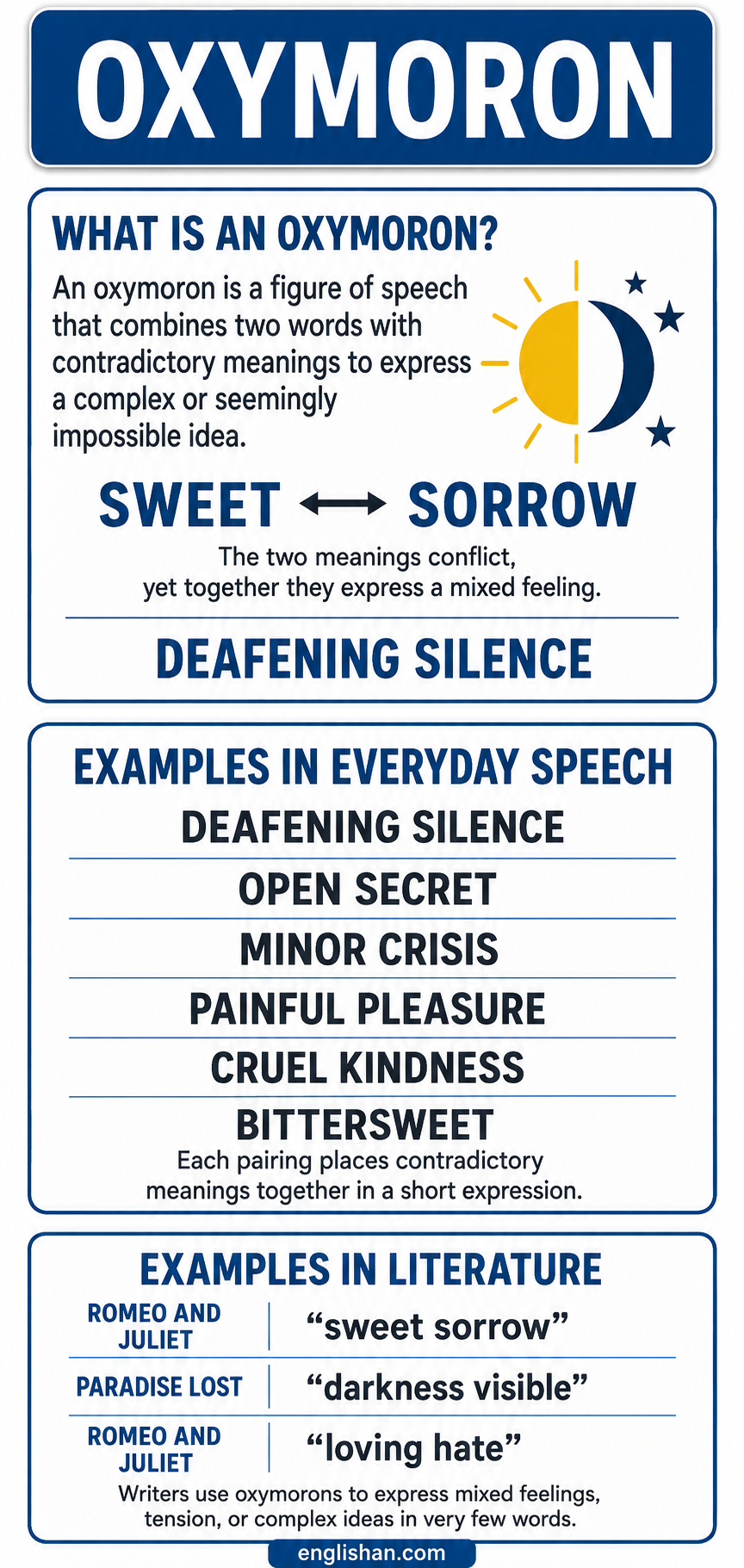
An oxymoron sets two words side by side whose ordinary meanings cannot both hold at once. The pairing is a figure of speech rather than a slip, so nobody reads it as a mistake. Writers choose it for a mixed state, a divided feeling, or a subject behaving against its own description.
Juliet’s sweet sorrow expresses a feeling no single English word can. Sweetness and sorrow contradict each other, yet the phrase holds both, and a reader takes both meanings at once.
- a deafening silence ✅ Silence makes no sound, so deafening cannot apply to it literally, and the pairing measures how heavily one silence weighed.
- an uneasy silence ❌ Unease and silence agree with each other, so the phrase describes a silence instead of contradicting one.
Both halves of the contradiction belong to the phrase itself. One condition, both halves inside the phrase, is enough for every doubtful phrase from Shakespeare down to the jokes.
The Width Rule: The Contradiction Has to Fit Inside the Phrase
The contradiction has to fit inside the phrase, and that phrase is two words long as a rule, three at the outside. Circle the two words and look at nothing else. Where the circled words alone contradict each other, the phrase is an oxymoron.
Where the clash needs a fact about the world, a second clause, or an outside opinion, the phrase belongs to another figure of speech.
- cruel kindness ✅
- an honest politician ❌ Politicians can be honest, so nothing inside the pair conflicts, and the clash depends on an opinion held outside the phrase.
Three words appear where a writer adds a modifier or a verb, as in make haste slowly or awfully good coffee. Past three words the contradiction spreads across a clause, and a different device claims the line.
Oxymoron vs Paradox: The Two-Step Test
An oxymoron finishes its contradiction inside a phrase, while a paradox needs a complete claim to make one. Two steps separate oxymoron from paradox, and a doubtful phrase needs both.
Step 1, measure the scope: count the words that contradict each other. Two or three words inside one phrase make an oxymoron, while a full statement with a subject and a verb makes a paradox.
Step 2, test for resolution: ask whether the line becomes true on reflection. On reflection a paradox resolves underneath its surface contradiction, while an oxymoron keeps its contradiction permanently and resolves into nothing.
Apply both steps to less is more. Step one finds a complete claim rather than a phrase, and step two finds the resolution underneath it, since less ornament intensifies the effect. Those two answers together identify a paradox. The same steps on deafening silence find two words at step one and nothing to resolve at step two, because no silence has ever deafened anybody.
The common mistake here treats an oxymoron as a paradox in miniature. Miniature or not, a paradox has to resolve, and deafening silence has nothing to resolve, so the two devices stay separate rather than nested. The forms of a paradox, along with this boundary of scope and resolution seen from the other direction, are set out under paradox.
Why the Word Oxymoron Contradicts Itself
Oxymoron comes from Greek oxys, meaning sharp, joined to moros, meaning dull or foolish. Sharp and dull cannot both describe one subject, so the word itself performs the contradiction it names.
The word obeys the width rule at the shortest length possible. Two Greek roots are the whole of it, and the contradiction is complete between them. Anyone who remembers those roots remembers the width rule with them.
An Oxymoron Does Not Have to Be Adjective Plus Noun
Hunt only for an adjective before a noun and you overlook every other grammatical form. That hunt misses act naturally in a passage and leaves half the device unrecognised.
The clash is semantic rather than grammatical. A pairing is an oxymoron whatever its grammar, so long as the contradiction stays inside the phrase, and five grammatical forms account for nearly everything a reader meets.
- Adjective plus noun: deafening silence, cruel kindness, minor crisis
- Adverb plus adjective: awfully good, painfully beautiful, seriously funny
- Verb plus adverb: act naturally, hurry slowly
- Verb plus object or complement: found missing, climb down, grow smaller
- Single compound word: bittersweet, frenemy, sophomore
The compound word hides the contradiction best, since sophomore joins sophos, wise, to the same moros that ends oxymoron. Verb pairings are the ones most readers miss, and anyone hunting adjectives will overlook them, though found missing and act naturally clash as sharply as any noun phrase.
Why Military Intelligence Fails the Rule
Military intelligence heads every collection of funny oxymorons, and it fails at the first step of the width rule. Nothing inside those two words conflicts.
Armies conduct intelligence operations as ordinary business, so the phrase names a real department in most governments. That contradiction starts outside the phrase: a speaker who thinks soldiers stupid brings it, and a listener who agrees completes the joke. Remove that opinion and the phrase goes back to naming a department.
The width rule disposes of business ethics, honest politician, airline food and government efficiency just as quickly. Those four phrases each pair two words that agree with each other perfectly well, and every one of them depends on a low opinion of the first word.
- sweet sorrow ✅
- business ethics ❌ Businesses keep written ethics codes, so the clash depends on a judgement about business rather than on the pair of words.
Is the Joke Sense Wrong?
Is jumbo shrimp a misuse of the term? Not quite, because the word oxymoron now names two senses rather than one.
The narrow sense names the deliberate device, built by a writer and recognised by an audience as a figure of speech. The extended sense stretches to any phrase a speaker declares self-contradictory, whether or not the two words conflict. Humorists named the second sense an opinion oxymoron, and the name fits, since such a joke passes an opinion off as a definition.
Purists call the extended sense a plain misuse, and that complaint stands inside a literary essay. Outside that setting, the joke works like a pun, because the phrase carries a second reading the audience infers.
Keep the two senses apart by asking where the contradiction starts. The contradiction starts in the words for the device, and in the speaker for the joke. Both senses appear in the same collections of examples, so the standard entries need auditing one at a time.
Dead Oxymorons: Contradictions That Stopped Being Felt
A writer who chooses pretty ugly to unsettle a reader unsettles nobody. That pairing stopped registering as a contradiction long ago, and it now passes as a plain intensifier.
Repetition drains a pairing. One word’s sense drifts as speakers repeat it until the clash goes. Pretty completed that process: before an adjective it stopped meaning attractive and became a booster, so pretty ugly now means fairly ugly and nothing more.
Repetition finished awfully good by the same drift, once awfully lost its link to awe and to dread. Both alone together and barely clothed have worn down as far, and bittersweet has nearly joined them.
Test a pairing by reading it aloud and watching for the pause. A live oxymoron creates that pause while a reader weighs both senses, and a dead one passes at the speed of ordinary speech. That difference in speed depends on the connotation each word carries now rather than on its older denotation.
Revive a worn pairing by swapping the drifted word for one that still means what it says.
- A deafening silence fell over the table. ✅
- The room went pretty ugly after that. ❌ Pretty now reads as a booster, so a reader hears an ugly room and no contradiction at all.
Auditing the Standard Examples
A student copying straight from a long example list hands in phrases that fail the width rule. Five of the most-repeated phrases fail that rule, and taking them one at a time shows what the rule excludes.
- civil war ❌ Civil here means of citizens rather than polite, so both words agree and no contradiction remains inside the phrase.
- jumbo shrimp ❌ Jumbo denotes a size grade within a species, so the pairing agrees with itself, and the joke depends on reading shrimp as a small person instead.
- friendly fire ❌ Friendly here means from one’s own side rather than kind, which makes the phrase a euphemism for shooting your own soldiers rather than a contradiction.
- virtual reality ❌ Virtual in computing means simulated rather than unreal, so the phrase names a technology and nothing inside it clashes.
- old news ❌ News has drifted from new reports to reports of any age, so the contradiction leaked out of the phrase and old news now reads as a single word.
Three failures account for all five: a word with a technical sense that never clashes, a joke read into the phrase from outside, and a live pairing worn flat by repetition. Those three lie behind much of any long collection of examples, so draw an assignment only from pairings whose two words genuinely clash.
Everyday Oxymorons That Pass
In every one of these pairings the contradiction stays inside the phrase, so the two circled words clash without help from a second sentence. These pairings divide into five groups, each named for the contradiction its members make.
- Feelings that go both ways: sweet sorrow, cruel kindness, painful pleasure, tender violence Each pairs a pleasant word with a painful one for a state made of both at once.
- Sounds that are not there: deafening silence, silent scream, quiet roar, loud whisper Each attaches a volume word to something silent, so the pairing measures an absence.
- Sizes that argue: minor crisis, small fortune, tiny giant, modest triumph Each sets a size word against a noun whose meaning already fixes the size in the opposite direction.
- Doing and undoing: act naturally, found missing, climb down, grow smaller Each verb means one action and the word after it means the opposite, which shows the device works outside noun phrases.
- Certainty that is not certain: accurate estimate, definite maybe, only choice, open secret Each pairs a word promising a settled answer with one admitting the answer stays open.
Romeo’s Thirteen Oxymorons in Four Lines
One oxymoron intensifies a sentence, while a series of them marks a speaker who can no longer name his own feeling. Romeo, told that street violence has broken out over nothing, answers with thirteen contradictions inside a handful of lines.
O brawling love, O loving hate,
O any thing, of nothing first create!
O heavy lightness, serious vanity,
Misshapen chaos of well-seeming forms!
Each pair on its own would mark a mixed feeling. Massed together, the same pairs stop naming feelings and start naming a mind that cannot settle on one, so Romeo’s series has an effect no single pairing has.
The passage works because the grammar keeps changing. Romeo moves from adjective plus noun to participle plus noun to a possessive phrase, so a reader never grows used to one construction. Repeat a single construction four times instead and the series becomes a tic.
Three oxymorons inside one paragraph of an essay read as a mannerism rather than as feeling. That risk grows in ordinary prose, so reserve a series of them for a speaker whose thinking has genuinely broken down.
Oxymorons in Literature, Film Titles and Song
Which writing outside Shakespeare relies on the device most? Writers and publishers choose the device for titles more than for anything else, because a reader stops at two contradictory words on a poster or a shelf.
- Milton, Paradise Lost: darkness visible, a fire in hell that gives no light
- Tennyson, Idylls of the King: faith unfaithful, loyalty that betrays the person it serves
- Film titles: Eyes Wide Shut, True Lies
- Song title: The Sound of Silence
A title has to finish its contradiction inside the phrase, exactly as a line of verse does, since a poster leaves no room for a second clause. Darkness visible meets that rule at the shortest length available, naming a quality of hellfire in two words that no added explanation would improve. The effect is epigrammatic, since a complete judgement arrives in the fewest words that will hold it.
What an Oxymoron Does to a Sentence
What changes when a writer pairs two contradictory words? A reader registers both contradictory meanings at once, and that double reading divides into three effects.
- Naming a mixed state: sweet sorrow names a parting that hurts and pleases together, and no single English word does that.
- Compressing a judgement: a minor crisis packs a verdict on the crisis into two words, without a sentence of argument.
- Marking strain in a speaker: a character who massed contradictions together shows a mind under pressure, and that pressure explains Romeo’s four lines.
An oxymoron compresses where hyperbole exaggerates. One balances two meanings for a reader to accept together, while the other overstates a single meaning past belief and expects a discount.
The error here treats the device as an ornament for sounding clever. That error crowds three pairings into one paragraph, and they read as decoration rather than as feeling. A reader stops trusting the feeling described, so use one pairing where the feeling genuinely divides and leave the rest plain.
Writing Your Own Without Producing a Mistake
Choose two words a reader already knows well, and the contradiction registers on the first pass. Choose two unfamiliar words and the phrase reads as a slip of the keyboard.
Start from the state you want to name rather than from a word you want to contradict. Describe that state in a full sentence, name the two opposed qualities inside it, then find one word for each quality. Pairings written in that order are ones a reader recognises, because the contradiction came from something real rather than from a thesaurus.
- a quiet roar ✅ Both words measure volume, so the two meanings collide on one scale and a reader notices at once.
- very unique ❌ Nothing is more unique than anything else, so the phrase reads as a grammar error rather than as a device.
- completely partial ❌ Neither word names a feeling a reader can have, so the pairing states a logical impossibility and stops there.
Weigh the formality before you choose a pairing, since deafening silence passes without comment in an essay while jumbo shrimp in the same paragraph raises a laugh. The difference is one of diction, and the register of the surrounding prose suits one pairing over another.
The Neighbours: Antithesis, Juxtaposition and Irony
An oxymoron keeps its contradiction inside a phrase, while its nearest relatives spread theirs across a clause, a scene or a whole situation. Four comparisons with those relatives resolve nearly every doubtful phrase.
- Antithesis: antithesis balances one clause against an opposite clause, as in to err is human, to forgive divine, and both halves stay literally true.
- Juxtaposition: juxtaposition places two unlike subjects side by side without contradicting anything, so a wedding scene cut against a funeral is juxtaposition even though no words clash.
- Irony: irony opens a gap between what a speaker says and what holds true, and that gap needs a situation to open in rather than a phrase.
- Contradiction in terms: a phrase describing nothing at all, such as a square circle, while an oxymoron stays usable because a reader takes a real meaning from deafening silence.
That last boundary settles the hardest phrases: deafening silence describes a state a reader recognises, while a square circle describes nothing at all.
Frequently Asked Questions
Q1. What is the difference between an oxymoron and a paradox?
The difference lies in scope and resolution. Take scope first: an oxymoron finishes its contradiction inside a phrase of two or three words, while a paradox needs a complete statement. Take resolution second: a paradox reads as true on reflection, and an oxymoron never resolves at all. Test any paradox or oxymoron by counting the words that clash, then asking whether the line becomes true on reflection.
Q2. Is “military intelligence” an oxymoron?
No, not in the strict sense. That sense puts the contradiction inside the two words, and armies conduct intelligence operations as ordinary business. Those operations make the phrase ordinary, so the clash depends on an opinion about soldiers rather than on the words. Keep the phrase out of literary analysis.
Q3. Can an oxymoron be more than two words?
Yes, an oxymoron stretches to three words, as in make haste slowly or awfully good coffee. Past three words the contradiction stops fitting inside a phrase and spreads across a clause, which makes the line a paradox or an antithesis instead. Count the words that actually clash rather than the words in the whole sentence.
Q4. What is the plural of oxymoron, oxymorons or oxymora?
Both spellings are correct, and the choice follows how formal the writing is. One form, oxymorons, keeps the ordinary English plural and dominates general writing, while oxymora keeps the Greek one and belongs to academic prose. Either spelling passes, so pick one and stay with it across a whole essay.
Q5. Can a person be an oxymoron?
No, not in strict usage, because the term names a phrase rather than a human being. That term still stretches figuratively, since a speaker calling someone a walking oxymoron means the person combines two traits that rule each other out. Written prose prefers a walking contradiction, which says as much without straining the term.
Q6. Can an oxymoron be unintentional?
Yes, and unintentional ones occur constantly in ordinary speech. Ordinary speech repeats act naturally, original copy and only choice, all pairing contradictory words without any speaker planning the effect. Those pairings pass most listeners without notice, so writers reserve the deliberate device for a moment where the contradiction has to register.
Q7. Why is the word “oxymoron” itself an oxymoron?
Oxymoron pairs the Greek oxys, meaning sharp, with moros, meaning dull or foolish. Sharp and dull cannot both describe one subject, so the word performs the very contradiction it names. That self-description doubles as a reminder of the width rule, since the clash fits inside a single word.