An epiphany is a sudden flash of insight, the moment a hidden truth becomes visible all at once. The word comes from the Greek epiphaneia, meaning a manifestation or a shining forth. For centuries it named a divine appearance before it described a realization in a short story or a life.
A character in a novel can have an epiphany. So can a scientist standing in a bath, a driver stuck in traffic, or a churchgoer marking the twelve days after Christmas. All three uses share one root and one shape: something hidden suddenly becomes visible. Only the setting differs, and English keeps all three meanings active wherever the word appears.
Epiphany Meaning and Origin
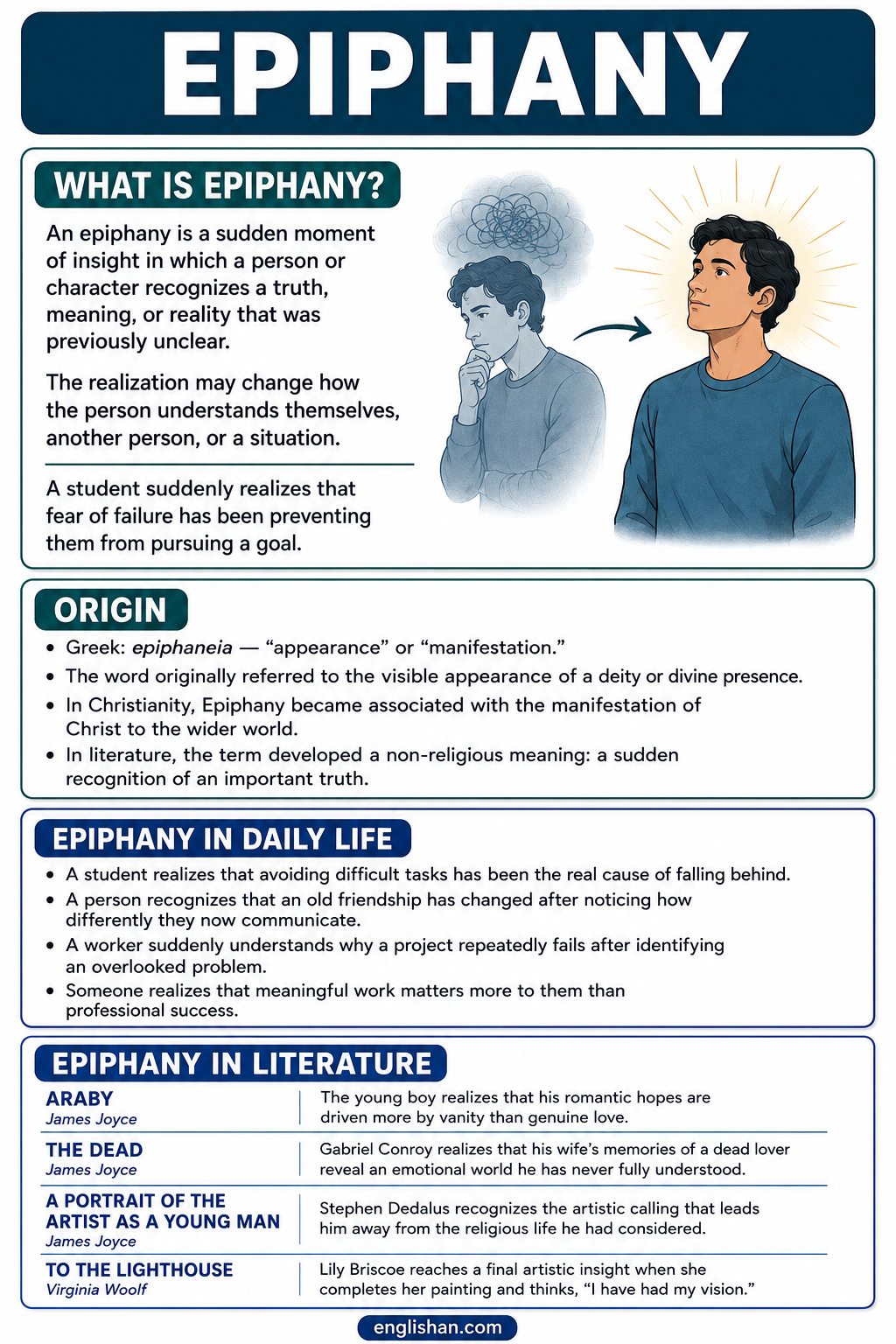
Ancient Greek used epiphaneia for the appearance of a god to a mortal. The noun comes from epiphainein, a verb meaning to show forth or bring to light. Early Christian writers borrowed the word for the feast now known as Epiphany, the day Christ’s divinity was made visible to the wider world.
Centuries later, English speakers and literary critics began using the same word for a private, non-religious version of that experience. In that sense, an ordinary person or a fictional character suddenly perceives a truth that had been in plain sight all along. The Christian sense, the literary sense, and the everyday sense all trace back to one Greek word for something hidden coming into view.
Epiphany as a Literary Device
In fiction, an epiphany is the moment a character suddenly understands something that changes how they see their situation, another person, or themselves. Two traits set it apart from an ordinary realization. First, it arrives without warning rather than through a slow buildup of evidence. The character does not reason their way to the truth so much as arrive at it in an instant.
Second, the trigger is small and ordinary rather than dramatic. A glimpsed face, a stray remark, a fall of snow, or a piece of music can be enough. The mismatch between that tiny cause and the large understanding it produces makes the device memorable.
An epiphany does not have to change what happens next in the plot. It can be the story’s climax, the turning point, while every outward event stays in place. A character can reach one and take no visible action at all, closing the story on a shift that exists only inside their own head.
That inward, private quality is why the device suits fiction about thought and perception rather than outward events. It also explains why the term became attached to modernist writing, the early twentieth-century fiction of Joyce and Woolf, rather than to storytelling in general.
William Wordsworth described an early version of the idea in The Prelude, where he called such moments spots of time. He meant charged instants from memory that keep a restoring power over the rest of a life. A small remembered scene that suddenly gains great weight is close to what later writers would call an epiphany. Wordsworth himself never used that word.
James Joyce and the Epiphany
James Joyce is the writer most responsible for turning epiphany into a working term for fiction. In Stephen Hero, an early and unfinished draft of what became A Portrait of the Artist as a Young Man, Joyce has his character Stephen Dedalus define it as “a sudden spiritual manifestation, whether in the vulgarity of speech or of gesture or in a memorable phase of the mind itself.”
Stephen ties the idea to Thomas Aquinas’s three conditions for beauty: wholeness, harmony, and radiance. In his argument, an object reveals itself fully and becomes radiant in one sudden instant of perception, not through gradual study.
Joyce kept notebooks of these moments himself, drawn from overheard scraps of speech and small street scenes around Dublin. Roughly forty of his recorded epiphanies survive. He never published them as a separate collection. Instead, he used the technique in his fiction to close stories and chapters on private recognition instead of outward resolution.
That choice made epiphany part of the standard vocabulary of criticism. Readers now use the term for any character’s sudden moment of clarity that the fiction shows rather than announces.
Epiphany Examples in Literature
Araby, From Dubliners
A young boy has a crush on a neighbor’s older sister. He crosses the city to a bazaar to buy her a gift, convinced the errand means as much as he feels it does. Standing under the darkened stalls near closing time, listening to the hollow flirting of two English clerks, he suddenly sees his own devotion as foolish and small.
The story closes with his own description of the moment: gazing up into the darkness, he sees himself as a creature driven and derided by vanity. Joyce plants the clerks’ idle chatter and the darkening hall earlier in the story as quiet foreshadowing, so the collapse feels earned rather than sudden for its own sake.
The Dead, From Dubliners
At a family party late in the story, Gabriel Conroy overhears his wife Gretta recall a young man who once loved her and died young.
Alone with her afterward, Gabriel watches snow fall over the city and over the graveyard where the boy is buried. He arrives at a quiet understanding of his own smaller place in her inner life. He also sees how thin the line runs between the living guests downstairs and the dead he has barely thought about all evening.
His realization is mixed with nostalgia for a past he was never part of. The final image depends on juxtaposition, setting the party’s living guests against the dead who, Gabriel now understands, never fully leave.
A Portrait of the Artist as a Young Man
Walking along a beach, Stephen Dedalus watches a girl standing alone in the tide, her skirt hitched and her face turned toward the sea. The sight convinces him in an instant that his calling is art, not the priesthood he had been considering.
Critics call this the bird-girl scene. Joyce presents the girl as a piece of symbolism, written almost entirely to trigger Stephen’s recognition rather than to develop as a character in her own right.
To the Lighthouse, by Virginia Woolf
Woolf worked with a related idea she called moments of being, and the best-known example closes her novel. The painter Lily Briscoe, struggling for years to finish a single canvas, adds one last brushstroke and thinks, I have had my vision. Woolf’s version replaces Joyce’s sudden collapse of self-image with a slower, earned arrival. It shows that the device can end a story on quiet completion as well as on shame.
Epiphany vs Anagnorisis
Anagnorisis is Aristotle’s term from the Poetics for the recognition scene in Greek tragedy. It names the moment a character discovers a hidden fact, most often their own identity or the identity of someone close to them. Oedipus learning that he has killed his father and married his mother is the model case. Aristotle rated tragedies highest when the recognition arrives at the same instant as a reversal of fortune, which he called peripeteia.
In Greek tragedy the discovery often arrives only after hubris has already set the character’s downfall in motion, so the recognition explains the ruin rather than preventing it.
Epiphany, as later critics and writers use it, is a looser and more private term. It rarely depends on a hidden fact about identity or the past, and it does not require a matching reversal of circumstances. A Joyce character can have one and go home unchanged on the outside.
Anagnorisis is a matter of plot; epiphany is a matter of perception. The gap between the two is one of the sharpest dichotomies in narrative theory. One term measures what a character finds out; the other measures what a character suddenly sees.
Epiphany as a Sudden Realization
Outside fiction, epiphany describes any sudden flash of insight, closer to the everyday phrase an aha moment than to a literary technique. No author has to design the trigger, and no plot has to make room for it. A person driving to work, reading in bed, or standing in the shower can have one. The only requirement is that the understanding arrive all at once rather than build gradually.
The Roman writer Vitruvius recorded the oldest famous version of this feeling. The Greek mathematician Archimedes was trying to test whether a king’s crown was pure gold. He is said to have solved the problem the instant he stepped into a bath and watched the water rise. He then ran through the streets shouting eureka, meaning I have found it.
Modern psychology studies the same pattern under the name the eureka effect: the sudden, unexpected arrival of a solution after a problem has been set aside rather than worked at directly. Whether the setting is a laboratory, a relationship, or a career, this everyday sense keeps the Greek root’s original shape. Understanding is absent one moment and complete the next.
The Christian Holiday of Epiphany
In the Western Christian calendar, Epiphany falls on January 6. The feast marks Christ’s divinity being made known to the wider world, centered historically on the visit of the Magi. These Wise Men brought gifts to the infant Jesus and revealed him to people outside the Jewish community he was born into. Theologians call a visible appearance of God to people a theophany, and the feast celebrates one.
Eastern Orthodox churches center the feast on Christ’s baptism in the Jordan River instead. Many Orthodox communities observe it on January 19 under the Julian calendar. Twelfth Night, the evening of January 5, marks the close of the twelve days of Christmas and leads directly into the feast the next morning.
Regional customs observed on the day vary widely:
- Spain and much of Latin America: The day is celebrated as Three Kings Day, with children receiving gifts from the Reyes Magos rather than from Santa Claus.
- Italy: A figure called La Befana delivers small gifts or lumps of coal to children on the eve of the feast.
- Ireland: The day goes by the older name Women’s Christmas, and taking down Christmas decorations before it arrives is considered bad luck.
- Greece: Priests bless local waters, and swimmers compete to retrieve a cross thrown into the sea or a river.
How to Recognize an Earned Epiphany in a Story
A sudden realization on the page does not, by itself, prove that a story earned it. A character pauses, announces a revelation, and the plot resolves right on schedule. Yet the moment falls flat because nothing before it pointed there. To tell an earned epiphany from a convenient twist, trace the moment backward through the pages that led to it rather than judging it on its own.
An earned epiphany uses details and tension the writer prepared earlier, without calling attention to them at the time. A remark dropped in an early chapter, an object mentioned once and never explained, or a habit a character repeats without noticing all return at the instant of recognition and give it weight.
An unearned one arrives with none of that groundwork behind it. The character understands something the story never built toward. The insight exists only to resolve the plot, not to complete a line of perception the reader has been following.
Go back through the pages before the moment and look for the seed. If it is there, the realization grows out of the story; if it is not, it was placed there to end the story.
For a writer building toward a moment like this, two conditions have to exist before the character ever reaches it. The first is a blind spot: some belief, habit, or misreading of another person that the character holds from the opening pages. The narrative lets the reader notice it long before the character does.
The second is a triggering event: a scene, image, or line of dialogue late in the story that makes the blind spot impossible to keep ignoring.
Neither condition works alone. A blind spot without a trigger leaves the character unchanged to the last page. A trigger without an established blind spot sounds like an announcement rather than a discovery, since the reader has no earlier pattern to measure it against.
✅ In Araby, the narrator’s crush is established early, and the narration treats it with warmth bordering on foolishness. When the bazaar’s hollow flirting exposes the gap between his devotion and its object, the recognition completes a pattern the story set up from its first paragraph.
❌ Picture a story where a character spends thirty pages pursuing a promotion with no doubt about the choice, then declares on the final page that ambition was hollow all along. Without an established blind spot or a scene that forces the reckoning, the declaration reads as the writer’s message rather than the character’s discovery.
FAQs
Epiphany names a sudden, complete understanding of something that had been hidden until that moment. The word comes from the Greek epiphaneia, a manifestation or appearance. English still applies that root to three related uses: a divine appearance, a character’s flash of insight in fiction, and an everyday aha moment about ordinary life.
In literature, an epiphany is a moment when a character suddenly grasps something about their situation, another person, or themselves, triggered by a small, ordinary detail rather than a major event. James Joyce is the writer most closely associated with the technique. He used it to close several stories in Dubliners and a decisive scene in A Portrait of the Artist as a Young Man.
Anagnorisis is Aristotle’s term for a plot-driven recognition scene in Greek tragedy, centered on a hidden fact about identity and paired with a reversal of fortune. An epiphany is a quieter, more private realization that does not need to expose a hidden fact or change a character’s outward circumstances at all.
Joyce adopted the term in his early manuscript Stephen Hero and defined it there as a sudden spiritual manifestation in speech, gesture, or thought. He then used the technique in his published fiction, most notably in Dubliners and A Portrait of the Artist as a Young Man. Those books made epiphany a standard term for a character’s sudden insight.
The Christian holiday of Epiphany falls on January 6 and marks Christ’s divinity becoming known to the wider world. Western tradition centers the feast on the visit of the Magi to the infant Jesus. Eastern Orthodox churches instead emphasize Christ’s baptism, and many observe the feast on January 19 by the Julian calendar.