Hyperbole is deliberate exaggeration, and a listener who believes it has misread it. Because a speaker who calls a bag heavy as a ton expects nobody to check, that expectation is the whole difference between hyperbole, a lie and an honest mistake.
What Is Hyperbole?
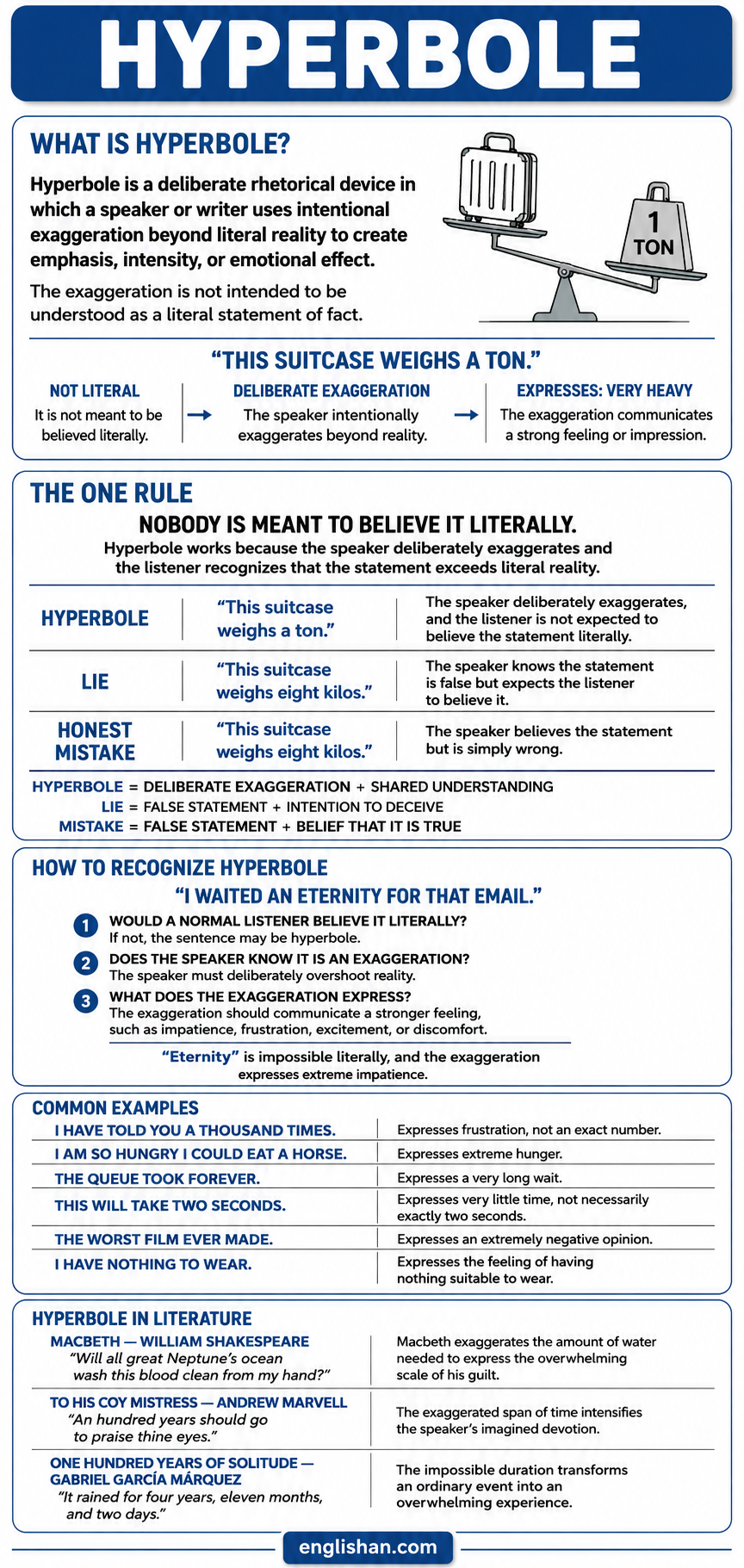
Hyperbole is an overstatement made on purpose, past the point where a listener would read the words literally. Because it reports feeling rather than fact, I have told you a thousand times measures frustration rather than occasions.
- I have told you a thousand times. ✅
- I told you three times last week. ❌ A number a listener can check is meant to be believed, so this reports last week rather than exaggerating it.
The One Rule: Nobody Is Meant to Believe It
In every genuine hyperbole, the speaker overstates on purpose, the listener discounts on cue, and each side knows the other’s move. Run it on three false statements about one suitcase, and only one survives as a device.
- This suitcase weighs a ton. ✅
- This suitcase weighs eight kilos, from a speaker who weighed it at twenty-two. ❌ The listener is meant to believe the figure while the speaker knows better, which makes the sentence a lie.
- This suitcase weighs eight kilos, from a speaker who never weighed it at all. ❌ This speaker believes the claim, so a wrong guess is a mistake rather than a device.
Call it the shared-discount rule, which governs every hyperbole in English: belief at face value puts a statement outside it.
Most often, learners go wrong by calling any false statement hyperbole, since falseness alone never makes a device: the speaker has to want the exaggeration noticed.
How to Test Any Sentence for Hyperbole
Take I waited an eternity for that email.
Would a normal listener accept it at face value? Hyperbole needs a refusal, so a listener who accepts it has heard none.
Does the speaker know the statement overshoots? A speaker who believes the claim has made a mistake rather than a figure of speech.
And what does the overshoot measure? Every overshoot trades a fact for a feeling, and the feeling matters more than the number.
On all three counts the email sentence passes: nobody waits an eternity, the speaker knows it, and the eternity measures impatience.
- The concert was so loud I lost my hearing. ✅ Concerts damage hearing, so the claim looks checkable. Total hearing loss still overshoots too far to accept, and the overshoot measures discomfort.
- He earns a fortune. ❌ A listener accepts the claim without strain, so the speaker is reporting a large salary rather than exaggerating one.
In practice the first question is enough.
Where the Word Hyperbole Comes From, and How to Say It
Hyperbole came into English from Greek, where huperbolē joins huper, meaning beyond, to ballein, meaning to throw, so the word means a throw that goes past its target.
Because Greek pronounced that final e as a full vowel, the word has four syllables: hy-PER-buh-lee, stressed on the second and rhyming with Kimberley. Even so, English spelling rules mislead learners into hyper-bowl.
As an adjective, hyperbolic describes speech of that kind, not the hyperbolic curve in geometry, which borrowed the same root.
The Frames That Carry Hyperbole in English
In English, speakers rarely invent hyperbole sentence by sentence. Instead they repeat five fixed frames, each a pattern with one open position.
| Frame | Pattern | Example |
|---|---|---|
| Result clause | so ___ (that) I ___ | so hungry I would eat a horse |
| Inflated number | a million / a thousand / a ton | I have asked you a million times |
| Endless time span | forever / for ages / for years | the queue took forever |
| Absolute quantifier | never / always / everyone / nobody | you never listen to me |
| Superlative plus ever | the ___-est ___ ever, in the world | the worst film ever made |
Across all five, the frame swaps a measurable quantity for an unmeasurable one, so the reader expects no measurement.
- So tired I would sleep standing up.
- I have asked you a million times.
- The lecture lasted forever.
- You never listen to me.
- That was the worst film ever made.
Change one number and the frame breaks.
- I have asked you six times. ❌ A precise number is meant to be checked, which drops the sentence out of hyperbole and into report.
Frames stack, and I have been waiting a thousand years puts an inflated number on an endless span.
Hyperbole That Shrinks: Exaggerating Toward Zero
Learners assume hyperbole only grows, while half of everyday English shrinks instead. Such shrinking builds I have literally nothing to wear, said of a full wardrobe.
In reverse, downward hyperbole reuses the same frames: the absolute quantifier becomes nobody, nothing or not a single, and the time span shrinks to a second or no time at all.
- I have literally nothing to wear.
- Nobody ever helps me with this.
- This will take two seconds.
In everyday use, upward hyperbole reads as colour, whereas downward hyperbole can sound like an accusation against someone present. That accusation follows when a learner chooses nobody ever helps me, while this always takes ages stays safe. Either way, direction changes the social effect more than size.
Hyperbole vs Understatement, Litotes and Meiosis
For the same heavy box, three sentences each need a different adjustment from the listener. Hyperbole overstates that weight, so the listener scales it down, while understatement and litotes go under it and the listener scales back up.
- It weighs a ton.
- It’s a bit heavy.
- It’s not exactly light.
Understatement is the whole family, while meiosis and litotes are two ways of understating. Meiosis picks a smaller word, as when a speaker calls a wound a scratch, and litotes denies the opposite, as in not bad.
Because all three run the shared-discount rule with the direction reversed, they stay in one family with hyperbole.
Hyperbole vs Simile and Metaphor: Both at Once
As tall as a skyscraper is a simile and a hyperbole at once. The word as makes it a simile, and the impossible height makes it a hyperbole.
Elsewhere, a metaphor states an identity rather than a comparison, personification lends the wind a human voice, and sarcasm belongs to irony. Those three double up with hyperbole:
- My brother is a walking encyclopedia.
- The wind screamed all night.
- Oh, brilliant, another meeting. Sarcasm and hyperbole appear together more often than any other pair, and this line is both at once.
Between them, simile and metaphor describe how the sentence is built, while hyperbole describes how far past the truth it goes. Name both when both apply.
Dead Hyperbole: When the Exaggeration Stops Being Felt
I’m starving looks like hyperbole and no longer works as one. Native speakers no longer compute starving, freezing, ages, tons of and dying to as exaggeration, because the phrases have lexicalised, hardening the exaggerated sense into an ordinary one.
Once the phrase hardens, a listener accepts I’m starving at face value, since the words now mean very hungry.
- I’m starving. ❌ No exaggeration registers at all, so calling this hyperbole describes the phrase’s history, not its effect.
- I’m hungry enough to eat the tablecloth. ✅
Literally has changed the same way, and that sense is now standard. I literally died claims no more than I’m starving.
Over time, most dead hyperboles have become idioms, and till the cows come home is both at once, since a frozen phrase keeps the original shape.
Live hyperbole is invented on the spot, while dead hyperbole comes ready-made. A listener feels nothing at a ready-made phrase.
Adynaton and Auxesis: Two Named Kinds
An adynaton claims something impossible rather than something merely enormous, and its Greek source means not possible.
- When pigs fly.
- Till the cows come home.
- I’d sooner die.
None of the three inflates a quantity, and the impossibility alone measures the feeling.
Does the statement exaggerate an amount or rule out a possibility? An amount inflates in I have told you a million times, whereas when hell freezes over rules the possibility out. Ruling out a possibility leaves an impossibility rather than a contradiction, which keeps adynaton apart from a paradox and an oxymoron.
Auxesis, from the Greek for growth, is hyperbole built by ascending steps: a delay becomes late, then unforgivably late, then late enough to end a friendship. The same climb fits inside one word, when a disagreement becomes a war.
Together, adynaton and auxesis each sharpen something the word hyperbole leaves vague.
Hyperbole in Advertising, and Why Puffery Is Legal
In advertising, four slogans claim more than any company would defend before a judge.
- The Ultimate Driving Machine.
- The Best a Man Can Get.
- The Happiest Place on Earth.
- Red Bull gives you wings. Wings fall outside possibility, which makes this an adynaton rather than a product claim.
In consumer law, advertising of that kind survives false-advertising claims as puffery, for one reason: no reasonable consumer would read it as a claim of fact. That reason restates the shared discount in law.
Still, protection stops where a measurable claim starts. That boundary appeared in 2014, when Red Bull settled a United States class action over performance claims: performance admits measurement, wings do not.
Beyond the overstatement, advertising appeals to feeling, so hyperbole and pathos run together through most campaigns.
Hyperbole in Political Speech: Where the Rule Breaks
Political speech breaks the discount more than any other setting, because the audience never agrees about the speaker. That audience splits in two: supporters hear colour and opponents hear a claim, so the same sentence reads as hyperbole for one group and as a lie for the other.
When President Kennedy promised to pay any price and bear any burden, no listener costed it. A promise that no citizen will ever pay another cent in tax draws the opposite reaction, since part of the audience expects it kept.
In the United States, courts have treated alarming statements at rallies as political hyperbole rather than threats, because the crowd laughed rather than believed.
In the market, puffery succeeds because the discount applies to everyone, whereas political overstatement fails where a speaker counts on part of the audience believing.
What English Learners Get Wrong With Hyperbole
Learner hyperbole fails in the gap between what the speaker meant and what the listener heard.
| What the learner said | What the learner meant | What the listener heard |
|---|---|---|
| Your food is always terrible. | mild dislike of one meal | a flat insult |
| Nobody in this office ever helps me. | I wanted more help today | an accusation against colleagues |
| This essay proves the theory beyond all doubt. | strong support | overclaiming in academic writing |
| I am dying to see it, said with no stress | excitement | a puzzling remark |
Where a learner means the claim literally, the device is cancelled and a plain opinion remains.
In speech, delivery matters as much as the words: speakers stress the exaggerated word, lengthen it and lift the pitch, whereas a flat tone leaves I am dying to see it plain.
On the page, academic essays, lab reports and professional emails discount nothing, so the data proves the theory beyond all doubt reads as a fault in reasoning.
Where a speaker exaggerates every sentence, the discount wears out: listeners stop scaling the claims back and start distrusting them.
At the other end, dead phrases sound like live exaggeration to a learner, and avoiding I’m starving removes an ordinary expression.
From the other side, a listener needs the same rule, and owes sympathy for I waited forever rather than a count.
Hyperbole in Literature: Five Worked Passages
Across five passages, writers build a whole scene out of one impossible claim, each on a frame from the table.
Shakespeare measures guilt by volume of water in Macbeth.
Will all great Neptune’s ocean wash this blood Clean from my hand?
In those two lines Macbeth sets the ocean as his unit and then reverses it: his hand would redden the seas, and guilt outgrows the world.
Andrew Marvell inflates courtship time in “To His Coy Mistress”.
An hundred years should go to praise Thine eyes, and on thy forehead gaze
Marvell builds those centuries in order to withdraw them, and the poem turns to how little time remains.
Auden chooses an adynaton in “As I Walked Out One Evening”.
I’ll love you, dear, I’ll love you Till China and Africa meet
Instead of a large number, Auden picks an impossible event, and continents that never meet fix the term more firmly.
Gabriel García Márquez attaches exact figures to an exaggeration in One Hundred Years of Solitude.
It rained for four years, eleven months, and two days.
Here precision blocks dismissal: readers accept the rain as fact while knowing no rain lasts that long, so exactness sharpens the overstatement.
Harper Lee builds a whole town out of absolute quantifiers in To Kill a Mockingbird.
There was no hurry, for there was nowhere to go, nothing to buy and no money to buy it with.
Nowhere, nothing and no money run one frame three times over, and the downward direction stretches across the sentence.
Writing Your Own Hyperbole: Calibration, Not Volume
When you write one yourself, the overstatement has to exceed belief and stay picturable. Exceeding belief triggers the discount, and a reader who sees nothing feels nothing.
- I was very, very, very tired. ❌ Repetition raises the volume without raising an image, so the reader receives emphasis and no picture.
- I was tired enough to fall asleep standing up in the lift. ✅
By setting, fiction, speech, comedy and advertising discount freely, while contracts, lab reports and academic essays discount nothing. That choice belongs to diction, where hyperbole falls at the informal end.
A frozen phrase like raining cats and dogs costs a line its effect, since the discount fires automatically and no picture forms. Replace it with an invented one.
Ask the three questions of your own line: failing the first rules out hyperbole, and failing the third leaves decoration.
Frequently Asked Questions
Q1. What is hyperbole?
Hyperbole is deliberate exaggeration that nobody is meant to believe. Under that definition the speaker overstates on purpose, the listener discounts automatically, and each side knows the other’s move.
Q2. What is an example of hyperbole?
A standard example is I’m so hungry I would eat a horse, where the impossible amount measures the hunger. Another, I have told you a million times, replaces a real quantity the same way.
Q3. How do you pronounce hyperbole?
Hyperbole has four syllables with the stress on the second: hy-PER-buh-lee. That final e comes from Greek, where it sounded as a full vowel. Yet English spelling rules mislead readers into hyper-bowl.
Q4. Where do you draw the line between hyperbole and lies?
Hyperbole overstates something the audience will not accept, while a lie states something the speaker wants accepted, so the line falls at belief. A speaker who profits from the listener believing has crossed it.
Q5. What is the difference between hyperbole and a simile?
A simile compares two unlike nouns with like or as, whereas hyperbole exaggerates past belief, so one describes form and the other degree. One sentence can be both, since as tall as a skyscraper compares and overstates.
Q6. How is hyperbole different from a metaphor?
A metaphor states that one thing is another, while hyperbole overstates a quantity, degree or possibility. Neither excludes the other, so my brother is a walking encyclopedia is both.
Q7. What’s the difference between hyperbole, litotes, and meiosis?
The difference lies in direction and method. Hyperbole overstates, while litotes and meiosis understate. Meiosis then picks a smaller word, and litotes denies the opposite, as in not bad.
Q8. Can hyperbole appear in formal writing?
No, not in academic essays, lab reports or contracts, where readers discount nothing and an overstatement reads as imprecision. Instead of the data proves beyond all doubt, write the data strongly supports, though speeches and opinion columns discount freely.
Q9. Is hyperbole always meant to be funny?
No, and comedy covers only one of its uses, which run from dread to devotion: Macbeth overstates for horror, a love poem for adoration, and a complaint for exasperation.
Q10. What is the difference between hyperbole and exaggeration?
Hyperbole is exaggeration marked as a figure of speech, with the audience expected to notice and discount it. Plain exaggeration runs wider, since it admits overstatements meant to be believed, like a padded job application.