Litotes affirms something by denying its opposite: not bad means good, no small feat means impressive. The denial works deliberately, and it never lands exactly where the plain word would, which is the whole reason a speaker chooses it. The Greek behind the name says as much: litos, plain or simple.
What Is Litotes
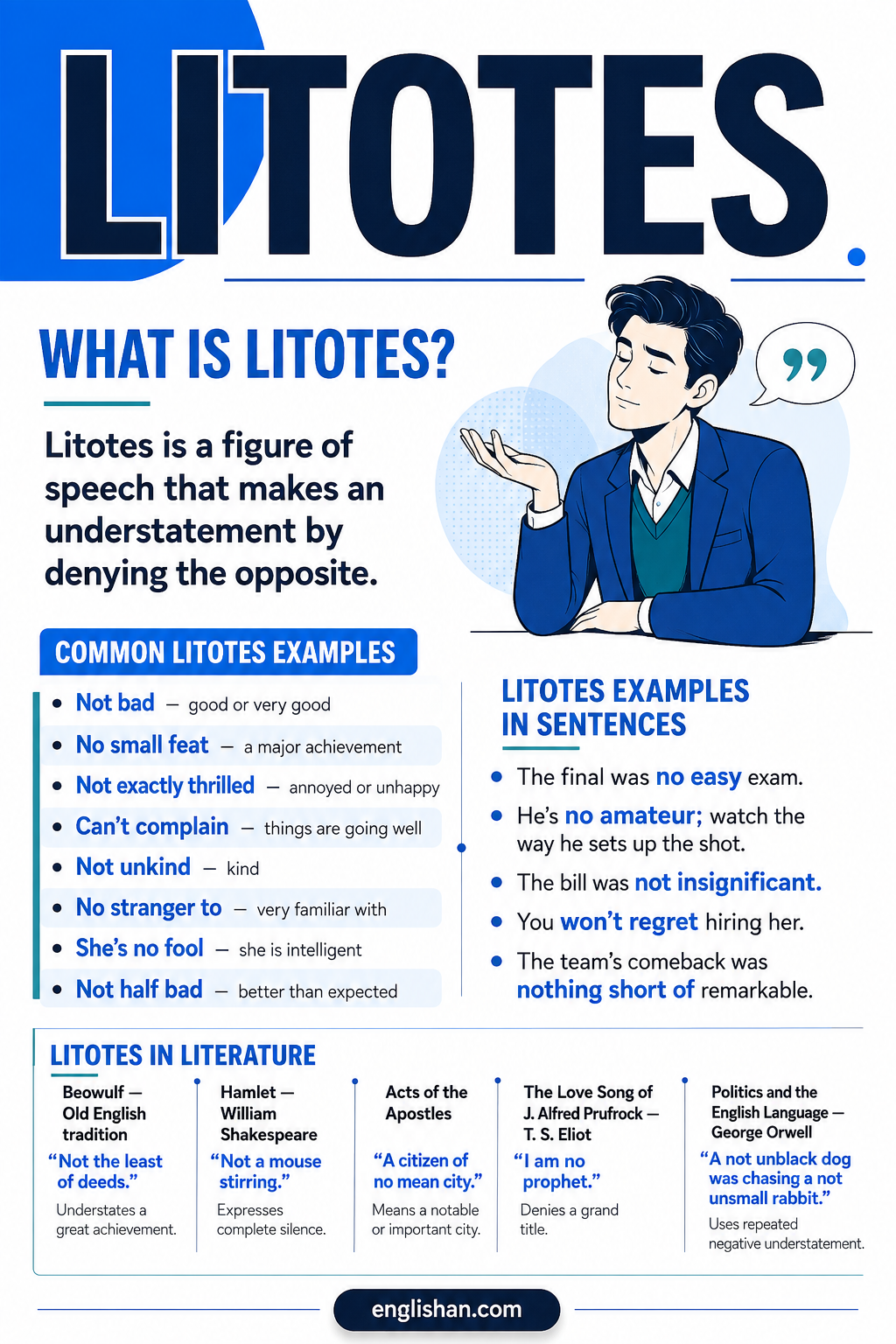
Litotes is a figure of speech in which something is affirmed by denying its opposite, as in not bad for good.
English took the word from Greek litotēs, meaning plainness, built on litos, plain or simple. The first recorded English use dates to 1589, and the name fits: praise that arrives dressed down.
Singular and plural at once: litotes is a figure of speech, one instance is a litotes, and two of them are still litotes. The final s comes from the Greek, not from an English plural, and the word never becomes litote.
The two negatives do not cancel: not unkind does not resolve to kind, and treating the device as arithmetic misses what the speaker is doing. Not uncommon means more frequent than expected, while conceding that the thing is still not everyday. Not unworthy dispels a doubt without claiming merit outright. Merriam-Webster makes the same reading: these constructions express something deliberately different from the plain positive.
A speaker who meant kind had the word available and declined it, and the gap between the two wordings is what the reader is meant to notice. Choosing the longer route signals restraint, or hesitation, or a doubt now being dismissed, and the listener reads all of that from the detour.
Delivery sets the distance: not bad from a coach after a personal best means excellent. The same two words from an examiner mean adequate and no more. The construction fixes the direction, and delivery fixes how far.
Rhetoric places the device in two categories at once. It counts as a form of understatement, because it says less than it means. Wikipedia also classes it as a form of irony, since the surface wording and the intended sense pull apart. Both labels are correct, and neither competes with the term.
How To Pronounce Litotes
Say it LIE-tuh-teez, three syllables with the stress up front. Dictionaries also record lie-TOH-teez, with the stress in the middle, and both are standard. The final -tes says teez, exactly as in diabetes.
The word defeats most first readers because the eye wants lit-oats, and nothing in English spelling warns against it. One rehearsal out loud fixes it permanently, which is more than can be said for most rhetorical terms.
Types Of Litotes
English forms litotes six ways, and each construction denies something different.
| Construction | The pattern | Two examples |
|---|---|---|
| Negated opposite | not plus the antonym of what is meant | Not bad, not the warmest posting |
| Not un- | not plus a word that already has a negative prefix | Not unkind, not unusual |
| No plus noun | no plus a diminishing noun | No small feat, no fool |
| Hardly and scarcely | a near-negative adverb doing the denying | Hardly a secret, scarcely a surprise |
| Far from | distance standing in for denial | Far from perfect, far from over |
| Negative verb | won’t, can’t or wouldn’t plus a negative outcome | Can’t complain, won’t be sorry |
The not un- row deserves a warning, because it is the pattern that goes wrong most. Two negative morphemes in three syllables strain the reader, and stacking them collapses the sentence entirely, which is what Orwell’s famous cure was written against.
Litotes Examples
A handful of fixed phrases move the device through ordinary English, and most speakers use them without ever naming the mechanism.
- Not bad: good, and the commonest litotes in the language
- No small feat: genuinely difficult, and accomplished anyway
- Can’t complain: all is well, and I decline to elaborate
- Not exactly thrilled: unhappy, phrased for a room that is listening
- She’s no fool: shrewd, with a warning attached
- Not half bad: better than expected
- No picnic: hard going
- Far from perfect: flawed, said kindly
Litotes Examples In Everyday Speech
Conversation uses the device whenever a plain word would cost too much. A colleague who calls a proposal not unreasonable has agreed without endorsing. A doctor reporting that a scan is not encouraging has delivered bad news at a pace the patient can absorb. A cook who says the sauce needs a little something has criticised nothing while changing everything.
Three patterns repeat across spoken English.
- Declining without refusing: I wouldn’t say no to a coffee accepts while leaving the host an exit
- Praising without gushing: you’ve done a decent job there from someone who means the opposite of faint
- Warning without accusing: that’s not the safest route home moves a whole argument into one negative
Litotes Examples In Literature
Beowulf, translated by Seamus Heaney
“Hildeburh had little cause / to credit the Jutes” reports that she had every reason to condemn them. The poem hands its grief to the reader by refusing to state it, and that refusal is the Anglo-Saxon manner throughout.
Hamlet by William Shakespeare
“Not a mouse stirring” opens the play on the battlements. Total silence, delivered through one small denied rodent, and the smallness is what makes the stillness feel enormous.
Acts of the Apostles, 21:39
Paul calls himself “a citizen of no mean city”, claiming greatness for Tarsus by denying its lowliness. The line has served as the classroom exhibit for two thousand years and still works.
The Love Song of J. Alfred Prufrock by T. S. Eliot
“I am no prophet” measures Prufrock’s deflated self-regard against the grand title he declines. Eliot lets the refused word do the describing.
For a hundred more written out as full sentences, work through this collection of litotes examples.
Why Speakers Use Litotes
Modesty: I know a little about engines, from the person rebuilding one, earns more trust than any boast. The gap between the claim and the evidence is what the listener reads as expertise.
Diplomacy: the numbers are not encouraging survives a boardroom that the numbers are disastrous would detonate. Same news, different temperature, and only one of the two lets the meeting continue.
Irony: that could have gone worse, said after a catastrophe, lets the speaker acknowledge the damage and keep a straight face at the same time.
Composure: understatement reads as control. A character who denies the opposite instead of shouting the claim sounds like someone with the situation in hand, which is why thriller dialogue and academic prose both use it heavily.
British English uses it hardest of all. A bit of a problem describes a crisis, not ideal describes a disaster, and I’ve had better describes a genuinely terrible day. Visitors regularly misread the severity of what they have just been told. The habit involves more than politeness. Refusing to overstate is a way of demonstrating that the speaker is not rattled.
How To Spot Litotes In A Sentence
Three questions, run in order, settle any candidate.
1. Is there a negative at all? The device cannot exist without one. A bit warm during a heatwave is understatement, but no word has been denied, so the label does not apply. If nothing is negated, stop here.
2. Does the negative attach to the opposite of what is meant? In she’s no fool, the denied word is fool and the intended sense is shrewd. The two occupy opposite ends of one scale, which is the signature. In I don’t have a car, the negative attaches to a plain fact and nothing is being affirmed underneath.
3. Does the result affirm something the plain word would have said differently? Not unkind affirms a kindness held slightly at arm’s length. If the sentence affirms nothing, the negation is doing ordinary grammatical work.
Run it on the trip was not exactly restful. A negative is present, restful is the opposite of what happened, and the sentence affirms exhaustion while sounding polite about it. Three yeses, so the label applies.
How Litotes Differs From Similar Devices
Five devices come close enough to be confused with litotes, and each differs from it on a different axis.
| Device | What it does | Test example |
|---|---|---|
| Litotes | Affirms by denying the opposite | No small feat |
| Understatement | Says less than is meant, negation optional | A bit warm |
| Meiosis | The general category of understatement | Calling a surgeon a knife guy |
| Irony | Surface wording and intent pull apart | That went well, after a disaster |
| Hyperbole | Overstates instead of understating | I’ve told you a million times |
Litotes vs Understatement
Every litotes counts as understatement, and most understatement does not count as litotes. The category outsizes the device.
Plain understatement shrinks a claim by any means available: a bit warm during a heatwave, a decent effort for a triumph, slightly damp for a flood. The device shrinks it one specific way, by negating the opposite: not exactly cool out, no small effort, not the driest week we have had.
A denied opposite settles the test, and it places the device inside the category rather than beside it.
Litotes vs Meiosis
Meiosis names the wider category of understatement. The device falls inside it as the member that works through negation, so the two nest rather than divide.
Britannica states it plainly: meiosis is the general term for understatement, and the device counts as a form of it. Treating the two as separate territories inverts the hierarchy, and an exam answer built that way loses marks.
The narrower use of meiosis names a belittling substitution, such as calling a transatlantic flight a hop. That still counts as understatement and as meiosis, but not as litotes, because nothing has been denied.
Litotes vs Irony
Verbal irony says one thing and means something else, frequently the reverse. That went well after a catastrophe means the opposite of its words.
Litotes performs a narrower operation. It denies the opposite of what it means, so the words point at the intended sense rather than away from it. Not bad does not reverse good; it reaches good by passing through bad on the way.
Rhetoric treats litotes as a form of irony because the surface and the intent separate. The separation is smaller and more controlled than in ordinary verbal irony, and it always works through a negative.
Litotes vs Hyperbole
Litotes and hyperbole work as exact opposites, which makes hyperbole the fastest way to fix the device in memory.
Hyperbole inflates: I’ve told you a million times, this bag weighs a ton. Litotes deflates: I’ve mentioned it once or twice, the bag is not the lightest. One exaggerates past the truth, the other stops short of it, and both leave the listener to find the real figure.
Writers who choose hyperbole by instinct produce energy. Writers who choose understatement produce authority. Neither is better, and the choice sets the whole feel of a passage. For the inflating half of the pair, work through these hyperbole examples.
Litotes vs Double Negatives
A grammatical double negative such as I don’t know nothing aims at a single negative and misfires, because standard English reads the two negatives as cancelling. It functions as an error in formal writing and as a legitimate dialect feature in several varieties of English.
Litotes aims two negatives at a deliberate affirmative and lands on purpose. Not unkind gets built, never stumbled into.
Intent makes the difference, and it shows in the result. One construction obscures its meaning; the other calibrates it.
A euphemism resembles the family without joining it. It swaps gentler vocabulary for a difficult truth, as in passed away for died, and needs no negation at all. He’s not with us anymore manages to be euphemism and litotes together, which is why obituaries use it so readily.
Mistakes To Avoid With Litotes
Stacking the negations: Orwell attacked the not un- habit in official prose in 1946 and prescribed a cure: memorise the sentence A not unblack dog was chasing a not unsmall rabbit across a not ungreen field. The sentence piles the device up until it collapses, and it ends the argument.
The not unhelpful manual was not unclear and not uninteresting. ❌
The manual was no small help. ✅
Reading it as cancellation: the commonest error in classrooms, and the one that produces wrong answers.
Not unhappy means happy. ❌
Not unhappy means somewhere short of happy, with unhappiness ruled out. ✅
Calling any double negative litotes: the negation has to attach to the opposite of what is meant.
I don’t know nothing is litotes, because it has two negatives. ❌
I don’t know nothing is a grammatical double negative, because nothing is being affirmed. ✅
Using it where clarity outranks style: safety instructions, medical dosage, legal obligation and emergency communication all need the plain word. A device built on making the reader work is the wrong instrument when the reader cannot afford to.
Related:
How To Use Litotes In Writing
One denial per compliment: the device costs the reader a small act of decoding, and two in a sentence doubles the price while halving the return.
Choose an antonym your reader already knows: not unlike works because unlike is common. Not unmalodorous fails because nobody keeps that word ready.
Match it to a speaker who would plausibly use it: the device signals restraint, so it suits the composed character, the cautious expert and the diplomat. On an excitable narrator it reads as an authorial intrusion.
Let the sentence do the measuring: since the construction fixes only the direction, the surrounding sentence has to tell the reader how far to go. Not bad alone is vague; not bad, considering he learned it last week is precise.
Litotes In Old English And Norse Verse
The device predates the English language and once carried far more weight than it does now.
Old English poetry and the Icelandic sagas both treat understatement as a mark of composure, and Britannica describes the result as a characteristic stoical restraint. A hero’s death, a battle lost, a family destroyed: the verse reports these by denying their opposites and leaves the emotion to the listener. Heaney’s Hildeburh had little cause to credit the Jutes is that manner in one line.
Old Norse verse used three constructions that modern English still has: denied negatives, denied positives, and a plainly negative adjective doing the affirming. The patterns in the table above are their descendants.
Old English restraint explains how the device reads today. Understatement in English has an inherited association with endurance and self-possession, which is why not ideal from a British speaker in a crisis sounds like control rather than evasion. The habit is a thousand years older than the stereotype.
Practice Spotting Litotes
Name the device in each line: litotes, plain understatement, hyperbole, or a grammatical double negative.
- That was no small achievement.
- This suitcase weighs a ton.
- It’s a bit chilly, said in a blizzard.
- I didn’t say nothing to anyone.
- She’s not unfamiliar with the procedure.
- The exam was far from easy.
- I’ve read that book a hundred times.
- You won’t be disappointed.
Answers: 1 litotes, no plus a diminishing noun. 2 hyperbole. 3 plain understatement, with no negation. 4 grammatical double negative, aiming at a single negative. 5 litotes, the not un- construction. 6 litotes, the far from construction. 7 hyperbole. 8 litotes, a negative verb plus a negative outcome.
FAQs
Litotes is a figure of speech that affirms a quality by denying its opposite. She’s no fool asserts shrewdness, and the trip was not exactly restful reports exhaustion through a polite negative.
Say LIE-tuh-teez, three syllables with the stress on the first. The variant lie-TOH-teez is also standard. The ending rhymes with diabetes.
Litotes is both. One instance is a litotes, and two of them are still litotes. The final s comes from the Greek rather than from an English plural ending, so litote is not a word.
Yes, and it ranks as the most common litotes in English. Bad is denied, and the listener reads an affirmation somewhere above it. Delivery decides how far above: not bad from a coach after a personal best means far more than the same words from an examiner.
Litotes is understatement achieved through a denied opposite, as in no small feat. Plain understatement shrinks the claim by any means, as in a bit warm during a heatwave. Every litotes counts as understatement, though most understatement does not qualify.
Verbal irony means the reverse of what it says, as in that went well after a disaster. Litotes denies the opposite of what it means, so the words point toward the intended sense rather than away from it. Rhetoric treats it as a narrow, controlled form of irony.
Litotes and hyperbole work as exact opposites. Hyperbole overstates, as in I’ve told you a million times. Litotes understates by negation, as in I’ve mentioned it once or twice. Both leave the listener to work out the real figure, from opposite directions.
Litotes is a controlled one. A grammatical double negative such as I don’t know nothing aims at a single negative and misfires. Litotes aims two negatives at a deliberate affirmative and lands exactly where the speaker intended.
Litotes delivers praise with modesty, criticism with diplomacy and irony with a straight face, and all three signal composure. The numbers are not encouraging says what a room can hear, which is a power the plain statement lacks.
Seamus Heaney’s translation gives “Hildeburh had little cause to credit the Jutes”, meaning she had every reason to condemn them. Old English verse used the device constantly, reporting grief and violence by denying their opposites.
You May Also Like