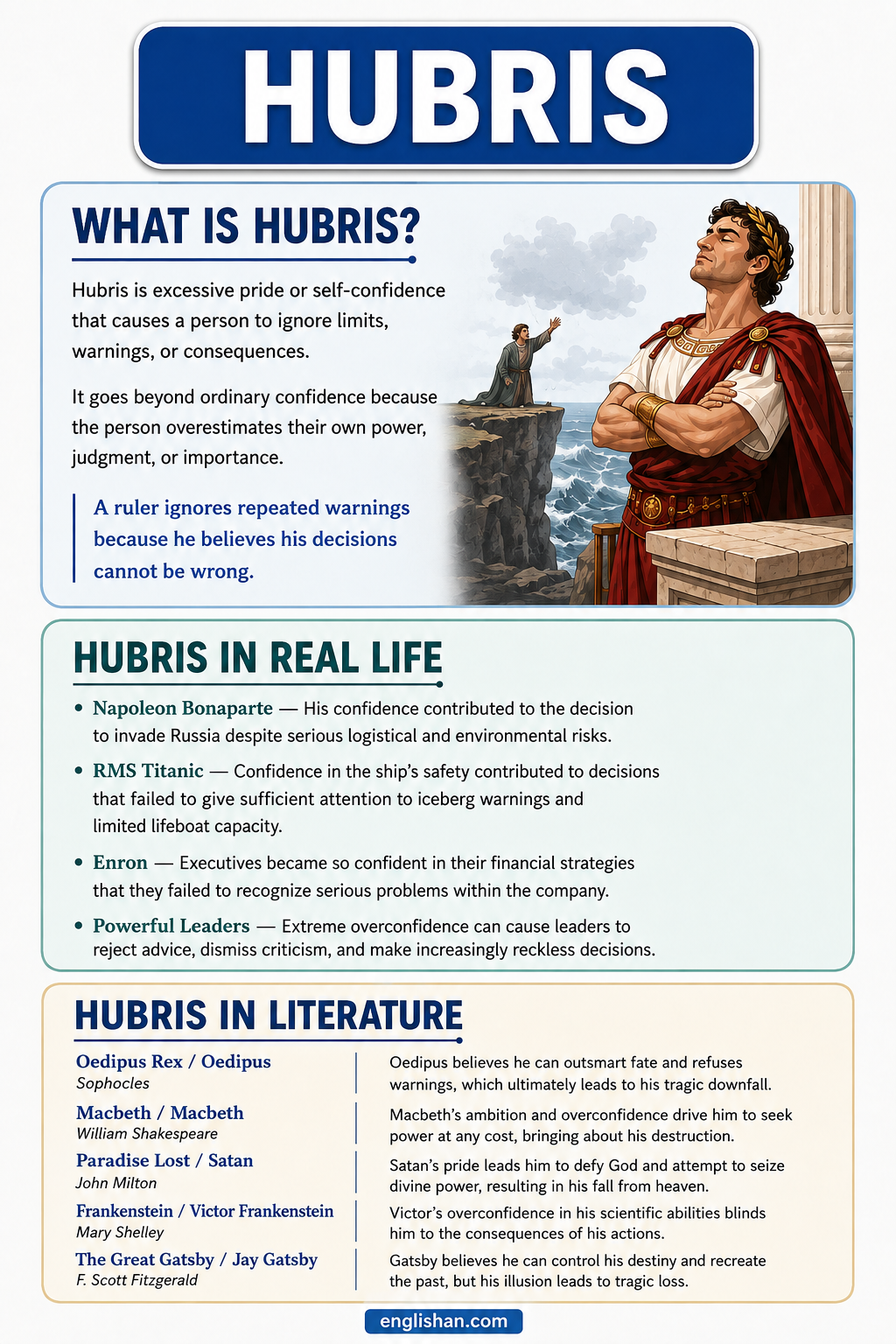
Hubris names a specific kind of pride: the excessive, boundary-breaking confidence of a person. That person believes the ordinary rules, warnings, or consequences that govern everyone else do not apply to them. The word already passes judgment on the person it describes. Ordinary pride stays in proportion to what a person has actually earned, while this kind pushes past that proportion until confidence turns into blindness.
A character or a real person acting on it ignores warnings and dismisses limits. They treat their own judgment as beyond question, and that refusal to see the truth is what brings them down.
English took the term from Greek tragedy, where it describes the exact pattern that ends a hero’s rise. In story after story, a figure of real ability or standing pushes past the line that separates human achievement from overreach, and the story punishes the crossing. That origin still decides what the word implies today. Calling an action hubris rather than confidence or ambition is already a verdict on where it leads.
Origin Of The Word Hubris
The Greek word hybris (ὕβρις) began as a legal term, not a literary one. In Athenian law, hybris named a public crime: an act meant to humiliate or dishonor another person through violence, insult, or public degradation. The offender did not need to gain anything from the act; the humiliation itself was the crime.
Athenian citizens could file a public lawsuit, a graphē hybreōs, against anyone accused of hybris. The city treated the deliberate humiliation of another person as an offense against the whole community, not just the victim.
Greek tragedians borrowed that legal weight and turned it toward the gods. On stage, hybris became the mortal version of the same crime: a human being claiming a status, power, or certainty that belonged only to the divine order.
A king convinced that fate answered to his own will committed hybris in this sense. So did a warrior who mocked a god’s power, and so did a craftsman who claimed skill equal to a deity. The insult was no longer against a neighbor but against the structure of the world itself, and Greek audiences understood that such a violation would not go unanswered.
Hubris In Greek Tragedy
By the time Aeschylus, Sophocles, and Euripides were writing for the Athenian stage in the fifth century BC, hubris had become the flaw at the center of tragedy. It marks the point where the tragic hero’s real strength hardens into certainty and the character stops checking judgment against reality. That strength takes the form of intelligence, courage, skill, or authority. The tragedy rarely punishes ability itself. It punishes the moment a character grows so sure of that ability that they stop listening.
Aristotle’s Poetics, written in the fourth century BC, gives the philosophical account of how this collapse works. For the fatal error itself, his word is hamartia, usually translated into English as the tragic flaw, rather than hubris.
Aristotle observed that the strongest tragedies turn on a single misjudgment that reverses the hero’s fortune, a shift he called peripeteia. With it comes a moment of recognition, anagnorisis, when the epiphany of the truth arrives too late to change the outcome.
Later readers of Greek tragedy, working from Aristotle’s framework, treat this excess of pride as the most common form that hamartia takes on stage. In that reading, it is a fatal misjudgment rooted specifically in overconfidence.
Hubris And Nemesis
Nemesis, the Greek goddess of righteous anger and retribution, is hubris’s natural consequence in Greek thought. Where a person’s pride outgrows their actual standing, nemesis restores the balance the Greeks called dike, or right order. The Greeks did not pair the two at random. Greek thought held that excess of any kind invited correction, whether in wealth, power, or pride. The gods personified that corrective force rather than leaving it to chance.
That belief explains why the pattern in tragedy so rarely goes unanswered. Icarus flies too high and falls. Oedipus insists on an investigation no one else wants pursued, and the truth destroys him. The pattern repeats because Greek audiences expected it: overreach brings on its own reversal. In Greek myth, nemesis names that reversal when it arrives with the weight of moral certainty behind it.
Watching a confident character walk straight toward a downfall the audience can already see coming is what gives Greek tragedy its dramatic irony. That irony is the gap between what the audience knows and what the hero, certain of himself, never stops to consider.
Hubris Vs Hamartia
Hamartia is the broader term, and hubris is one specific way hamartia shows up. Hamartia refers to any error of judgment, ignorance, or misreading of a situation that triggers a tragedy, and it does not always grow from pride. A character acts on facts that turn out to be wrong, misreads another person’s intentions, or makes a single mistaken choice under pressure. Yet none of those failures require arrogance.
Hubris narrows the broader category to one particular cause: the error exists because the character’s confidence has outgrown their actual knowledge or standing.
Oedipus’s hamartia is his refusal to stop investigating his own origins even as the evidence turns against him. Specifically, his own overconfidence produces that refusal: he is convinced that his intelligence makes him equal to solving a mystery the gods have already answered. Not every hamartia is hubris, though every downfall of this kind counts as hamartia.
Examples Of Hubris In Literature
Icarus
Daedalus built wings of feathers and wax for himself and his son Icarus. He warned the boy to fly a middle course, neither too low toward the sea nor too high toward the sun’s heat. Icarus, thrilled by flight, ignored the warning and climbed higher until the wax melted and he fell into the sea.
In later retellings, the wings themselves become lasting symbolism of hubris: a gift that works exactly as intended until pride pushes it past its design.
Oedipus, in Sophocles’ Oedipus Rex
Told by the prophet Tiresias to abandon his search for his father’s killer, Oedipus instead accuses Tiresias of conspiracy and presses forward. He is certain that his own reasoning will uncover a truth others are too afraid to face.
His reasoning is correct. The truth it uncovers, that he is his father’s killer and his mother’s husband, destroys him. And it does so precisely because his confidence never allowed for the possibility that he was already living inside the answer.
Macbeth, in Shakespeare’s play of the same name
Told that no man born of woman can harm him, Macbeth treats the foreshadowing of the witches as proof of his own invincibility rather than as the riddle it actually is. On that misplaced certainty he undertakes a campaign of murder he would never have attempted without it. It collapses the instant Macduff reveals he was delivered by cesarean birth, a technicality the prophecy never actually excluded.
Doctor Faustus, in Christopher Marlowe’s play
Faustus sells himself to the devil Mephistophilis for twenty-four years of unlimited knowledge and power, convinced his intellect can master what theology forbids and still escape the bargain’s terms. He spends his borrowed years on tricks and spectacle rather than the greatness he imagined, and when the contract comes due, his hubris has left him no genuine path to repentance.
Dr. Jekyll, in Robert Louis Stevenson’s Strange Case of Dr Jekyll and Mr Hyde
Dr. Jekyll trusts his own science to separate the evil half of his nature from the good and control it at will. Instead, the potion he brews gives that evil half a body of its own. The doppelganger he creates in Mr. Hyde is not a monster from outside himself but the direct result of his own overreach, and it eventually consumes him.
Jay Gatsby, in F. Scott Fitzgerald’s The Great Gatsby
Jay Gatsby believes that money and unrelenting will can undo time itself. Together, his fortune, his mansion, and his parties exist to recreate a version of the past in which he and Daisy never separated. That nostalgia grows into a certainty that reality will bend to match his memory. It does not, and the gap between the past he insists on rebuilding and the present he actually has to live in costs him everything.
Examples Of Hubris In Real Life
The pattern did not stay confined to the stage. Napoleon Bonaparte’s invasion of Russia in 1812 shows the same pattern at national scale. Confident in a military record that had already conquered most of Europe, he marched roughly 600,000 troops into Russian territory. He did so against the advice of officers who warned about supply lines and the coming winter. The retreat that followed destroyed the army and marked the beginning of his fall from power.
The RMS Titanic repeats the same story more quietly. Press coverage before its 1912 voyage promoted the ship’s sealed-compartment hull as making it one of the safest vessels ever built. That confidence stopped people from questioning the safety margins that actually mattered.
The ship carried lifeboats for roughly half its passengers and crew, and it kept its speed through a night of repeated iceberg warnings. The disaster followed from decisions made by people who had stopped treating caution as necessary.
Corporate history offers a similar case in Enron, the American energy company whose executives believed their financial engineering was too sophisticated to fail or to be questioned. That confidence concealed years of fraudulent accounting until the company collapsed in 2001, one of the largest bankruptcies in United States history at the time. It wiped out employee pensions and shareholder value, all of it dependent on a certainty that no one inside the company questioned anymore.
Modern psychiatry has given this pattern in leaders a formal name. The physician and former British Foreign Secretary Lord David Owen, working with the psychiatrist Jonathan Davidson, proposed the term hubris syndrome in a 2009 study. It describes leaders who have held power long enough to develop exaggerated self-confidence, restlessness, recklessness, and contempt for the advice of others.
The same motif connects Athenian tragedy to a modern clinical paper: a leader whose confidence no one questions eventually stops answering to anyone, reality least of all.
Hubris Vs Pride
Pride and hubris differ in degree rather than in kind. But the dichotomy between them decides how a story ends, not just how similar the two look on the surface. Ordinary pride matches what earned it. A person feels genuine satisfaction in an accomplishment that actually reflects their effort or skill, and that satisfaction rarely distorts their judgment about anything else.
Confidence works the same way when it stays realistic. A surgeon’s confidence in a procedure she has performed a thousand times matches that record, nothing more. It does not blind her to the one case that genuinely needs more caution.
By contrast, hubris breaks that proportion. It takes the same raw material, real ability or real success, and inflates it. From there, the inflation continues until the person stops distinguishing between what they have actually mastered and what they merely assume they can master.
Each word’s connotation marks the difference: pride and confidence read as neutral or admirable, while hubris never reads as a compliment. The juxtaposition that defines a hubris narrative is exactly this. A character’s quiet, earned strength is placed beside the loud, unearned certainty it hardens into once no one is left to question it.
How To Use Hubris In A Sentence
The word functions as an uncountable noun in English, so it never takes a plural form and rarely takes an indefinite article. In practice, writers commonly pair it with verbs of blindness or collapse, since the word already implies where the story is headed.
- The critics called the merger sheer hubris, a bet on unlimited growth no market was ever going to sustain.
- Blinded by it, the general refused to consider that his supply lines were about to fail.
- It was hubris, not bad luck, that convinced the captain to outrun the storm instead of avoiding it.
FAQs
In Greek tragedy, it means excessive pride that leads a character to overstep the limits placed on human beings, whether by defying the gods or by trusting their own judgment over every warning they receive. That overreach starts the tragedy moving and ends, in most surviving plays, in the character’s downfall.
The difference is proportion. Pride is satisfaction that matches what a person has genuinely earned or accomplished. Hubris is pride that has grown past that proportion, until the person believes that ordinary limits and warnings no longer apply to them.
Hamartia is the broader term for any error of judgment that triggers a tragic reversal, while hubris names one specific cause: excessive pride that leaves a character certain the rules no longer apply to them. Not every hamartia has that cause.
Hubris syndrome names a pattern identified by the physician Lord David Owen and psychiatrist Jonathan Davidson in a 2009 study. It describes leaders who develop exaggerated self-confidence, recklessness, and contempt for advice after holding power for an extended period.
It is pronounced HYOO-briss, with the stress on the first syllable and a short second syllable, matching its Greek origin rather than a French or Latin pattern.