Diction is a writer’s or speaker’s deliberate choice of words, and that choice shapes how a reader receives an idea. Mark Twain said the difference between the right word and the almost right word is the difference between lightning and a lightning bug. Diction controls exactly that gap. A shift from stroll to stagger changes nothing about the fact of walking and everything about the picture that forms in a reader’s mind.
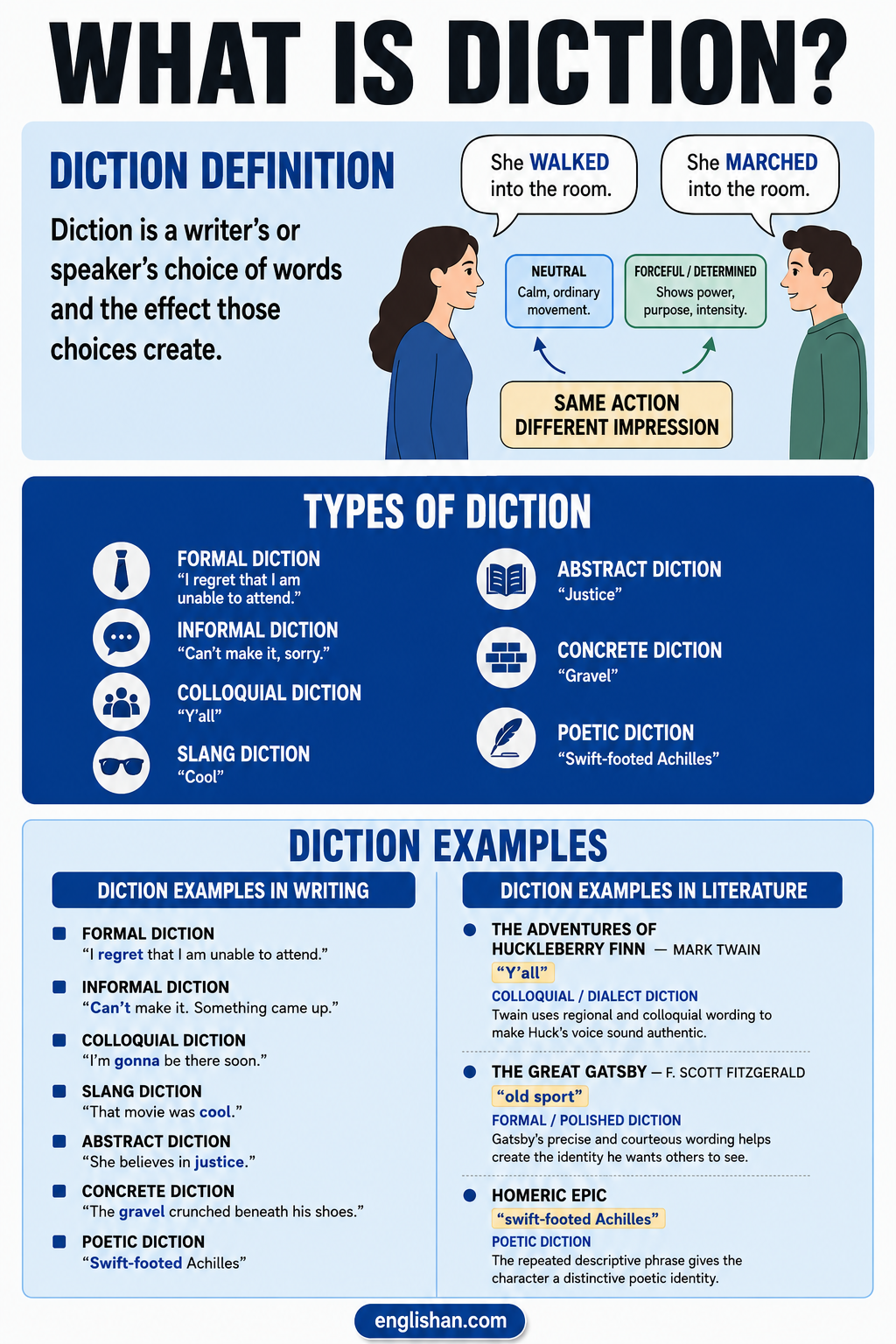
What Is Diction in Writing
Diction is a writer’s or speaker’s choice of words, set apart from plain vocabulary by the effect that choice produces beyond the literal meaning of what is said. Two writers can describe the same rainstorm and arrive at entirely different impressions, purely because one writer picks drizzle and the other picks deluge.
That effect depends on two layers working together. Denotation is a word’s dictionary meaning, the definition a reader would find printed on the page. Connotation is everything beyond that definition: the associations and the emotional weight a word gathers through use.
Home and residence denote the same building, but home connotes warmth and belonging while residence connotes distance and formality. Choosing between the two is a matter of word choice, not grammar.
The word itself traces back to the Latin dicere, meaning to speak. That root explains why diction also describes spoken pronunciation in some contexts, as when a singer is praised for crisp pronunciation. In literary and rhetorical study, the term almost always means word choice rather than pronunciation, and that is the sense every type in this guide covers.
Types of Diction Writers Use
Writers work within a handful of recognized registers. A register is a level of formality in language, running from official wording at one end to casual talk at the other. Most published prose blends more than one register, depending on what a given sentence needs to do.
Formal Diction
Formal wording relies on precise, elevated vocabulary and avoids contractions, slang, and casual expressions. It shows up in academic writing, legal documents, official correspondence, and any context where the writer needs to sound authoritative and impersonal. A formal sentence declining an invitation reads, “I regret that I am unable to attend,” and the same refusal in a text message drops to two words.
Informal Diction
Informal wording is conversational, contraction-heavy, and closer to how people actually talk to friends and family. Novels written in first person favor this register to make a narrator sound like a real person rather than a lecturer. “Can’t make it, sorry, something came up” delivers the same refusal as the formal example, but it sounds like a friend texting rather than a memo.
Colloquial Diction
This register uses expressions native to a particular region, generation, or community. Phrases like y’all, ain’t, or fixing to mark a speaker’s geography as sharply as an accent would. Colloquial diction overlaps with colloquialism as a broader device, since colloquial wording supplies the individual words that create colloquial speech patterns on the page.
Mark Twain built the narrative voice of The Adventures of Huckleberry Finn on Mississippi River colloquial wording, spelling words the way his characters would have pronounced them rather than the way a dictionary would.
Slang Diction
Slang wording pulls from words invented or repurposed inside a specific subculture or generation. It goes out of date faster than any other register, since slang terms fall out of use once they spread beyond their original group. A word like cool has survived for decades as slang for approval, while countless other slang terms from the same era are unrecognizable today.
Writers use this register to tie dialogue to a specific decade or social group without stating the setting outright.
Abstract Diction
Abstract wording names emotions, qualities, and states with no physical form: justice, freedom, grief, courage. Because these words point beyond anything a reader can picture directly, heavy use of this register risks real ambiguity. Two readers can attach different mental pictures to the same abstract word without either being wrong. Pairing an abstract term with a concrete example pins the meaning down.
Concrete Diction
Concrete wording names objects a reader can see, hear, touch, taste, or smell: gravel, rust, the metallic taste of blood. Where abstract wording risks vagueness, concrete wording delivers precision, and it is the register most responsible for vivid imagery.
A concrete object described in enough specific detail can take on meaning beyond its physical presence in a scene. That is part of how symbolism forms: a writer’s repeated return to one carefully chosen concrete word or image gives that object meaning the plot alone would not supply.
Poetic Diction
Poetic wording favors language chosen partly for sound, rhythm, and musical effect alongside meaning. It draws on devices like alliteration and assonance to make a line pleasing to hear as well as read. Harsh, clashing consonant sounds stacked deliberately produce cacophony, a poetic effect word choice alone can generate without any change in a sentence’s grammar.
The term has a documented history. In the 1802 preface to Lyrical Ballads, William Wordsworth attacked what he called the artificial “poetic diction” of eighteenth-century verse. He meant elaborate, Latin-based vocabulary far removed from everyday speech, and he argued that poetry should use language people actually spoke.
Homeric epic occupies the opposite extreme in practice. Fixed descriptive phrases like “swift-footed Achilles” work as a repeated epithet, and each one depends entirely on a poet’s deliberate word choices.
How Diction Shapes Tone and Characterization in Literature
A writer’s word choice is the fastest way to tell characters apart without a single line of description.
Ernest Hemingway is famous for spare, concrete wording built largely from one-syllable words. William Faulkner is just as famous for the opposite: long, abstract, elaborate sentences loaded with subordinate clauses. Both won the Nobel Prize in Literature while writing at nearly opposite ends of the same spectrum. Neither approach is more correct than the other; each serves a different kind of story.
Dialogue is where this choice does its most visible character work. In Huckleberry Finn, Twain gives Huck and Jim colloquial, dialect-heavy speech while keeping the surrounding narration in a slightly more standard register. The juxtaposition of the two registers, set side by side on the same page, tells a reader about class and education before any character says so directly.
F. Scott Fitzgerald does something similar in The Great Gatsby. Gatsby’s own wording is precise, courteous, and dotted with the repeated phrase “old sport.” That verbal habit signals a man performing a class identity he was not born into.
Repetition strengthens the effect. When a writer returns to the same charged word across a novel or poem, that repetition grows into a motif whose weight increases with each appearance. A single word choice is a decision; the same word choice made five times becomes a pattern the reader starts to track.
Diction and Tone: What Separates Them
Diction is the raw material; tone is what that material produces. Tone is a writer’s or narrator’s attitude toward what is being described. Word choice is one of the primary tools that creates it, alongside sentence length, detail selection, and punctuation. The same event described through different wording produces a different tone even when every fact stays identical.
- She marched into the room. Here marched assigns purpose and force to the action, producing a tone of confidence or aggression.
- She wandered into the room. Here wandered assigns drift and hesitation to the same physical act, producing a tone closer to uncertainty.
A writer calling a disaster “a bit of a setback” is choosing deliberately understated wording, a device called meiosis. That understatement is itself a word choice made to soften tone rather than strengthen it. The words come from that choice; the atmosphere they leave behind once the sentence ends is tone.
Diction and Syntax: What Separates Them
Diction and syntax get confused constantly because they operate on the same sentence at the same time, but they work on different levels. One governs which words a writer picks. The other governs how those words get arranged: word order, clause structure, sentence length, and punctuation choices.
A writer can keep word choice constant and change only sentence structure to shift an effect. Stringing several clauses together with no connecting conjunctions, a technique called asyndeton, speeds a passage up and adds urgency without swapping out a single word for a fancier one. Repeating the same grammatical form across a list, known as parallel structure, creates rhythm and emphasis through arrangement rather than vocabulary.
Plain wording paired with tightly controlled syntax can carry as much force as elaborate wording paired with loose syntax. The two variables move independently, and separating which one is doing the work in a given sentence sharpens close reading.
Why Word Choice Builds Credibility in Writing
Word choice does more than decorate a sentence in argumentative and rhetorical writing; it establishes or undermines a writer’s credibility before a single claim gets tested. Precise, field-appropriate jargon (the specialized terminology a doctor, lawyer, or scientist would actually use) signals expertise and strengthens ethos, the audience’s trust in the speaker. Vague or inconsistent wording does the reverse, making even a sound argument feel unreliable.
The same principle applies outside formal argument. A resume built on concrete, active wording reads as more capable than one padded with vague abstraction, even when the facts match exactly. Managed a team of twelve carries more weight than was involved with team activities.
Word choice is rarely the flashiest device available to a writer, but it is the one every sentence depends on. No sentence exists without the words chosen to make it.
How to Sharpen Diction in Your Own Writing
Run a swap test on any sentence you doubt. Pull out a noun or verb and replace it with a near synonym: walked for marched, use for utilize, big for massive. If the sentence’s tone, register, or precision shifts after the swap, the original word was doing real work. If nothing shifts, the word was filling a slot rather than earning it.
Marched cannot take a quiet substitute without losing its force. Swap utilize for use and nobody notices the difference, which is the surest sign the fancier word never mattered in the first place.
Apply that test during revision by targeting nouns and verbs before adjectives and adverbs, since most of a sentence’s meaning comes from its nouns and verbs. A vague verb like went, got, or made needs an adjective standing behind it to mean anything specific; a precise verb like stumbled, seized, or forged stands on its own.
Once the nouns and verbs do their work, check the remaining wording against register and audience. Legal vocabulary drags down a passage written in a teenage narrator’s voice, and slang undercuts a passage aimed at a courtroom. Read the sentence in the voice it is supposed to belong to; a mismatch surfaces on the tongue before it surfaces on the page.
❌ The manager did some work on the project that affected the team.
Work, project, and team stay vague enough to describe almost any job at any company, so the sentence names nothing a reader can picture.
✅ The manager rewrote the shipping schedule, cutting three days off every order the warehouse team processed.
Rewrote and shipping schedule name the exact action and object, while three days and warehouse team anchor the claim to a specific, checkable event.
FAQs
In literature, diction means the specific words a writer selects for a passage, judged by their formality, connotation, and effect on tone rather than by grammar alone. Two writers describing the identical event can produce very different reading experiences purely through the word choices each one makes.
The main types are formal, informal, colloquial, slang, abstract, concrete, and poetic. Most writing blends several of these registers rather than staying inside just one for an entire work.
A one-word swap shows diction at work. “The children scampered across the yard” and “the children trudged across the yard” both describe the same action, but scampered implies energy and lightness while trudged implies fatigue or reluctance. That single-word swap is word choice operating on its own, with the rest of the sentence unchanged.
Diction is the word choice itself, while tone is the attitude that word choice, along with sentence structure and detail, produces in a reader. Diction is a tool; tone is one of the effects that tool produces.
Diction concerns which words a writer selects, and syntax concerns how those words are arranged into sentences. A writer can change one while keeping the other constant, since the two operate independently on the same passage.
Word choice shapes meaning, tone, and a reader’s trust in the writer, before the reader consciously registers why. Precise wording sharpens a passage and makes the writer sound credible, while vague or mismatched wording weakens even a well-reasoned one.