Asyndeton is the deliberate omission of a conjunction such as and, but, or or between words, phrases, or clauses that would normally take one. A comma marks the place where the missing word would go. Writers drop these conjunctions when they want a sentence to move without stopping, and a reader feels that speed before they can name what caused it. A line like “she opened the door, dropped her bag, kicked off her shoes” runs on three quick beats instead of pausing for an and before the last one.
What Is Asyndeton?
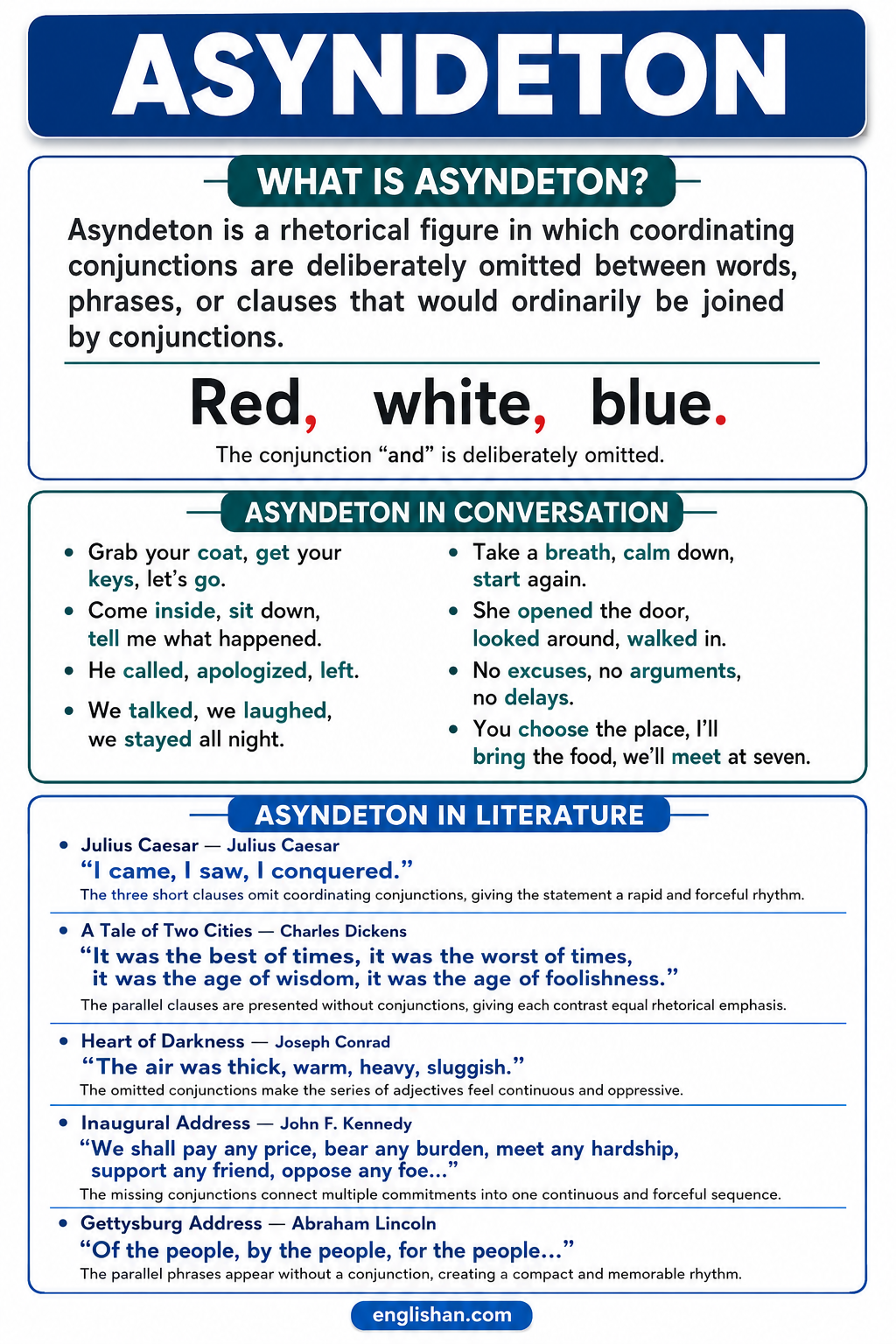
Asyndeton is a rhetorical device that leaves out the coordinating conjunction a sentence would normally use between parallel words, phrases, or clauses. A comma or a full stop marks the connection instead. The name comes from the Greek asyndeton, meaning “unconnected.” Ancient rhetoricians such as Aristotle noted that the missing conjunction suited spoken argument better than written prose, since a speaker’s voice supplied the rhythm a conjunction would otherwise provide.
The opposite habit, syndeton, keeps every conjunction in place, as in “red, and white, and blue” rather than “red, white, blue.” Most writers use syndeton without thinking about it. Dropping a conjunction on purpose is what turns an ordinary list into a rhetorical choice.
Types of Asyndeton
Rhetoricians separate asyndeton into two kinds. The difference depends on what the missing conjunction would have joined.
Asyndeton between words or phrases: the omission occurs inside a single clause, across a short list of adjectives or verbs.
- She packed quickly, quietly, carelessly. Dropping and before the final adverb keeps all three actions moving at the same pace. Nothing warns the reader that the list is about to end.
Asyndeton between clauses or sentences: the omission occurs between complete thoughts that each stand on their own as a separate sentence.
- I came. I saw. I conquered. Julius Caesar’s report to the Roman Senate breaks into three separate sentences rather than one sentence joined by and. Each verb gets its own full stop and its own moment.
Why Writers Use Asyndeton
Dropping the conjunction removes the one word in a list that lets a reader predict how much longer the list will run. The items seem to arrive faster, with equal stress on each one. A conjunction such as and also signals that a sentence is about to end, since readers expect one more item after it and then a full stop. Take that signal away, and every item reads as a possible last one. That is why asyndeton reads as urgent, breathless, or clipped depending on the sentence around it.
The device works especially well at the end of an argument or speech, where a writer wants the close to feel immediate rather than measured. This reinforces the speaker’s ethos at the exact moment an audience is deciding whether to trust them. Aristotle noticed this in his own teaching on rhetoric. He recommended the disconnected style for a speech’s close rather than its opening, since a listener needs the connected, explained version first and the compressed, urgent version last.
Asyndeton also shows up in branding and everyday slogans for the same reason it works in speeches. Three short items make a stronger impression than one long sentence explaining them, which is why so many memorable taglines use exactly this shape.
Overuse weakens the effect. A paragraph where every sentence drops its conjunctions stops feeling urgent and starts reading as a pile of fragments. The reader loses the connections that show how one idea leads to the next. The effect depends on contrast with the ordinary sentences around it, not on replacing all of them.
Examples of Asyndeton
The device shows up in nineteenth-century novels, twentieth-century speeches, and taglines written this decade, since the same missing conjunction does the same job in each.
In Literature
- It was the best of times, it was the worst of times, it was the age of wisdom, it was the age of foolishness. Charles Dickens opens A Tale of Two Cities with parallel clauses joined only by commas, setting each juxtaposition against the next without a single and slowing the sentence down.
- The air was thick, warm, heavy, sluggish. Joseph Conrad strips the conjunctions from this line in Heart of Darkness. The four adjectives read as one unbroken impression instead of a tidy grammatical list.
In Speeches
- We shall pay any price, bear any burden, meet any hardship, support any friend, oppose any foe, to assure the survival and the success of liberty. John F. Kennedy’s 1961 inaugural address joins five commitments with no and between them, so the list reads as one continuous vow rather than five separate promises.
- And that government of the people, by the people, for the people, shall not perish from the earth. Abraham Lincoln closes the Gettysburg Address on three phrases in parallel structure with nothing joining them. That gap is part of why the line is quoted whole rather than paraphrased.
In Everyday Language
- Reduce, reuse, recycle. The missing and turns three separate instructions into one instruction with three parts, which is exactly what a slogan needs to stay memorable.
- Live, laugh, love. The three imperative verbs would normally take and before the last one. Leaving it out gives the phrase its rhythm and lets it be said in one breath.
How Commas Work in Asyndeton
Once the conjunction is gone, the comma is the only punctuation left to mark where one item ends and the next begins. This is why an asyndetic list almost always relies on commas rather than any other mark. Inside a single clause this causes no confusion, since a string of adjectives or short phrases separated by commas reads as a list whether or not a conjunction is present.
The risk shows up when asyndeton joins two independent clauses, each with its own subject and verb. A comma between two independent clauses with no conjunction is normally a comma splice, an error rather than a stylistic choice. The difference between the mistake and the device is control. A comma splice happens by accident in a paragraph that was not written to use it. Asyndeton uses the same gap on purpose, across short, balanced clauses that match each other in length and rhythm.
- She was tired, she kept walking, she never looked back. ❌ Three independent clauses joined only by commas, with nothing to signal that the run-on is deliberate, read as a comma splice rather than a controlled effect.
- She was tired. She kept walking. She never looked back. ✅ Splitting the same three clauses into short, even sentences keeps the deliberate rhythm without using commas to do a conjunction’s job.
A full stop signals the same break a conjunction would have marked. This is why most asyndeton between complete clauses uses periods rather than commas, saving the comma-only version for lists of words and phrases inside a single clause.
Asyndeton vs Polysyndeton
Polysyndeton does the opposite of asyndeton. Instead of dropping every conjunction, it repeats one so many times that each item in the list feels heavier rather than faster. Where asyndeton speeds a sentence up, polysyndeton slows it down and makes it feel deliberate, almost ceremonial.
- In asyndeton: I came, I saw, I conquered. The missing conjunction lets the reader move from verb to verb with nothing to slow them down.
- In polysyndeton: I came, and I saw, and I conquered. Every added and gives the same three verbs a small pause, so the sentence reads as weighted and deliberate instead of fast.
The choice between them depends on the effect the sentence needs. Asyndeton suits a moment that calls for speed, and polysyndeton suits one that calls for weight.
Asyndeton vs Parataxis
Parataxis is the broader category. It means placing clauses side by side without a subordinating conjunction such as because, although, or since to make one clause depend on the other. It allows commas, semicolons, full stops, or even and to appear between the clauses. Asyndeton is the stricter case inside that category, the one where even the coordinating conjunction is missing rather than left in place.
Every asyndetic sentence is paratactic, since dropping the conjunction still leaves the clauses side by side as equals. Not every paratactic sentence is asyndetic, though. Parataxis allows and, so, or a semicolon just as readily to keep the clauses equal and connected. Caesar’s report to the Senate is both at once. It is paratactic because none of its three clauses is subordinated to another, and asyndetic because the conjunction between them is missing altogether.
How to Use Asyndeton in Your Own Writing
A reader tells a deliberate omission apart from a stray error through sound, not by counting commas. Read the sentence aloud and listen for where the voice naturally pauses. If each clause stands as its own complete sentence and the missing word only removes a short pause between them, the omission is doing rhetorical work. If the voice stumbles, or a listener has to go back and find the subject of the next clause, the sentence has broken rather than sped up.
A second test is to isolate each clause and check whether it contains a full subject and verb, forming a complete sentence on its own. Caesar’s “I came. I saw. I conquered.” passes, since each clause already works as a sentence; the missing and only removes a formality between three clauses that were already independent. A string of half-formed clauses linked with commas fails the same test, since at least one clause depends on the one before it and makes no sense without it.
Use asyndeton when a passage needs speed. It fits a climax at the end of a paragraph, a rush of images meant to reach the reader in one motion, or a list that gains force by arriving fast. Leave the conjunctions in when a reader needs to track cause and effect, sequence, or contrast, since stripping and, but, or or from those sentences erases the very information the logic depends on.
- ✅ She grabbed her coat, slammed the door, ran for the train. Three short, complete actions follow back to back, and the missing and keeps the sentence moving at the pace of the character herself.
- ❌ She grabbed her coat because it was raining, slammed the door which was already broken, ran for the train she had missed twice that week. Each clause depends on information the one before it supplies, so cutting the conjunctions removes the cause-and-effect logic a reader needs, leaving a run-on rather than a rush.
FAQs
Q1. What is the opposite of asyndeton?
Polysyndeton is the direct opposite, since it repeats a conjunction across a list instead of dropping it. Syndeton is the neutral middle ground that uses conjunctions the normal way.
Q2. Is asyndeton grammatically correct?
Yes, asyndeton is a recognized rhetorical device rather than an error. The same missing conjunction between two independent clauses reads as a comma splice when nothing in the sentence signals that the omission is deliberate.
Q3. Does asyndeton use commas?
Yes, a comma marks the connection a conjunction would otherwise mark. The exception is asyndeton between full clauses, where a full stop between short sentences is the more common and safer choice.
Q4. What is the adjective form of asyndeton?
The adjective is asyndetic, used to describe a list, clause, or style built on omitted conjunctions, as in an asyndetic list.
Q5. Is asyndeton tested on the AP Lang exam?
Yes, asyndeton is listed among the rhetorical devices that AP English Language and Composition and AP English Literature courses teach. Students are commonly asked to identify it inside a passage or explain its effect on a given line.
Q6. Can asyndeton and anaphora appear together?
Yes, the two devices regularly overlap in the same passage. Anaphora repeats a word or phrase at the start of each clause while asyndeton removes the conjunction between those same clauses.
Q7. How do you pronounce asyndeton?
Asyndeton is said uh-SIN-dih-tahn, with the stress on the second syllable. The run of vowels near the end is the part most English speakers get wrong, since the word keeps its Greek shape rather than a more familiar English pattern.