An epithet is a descriptive word or phrase fixed to a name, used to single out one quality of the person, place, or thing it names. Homer never wrote “Achilles” alone. He wrote “swift-footed Achilles,” repeating the same descriptive tag across thousands of lines of the Iliad, whether Achilles was fighting, sulking, or grieving.
The device appears in ancient Greek poetry and in everyday conversation alike. In modern speech, the word more often names something far less flattering: a slur aimed at a person’s race or identity.
What Is an Epithet?
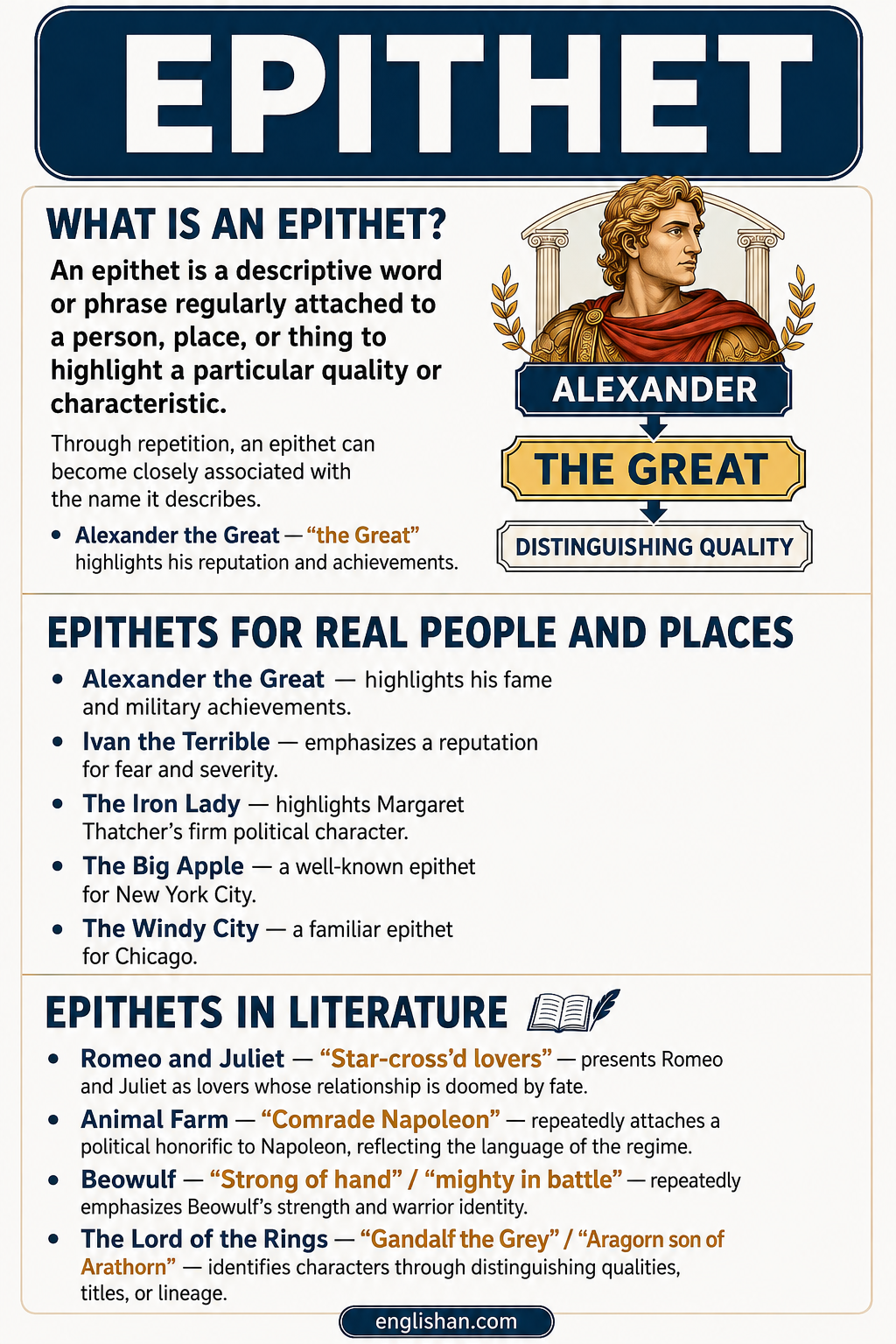
An epithet is a descriptive word or phrase attached to a name, chosen to single out one quality of the person, place, or thing it identifies. A plain adjective describes something once. An epithet repeats, appearing beside the same name so often that the phrase becomes a second name in its own right.
Alexander the Great is not just a successful king who happens to be named Alexander. “The Great” has become part of his name, just as “swift-footed” became part of Achilles. Dropping either phrase would feel like dropping part of the name itself.
The word comes from the Greek epitheton, built from epi- (upon) and tithenai (to put). The term literally names something placed upon a word. It reached English through Latin in the late sixteenth century, first recorded around 1579. The English word kept the sense it had in Greek rhetoric: an added phrase that characterizes a thing rather than merely labels it.
That fixing power works in two directions. The mechanism that turns “the Great” into a mark of honor also turns a slur into a fixed, damaging label. This is why epithet has two nearly opposite meanings today.
In literature and history, the word names a badge of distinction. In ordinary speech, it more commonly names an insult, especially one aimed at race or ethnicity. Both senses share the same idea: a word fixed onto an identity, one that either praises what it names or condemns it.
Types of Epithets
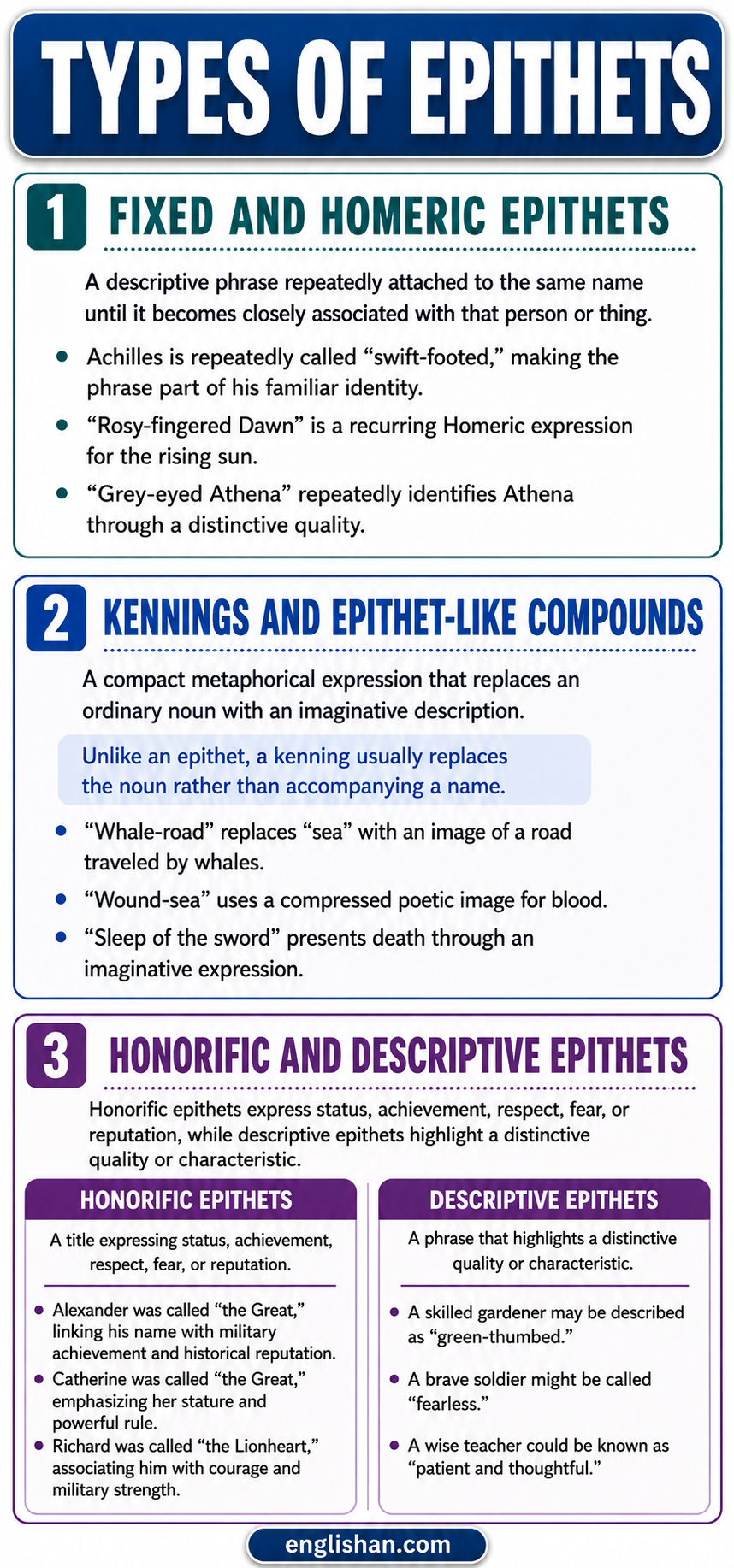
Scholars studying the device across languages and periods sort it into three recurring groups, though real examples often fit more than one group at once.
Fixed and Homeric Epithets
A fixed epithet, also called a Homeric epithet after its most famous user, is a descriptive phrase permanently attached to one name. It repeats every time that name comes up, regardless of what is happening in the story at that moment.
Achilles stays “swift-footed” even while sitting still in his tent, and the dawn stays “rosy-fingered” on a battle morning as readily as on a calm one. The phrase has become part of the name rather than a comment on the current scene.
Kennings and Epithet-Like Compounds
A kenning is a compressed, two-word metaphor that substitutes for an ordinary noun. It is common in Old English and Old Norse poetry: whale-road for the sea, wound-sea for blood, sleep of the sword for death.
The real distinction is that a kenning replaces the noun outright, while an epithet accompanies a name. Both devices share a compressed, image-driven approach to diction. Beowulf relies on kennings the way the Iliad relies on fixed epithets, and literature courses frequently pair the two poems for exactly that contrast.
That substitution also resembles metonymy and synecdoche. Those two devices swap one name for another, through association or through a part standing for the whole. An epithet, by contrast, keeps the original name in place beside its descriptive tag rather than replacing it.
Honorific and Descriptive Epithets
An honorific epithet attaches a title of respect, fear, or achievement to a ruler’s or leader’s name: Catherine the Great, Ivan the Terrible, Richard the Lionheart. Historians also call such a title a byname or sobriquet, an added name used alongside the personal name. Because the ruler’s reputation repeats with the name every time it is spoken, the title works as a built-in appeal to ethos.
A descriptive epithet names an ordinary quality instead of a historical rank. Calling someone “moneybags,” or calling a keen gardener “green-fingered,” puts the same device to work in casual talk. Such phrases count as colloquialism, and most speakers never notice that they are also a literary device.
Homeric Epithets in the Iliad and the Odyssey
Homer built entire poems around the device, and the pattern is dense enough that a passage rarely runs long without one.
| Who or What | Common Epithet |
|---|---|
| Achilles | Swift-footed |
| Odysseus | Man of many ways |
| Athena | Bright-eyed |
| Hera | White-armed |
| The dawn | Rosy-fingered |
| The sea | Wine-dark |
Because each phrase recurs at set intervals across thousands of lines, it reads less like a passing description and more like a motif, a repeated element the audience learns to expect and recognize.
The classicist Milman Parry showed in the 1920s that these fixed phrases worked as ready-made building blocks for oral performance. Homer’s epics grew out of oral tradition, poetry recited from memory long before it was written down. Scholars call the technique oral-formulaic composition: verse assembled from stock phrases during live recitation.
The phrases had a practical purpose. A poet reciting from memory used “swift-footed Achilles” or “rosy-fingered dawn” as a complete metrical unit that filled a gap in the line. There was no need to invent a fresh phrase on the spot. The phrases also fit dactylic hexameter, the six-beat rhythm Greek epic poetry required. A phrase that scanned correctly could fill any line where the meter left room for it.
Beyond the practical use, the repetition develops character. Odysseus earns different epithets depending on what the poem stresses in that passage: “man of many ways” for his cleverness in one scene, “much-enduring” for his suffering in another. The fixed phrases accumulate into a fuller portrait across the whole epic.
Epithets in Literature Beyond Homer
Fixed and descriptive epithets stayed in use for nearly three thousand years after Greek epic, turning up wherever a writer wants a name and a quality to appear together.
- A pair of star-cross’d lovers take their life. Shakespeare opens Romeo and Juliet with this epithet built into the prologue itself, so the audience knows the outcome before the play begins.
- Comrade Napoleon has stated categorically that all rumours of Snowball’s complicity are lies. George Orwell’s Animal Farm fixes “Comrade” to Napoleon’s name throughout the novel, and the honorific grows more hollow each time it repeats as the pig’s rule turns tyrannical.
- Whale-road and swan-road, Old English kennings for the sea from Beowulf, occur alongside the poem’s more conventional epithets for its hero. Beowulf himself is described repeatedly as strong of hand and mighty in battle.
Fantasy and adventure fiction use the same device for world-building. J.R.R. Tolkien fixes “Aragorn son of Arathorn” and “Gandalf the Grey” so consistently across The Lord of the Rings that readers track characters partly through their attached phrases. A Greek audience once tracked Homer’s heroes the same way.
Epithets for Real People and Places
Outside fiction, epithets attach to public figures and places the same way they attach to Achilles, through repetition until the phrase reads as inseparable from the name.
- Alexander the Great: honors the Macedonian king’s conquests across three continents by his early thirties.
- Ivan the Terrible: the first Tsar of Russia, whose epithet suggests both dread and commanding power in the original Russian.
- The Iron Lady: a name Soviet media gave British Prime Minister Margaret Thatcher in 1976 for her unbending politics. She later adopted the name with pride.
- The Great Emancipator: attached to Abraham Lincoln for the Emancipation Proclamation.
Places acquire epithets just as readily. New York goes by “the Big Apple,” and Chicago goes by “the Windy City.” Rome goes by “the Eternal City,” a phrase that condenses the city’s long, unbroken history into two words. Calling Rome “the Eternal City” amounts to a built-in allusion, since the phrase recalls more than two thousand years of association every time someone uses it.
Epithet vs Kenning vs Nickname
The three terms overlap enough to confuse learners, though each does a distinct job.
| Device | What It Does | Example |
|---|---|---|
| Epithet | Attaches a fixed descriptive phrase to a name | Swift-footed Achilles |
| Kenning | Replaces a noun entirely with a compressed metaphor | Whale-road for the sea |
| Nickname | Substitutes an informal name, changeable and personal | Liz for Elizabeth |
A nickname can shift from person to person, or even day to day, and commonly reflects affection or convenience rather than a settled public reputation. An epithet, by contrast, hardens into fixed, near-permanent use, whether it names a war hero, a monarch, or a city.
The Negative Meaning of Epithet
Most people encounter the word epithet today in news coverage or conversation, where it names a hostile or insulting word aimed at someone because of race, ethnicity, religion, or another part of their identity. The mechanism stays the same as the literary sense: a word fixes onto a person’s identity and stays attached to them. What changes is the intent, from praising a person to demeaning one.
News organizations, courts, and everyday speakers frequently use epithet as a deliberate substitute for repeating an offensive word aloud. Reporting that someone “used a racial epithet” describes the act of using a slur without reproducing the slur itself. That is why the word shows up constantly in headlines and legal transcripts covering harassment or hate speech.
This use is narrower than “insult” in general: the term in this sense targets identity specifically, rather than covering any rude remark.
The two senses of the word rarely cause real confusion in context. A reader encountering “Alexander the Great” and a reader encountering “hurled a racial epithet” understands instantly which meaning applies, because the surrounding words settle it.
How to Use an Epithet in Writing
A working epithet needs to reveal something true and specific about the person or thing it names, not decorate a name with a generic compliment. Weak epithets recycle vague praise that fits almost anyone; strong ones name one concrete trait a reader can picture and repeat it with purpose.
- The great warrior fought bravely in every battle. ❌ “Great” and “bravely” are generic labels that add nothing a reader can picture, and neither phrase repeats elsewhere to establish a fixed identity.
- Swift-footed Achilles led every charge before the rest of the army caught up. ✅ “Swift-footed” names one concrete, visual trait and, used consistently across a text, becomes the character’s signature the way it did in Homer.
Reuse the phrase deliberately once chosen. The effect of a fixed epithet comes from repetition, so scattering three different descriptive phrases across three mentions of the same character undercuts the device rather than strengthening it.
Writers describing real groups of people should also watch how quickly a descriptive epithet turns into a stereotype. A trait attached too freely to an entire nationality, religion, or ethnicity stops describing an individual. It starts working the same fixing mechanism behind a slur, aimed at a group rather than a person.
FAQs
A Homeric epithet is a fixed descriptive phrase that Homer attaches permanently to a character or object. It repeats every time that name comes up in the poem, such as “swift-footed Achilles” or “wine-dark sea.” The phrase stays constant regardless of the scene, since its purpose in oral poetry was to fill a metrical line and reinforce a trait, not to comment on the immediate action.
An epithet attaches a descriptive phrase alongside a name, while a kenning replaces an ordinary noun entirely with a compressed, two-word metaphor. “Swift-footed Achilles” keeps the name and adds a description beside it, whereas “whale-road” for the sea drops the plain noun altogether and takes its place.
A nickname is an informal substitute name that can change between speakers or over time and commonly reflects personal familiarity. An epithet, instead, is a fixed descriptive phrase that passes into permanent public use alongside someone’s actual name. “Liz” is a nickname for Elizabeth; “the Iron Lady” is an epithet for Margaret Thatcher.
A racial slur is called an epithet because it works the same way a literary epithet does. It fixes a description onto a person’s identity so consistently that the description and the identity become linked. News reporting and legal writing favor the neutral term “racial epithet” over repeating the slur itself, which is why the word dominates coverage of hate speech and harassment.
Yes, “the Great” attached to Alexander’s name is an honorific epithet, a fixed phrase recognizing his military conquests. It has remained fixed to his name for more than two thousand years, part of how history identifies him rather than a separate compliment.