Metonymy is a figure of speech that replaces the name of one thing with the name of something closely associated with it: the crown for the monarchy, Wall Street for finance. The substitute is never a part of the original. It is a neighbour, and English speakers complete the swap without noticing they have done it. The Greek behind the word says as much: metōnymia, a change of name.
What Is Metonymy
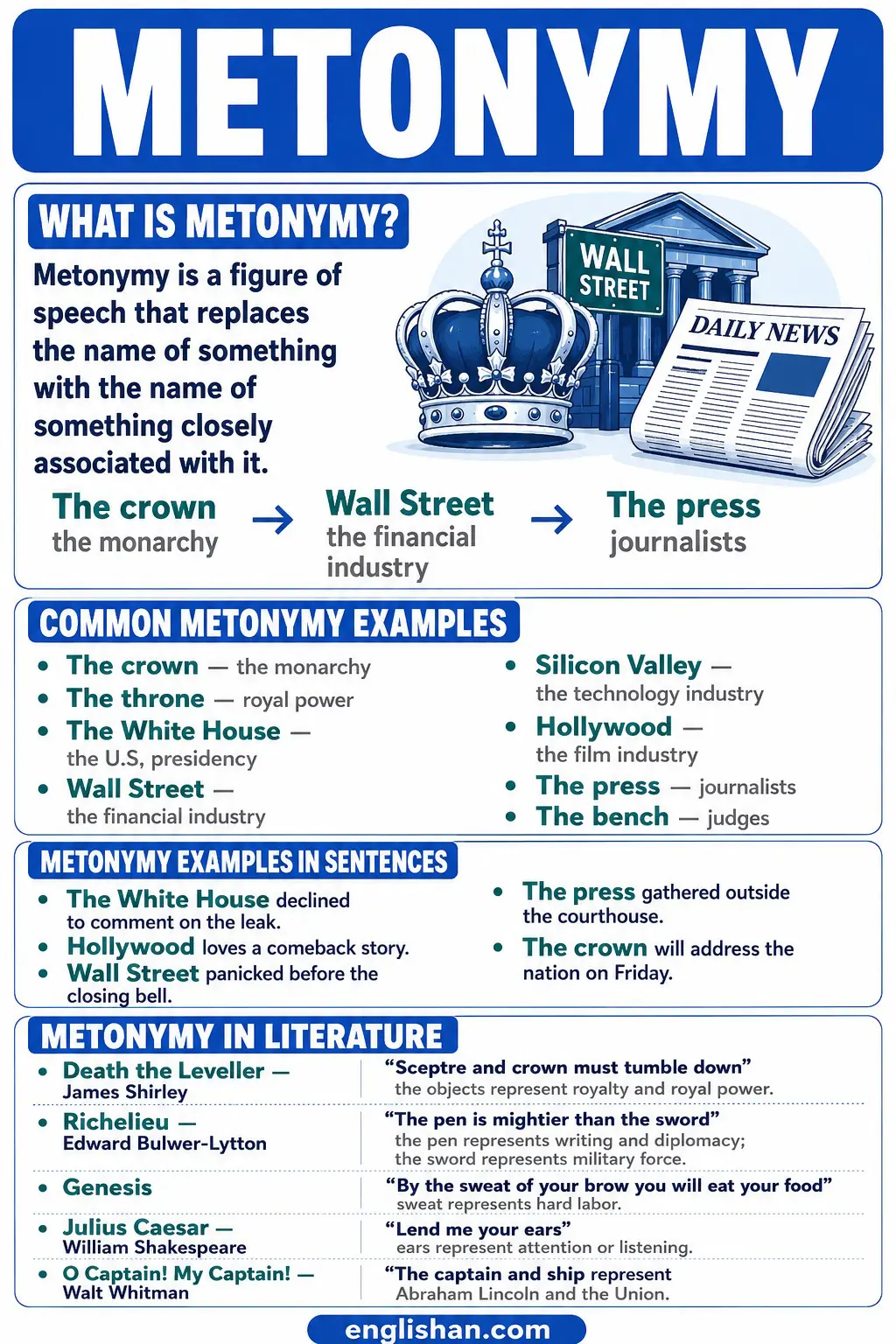
Say it meh-TON-uh-mee in British English and meh-TAH-nuh-mee in American English, four syllables either way, with the stress on the second. One instance of the device is a metonym, and the adjective is metonymic.
The swap works because the two words already share a world. A monarch wears a crown, so the crown renames the monarchy. Financial firms cluster in one New York street, so Wall Street renames American finance. You complete the connection from what you already know about crowns and streets, not from anything the sentence tells you. That is why the device reads as plain speech rather than as decoration, and why nobody stops mid-headline to work it out.
Roman Jakobson gave the relation its technical name: contiguity, meaning nearness. Metaphor works by similarity, and metonymy works by nearness. That one distinction settles almost every hard case you will meet.
The Greek parts confirm it. Metá means beyond or after, and ónuma means name, so metōnymia describes a name passed beyond its owner to whatever is nearest to it.
Types Of Metonymy With Examples
Metonymy is not one move but eight. Naming the relation turns a memorised list into something you can apply to a word you have never met. Each type answers the same question a different way: what connects the substitute to the thing it renames?
| Relation | The rule | Three examples |
|---|---|---|
| Place for institution | A location renames the body housed there | Washington, the White House, Wall Street |
| Badge for office | An object of office renames the office | The crown, the bench, the cloth |
| Container for contained | The vessel renames what is inside it | The bottle, the kitchen, the dish |
| Producer for product | The maker renames what was made | A Picasso, a Ford, Shakespeare |
| Tool for the work | The instrument renames the trade | The pen, the press, the sword |
| Body part for the faculty | A part of the body renames what it does | The ear, the tongue, a good head |
| Material for the object | The substance renames the finished thing | The irons, brass, canvas |
| Effect for cause | A visible result renames what produced it | Sweat, grey hairs, tears |
Place for institution. The commonest relation in modern English, and the one that fills news writing. A government occupies a building, a trade occupies a district, and the address takes over the name. Washington means the US federal government. The White House means the presidency and everyone who speaks for it. Wall Street means American high finance, and it kept the meaning long after most trading left the street itself.
Badge for office. Authority wears something, and the something becomes the authority. The crown means the monarchy, the bench means the judges and by extension the ruling they hand down, and the cloth means the clergy. Notice that none of these renames a person. They rename a role, which survives whoever fills it.
Container for contained. The vessel takes the name of what is inside it. The bottle means drinking and the dependence that follows it, which is exactly why obituaries prefer it to the direct word. The kitchen means a restaurant’s cooking staff. The dish means the food served rather than the porcelain.
Producer for product. The maker’s name migrates to the thing made. You hang a Picasso, you drive a Ford, and you read Shakespeare rather than reading the plays themselves. This relation also produces trademarks that swallowed their whole category, which English speakers use daily without registering them as figures of speech at all.
Tool for the work. The instrument renames the labour or the labourer. The pen means writing and diplomacy, the sword means military force, and the two set against each other gave English its most quoted line about both. The press began as a printing machine and now means every journalist alive.
Body part for the faculty. A part of the body renames what that part does. The ear means attention or musical judgement, the tongue means a language, and a good head means steady intelligence. This relation comes closest to synecdoche and produces most of the confusion between the two devices.
Material for the object. The substance renames the finished object. The irons means shackles, brass means senior officers, and canvas means the painting rather than the cloth beneath it.
Effect for cause. The visible result renames whatever produced it. Sweat means hard labour, grey hairs mean years of worry, and tears mean grief. Reversed, the cause renames the effect, which is how blood came to mean both violence and family descent.
Common Metonyms And Their Meanings
The bank below runs under the same eight relations, so every metonym arrives with its logic attached rather than as a word to memorise.
Place for institution
- Downing Street: the office of the British Prime Minister
- Number Ten: the Prime Minister personally, and the decisions taken there
- Westminster: the British Parliament and its politics
- Whitehall: the British civil service
- The Kremlin: the Russian government
- The Vatican: the leadership of the Roman Catholic Church
- The Pentagon: the US Department of Defense
- Langley: the CIA
- Threadneedle Street: the Bank of England
- The City: London’s financial district and the money moving through it
- Silicon Valley: the American technology industry
- Hollywood: the American film industry
- Bollywood: the Hindi-language film industry
- Nashville: American country music and the business behind it
- Motown: the Detroit label and the soul sound it defined
- Broadway: American commercial theatre
- The West End: London commercial theatre
- Fleet Street: the British national press, decades after the newspapers left
- Madison Avenue: the American advertising trade
- Brussels: the institutions of the European Union
- Beijing: the Chinese government
Badge for office
- The throne: royal authority as an institution
- The sceptre: sovereign power at its most formal
- The bar: the legal profession, and the barristers within it
- The gavel: the authority of a judge or a chairman to decide
- The pulpit: preaching, and the clerical position that permits it
- The mitre: a bishop’s office
- The badge: the police
- The flag: a nation, and the loyalty owed to it
- The suits: corporate management, named by the people who resent them
- The stage: the acting profession as a career
- The mortarboard: a graduate, and graduation as a milestone
- The stethoscope: the medical profession
- The uniform: military service, and the discipline attached to it
Container for contained
- The kettle: the water boiling inside it
- The glass: a drink, counted by the vessel
- The plate: a serving of food
- The pot: whatever has been cooked in it
- The cup: a hot drink, and separately a trophy
- The barrel: the beer inside it
- The house: a theatre audience, as in a full house
- The box office: ticket sales, and commercial success measured by them
- The cellar: a wine collection
Producer for product
- A Stradivarius: a violin built by Antonio Stradivari
- Chopin: his compositions, when a pianist plays them
- A Dickens: any one of his novels
- A Rembrandt: a painting from his hand
- A Steinway: a piano from that maker
- Hoover: any vacuum cleaner, in British English
- Kleenex: any paper tissue
- Band-Aid: any adhesive dressing
- Biro: any ballpoint pen
- Sellotape: any adhesive tape
- Xerox: any photocopy, and the act of making one
- Thermos: any vacuum flask
Tool for the work
- The mic: a broadcasting or performing career
- The airwaves: radio and television broadcasting
- The big screen: cinema
- The small screen: television
- The brush: painting as a trade
- The boards: the stage, from an actor’s side of it
- The wheel: whoever is driving, as in the man behind the wheel
- The needle: tailoring, and separately an injection
- The plough: farming as a way of life
Body part for the faculty
- The eye: visual judgement, as in an eye for colour
- A strong arm: force used to compel someone
- A soft heart: compassion, and the tendency to act on it
- The gut: instinct arriving ahead of reasoning
- The nose: a trained sense of smell, and the judgement of a wine or perfume expert
- The voice: a singer, and separately the settled opinion of a public
- The hand: help given, as in lend a hand
- The face: whoever represents an organisation publicly
- The brains: the person who planned an operation
Material for the object
- Steel: a blade
- Silver: cutlery and formal tableware
- Plastic: a credit card, and payment by card
- Glass: a mirror, and separately a drinking vessel
- Marble: a sculpture cut from it
- Tin: a sealed can of food
Effect for cause
- A limp: the old injury behind it
- Blood: violence, and separately family descent
- Sleepless nights: the anxiety producing them
Metonymy Examples In Sentences
Each sentence below uses one metonym in ordinary written English, with the substitution marked. Notice how rarely the device draws attention to itself, and how the metonym moves around the sentence rather than always opening it.
- The White House declined to comment on the leak.
- Traders spent the morning waiting for Threadneedle Street to move first.
- Hollywood loves a comeback story.
- By the closing bell, Wall Street had given back every gain of the week.
- Outside the courthouse, the press had gathered by six.
- The bench overruled every objection that morning.
- On Friday, the crown will address the nation.
- Within minutes, Downing Street issued a correction.
- He gave up the bottle the year his daughter was born.
- All Sunday, the pulpit thundered against the new law.
- She left the stage for teaching and never regretted it.
- The kitchen sent out its apologies with a free dessert.
- The front office refused to trade the young striker, and the badge backed them.
- Nobody expected Brussels to approve the merger so quickly.
- Two hours after the vote, Westminster emptied.
- The Pentagon confirmed the deployment without naming the unit.
- She has an ear for dialogue that no editor taught her.
- Their new album barely troubled the airwaves.
- The suits killed the project before the pitch finished.
- Ask him anything about Burgundy, because the nose is never wrong.
- He paid with plastic and regretted it by Thursday.
- After eleven years, the boards still frighten her before curtain-up.
- A Rembrandt sold that afternoon for more than the gallery earned all year.
- The whole village turned out when the mitre came to visit.
- Between them, Silicon Valley and Fleet Street told two different stories about the same week.
- Somebody put the kettle on and the argument cooled.
- Grey hairs arrived the year he took the department over.
- Under the irons, the prisoner said nothing for three days.
- Her son plays Chopin better than he plays anything written since.
- The gavel came down before the lawyer finished speaking.
For thirty more written out in full, with the substitution marked in each, work through this collection of metonymy example sentences.
Metonymy In Everyday Speech
Most metonyms you use never strike you as figures of speech, because repetition wears the figure off. Ask a colleague to give you a hand, order a glass rather than a measure of wine, or complain that the office has decided something. You have used the device three times before lunch without meaning anything poetic by it.
Linguists call these conventional or dead metonyms. They arrived as fresh substitutions, spread through repetition, and settled into the dictionary as ordinary meanings. The press is fully dead: no English speaker pictures a printing machine. The bottle is halfway there, still carrying enough of its original object to feel deliberate in a sentence about someone’s drinking. A metonym you invent this afternoon is fully alive, and the reader notices the swap.
The distinction changes how you write. A dead metonym does the work of a plain word and costs the reader nothing. A live one asks for a moment of attention, so one per paragraph is generous and three is fog.
It also decides which expressions survive when you read English written elsewhere. The front office means a sports team’s management to an American reader and nothing at all to most British ones. Threadneedle Street runs the other way. A metonym only functions when writer and reader share the association, which makes these the hardest expressions to use across varieties of English.
Metonymy In News Headlines
Headline writing depends on metonymy because headlines are sold by the character. Washington and Beijing traded warnings replaces two governments, two foreign ministries and four spokespeople with two city names, and loses nothing a reader needed.
Three headline patterns repeat across the English-language press.
The capital acts. Brussels rejects, Moscow denies, Tokyo intervenes. One word delivers a state, an institution and a decision.
The building speaks. The White House confirmed, Number Ten refused, the Vatican issued. Buildings cannot speak, and readers correct for it instantly, which is what makes the pattern invisible.
The trade reacts. Wall Street panicked, Fleet Street pounced, Silicon Valley shrugged. An industry becomes one nervous character with a single mood, and abstract economic movement gains a face.
These substitutions age at different speeds. Institutions last, so a headline built on the Kremlin reads the same in twenty years. Personal metonyms date quickly, which is a reason to prefer the address to the officeholder in anything you want to survive.
Metonymy Examples In Literature
Writers reached for the device long before anyone named it, and the most quoted lines in English rest on substitutions readers no longer examine.
Richelieu by Edward Bulwer-Lytton. “The pen is mightier than the sword” entered English from this 1839 play. Two tools rename two professions, and the sentence compares writing with warfare without naming either.
Julius Caesar by William Shakespeare. “Friends, Romans, countrymen, lend me your ears” is the disputed case, and the disagreement teaches the boundary better than any settled example would. Read ears as a physical part of the listeners and the line is synecdoche. Read ears as the attention those ears perform, and it is metonymy, because attention is no part of a body. Britannica files the line under metonymy. Plenty of classroom handbooks file it under synecdoche. Both readings have support, and an examiner who marks one wrong is overstating the case.
Metonymy In Poetry
The Glories of Our Blood and State by James Shirley, anthologised as Death the Leveller. “Sceptre and crown must tumble down, and in the dust be equal made with the poor crooked scythe and spade.” Four objects rename two whole classes, and the poem argues its entire case about mortality through substitution alone.
Ode to a Nightingale by John Keats. Keats asks for “a beaker full of the warm South”, where the South renames the wine produced there. The place has taken the name of its product, and the line delivers heat, harvest and geography in three words.
O Captain! My Captain! by Walt Whitman. Whitman renames Abraham Lincoln as a captain and the Union as his ship, then sustains the substitution across the whole elegy. The grief is heavier for never naming its object directly.
Metonymy In The Bible
Genesis 3:19. “By the sweat of your brow you will eat your food” makes sweat the name of labour itself, an effect renaming its cause centuries before Greek rhetoric named the pattern.
Matthew 26:52. “All they that take the sword shall perish with the sword” uses one tool to rename violence twice in a single clause.
Isaiah 2:4. “They shall beat their swords into plowshares” sets two tools against each other so that war becomes farming without either word being written.
Metonymy In Songs And Film
Ebony and Ivory, written by Paul McCartney and recorded with Stevie Wonder. Two piano keys rename two groups of people, and the whole argument of the song rides on a substitution made in the first line.
Juicy by The Notorious B.I.G. The limelight renames fame. Limelight was a nineteenth-century stage lamp, so the word had already died into ordinary English before the song revived enough of it to matter.
What Makes You Beautiful by One Direction. Turning heads renames attracting attention, a body part renaming the faculty it performs, and one of the most-used live metonyms in pop lyrics.
Film language runs almost entirely on the device. The big screen renames cinema, the box office renames commercial success, and Hollywood renames an industry that outgrew its neighbourhood decades ago. A reviewer who writes that a film died at the box office has renamed the audience by the desk where tickets were sold.
Why Writers Use Metonymy
Four payoffs keep the device in constant service.
Concision: Washington and Beijing traded warnings replaces two governments, their ministries and their spokespeople with two city names.
Drama: institutions become characters, so streets panic and benches overrule, and abstract power gains something like a body.
Distance: the associate softens what the direct word would harden, which is why obituaries and family arguments prefer the bottle to alcoholism.
Rhythm: the metonym is almost always the shorter word, and in a headline or a line of verse the saved syllables decide whether the sentence scans.
Metonymy vs Synecdoche
The two devices substitute names on different axes, and one question separates them: is the substitute physically a part of the thing, or the thing a part of it?
Wheels for a car is synecdoche, because wheels are literally part of the car. The crown for the monarchy is metonymy, because a crown is no part of a person or a government. It merely accompanies power. Hands, sails and mouths substitute as parts. Addresses, garments and tools substitute as associates.
| Device | Axis | Examples |
|---|---|---|
| Metonymy | Association | The crown, Wall Street, the press |
| Synecdoche | Part and whole | All hands, new wheels, Germany won |
Classical rhetoric filed synecdoche as a subtype of metonymy, and linguists still argue the border, so when two textbooks disagree, both have precedent behind them. For a fuller set of part-for-whole substitutions, work through these synecdoche examples.
Metonymy vs Metaphor
Metaphor compares across domains. Metonymy renames within one.
Life is a highway moves life into the world of asphalt and asks you to map the two. The domains are unlike, and the likeness is invented by the writer. The crown ruled wisely invents no likeness at all, because crowns and monarchs already share one royal world, and the name passes from one to its neighbour.
Metaphor asks you to imagine; metonymy asks you to remember.
That is Jakobson’s similarity and contiguity restated for a reader who never met the terms. Apply the test to any hard line: if the sentence wants a resemblance you did not previously see, it is metaphor. If it wants a connection you already had, it is metonymy.
Metonymy vs Metalepsis
Metalepsis is a metonym built on a metonym, so the reader makes two steps rather than one.
Lead foot describes a fast driver. Step one substitutes a heavy foot for pressure on the accelerator. Step two substitutes lead for heaviness. Neither step alone produces the meaning, and no lead is anywhere near the car.
The same doubling produces I’ll catch the worm tomorrow for an early start. The worm comes from the proverb about the early bird, and the proverb comes from the habit of rising early, so the sentence renames a renaming.
| Device | What the substitute is | Test example |
|---|---|---|
| Metonymy | An associate of the thing | The crown ruled wisely |
| Synecdoche | A literal part of the thing | All hands on deck |
| Metaphor | An invented likeness from elsewhere | Life is a highway |
| Metalepsis | An associate of an associate | He has a lead foot |
How To Spot A Metonym In Any Text
Run three questions in order, and the device identifies itself.
1. Is the word naming something it does not literally denote? The kitchen apologised fails literal reading, because rooms do not apologise. That failure is your signal that a figure is at work. If the sentence reads literally, stop here.
2. Is the substitute a physical part of what it renames? A kitchen is not part of its staff, so the answer is no and the line is metonymy. If the answer is yes, as with all hands on deck, you have synecdoche.
3. Do you have to invent a likeness, or recall a connection? Restaurants have kitchens, so you recalled a connection you already owned. Metonymy confirmed. Had you needed to imagine a resemblance between two unlike worlds, the answer would be metaphor.
Applied to He has a lead foot, the three questions produce a fourth: the connection needed two hops rather than one, which files the line under metalepsis.
Mistakes To Avoid With Metonyms
Four errors account for almost every misuse, and three of them show up in exam answers rather than in writing.
Stacking metonyms in one sentence. Each one compresses an institution, and compressed institutions need room to expand in the reader’s head.
The crown, the bench, and the press all sided with the suits. ❌
The crown agreed, and the press reported it by morning. ✅
Switching the metonym midway through. A crown that becomes a throne that becomes a palace reads as three separate governments. Choose one substitution for one institution and keep it from first mention to last.
Choosing an association the reader does not share. The front office lands for an American sports reader and dissolves for everyone else. Before you use a metonym, ask who is expected to complete it.
Calling a part an associate. In an exam answer, all hands on deck is synecdoche and marking it metonymy loses the point. Hands are literally attached to sailors, so the part-and-whole axis applies.
All hands on deck is metonymy, because hands means the crew. ❌
All hands on deck is synecdoche, because hands are part of the crew. ✅
Related: Hyperbole Examples Sentences
How To Use Metonymy In Writing
Deploy one metonym at a time and let it govern a full clause before the next arrives. Choose the associate your reader already owns, since the bench works for a legal readership and means furniture to everyone else. Once a metonym enters your writing, keep it stable.
One further failure worth naming: a metonym that fights the sentence around it. The crown tightened its belt asks a symbol of office to wear clothing, and the reader now pictures a hat with a waistband. When you rename something, check that the verbs which follow still suit the substitute rather than the original.
Practice Spotting The Metonym
Classify each line as metonymy, synecdoche, metaphor or metalepsis. Answers follow.
- Downing Street refused to confirm the date.
- We need more boots on the ground.
- Her argument was a locked door.
- He has been on the bottle since March.
- The captain counted forty sails on the horizon.
- She turned heads all evening.
- My grandmother left me her silver.
- Grief is an uninvited guest.
Answers. 1 metonymy, place for institution. 2 metonymy built on a metonym, so metalepsis: boots for footwear worn by soldiers, then soldiers for deployed force. 3 metaphor, an invented likeness. 4 metonymy, container for contained. 5 synecdoche, sails being literally part of the ships. 6 metonymy, body part for the faculty it performs. 7 metonymy, material for the object. 8 metaphor.
FAQs
Metonymy is a figure of speech that substitutes a word with something closely associated with it. The White House announced new sanctions is metonymy, because the building names the presidency and every reader completes the association without noticing the swap.
The difference is whether the substitute is physically part of the thing. Synecdoche uses a literal part for its whole, as in wheels for a car or hands for sailors. Metonymy uses an associate that is no part at all, as in the crown for the monarchy.
A metaphor invents a likeness across two unlike worlds, as in grief is a locked room. Metonymy recalls a connection that already existed inside one world, as in the bench ruled. Metaphor asks you to imagine, and metonymy asks you to remember.
Eight relations account for almost every English metonym. Four rename by an object or a setting: place for institution, badge for office, container for contained, and material for the object. Four rename by an origin or a result: producer for product, tool for the work, body part for the faculty, and effect for cause.
Yes, and it is the standard modern case. The building substitutes for the presidency and its administration through pure association. Downing Street, the Kremlin and the Vatican work identically for their governments in news English every day.
Say meh-TON-uh-mee in British English and meh-TAH-nuh-mee in American English, four syllables with the stress on the second. The adjective is metonymic, and one instance of the device is a metonym.
Metonymy compresses institutions into single words, turns abstract powers into acting characters, and softens harsh material through its associates. Washington blinked delivers a government, a confrontation and a verdict in two words, which no literal statement matches for speed.
Lend a hand, the press, a glass of red, the office decided, and she has an ear for it are the ones English speakers use weekly. Repetition has worn the figure off all five, so they now read as ordinary vocabulary rather than as rhetoric.
Shakespeare’s most cited case is Mark Antony’s “lend me your ears” in Julius Caesar, and scholars disagree about it. Read ears as attention and the line is metonymy. Read ears as parts of the listeners and it is synecdoche. Britannica files it under metonymy, and many teaching handbooks do not.
James Shirley’s “sceptre and crown must tumble down” renames royalty by two objects of office, then sets peasantry against it as the poor crooked scythe and spade. Four tools deliver the poem’s whole argument that death equalises rank.