Situational irony is an outcome that reverses the expectation a situation itself created. A fire station burns down, and the one building in town whose purpose was stopping fires ends as ash, which is the reversal at full strength.
Rain on a wedding day is not irony, since no wedding ever promised sunshine, and the source of the expectation separates every disputed example.
What Situational Irony Is
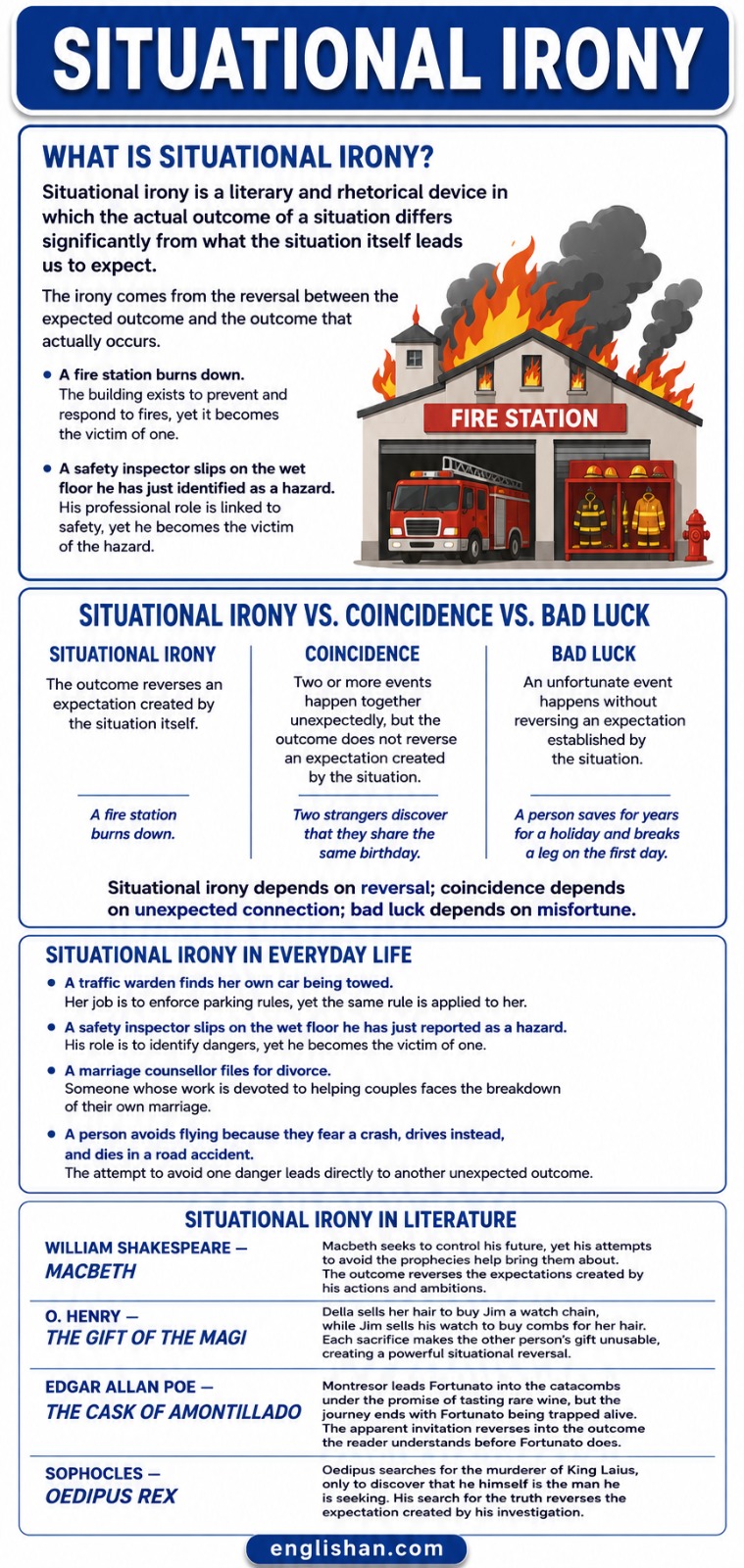
Situational irony is a reversal in events rather than a reversal in words: the outcome contradicts what the situation led people to expect.
Among the three types of irony, this one alone needs no speaker and no informed audience. Verbal irony needs a speaker who means the reverse of the words chosen. Dramatic irony needs an audience who knows what a character lacks. Situational irony places the whole reversal in the events, so a reader who joins late still finds it intact.
- A locksmith comes home to a burgled house. ✅
- A famous chef eats a bad meal on holiday. ❌
A surprising outcome is not enough on its own, since nothing about a holiday ever promised the chef good cooking. Plenty of surprising outcomes overturn no expectation at all, and a reader who treats every twist as irony ends up calling ordinary bad news by the wrong name.
Where the Expectation Has to Come From
Readers misfile an example at one joint, finding the expectation in somebody’s hopes rather than in the situation. Hopes attach to everything, so anyone defining irony from hopes alone ends up calling every disappointment in the world ironic.
One clause is the whole answer: the situation itself has to be what created the expectation the outcome reverses.
A fire station promises through its purpose. A lifeguard promises through his training. A pardon promises through the function of the document, and none of the three ever states the promise aloud. Events break those promises without anybody saying a word.
Ask two questions of any case:
- What did the situation promise, and what inside the situation made the promise?
- Has the outcome reversed that promise, or has it only disappointed the person hoping?
A case failing question one never proceeds to question two. Such a case has no promise to break, whatever the outcome costs the person who suffers it.
Nine Situations, Worked to a Verdict
Name the promise first and the reversal second, on the cases here and on any case of your own.
When the Purpose Is the Promise
The thing’s own function creates the expectation here, so no other setup is needed.
- A fire station burns down. ✅ The building exists to stop fires, so the purpose sets the expectation and the fire reverses it directly.
- A lifeguard drowns while on duty. ✅ His training in that water promised competence in it, so the drowning reverses the promise. A shark taking him breaks no promise, because no training ever claimed protection from sharks.
- A traffic warden finds her own car towed. ✅ Her job enforces the very rule the tow enforces against her, so the reversal comes out of the work she does.
When Nothing Made a Promise
The expectation came from a person’s hopes in each case here, so the outcome only disappoints.
- Rain falls on your wedding day. ❌ A wedding makes no promise about weather, so the hope for sun came from the couple rather than from the day.
- You meet the man of your dreams, then meet his beautiful wife. ❌ Meeting someone promises nothing about his marital status, so the discovery hurts without reversing anything.
- You win the lottery and die the next day. ❌ One event follows the other and nothing connects them. A win that caused the death would change the verdict, since the good fortune would then have ruined him.
When the Promise Is Hiding
An expectation exists here, and a reader has to work out who or what created it.
- A marriage counsellor files for divorce. ✅ Her job asserts expertise in keeping marriages whole, so the divorce reverses the claim she makes for a living.
- Two friends arrive at a party in the same dress. ❌ Coincidence explains the match, since nothing set an expectation for either woman. Neither woman promised anything, and a promise not to wear that dress would create the expectation the same arrival then reverses.
- A man afraid of flying drives instead and dies in a crash on the way. ✅ He chose the road to avoid dying in transit, and the road killed him anyway. His avoidance is the setup, which separates the case from ordinary bad luck.
Situational Irony or Coincidence
A coincidence pairs two improbable events, while situational irony sets an outcome against the expectation the situation raised. Coincidence needs no expectation at all, and the overlap between the two devices ends right there.
Test a suspect case by asking what would have to be true for the outcome to feel ordinary in that situation. Where the answer names something the situation promised, the case is situational irony. Where the answer has nothing beyond low probability in it, the case stays a coincidence.
- Two strangers on a train discover they share a birthday. ❌
- A stunt driver crashes on the way home from collecting a safest-driver award. ✅
Coincidence separates from irony the way a non sequitur separates from an argument. One is a claim nothing before it supports, and the other an outcome nothing before it set up.
Neither device resembles a paradox, which keeps its contradiction open permanently. Situational irony leaves nothing open, since one outcome occurs and one expectation breaks.
Situational Irony or Bad Luck
Can misfortune with a sharp contrast be irony? Only misfortune reversing an expectation the situation set is ironic, and most misfortune breaks no promise.
Bad luck hurts whoever suffers it and undoes nothing. Bad luck with a wide gap between hope and result feels like irony, and the width of the gap means nothing here. Everything turns on where the expectation came from.
- A man saves for twenty years for one holiday and breaks his leg on day one. ❌
- A safety inspector slips on the wet floor he has just written up as a hazard. ✅
What the Song “Ironic” Gets Right and What It Gets Wrong
Alanis Morissette’s “Ironic” gave the term its most-argued exhibit, and most arguments about it end in a verdict on the whole song. The song splits under line-by-line judgement, and one line is ironic outright.
Judge the four disputed lines one at a time, always by where the expectation came from.
- A black fly in your chardonnay ❌ Wine makes no promise about insects, so the fly spoils a glass and reverses nothing.
- A traffic jam when you’re already late ❌ Roads promise nobody an open lane, so a jam on a late morning is bad timing and nothing more.
- A death-row pardon two minutes too late ✅ A pardon exists to stop an execution, so arriving after the execution reverses the whole purpose of the document. Only here does the song get it right.
- Ten thousand spoons when all you need is a knife ❌ A drawer of spoons never claimed to hold a knife, so the situation only frustrates.
Dismissing the song wholesale repeats the very error it became famous for, since one line in four meets the rule exactly. Judge by line rather than by reputation, on this song and on any long list of examples.
Cosmic Irony, When the Reversal Reads as Fate
Cosmic irony is the case where the reversal fits so precisely that a reader reads it as arranged rather than as accident. Nothing licenses that reading unless the text names an arranger: fate, the gods, or a will beneath events.
Thomas Hardy ends Tess of the d’Urbervilles with the sentence that anchors the term: “‘Justice’ was done, and the President of the Immortals, in Aeschylean phrase, had ended his sport with Tess.” Hardy names the arranger, calls the arrangement sport, and hands the reader that reading directly.
Hardy’s poem “The Convergence of the Twain” repeats the same design. The poem sets ship and iceberg growing toward each other for years before they meet. Those two histories, built for one collision, are the arrangement cosmic irony asks for.
The error to avoid here calls every tragic outcome cosmic irony. Tragic outcomes fail the first test, since a death from illness contradicts no expectation and names no arranger. Cosmic irony needs the reversal first and the sense of design second.
Poetic Justice, When the Reversal Is Deserved
Poetic justice is situational irony with one extra condition: the character earned the reversal through his own conduct. Deservedness alone is not irony, and a reversal alone is not justice.
Haman, in the Book of Esther, builds a gallows for Mordecai and hangs on it himself. The gallows sets the expectation, since Haman built it for one purpose, and the reversal kills him with his own construction.
- A blackmailer is undone by the recordings he made of his victims. ✅
- A cruel landlord is killed by lightning. ❌
Punishment from outside the character’s own conduct ends a story fairly and stops there.
Situational Irony and Dramatic Irony
Both devices open a gap between two positions, and the positions differ. Dramatic irony opens its gap between what the audience knows and what the character knows. Situational irony opens its gap between the expected outcome and the actual one.
Ask which character believes something false, if any. Where a character believes something false while the audience knows the truth, the scene is dramatic irony. Where nobody believes anything false and the events themselves reverse, the scene is situational irony.
Both can run in one scene at once, as Oedipus proves. Oedipus hunts the killer of Laius while the audience knows he hunts himself, and that gap is dramatic irony. His search destroys the man conducting it, and that reversal is situational irony, while his recognition at the close is an epiphany.
Situational Irony and Peripeteia
Peripeteia, a term from Aristotle’s Poetics, names the moment where a character’s fortune turns. A turning fortune is not a reversed expectation, so situational irony and peripeteia answer to different tests.
A fortune can reverse without any expectation breaking. Fortune rises for a soldier inheriting money from an uncle he never met, and nothing in that situation promised poverty, so peripeteia alone fits the case.
The two coincide when news meant to reassure Oedipus destroys him, dropping his fortune and reversing the expectation the messenger created.
Five Printed Reversals
A printed reversal states its own setup, so a reader can point at both halves inside one story.
- “The Gift of the Magi”: Della sells her hair for a watch chain while Jim sells the watch for her combs. ✅
- “The Ransom of Red Chief”: two kidnappers take a boy and end up paying his father to take him back. ✅
- “Ozymandias”: the inscription commanding the mighty to despair stands in an empty desert. ✅
- “Oedipus Rex”: the king’s hunt for the murderer of Laius ends on himself. ✅
- “The Necklace”: Mathilde works ten years to replace a diamond necklace that turns out to be paste. ✅
The watch and the combs are left as proof of the loss, so they read as symbolism. That inscription in the desert overreaches, and overreach of that size goes by its own name, hubris, which manufactures the reversal in half the standard examples.
How to Build Situational Irony in Your Own Writing
Where should a writer start? Start at the promise rather than at the twist, since a reversal with no planted expectation reads as an accident.
Four moves build it in order:
- Name the promise the situation makes, and say what inside the situation created it.
- Plant that promise before the outcome, in an action or an object rather than in a statement.
- Choose the outcome reversing that specific promise, not merely a bad outcome.
- Let the setup cause the reversal wherever you can, because a caused reversal reads as design and a random one reads as a stumble.
Foreshadowing is move two done without announcement, since a detail paying off later plants the expectation while a reader takes it for scenery.
The common failure builds move three first and skips move two entirely. That failure drops an ending in unprepared, and a reader meets a surprise that cancels nothing, because nothing earlier promised otherwise.
Turning a Coincidence Into an Irony
Writers repair a flat coincidence in the wrong direction, planting the expectation after the outcome so a reader feels the joint. Repair runs the other way, changing the setup and never the ending.
Three steps do the repair:
- Start from the outcome you already have.
- Ask which agent, object or claim would have promised the opposite.
- Hand that agent, object or claim to your character before the outcome.
Rain on a wedding day repairs in one stroke: make the bride a meteorologist who set the date by her own forecast, and the rain reverses a promise she made herself.
Move the ten thousand spoons into the drawer of a knife shop, and the drawer belongs to a business whose entire stock promises the missing blade.
Both repairs changed the setup and left the outcome untouched, which is the order keeping a reversal honest.
Mistakes That Belong to No Single Case
You can know the rule and still make three errors: a promise kept, a reader’s own knowledge mistaken for the situation’s, and a plot twist taken for a reversal.
The met expectation: a setup promising something and then delivering it makes no irony, however carefully the promise was planted. Readers mislabel these because the setup felt like a signal of a twist ahead. Such a signal promises nothing about reversal, and a promise kept builds a plot rather than an irony.
Whose expectation counts: the case turns on the situation’s promise, never on the reader’s knowledge. Knowledge of the ending changes nothing, so a rereader loses the surprise and keeps the irony, because the fire station’s purpose still contradicts its burning.
The twist taken for a reversal: a plot twist changes what a reader believed about the story, while situational irony reverses what the situation promised inside the story. A revealed identity startles the reader without reversing any promise the events made, and a hidden narrator startles the same way.
Frequently Asked Questions
Q1. What is the difference between situational irony and coincidence?
The difference lies in whether an expectation existed at all. Coincidence needs no expectation, since it pairs two improbable events with nothing set up before them. Situational irony instead requires the situation to have promised the opposite, so two strangers sharing a birthday stay a coincidence while a safest-driver award followed by a crash is irony. Ask what the situation promised, and a case with no answer stays coincidence.
Q2. Are the examples in the song “Ironic” actually ironic?
Some lines are ironic and most are not. Three of them break no promise the situation made: rain on a wedding day, a fly in the wine and a traffic jam. Only the pardon breaks a real promise, since a pardon exists to stop an execution and one arriving two minutes late reverses that purpose. Judge that way on every line, against the situation’s own promise rather than against the song’s reputation.
Q3. What is cosmic irony?
One kind of situational irony reads as arranged rather than as accidental, and cosmic irony is the term for it. Cosmic irony finds its anchor in Hardy, whose closing sentence in Tess of the d’Urbervilles states the arrangement outright: the President of the Immortals had ended his sport with Tess. Arrangement alone is not enough, so a tragic outcome breaking no expectation stays misfortune.
Q4. What is the difference between situational irony and dramatic irony?
The difference lies in where the gap opens. Dramatic irony opens a gap between what the audience knows and what the character does not, so it needs somebody who believes something false. Situational irony opens a gap between the expected outcome and the actual one, and it is still there even where every character and reader knows the ending. One scene can run both at once, as the whole of Oedipus’s search proves.
Q5. Is poetic justice the same as situational irony?
No, poetic justice is one sub-case of it, with one extra condition on the reversal. That reversal has to be deserved, and the deservedness has to grow out of something the character did, as when Haman hangs on the gallows he built for Mordecai. Where the punishment comes from outside the character, as with a villain killed by lightning, the ending is neither poetic justice nor irony.
Q6. Why is “The Gift of the Magi” situational irony?
Every gift in the story destroyed the thing it was bought to serve. Della sold her hair to buy Jim a chain for his watch, and Jim sold the watch to buy combs for her hair. That expectation came from the value each character places on the other’s treasure.