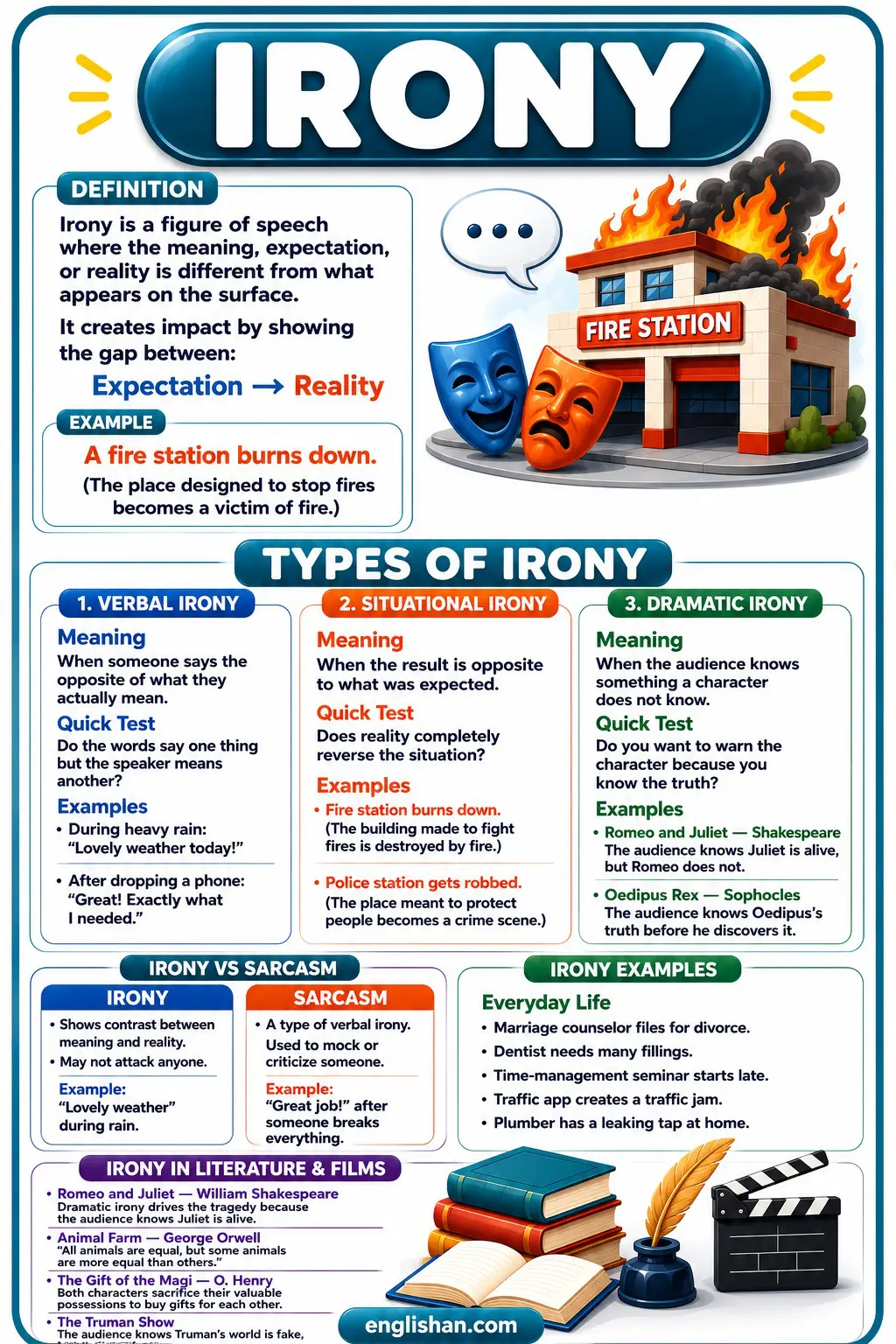
Irony is the gap between expectation and reality: a fire station burns down, a marriage counselor files for divorce, a tweet complaining about wasted time gets three hours of engagement. The device turns that gap into meaning, and English uses it in three main forms: verbal irony says the opposite of what is meant, situational irony delivers the opposite of what was expected, and dramatic irony lets the audience know what a character does not. Learn the three tests and you will label any example in seconds, even the ones the internet argues about.
What Is Irony?
Every form of irony is built on a double layer: what is said, expected, or believed on the surface, and what is actually true underneath. The pleasure and the sting both come from watching the layers separate. The term reaches back to Greek comedy, where the eirōn was a stock character who won arguments by feigning ignorance, and eirōneia meant that feigned ignorance; twenty-five centuries later, pretending one thing while meaning another is still the core of the device.
Irony is not lying, because the audience is meant to see through it, and it is not mere surprise, because the reversal must invert the expectation rather than just differ from it. A lottery win is a surprise; a lottery win bankrupting the winner within a year is irony.
The 3 Main Types of Irony
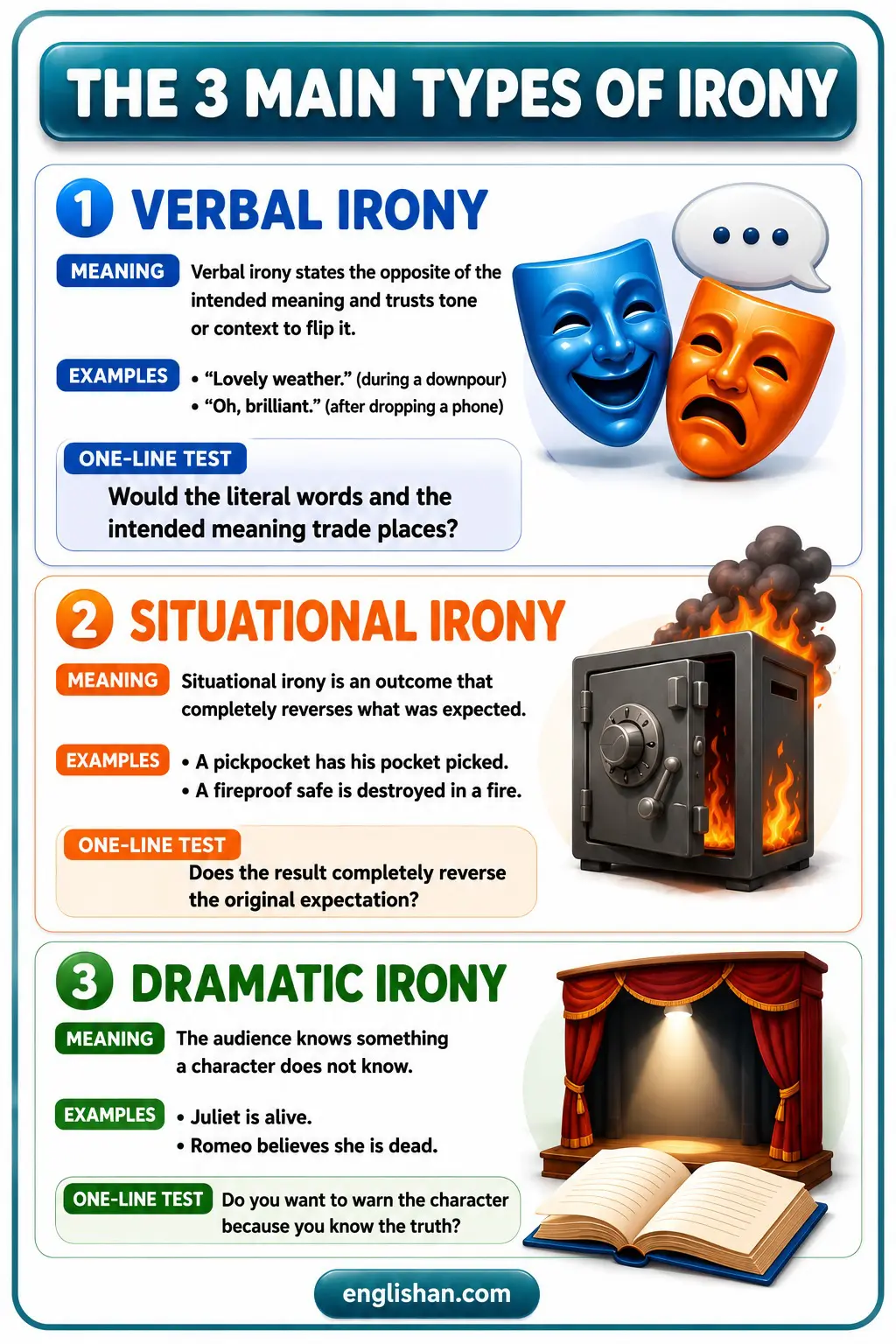
Three types account for nearly every real case, and each has a one-line test.
Verbal Irony
Verbal irony states the opposite of the intended meaning and trusts tone or context to flip it: “lovely weather” in a downpour, “oh, brilliant” over a shattered phone screen. The test: would the literal words and the intended meaning trade places on a truth table? Understatement and overstatement both serve it, which is why “not bad” from a British examiner means excellent.
Situational Irony
Situational irony is an outcome that inverts the setup: the outcome not only differs from expectation but mocks it. A pickpocket has his pocket picked; a fireproof safe is destroyed in a fire that harms nothing else. The test: state the expectation, state the result, and check that the result is the expectation reversed rather than merely disappointed.
Dramatic Irony
Dramatic irony gives the audience knowledge a character lacks, then makes the character act on the missing piece. Juliet is alive, the audience knows it, and Romeo drinks the poison anyway. The test: do you want to shout the secret at the character? If the urge exists, the irony is dramatic, and every horror film that sends a teenager toward the basement is running it.
More Types of Irony
Three further labels refine the map. Cosmic irony stages fate itself as the joker: Thomas Hardy’s characters strive while the universe quietly reverses each effort. Socratic irony is feigned ignorance as a teaching weapon; Socrates asked innocent questions until the confident answers collapsed, and courtroom lawyers run the same play today. Historical irony is hindsight’s specialty: Decca Records turned down the Beatles in 1962 with the verdict that guitar groups were finished, and the “war to end all wars” was renumbered within twenty-one years.
Irony Examples in Everyday Situations
Each of these pairs the expectation against the reversal, which is the fastest way to train the eye.
- The fire station burned down: the one building equipped against fire lost to it.
- The police station was burgled overnight: the safest address in town proved the easiest target.
- A marriage counselor filed for divorce: the expert’s specialty failed at home.
- The dentist needed six fillings: the enforcer of brushing skipped his own rules.
- A time-management seminar started late: the lesson defeated the lecturer.
- The traffic app crashed and caused a jam: the tool built to prevent delay produced one.
- A lifeguard who fears deep water: the rescuer needs rescuing from the job description.
- The spelling bee champion misspelled “champion” on the trophy form: mastery slipped at the victory lap.
- A post complaining about screen time went viral: the complaint fed the machine it accused.
- The plumber’s house has a leaking tap: the fixer’s own fixture drips.
- An English teacher’s resignation letter contained three typos: the red pen turned on its owner.
- The bank robber’s getaway car was stolen during the robbery: the thief was robbed on schedule.
- A fitness influencer sprained an ankle stepping off the stage at a wellness talk: the demonstration contradicted the demonstrator.
- The museum’s fire-safety exhibit set off the sprinklers: the warning became the accident.
- A book on decluttering is buried somewhere in the house: the solution joined the problem.
Verbal Irony Examples in Speech
Spoken irony rides on tone, and these lines flip in the mouth.
- “Lovely weather,” said into horizontal rain.
- “Oh good, another Monday,” from the office doorway.
- “Fantastic,” over a phone face-down on concrete.
- “Take your time,” to the slowest queue in the supermarket.
- “Because that worked so well last time,” in any planning meeting.
- “What a shame,” about a canceled meeting nobody wanted.
- “You don’t say,” greeting the obvious.
- “Not bad,” from an examiner, meaning outstanding.
- “I love waiting on hold,” to the recorded apology.
- “Sure, the diet starts today,” reaching for the cake.
Irony Examples in Literature
The canon’s most-taught passages are irony lessons in costume.
- Oedipus Rex by Sophocles: the founding case of dramatic irony; Oedipus vows to find the plague’s cause while the audience knows he is it, and every vow tightens the trap.
- Romeo and Juliet by William Shakespeare: Juliet sleeps, the audience knows, Romeo doesn’t; the tragedy’s engine is one missed letter and the viewer’s helpless knowledge.
- The Gift of the Magi by O. Henry: she sells her hair to buy him a watch chain; he sells his watch to buy her combs. A double situational reversal that lands as tenderness instead of cruelty.
- A Modest Proposal by Jonathan Swift: verbal irony sustained for an entire essay; Swift recommends the unspeakable in the calm voice of an economist until the reader hears the rage underneath.
- The Necklace by Guy de Maupassant: ten years of poverty repay a borrowed necklace that was fake all along; the reveal reverses the entire decade in one sentence.
- Animal Farm by George Orwell: “All animals are equal, but some animals are more equal than others” collapses the revolution’s promise inside its own slogan.
- The Wonderful Wizard of Oz by L. Frank Baum: the brain, the heart, and the courage were on board the whole journey; the quest’s goal was its starting inventory.
Irony in Movies and TV
Modern screens run the classical machinery at full speed.
- The Truman Show: two hours of pure dramatic irony; every viewer of the film shares the secret every viewer inside the film is keeping from Truman.
- Titanic: history supplies the dramatic irony free of charge, since the audience boards knowing the ending the passengers were promised was impossible.
- The Sixth Sense: the twist converts the whole film into retroactive dramatic irony, and the second viewing becomes a different genre.
- Shrek: situational irony as franchise premise; the monster is the hero, the prince is the villain, and the fairy tale mocks its own shelf.
Irony vs Sarcasm
Sarcasm is verbal irony with a target. Both say the opposite of what is meant, but sarcasm aims the reversal at a person to wound or mock: “nice job” to a colleague who deleted the database. All sarcasm is irony, while most irony has no victim at all; “lovely weather” mocks nobody. Tone reads the difference aloud, and intent settles it on paper.
Irony vs Coincidence
Half the internet’s irony arguments dissolve under one test: a bad break is not irony unless it reverses an expectation. Rain on a wedding day is misfortune; rain on the wedding day of a weather forecaster who chose the date from her own forecast is irony. A traffic jam when you’re already late is Tuesday; a traffic jam caused by the traffic-prevention system is irony. Alanis Morissette’s song Ironic became the debate’s permanent exhibit, since most of its scenarios (ten thousand spoons, a free ride already paid for) are plain bad luck, and a song titled Ironic containing little irony is the best irony in it. The rule to keep: coincidence surprises, irony reverses.
How to Use Irony in Writing
Irony is built from managed expectations, and the construction order is fixed: plant the expectation first, or the reversal has nothing to reverse. For situational irony, establish the promise (the unsinkable ship, the incorruptible cop) before breaking it. For dramatic irony, hand the reader the secret early and let scenes strain against it. For verbal irony, trust context to flip the words and never explain the flip. The labeling error kills the device faster than anything.
Ironically, the fire station ironically burned down, which was ironic. ❌
The town’s fire station burned down during Fire Safety Week. ✅
The first announces the irony three times and delivers none; the second sets expectation and reversal side by side and lets the reader feel the gap.
FAQs
Verbal irony says the opposite of what is meant, situational irony delivers an outcome that reverses expectation, and dramatic irony gives the audience knowledge a character lacks. Nearly every example sorts into one of the three, and the tests are: would the words flip, did the outcome invert, do you want to shout the secret.
Irony is a contrast between expectation and reality. A fire station burning down is situational irony: the building most prepared for fire is the one destroyed by it, so the outcome reverses the expectation rather than merely disappointing it.
Sarcasm is one kind of verbal irony: the reversal aimed at a person to mock or wound. Every sarcastic remark is ironic, but most irony has no target; “lovely weather” in a storm mocks the sky, not a colleague.
No, it is bad luck, because no expectation is reversed; weather owes weddings nothing. It turns ironic only with a reversal attached, as when a weather forecaster picks the date from her own sunny forecast. The distinction settles most everyday irony debates.
In O. Henry’s The Gift of the Magi, a wife sells her hair to buy a chain for her husband’s watch while he sells the watch to buy combs for her hair. Each gift reverses the other’s purpose, a double situational irony that defines the type.
Dramatic irony is the gap between what the audience knows and what a character knows, with the character acting on the missing knowledge. Romeo drinking poison beside a living Juliet is the canonical case, and every audience wanting to shout at the screen is feeling the device work.