Verbal irony is a speaker saying one thing and meaning the opposite, with the hearer left to detect the difference. A speaker who calls a downpour lovely weather states nothing true and communicates something exact. In print the hearer has no tone of voice to work from, so a writer builds the contradiction into the sentence itself, and a reader who misses it loses the whole line.
What Verbal Irony Is
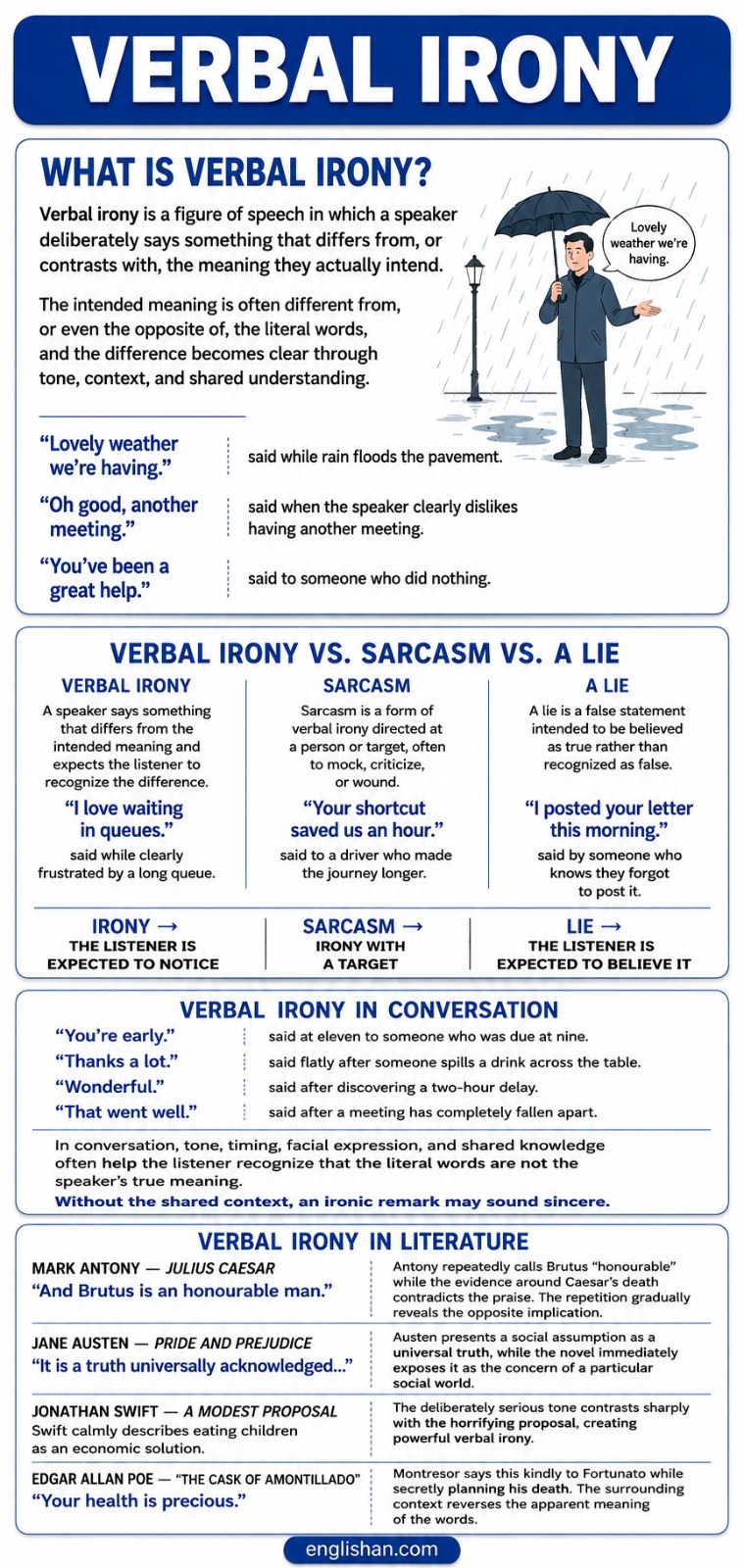
Verbal irony is two meanings inside one sentence: the meaning the words state and the meaning the speaker intends. The speaker states the false meaning on purpose and expects the hearer to infer the other one. One species of irony behaves that way, since verbal irony lives inside a line somebody utters while the other two live elsewhere.
- Lovely weather we’re having, said as rain floods the pavement. ✅
- Oh good, another meeting. ✅
- You’ve been a great help, said to a colleague who did nothing all afternoon. ✅
Do not treat every mismatch between words and reality as verbal irony. Mismatch alone never makes the device, because a speaker who says Tuesday and means Wednesday planned nothing. Instead, verbal irony needs a falsehood the speaker chose, and chose so the hearer would catch it.
The Shared Understanding Behind Every Ironic Line
Set the speaker’s words beside what the hearer already knows, and the irony is the distance between them. The words praise the rain; the hearer watches the rain. Neither half is irony alone, and the clash of the two makes all of it.
Missing either half changes the reading, so a colleague who watched the meeting collapse hears that went well as despair, and a colleague who walked in afterwards hears a plain report.
Sarcasm adds a target to that shared understanding, a lie withholds it, and a printed page forces the writer to build it out of context alone.
Verbal Irony vs Sarcasm
Are sarcasm and verbal irony two names for one thing? Sarcasm belongs to verbal irony as one kind of it, separated from the rest by a target. A speaker aims sarcasm at a person with intent to wound. So all sarcasm is verbal irony, while plenty of verbal irony aims at nobody at all.
- Your shortcut saved us an hour, said to the driver who added one. ✅
- Wonderful, muttered at a departures board announcing a two-hour delay. ❌ The remark wounds nobody, so the line stays verbal irony and calling it sarcasm would invent a target that never existed.
Untargeted irony fills ordinary speech: a speaker alone in a kitchen drops a plate, says marvellous, and wounds nobody in the room.
Sarcasm also occurs with no reversal at all, which catches out a reader who trusts the containment rule. One line proves the trouble: you are the worst person I have ever met, spat in earnest, sounds cutting and means exactly what it says. A cutting line meant literally falls outside the device, however sharp it sounds, since sharpness alone never makes verbal irony.
Readers reverse the containment and go wrong, since sarcasm never encloses verbal irony. The containment goes in one direction only: the target creates the sarcasm, and the reversal underneath creates the irony.
Verbal Irony vs a Lie
A reader who calls verbal irony a polite kind of lying has picked the wrong criterion. Both statements read as untrue on their face, and only one of them wants to pass undetected.
- I love waiting in queues, said by a speaker at the back of a long one. ✅
- I posted your letter this morning, said by somebody who forgot. ❌ The speaker wants the statement accepted, so being caught would ruin it, which makes the sentence a lie.
A lie needs you not to notice, and irony needs you to notice. An ironic line still works once you catch it, while a lie fails at that moment. Detection separates the two, and falsehood does not.
An ironic line that nobody catches has failed rather than turned into a lie. The speaker still intended the reversal, so the line is ironic whatever the hearer made of it.
Overstatement: Saying More Than You Mean
Oh good, another meeting praises an event the speaker dreads, and the praise overshoots anything the occasion supports. A speaker opens the gap between the words and the shared knowledge in one of three directions: upward, downward, or sideways into feigned ignorance. Upward is overstatement.
Ironic overstatement borrows the exaggeration of hyperbole and aims it where the facts run the other way. Plain hyperbole overshoots in the direction of the truth, calling a heavy bag a ton. Ironic overstatement overshoots against the truth, calling a tedious afternoon fascinating.
- Thank you for the most fascinating two hours of my life, after a delayed train. ✅
- He’s an absolute genius, said of a man who locked his keys inside the car. ✅
- As subtle as a brick through a window. ✅ Ironic similes freeze the overstatement into a set phrase, so the second half denies the quality the first half claims.
Understatement: Saying Less Than You Mean
Open the same gap downward and understatement follows. A speaker names something far smaller than the shared knowledge supports, and the hearer scales the statement back up.
- A bit of a setback, said of a company that lost half its staff in a week. ✅
- Not bad, said of a performance the speaker thought outstanding. ✅
- I’ve had worse, said with a broken arm in a sling. ✅
Students of English go wrong on not bad more than on any other understatement. The written phrase reads as lukewarm and means high praise in speech, so taking it for a shrug loses most of what the speaker offered.
Ironic understatement parts from plain modesty on one point: has the shared knowledge already contradicted the words? Such shrinking has two named forms: meiosis picks a smaller word for something large, while litotes denies the opposite instead of naming the quality. Neither becomes ironic until both parties already know the true size.
Socratic Irony: Pretending Not to Know
Socrates asks a confident young man to explain what justice means, and Socrates already knows an answer. Knowing the answer while asking the question makes Socratic irony, since the speaker professes ignorance and the profession itself is the falsehood.
Genuine puzzlement goes by its own name, aporia, and the two look identical on the surface. Separate them by hunting the earlier pages for evidence that the speaker already knows. A reader who finds that evidence has found Socratic irony, and a reader who finds none has found real doubt.
- I’m sure you understand the budget far better than I do, from the finance director. ✅
- Remind me how the printer works, from the engineer who installed it. ✅ Prior knowledge belongs to the speaker’s own history, and the question exposes whoever has been breaking the machine.
You overshoot badly if you call every innocent-sounding question Socratic irony. A question asked by somebody the text has never shown to know the answer stays a question.
How Verbal Irony Is Signalled on the Page
A reader hunting for a tone of voice inside a printed sentence finds nothing and files the line as sincere. A printed sentence has no pitch, no drawl and no raised eyebrow, so a writer builds the shared understanding out of the text itself.
- The house had burned to the foundations. “Well,” said Mira, “that saves us the redecorating.” ✅ The sentence before the quotation states the disaster, so the remark cannot be weighed against anything except ruin.
- Three hours in a corridor with no chair, and Delia called it the highlight of her year. ✅ The praise overshoots what the occasion supports, and the overshoot itself tells a reader how the afternoon went.
- He observed that being shot twice before lunch had put him rather behind schedule. ✅ A narrator reports something outrageous as calmly as a timetable, and the calm itself signals that nobody expects the words taken straight.
- We were treated to a “complimentary” upgrade that cost us forty pounds. ✅ Scare quotes around one word cancel it, since the punctuation hands a reader the writer’s distance from the term.
- Marcus had spent the morning setting fire to the archive. “Do be careful with those documents,” he said. ✅ Surrounding context rules out a literal reading altogether, so the caution reverses into a boast.
Praise words carrying warm associations cannot be read straight when the text has already described the scene as a disaster.
Repetition hardens an ironic phrase with each return, and Mark Antony builds an entire funeral speech on the hardening. That hardening has a partner outside the quotation, where reporting verbs set the reading before it opens: drawled, offered and observed separate a speaker from the words, while shouted joins them.
Reading Verbal Irony in a Second Language
A learner who hears lovely weather during a downpour and files it as a remark about the sky has lost the whole sentence. Nothing in it announced the loss.
Losing a sentence that way troubles some readers more than others, because speech communities differ in how much irony they expect and how heavily they flag it.
You catch irony by working through a procedure rather than by having an ear for it. Ask three questions of any suspect line. First, does the situation the speaker stands in contradict the words? Where it does, ask second whether the praise overshoots what the occasion supports. Where the praise overshoots, ask third whether a sincere reading would leave the speaker sounding foolish or oddly cheerful.
- You’re early, said at eleven to somebody due at nine. ✅
- Thanks a lot, said flatly to somebody who has knocked a drink across the table. ✅
Learners also attempt irony that nobody catches. Catching it needs the shared half, so a hearer without that half files an ironic remark as sincere praise or a sincere insult.
Must the Ironic Meaning Be the Exact Opposite?
Must an ironic line invert into its exact opposite? Exact opposition accounts for most cases without ever becoming the rule, so the answer runs no. Incompatibility is the real rule: the intended meaning has to clash with the literal one.
- Lovely weather, said in a downpour. ✅
- That was interesting, said of a flight that lost an engine over the Atlantic. ✅ Nobody means boring, so the antonym names the wrong reading and the intended sense runs closer to terrifying.
Incompatibility differs from the self-contradiction inside a paradox, where the reader holds both halves of the sentence at once and cancels neither. In verbal irony the reader drops the literal reading outright and keeps only the intended one.
Ask what the hearer ends up believing rather than what the antonym would be, since a reader who hunts for opposites will stall on half the ironic lines in English.
Dead Irony: When the Reversal Stops Working
Once a reversal becomes the settled meaning of a phrase, no inference remains for the hearer to make. Phrases at that stage mean the reversed sense straight.
- Thanks a lot. ✅
- Nice one. ✅ Approval and reproach both live in the phrase now, and only the situation tells a hearer which one is meant.
- Tell me about it. ✅ A speaker inverts a request to be told more, and the phrase has meant agreement long enough to lose its reversal.
- Great, said flatly at bad news. ✅
Treating these as live verbal irony misdescribes what a hearer actually infers. Live irony asks the hearer to reverse the line, while dead irony hands over the reversed sense already made.
Students of English meet the trouble twice over, since fixed ironic phrases outnumber invented ones in daily speech and a frozen phrase no longer shows its reversal.
Punctuating Irony: The Marks That Never Caught On
Why has English never adopted an irony mark, when so many printers have proposed one? Printers and writers have tried for more than four centuries, and every attempt has died.
Henry Denham, an English printer, proposed the percontation point in the 1580s, a reversed question mark for rhetorical questions. Marcellin Jobard proposed another symbol in print on 11 October 1841. Alcanter de Brahm published a rival symbol in 1899, the point d’ironie, a small raised question mark facing backwards. Hervé Bazin offered one more symbol in 1966, a Greek psi with a dot beneath it. Ethiopic writing already had one more symbol of its own, the temherte slaq, an inverted exclamation point for sarcasm, and English borrowed nothing from it. Such proposals failed in the same way afterwards, from the SarcMark of 2010 to the /s and the tilde that online writers append now.
Every one of those symbols failed for one reason: no symbol can manufacture shared understanding. Print the symbol beside a sincere sentence and a reader learns only that the writer wanted a reversal. Building the reversal needs the words and the situation, so the burden falls entirely on context.
Four Literary Lines and How Each One Lands
Four famous lines each signal the reversal differently: repetition, overstatement, a flat report and surrounding context. Repetition runs Mark Antony’s speech over Caesar’s body in Shakespeare’s Julius Caesar.
But Brutus says he was ambitious; And Brutus is an honourable man.
Antony repeats honourable while the evidence he cites contradicts the word, and repetition hardens it with each pass. The crowd hears an accusation Antony never states.
Jane Austen opens Pride and Prejudice with a claim about the whole world.
It is a truth universally acknowledged, that a single man in possession of a good fortune, must be in want of a wife.
Austen states as universal what the novel then reduces to the wish of a few mothers in one neighbourhood. That universal claim overshoots, since no truth commands universal agreement.
Jonathan Swift writes A Modest Proposal in the flat vocabulary of an economic pamphlet.
A young healthy child well nursed is at a year old a most delicious, nourishing, and wholesome food.
Swift proposes cannibalism without once raising his voice. He signals the irony by keeping the tone flat against that content, and a reader who takes the sentence straight has ignored what the words describe.
Montresor speaks kindly to Fortunato in Poe’s “The Cask of Amontillado”.
Your health is precious.
Montresor addresses a man he plans to wall up alive, so surrounding context reverses the words into a threat. That line is verbal irony, while the reader’s foreknowledge of the murder is dramatic irony, and one sentence does both at once.
Writing Verbal Irony Your Reader Will Catch
Build the ground before the ironic line, since the text has to state the contradicting fact ahead of the remark. Description first, remark second.
- The roof had come down in the night. “Nothing a bit of tape won’t fix,” said Ade. ✅
- “Nothing a bit of tape won’t fix,” said Ade. The roof had come down in the night. ❌ Nothing weighs against the remark as the reader meets it, and the correction follows one sentence too late.
A word too formal or too warm for the occasion exposes a writer’s distance from it, and that choice of words is diction.
Explaining the irony afterwards cancels it, because the hearer’s own inference creates the entire effect and a narrator who spells out the reversal leaves a flat statement behind.
Typography deserves a light hand, since scare quotes and italics apply to one word at a time. Use them on every line and the signal dies, because a reader meeting the device everywhere stops checking the situation.
Verbal Irony Against Situational and Dramatic Irony
Set the three types side by side and one axis separates them: where the gap opens and who knows its two halves.
| Type | Where the gap sits | Who holds the halves |
|---|---|---|
| Verbal irony | Between the words uttered and the meaning intended | A speaker and a hearer |
| Situational irony | Between an expected outcome and the real one | An expectation and an event |
| Dramatic irony | Between what the audience knows and what the character does not | An audience and a character |
Ask who knows the two halves, and the type of irony follows without argument. Nobody knows either half in a fire station burning down, since no speaker uttered anything, and the outcome alone makes the irony.
Frequently Asked Questions
Q1. What is the difference between verbal irony and sarcasm?
The difference lies in the target. A target makes sarcasm, so all sarcasm is verbal irony while much verbal irony aims at nobody. Nobody suffers when a passenger mutters wonderful at a delayed train, so the line reverses like any ironic one and stays outside sarcasm.
Q2. Is verbal irony the same as lying?
No, and the two split on detection. Detection separates them: a lie needs the hearer not to notice, while verbal irony needs the hearer to notice and reverse the statement. Both sentences read as untrue on their face, and only the liar profits from going uncaught.
Q3. Can verbal irony be a compliment?
Yes, when the reversal runs from a harsh word towards a warm meaning. One coach telling a striker you’ll never do anything with that left foot seconds after a goal means the opposite of the words. Nobody suffers, so ironic praise stays verbal irony and never becomes sarcasm.
Q4. What is the difference between verbal irony and Socratic irony?
The difference lies in what the speaker fakes. Ordinary verbal irony fakes the matter at hand, and Socratic irony fakes what the speaker knows. Socratic questions have answers the speaker already holds, and the pretence itself is the untrue part. Socratic irony is one kind of verbal irony rather than a rival to it.
Q5. How do you spot verbal irony in writing when you cannot hear the tone?
A writer signals verbal irony through five cues a reader can check. Two belong to the line itself: praise goes to a scene the text has already described as a disaster, and the praise overshoots what the occasion supports. Three belong to the telling: a narrator reports something outrageous without alarm, scare quotes or italics cancel a single word, and repetition hardens a phrase each time it returns. Check all five and the reading follows, since a sentence contradicting what the text has just shown reads as ironic rather than as literal.
Q6. Does verbal irony always mean the exact opposite?
No, though exact opposition accounts for most cases. Opposition is not the rule, since the intended meaning has to clash with the literal one rather than invert it. That was interesting, said of a flight that lost an engine, never inverts to that was boring, and the speaker means something nearer terrifying.