An anecdote is a short, true story told to make a point. A grandmother’s story about her first job, a comedian’s account of a bad flight, and a teacher’s memory of a student who finally understood a hard lesson are all anecdotes. English speakers use them almost every day in conversation, speeches, and books, because a short true story convinces faster than a general statement.
What Is an Anecdote?
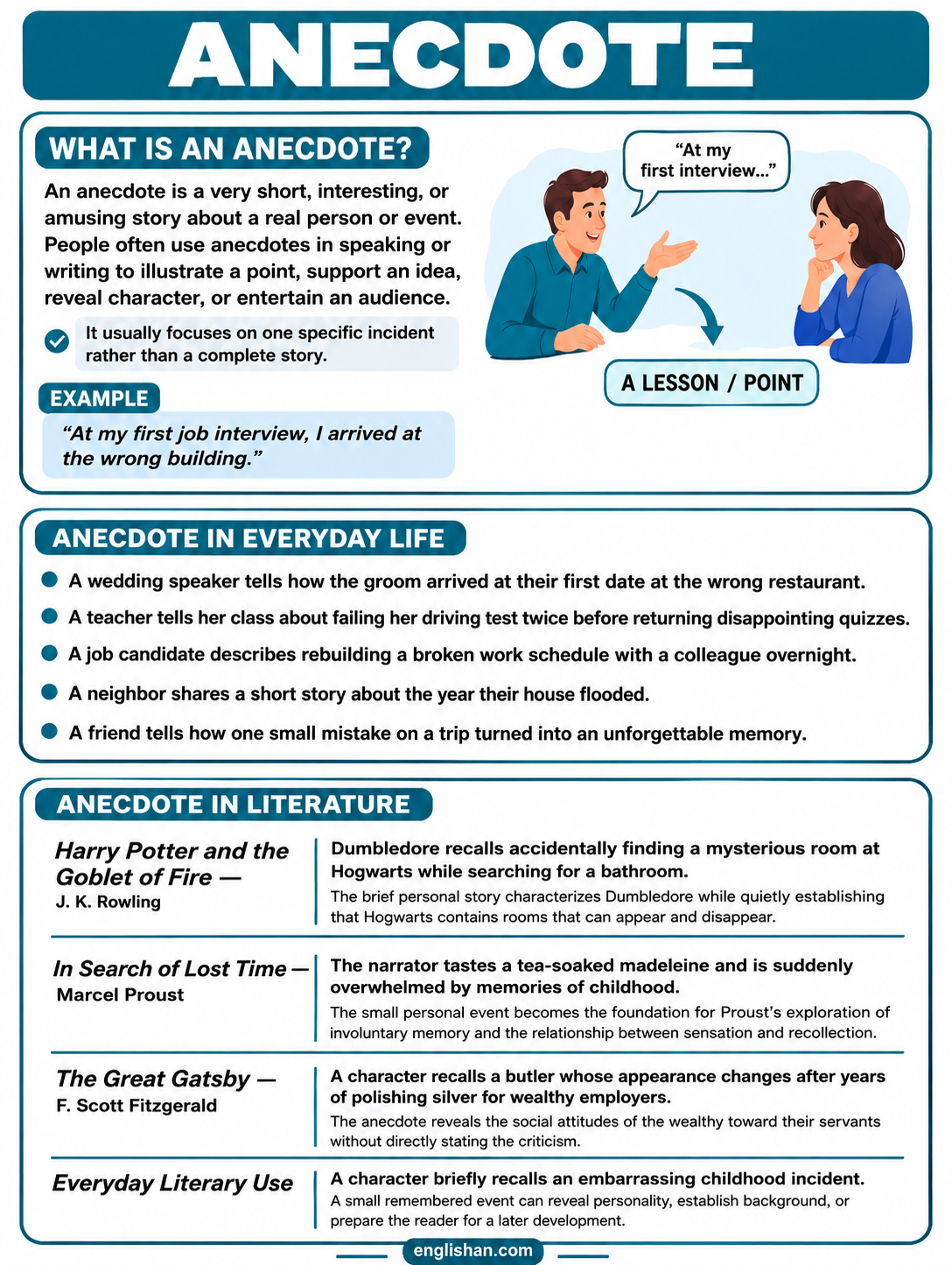
An anecdote is a short account of a real event involving a specific person, told to make a point, entertain, or add a human detail to a larger idea. Three traits set it apart from a story in general. It reports something that actually happened, and it stays brief, a few sentences to a short paragraph. The teller also uses it for a reason beyond the story itself. A speaker does not tell an anecdote just to pass the time; they tell it to prove something, warn someone, or make an audience laugh.
The word comes from the Greek anekdota, meaning “unpublished things.” Early anecdotes were private accounts about public figures, the type of detail left out of an official record. That sense of a small, personal, behind-the-scenes moment still shapes how the word works today.
Types of Anecdotes
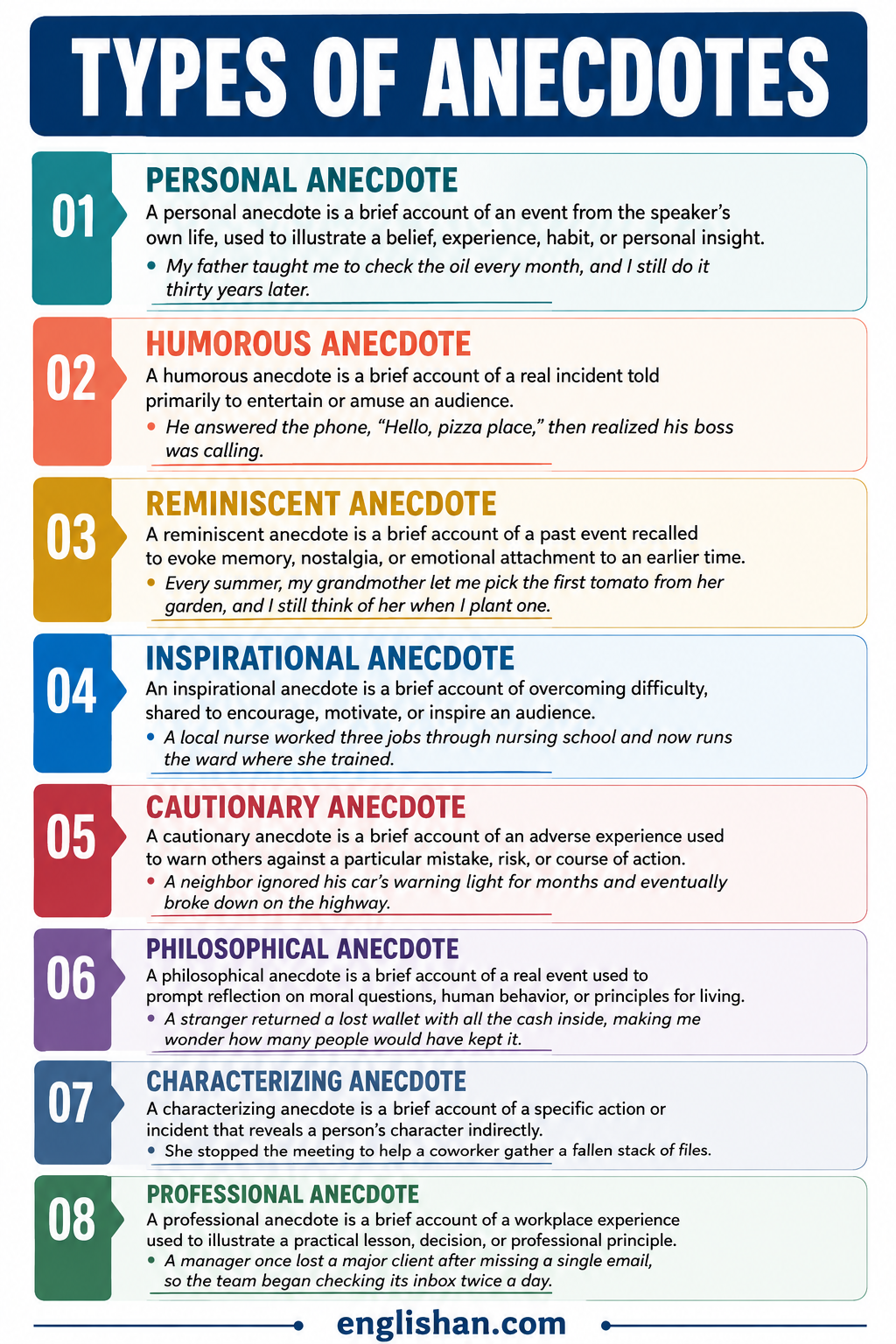
Anecdotes take different shapes depending on what the teller wants to achieve. Recognizing the type shows a reader or listener why a speaker chose that particular memory to share.
- Personal: The teller draws this story from their own life to explain how a belief or habit formed. My father taught me to check the oil every month, and I still do it out of habit thirty years later.
- Humorous: The teller aims mainly to make an audience laugh, usually with a small accident or an awkward moment. He answered the phone with “Hello, pizza place,” only to realize it was his boss calling.
- Reminiscent: This type looks back on a shared or personal past, with a note of nostalgia for a time or a person who mattered. Every summer, my grandmother let me pick the first tomato from her garden, and I still think of her whenever I plant one.
- Inspirational: The teller recounts someone overcoming a real obstacle in order to motivate the listener. A local nurse worked three jobs through nursing school and now runs the ward where she once trained.
- Cautionary: The teller warns against a mistake by describing what happened to someone who made it. A neighbor skipped his car’s check-engine light for months and ended up stranded on the highway with a burned-out engine.
- Philosophical: The teller uses a small real event to raise a larger question about right and wrong, or about how people should live. A stranger returned a lost wallet with all the cash inside, which made me wonder how many people would have kept it.
- Characterizing: One small, specific moment reveals what a person is like, without any direct description. She stopped mid-meeting to help a coworker who had dropped a stack of files, and that told me everything about how she leads.
- Professional: Colleagues share this type at work to illustrate a lesson learned on the job. A manager once described losing a major client over a single unreturned email, and the team has double-checked its inbox ever since.
How Anecdotes Are Structured
A well-told anecdote follows a narrative shape that rarely changes, whatever it describes. First comes the setup, which narrative writing calls the exposition: who was involved and where the moment took place, given in as few words as the listener needs. Then comes the central event, the single thing that happened, told without extra specifics that would slow it down. Last comes the takeaway, the reason the story was worth telling in the first place, whether that reason is stated outright or left for the listener to work out alone.
Consider a short workplace example. Setup: a new employee’s first week at a busy restaurant. Event: she dropped a full tray in front of the owner on her second shift, certain she would be fired on the spot. Takeaway: the owner just handed her a mop and said everyone breaks a plate their first month, and she still works there five years later. Strip out any one of those three parts, and the anecdote either confuses the listener or loses its point.
Anecdote Examples in Literature
Inside larger works, writers place an anecdote where it can slow the pace, reveal character, or plant an idea the reader will need later.
In J.K. Rowling’s Harry Potter and the Goblet of Fire, Dumbledore tells a brief, passing story about taking a wrong turn on the way to the bathroom. He describes finding a room full of chamber pots that vanished when he went looking for it again. The anecdote does double work: it makes Dumbledore seem approachable and slightly odd, and it establishes that Hogwarts hides rooms that appear and disappear, a detail the plot depends on later.
Marcel Proust opens a famous passage of In Search of Lost Time with an anecdote about tasting a tea-soaked madeleine cookie as an adult. The taste floods the narrator with childhood memories he thought he had lost. The anecdote is not decoration; it is central to the whole novel, since Proust builds an argument about memory out of one small, specific taste.
In The Great Gatsby, F. Scott Fitzgerald has a minor character share an anecdote about Daisy’s butler, whose nose gets so raw from polishing silver that Daisy stops noticing his face at all. The brief story reveals how the wealthy characters treat the people who serve them, without Fitzgerald ever stating the point outright.
Anecdote Examples in Everyday Life
Outside of books, anecdotes fill most of the small talk, speeches, and lessons that make up an ordinary day. Speakers deliver them in relaxed, colloquial language that would feel out of place in formal writing.
- A best man opens a wedding toast with a story about the groom showing up to their first date in the wrong restaurant, two blocks from where he was supposed to be.
- A teacher tells a class about the time she failed her own driving test twice, right before handing back a set of disappointing quiz scores.
- A job candidate answers an interview question about teamwork by describing the week she and a coworker rebuilt a broken schedule from scratch overnight.
- Two neighbors chatting over a fence trade short stories about the years their houses flooded, each one topping the last.
Why Writers Use Anecdotes
Writers and speakers use anecdotes to do work that a plain statement cannot. A real detail about a real person is harder to dismiss than an abstract claim, which is why anecdotes are one of the oldest ways of establishing ethos in a speech or an essay. Many writers also open with one as a hook, the short opening of a speech or essay that pulls the audience in. An anecdote turns a complicated idea into something concrete as well. An economist explaining inflation with a story about one family’s grocery bill will reach more people than the same economist quoting a percentage. Beyond persuasion, anecdotes add humor and break up long stretches of explanation. They also give a reader something specific to remember once the surrounding facts have faded.
How to Use Anecdote in a Sentence
Anecdote functions as a countable noun and pairs naturally with verbs like tell, share, open with, and illustrate with.
- She opened her speech with an anecdote about her first day on the job.
- He shared a quick anecdote to explain why the new policy mattered.
- The essay illustrates its main point with a brief anecdote about a small business owner.
The related adjective is anecdotal, used to describe evidence based on individual accounts rather than formal study: the results are anecdotal, so the team still needs a proper study to confirm them.
Anecdote vs Antidote
These two words blur together in writing because they share nearly every letter, but their meanings do not overlap at all. An anecdote is a short true story. An antidote is a substance that works against a poison, or more loosely, a remedy for a problem. The hospital kept an antidote on hand for snakebites. A memory trick keeps them apart: antidote starts with anti-, the same prefix found in antibody and antifreeze, both of which work against something harmful. Anecdote has no such prefix; it echoes its Greek root about untold stories. If the sentence involves a cure, a treatment, or undoing harm, the word needed is antidote, never anecdote.
Anecdote vs Story
Every anecdote is a type of story, but not every story is an anecdote. A story can be invented, and it can exist purely to entertain. It can also run to any length; a memoir, for example, is a book-length account of the writer’s own life built from many linked anecdotes. An anecdote on its own is shorter by definition and is presented as something that actually happened. The teller always has a specific purpose inside a larger conversation or written work: to prove a point, warn a listener, or reveal something about a person. One more distinction is worth drawing: an analogy compares two unlike subjects to explain one of them, while an anecdote reports something that occurred. Learning a language is like building a house is an analogy; I once spent a month learning ten words a day and finally held a full conversation in Spanish is an anecdote.
Is an Anecdote Reliable Evidence?
An anecdote can support a point, but it cannot prove one on its own. A single account only shows that something happened once, not that it happens in every case. Accounts of this kind count as anecdotal evidence, and treating them as proof of a broad claim is a reasoning error called the anecdotal fallacy, or hasty generalization. A friend who smoked for sixty years without getting sick does not disprove the health risks of smoking. One account can never stand in for logos, reasoning built on data and structured argument rather than individual example. Used well, an anecdote still belongs beside real evidence. It makes an abstract statistic feel human, and a careful writer pairs the two rather than choosing one over the other.
FAQs
Yes, an anecdote is presented as a true account of something that actually happened, even when small specifics are smoothed over or the exact words are not recalled word for word. A story known to be invented, however short or purposeful, is closer to a fable or a parable than an anecdote.
Yes, an anecdote can center on the teller or on another person entirely. The teller can speak in the first person about their own life or in the third person about someone else. A speaker telling a story about a grandparent, a coworker, or a public figure is still telling an anecdote, as long as the account is brief, true, and told to make a specific point.
Close synonyms are story, tale, account, and reminiscence, though none matches the exact same sense of brevity and purpose. Story is the broadest of these and can describe something invented, which an anecdote cannot be.
The word comes from the Greek anekdota, meaning “unpublished things,” first used in English in the early eighteenth century. It originally described private facts about public figures that had been left out of the official record, which is why anecdotes still tend to feel like a small, personal glimpse behind the main story.