A colloquialism is a word or phrase that belongs to everyday, casual speech rather than formal writing, and it is usually tied to one region or time period. Writers reach for it to make dialogue sound real, and readers meet it constantly without ever learning its name. Terms like y’all, gonna, and ain’t are colloquialisms in daily use across English, and each region adds colloquialisms of its own. Once you spot the pattern, you notice it everywhere.
What Is Colloquialism
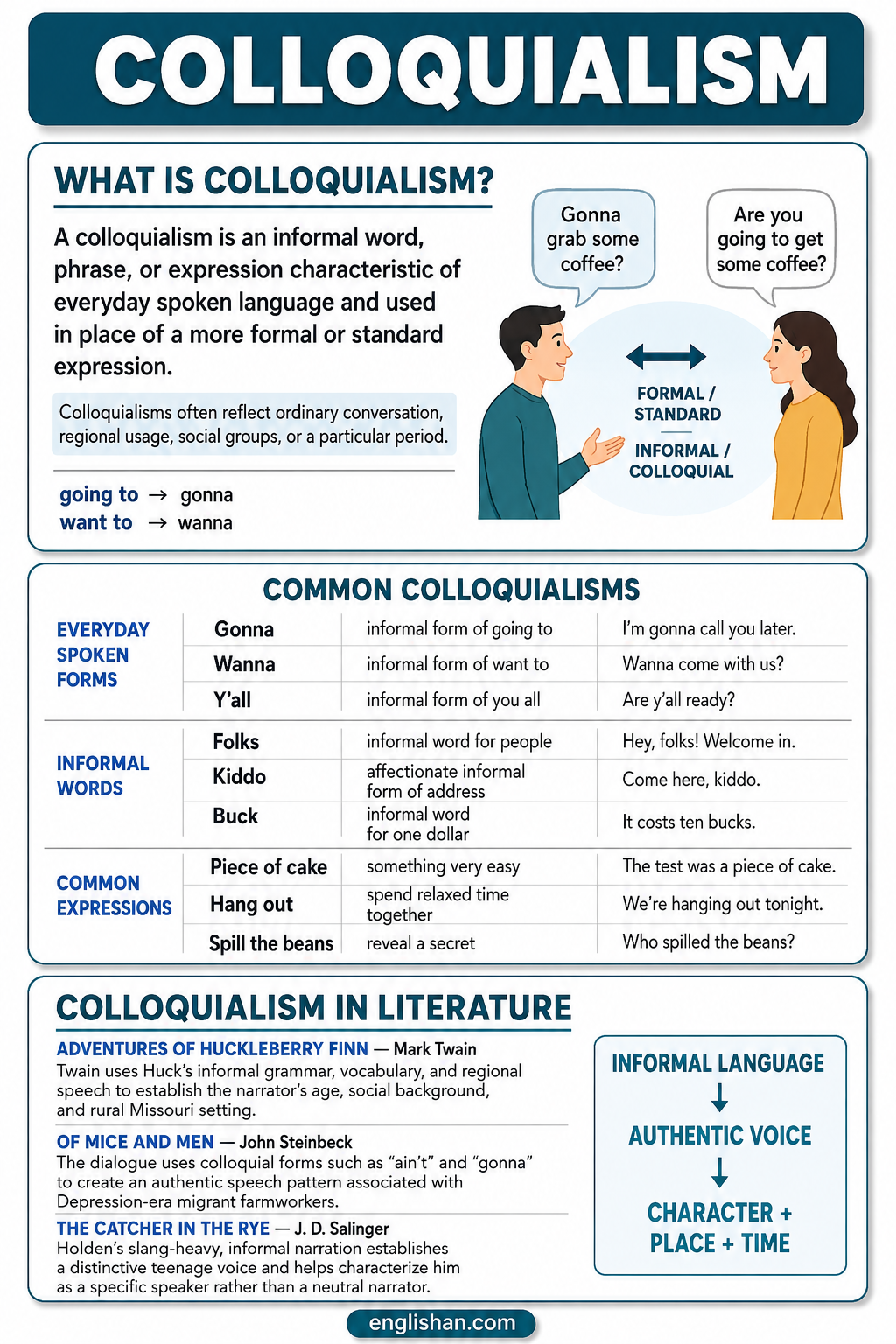
A colloquialism is an informal word or expression typical of ordinary conversation in a particular region, community, or era, used in place of a more formal equivalent. Colloquialism is also a recognized literary device: writers use it deliberately to build realistic dialogue, mark a character’s background, or bring a reader closer to the page. The word entered English use in 1810, built from colloquial plus the suffix -ism. Colloquial itself comes from the Latin colloquium, meaning “conversation,” formed from com- (“together”) and loqui (“to speak”). That root explains the whole idea: colloquial language is the language of people speaking together, not the language of a formal report.
Colloquialism differs from a dialect in scope. A dialect is a full variety of a language, with its own grammar, pronunciation, and vocabulary. A colloquialism is a single word or phrase, and it can appear inside many dialects at once. Y’all belongs to Southern American dialect, but plenty of speakers outside that region use it casually too.
Colloquial vs Colloquialism
Colloquial and colloquialism share one root but do different grammatical work. Colloquial is an adjective, describing language, tone, or a specific word: “That line sounds colloquial.” Colloquialism is a noun, naming the informal word or phrase itself: “‘Ain’t’ is a colloquialism.” You can call a whole passage of dialogue colloquial, but you would call one specific phrase inside it a colloquialism. Getting this pair right matters for anything from an essay on diction to a quick note in the margin of a novel.
How Writers Use Colloquialisms
Writers turn to colloquial language for four connected reasons, and most passages of realistic dialogue lean on more than one at once.
Realistic dialogue: characters who speak in stiff, formal sentences rarely sound like real people, so a novelist writes the way a character would actually talk, contractions and all.
Character voice and background: a single colloquialism can signal a character’s home region, generation, or social class faster than a paragraph of description could. A character who says “y’all” reads as Southern before the narrator ever mentions the setting.
Tone and intimacy: colloquial language has a different connotation than its formal equivalent. “Grab a seat” feels warmer and more immediate than “Please be seated,” even though both sentences ask for the same thing.
Historical or regional setting: period-specific colloquialisms place a scene in a particular decade or place without any direct explanation, since readers absorb the era from the words alone.
Examples of Colloquialisms in Everyday Speech
These words and phrases turn up constantly in casual conversation and casual writing across English, though not every English speaker uses every one of them.
- Y’all: a contraction of “you all,” common across the American South and increasingly beyond it.
- Gonna: the casual spoken form of “going to.”
- Wanna: the casual spoken form of “want to.”
- Ain’t: an informal substitute for “am not,” “is not,” or “are not.”
- Folks: a warm, informal word for “people,” especially a group.
- Kiddo: an affectionate, informal way to address a child.
- Buck: an informal word for one dollar.
- Couch potato: someone who spends most of their free time sitting and watching television.
- Break a leg: a traditional way to wish someone good luck before a performance.
- Piece of cake: something very easy to accomplish.
- Hang out: to spend relaxed, unstructured time with someone.
- Chill out: to calm down or relax.
- Take a rain check: to postpone an invitation to a later date.
- Cost an arm and a leg: to be very expensive.
- Spill the beans: to reveal a secret, often accidentally.
- Under the weather: feeling mildly unwell.
- Hit the sack: to go to bed.
- Once in a blue moon: very rarely.
- Gotcha: an informal way of saying “I understand” or “I have caught you.”
- Fender bender: a minor car accident.
- Doohickey: an informal word for a small object whose name the speaker has forgotten.
- Betcha: the casual spoken form of “bet you.”
- Freak out: to react with sudden, strong alarm or excitement.
- Cheers: used informally in British and Australian English to mean “thank you” or “goodbye.”
- What’s the buzz: an informal way of asking what is happening or being talked about.
- Go nuts: to react with extreme excitement or, in some contexts, extreme anger.
- Being blue: feeling sad, an informal way of naming a low mood.
Colloquialism Examples by Region
Colloquial vocabulary changes sharply from one region to the next, since it grows out of local speech rather than a fixed standard.
American Colloquialisms
- Fixin’ to: about to do something, common across the American South.
- Wicked: used to mean “very,” a hallmark of New England speech.
- Ope: a soft exclamation of surprise or apology, common across the American Midwest.
- Pop: the word much of the American Midwest uses for a carbonated soft drink.
- Soda: the word most of the American Northeast and West Coast use for the same drink.
- Reckon: an informal way of saying “suppose” or “think,” common in the American South.
British Colloquialisms
- Bloody: a mild informal intensifier, roughly equivalent to “very.”
- Knackered: extremely tired.
- Chuffed: very pleased about something.
- Quid: an informal word for one British pound.
- Telly: an informal word for television.
- Gutted: deeply disappointed.
Australian Colloquialisms
- Arvo: an informal shortening of “afternoon.”
- Servo: an informal shortening of “service station.”
- Brekkie: an informal shortening of “breakfast.”
- Mate: a friendly, informal word for a friend or companion, used widely in daily conversation.
- No worries: an informal, easygoing way of saying “you’re welcome” or “that’s fine.”
- Heaps: an informal way of saying “a lot,” as in “heaps of fun.”
Colloquialism Examples in Literature
Novelists reach for colloquial dialogue when a character’s exact voice matters more than polished grammar, and these four books show the range of what that choice can do.
Adventures of Huckleberry Finn by Mark Twain narrates almost entirely in the voice of a barely-educated boy from rural Missouri. Twain writes lines like “I reckon a body that ups and tells the truth when he is in a tight place is taking considerable many risks,” letting the grammar and word choice establish the setting instead of describing it directly.
Of Mice and Men by John Steinbeck fills its dialogue with the plain, clipped speech of Depression-era migrant farmworkers. Characters say “ain’t” and “gonna” throughout, which keeps the men sounding like laborers rather than narrators reading a script.
To Kill a Mockingbird by Harper Lee sets its child narrator’s own voice against the wider Southern speech around her, so colloquial phrases mark class and background even within the same small town.
The Catcher in the Rye by J.D. Salinger runs almost entirely on the slangy, restless colloquial voice of a 1950s American teenager. That voice is a large part of why the narration still reads as a specific person rather than a generic storyteller decades later.
Colloquialism vs Slang, Jargon, and Idiom
These three terms overlap with colloquialism constantly, and mixing them up is one of the most common confusions learners run into.
| Term | What ties it together | Quick test |
|---|---|---|
| Colloquialism | Tied to a region or era, used by the general population | Would most people in that place say it in casual speech? |
| Slang | Tied to a social or age group rather than a place, changes quickly | Does it belong to a specific in-group rather than a whole region? |
| Jargon | Tied to a profession or field, can be formal within that field | Would only people in that job or hobby understand it? |
| Idiom | A fixed phrase whose overall meaning differs from its literal words | Does the phrase mean something the individual words don’t say? |
A single expression can fall into more than one category at once. Kick the bucket, meaning “to die,” is both a colloquialism (informal, widely used) and an idiom (its meaning has nothing to do with a literal bucket). No cap, meaning “no lie” or “seriously,” is slang rather than a broad colloquialism, since it belongs mainly to younger speakers and shifts fast. Tennis elbow, the everyday name for a specific tendon injury, is jargon that has become familiar enough to sound almost colloquial, though a doctor’s precise term for it remains formal medical jargon. This overlap is also why idioms confuse new English speakers. The phrase’s literal words point one way while its real meaning points another, which creates a moment of ambiguity until the fixed meaning is learned.
How to Use Colloquialisms Without Overusing Them
Colloquial language earns its place in writing when it serves a real purpose, and it costs the writing when it doesn’t.
Match it to your audience. A colloquialism that feels natural in a text message can feel out of place in a formal report. Check the register of the piece, meaning its expected level of formality, before reaching for one.
Don’t stack too many at once. A single well-placed colloquialism signals character or setting; a paragraph packed with them starts to read like an impression rather than a person.
Keep it authentic to the setting. A colloquialism from the wrong decade or the wrong region breaks a reader’s trust in the world of the story faster than almost any other slip.
Colloquial language ages quickly. A phrase that sounded current when a book was written can sound distinctly of its era a generation later, which is exactly why period colloquialisms in older novels now come with a strong sense of nostalgia they didn’t originally have.
That aging effect isn’t a flaw to avoid; used on purpose, it’s one more tool a writer can reach for when the goal is placing a reader firmly inside a specific decade.
FAQs
Common examples of colloquialisms in American English include y’all, gonna, and ain’t. Each one is an informal substitute for a more formal phrase, and each is tied to casual, everyday speech rather than formal writing.
Yes, colloquialism is a recognized literary device. Writers use it deliberately to build realistic dialogue, establish a character’s regional or social background, and create an informal, accessible tone for the reader.
The difference is what each one is tied to. A colloquialism is tied to a region or time period and is used by the general population there. Slang is tied to a specific social or age group, and it tends to change much faster than regional colloquial speech.
Yes, “ain’t” is a colloquialism. It functions as an informal substitute for “am not,” “is not,” or “are not.” It also appears across many regions of English rather than belonging to one narrow group, which is what separates a colloquialism from slang.
Colloquialism is pronounced kuh-LOH-kwee-uh-liz-um, with the main stress falling on the second syllable. The adjective form, colloquial, follows the same stress pattern on its own second syllable.
No, colloquial functions only as an adjective in standard English, describing language or tone. The noun form of the word is colloquialism, which names the specific informal word or phrase itself.
No, colloquialism and jargon are different. A colloquialism is everyday, informal language used by the general public. Jargon is specialized vocabulary tied to a particular profession or field, and it can remain formal within that field even though it sounds unfamiliar to outsiders.
Colloquial expression and colloquial phrase are common alternatives for colloquialism. Vernacular is a related but broader term, since it refers to the everyday spoken language of a whole region rather than one specific word or phrase within it.