

Juxtaposition is the placement of two contrasting people, images, or scenes near each other so their differences, or their hidden similarities, appear without a word of explanation. Charles Dickens opened A Tale of Two Cities with the device packed into one sentence: it was the best of times, it was the worst of times.
Through pairings like that, writers sharpen an argument, deepen a character, or let a single scene convey meaning no narrator states outright. Readers meet the technique everywhere, from Shakespeare’s tragedies to a photograph that sets a glass tower beside a tin-roofed slum.
What Is Juxtaposition?
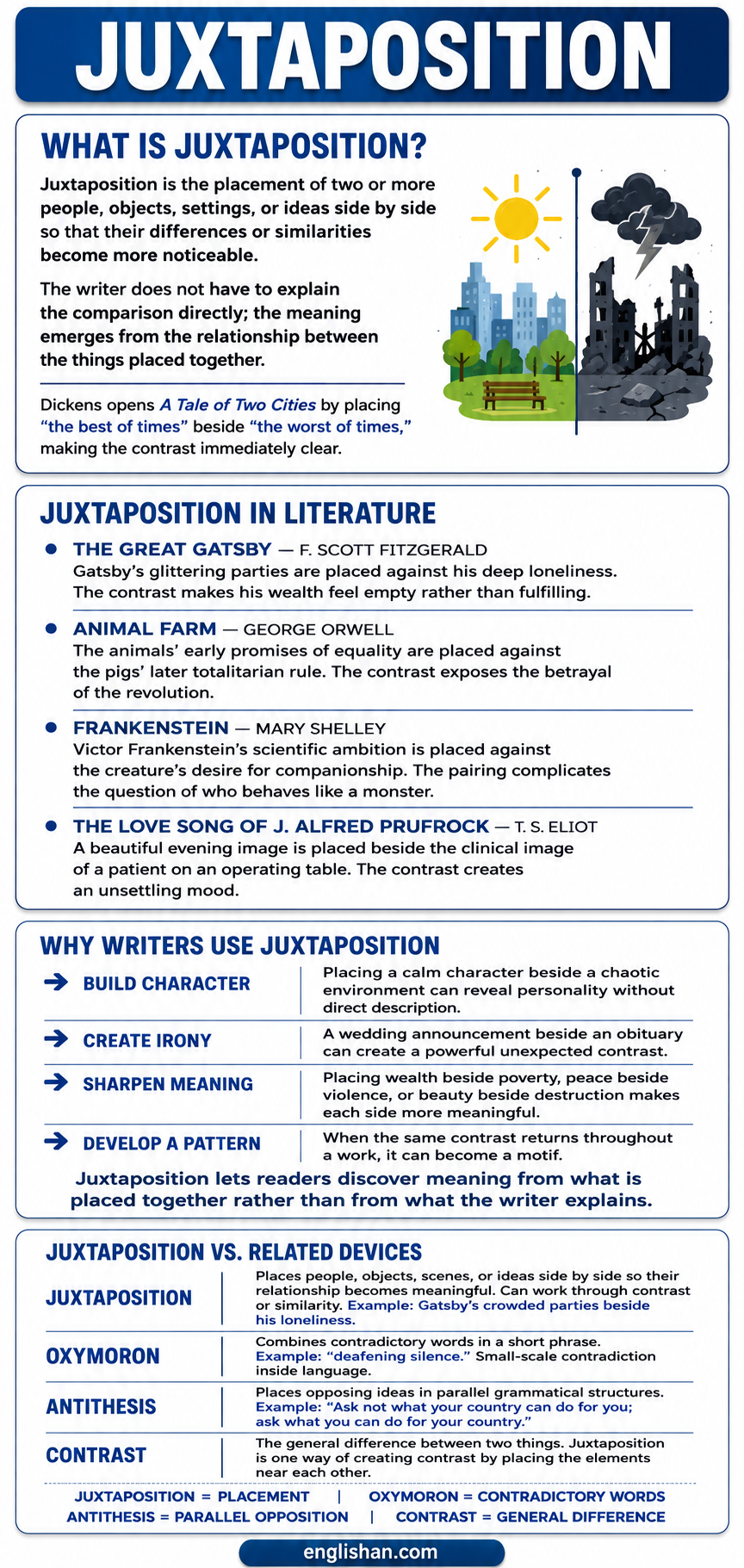
Juxtaposition is a literary technique in which a writer places two or more contrasting people, objects, settings, or themes next to each other. The placement makes their differences impossible to miss.
The technique states nothing directly. Unlike a simile or an analogy, which spells out a comparison in words such as like or as, juxtaposition includes no explanation at all. The writer places the two directly beside each other and leaves the reader to notice the difference or the overlap without help.
The word applies beyond contrast, too. Grammarians use juxtaposition for two words or clauses placed directly next to each other with no linking conjunction between them. That construction is closer to asyndeton than to a figure of opposition. In Julius Caesar’s veni, vidi, vici, “I came, I saw, I conquered,” three clauses appear together with not a single and joining them.
The technique can involve more than two people or images at once, and it never requires opposition. Placed side by side, two photographs of soldiers from wars a century apart can reveal something unexpected. The fear on a young face looks the same no matter the uniform. Most of the time the technique creates contrast, but resemblance works exactly the same way.
Juxtaposition in Literature
The technique shows up in the opening lines of some of the most read novels in English. Leo Tolstoy began Anna Karenina with a pairing condensed into two clauses: happy families are alike, and every unhappy family is unhappy in its own way. With an entire era instead of a single household, Dickens did the same. Both sentences work because the second half undercuts or restates the first without a connecting explanation.
The same technique appears at the level of character throughout longer fiction. A character written mainly to contrast another, and so to sharpen the reader’s view of both, is called a foil.
- F. Scott Fitzgerald’s The Great Gatsby: Fitzgerald juxtaposes the glitter of Gatsby’s parties with the moral emptiness of the guests who attend them. The wealth on display makes Gatsby’s own loneliness sharper by comparison.
- George Orwell’s Animal Farm: Orwell juxtaposes the animals’ early revolutionary promises with the totalitarian rule the pigs eventually build. The contrast between the two exposes the betrayal without a single accusing sentence from the narrator.
- Robert Louis Stevenson’s Strange Case of Dr Jekyll and Mr Hyde: the respectable Dr. Jekyll and the violent Mr. Hyde occupy one body, a doppelganger made from the contrast between a person’s public virtue and a private capacity for harm.
- Mary Shelley’s Frankenstein: Shelley juxtaposes Victor Frankenstein’s scientific ambition with the creature’s plain desire for companionship, leaving the reader to decide which of the two behaves less like a monster.
- Joseph Conrad’s Heart of Darkness: Conrad juxtaposes the machinery of a French warship firing blindly into an unmapped African coastline with the vast, indifferent wilderness around it. The pairing exposes the absurdity of the whole colonial project.
- T.S. Eliot’s “The Love Song of J. Alfred Prufrock”: the poem juxtaposes an evening “spread out against the sky” with the cold, clinical image of “a patient etherized upon a table.” The pairing unsettles the reader before a single event happens.
Poetry outside the English tradition uses the technique even more directly. Japanese haiku relies on a kireji, a cutting word that splits the poem into two separate images with no stated link between them. The reader feels the connection rather than reads it.
In Bashō’s most famous haiku, a frog, a still pond, and the sound of water appear inside just three lines. The meaning forms in the space between the images, not in any single line.
Juxtaposition in Film
On screen, juxtaposition is achieved through editing, framing, and color grading, since a director rarely has a narrator available to state a contrast outright. Francis Ford Coppola’s The Godfather juxtaposes a baptism with a string of assassinations, cutting between the sacred ceremony and the murders it authorizes. Across that single sequence, the audience watches Michael Corleone become a godfather in both senses.
Victor Fleming’s The Wizard of Oz juxtaposes a sepia-toned Kansas with the Technicolor world of Oz. The shift in film stock alone marks Oz as the world of wonder, no dialogue required.
Steven Spielberg’s Jurassic Park juxtaposes the small scale of its human characters against the towering dinosaurs surrounding them. Before a single line explains either, the composition alone conveys the danger and the awe.
Editors call the underlying principle the Kuleshov effect: place two unrelated shots next to each other. An audience will invent a relationship between them whether the filmmaker intended one or not. In film, the technique depends on that same instinct. The cut itself becomes the sentence a narrator would otherwise have to write.
Juxtaposition in Visual Art and Photography
In photography, juxtaposition is relied on constantly, since a single frame has no space for a caption to explain a contrast. A hand span next to a skyscraper’s base states scale better than any printed number. Behind a modern billboard, a crumbling Roman ruin shows the passage of centuries better than a date stamp.
Marc Riboud’s 1967 photograph shows a young protester holding a single flower toward a row of soldiers’ bayonets. It remains one of the most reprinted images from the Vietnam War era. With no caption required, the pairing of a flower against a rifle reads as an argument about peace against force.
Painters and designers use the same principle with color and symbol. A single warm-toned figure inside an otherwise cold, blue-gray composition pulls the eye immediately. The temperature contrast makes the point a written label would otherwise have to state.
In this way, symbolism and juxtaposition regularly work together. Two symbols placed side by side can suggest a relationship that neither symbol states on its own. Picture a wilting flower beside a wedding ring, or a cracked mirror beside a family photograph.
Why Writers Use Juxtaposition
In fiction, juxtaposition is used first of all to build character through contrast. A calm soldier standing at the edge of a battlefield tells a reader more about his character than three paragraphs of direct description. The chaos around him throws his composure into relief, defining him by what surrounds him rather than by a list of adjectives.
The technique also creates irony: a wedding announcement printed beside an obituary, or a villain’s speech about mercy delivered moments before a cruel act. A peaceful scene placed directly before violence functions as foreshadowing, since the stillness itself signals that the mood is about to break. Having met the pattern before, readers start bracing for it.
Diction, a writer’s word choice, sharpens every pairing. A sentence that pairs a word with a warm connotation against one with a cold, clinical charge does more work than the literal meanings alone. The emotional charge of each word colors the other.
When a novel returns to the same pairing again and again, that repeated contrast becomes a motif. A garden beside a graveyard and a child’s toy beside a soldier’s rifle are pairings of that kind. It is a pattern the reader starts to watch for on its own.
Persuasive writing uses the same device. A writer places a policy’s promised benefit directly beside its actual cost, with no editorial comment between them. The pairing argues the point more forcefully than an open paragraph of argument ever does.
Juxtaposition vs Oxymoron
An oxymoron compresses two contradictory terms into a single phrase, an adjective paired with a noun that cancels it out: deafening silence, bittersweet, living dead. The contradiction stays inside two or three words and nowhere else.
Juxtaposition operates at a larger scale, since it can pair whole characters, scenes, chapters, or photographs without requiring the two sides to contradict each other inside one phrase.
Every oxymoron technically relies on a miniature juxtaposition of meaning packed into adjacent words, but the reverse isn’t true. The technique rarely compresses into two contradictory words. That is why Dickens’s opening line, the baptism scene in The Godfather, and Riboud’s photograph all use it without a single oxymoron between them.
Juxtaposition vs Antithesis
Antithesis is juxtaposition built on matching grammar: two clauses of parallel structure that state a direct opposition. John F. Kennedy balanced his inaugural address this way: ask not what your country can do for you, ask what you can do for your country. Because the grammatical pattern repeats, the parallel structure turns a plain contrast into antithesis and makes the opposition impossible to miss.
Juxtaposition demands no such match. Picture a paragraph describing Gatsby’s crowded parties, followed by a paragraph describing his solitary wait for Daisy. The pairing still makes its contrast felt without a single matching clause between the two. By definition, every antithesis qualifies as a juxtaposition, since it places two opposing sides beside each other. Most juxtapositions never rise to antithesis, though, since most contrasts in fiction and film skip the matching grammar entirely.
Juxtaposition vs Contrast
Contrast is the general term: any difference noted between two people, objects, or scenes, whether stated outright or only implied. Juxtaposition is one specific method for creating contrast: placing the two directly next to each other. The writer trusts the reader to notice the difference without a linking word such as unlike or however.
A writer can describe a contrast with none of the technique at all, spelling out both sides across two full paragraphs and naming the difference directly.
A dichotomy is a stricter term than either: it splits a whole category into two mutually exclusive halves with no middle ground, right against wrong, true against false.
By contrast, juxtaposition makes no such demand: it places two people, images, or scenes together without requiring them to be opposites, and without ruling out a third option. The technique can even reveal similarity rather than difference, as when two war photographs from different decades appear side by side to show how little combat has changed.
Chiasmus is a different device altogether. It reverses the order of matching words or phrases across a sentence, a structural mirror rather than a study in contrast. Even without any opposition for a reader to notice, a sentence can still use chiasmus for the shape alone.
The Latin Origin of Juxtaposition
The word traces to Latin iuxta, meaning near or close by, combined with position. French speakers joined the two into juxtaposition first, and English borrowed the compound whole in the 1660s to describe the act of placing objects close together. Later, in 1826, the verb juxtapose arrived, either as a shortened form of the noun or borrowed directly from the French juxtaposer.
Iuxta shares a Proto-Indo-European root, yeug-, meaning to join, with a wide family of English words: join, joint, junction, conjugate, and subjugate all trace back to the same root. Every one of them describes some form of bringing two separate parts together. That family history fits a word that has meant exactly this for over three and a half centuries.
How to Use Juxtaposition in Your Own Writing
Two nouns placed near each other in a sentence do not amount to juxtaposition on their own. A line such as “She wore red boots and carried a blue umbrella” sets two colors beside one another without producing any tension between them. The pairing changes nothing about how a reader understands either object.
A genuine juxtaposition changes how a reader sees both halves, because the two sides sharpen each other. Placing wealth beside poverty, or stillness beside violence, shows the reader something neither side reveals alone. Test a pairing by removing one half and asking whether the other half loses force. If nothing is lost, the two never contrasted at all; they only stood near each other on the page.
Choosing what to place against what starts with common ground, not opposition. Two subjects need enough shared context for a reader to consider them together. A wedding and a funeral both mark a turning point in a life; a palace and a slum both house a family. Only once that shared ground exists does the difference between them register as meaningful.
From there, a writer isolates the one respect the argument turns on: wealth against poverty, silence against noise, mercy against cruelty. The writer then lets every other quality between the two subjects stay identical. A pairing that differs in ten respects at once buries the one contrast that matters under nine that do not. A pairing that differs in exactly one respect puts that difference under full pressure.
The following sentences share a subject, a soldier returning home, yet only one uses the pairing to say something.
- A soldier who had crawled through mud for a year knelt to remove his boots at his mother’s spotless doorway. ✅ The war he carries on his body and the order of the house he re-enters expose how far he has traveled, in a way neither image states on its own.
- A soldier came home and noticed that his neighbor had painted the fence. ❌ The fence and the war share no common ground beyond both existing in the same sentence, so the pairing produces observation rather than meaning.
FAQs
Q1. What is the difference between juxtaposition and antithesis?
Antithesis is a specific form of juxtaposition that uses parallel grammatical structure to state a direct opposition, such as balancing two clauses of matching length and rhythm. Juxtaposition names the broader technique of placing any two contrasting or unexpectedly similar people, images, or scenes near each other, with no requirement that the grammar match.
Q2. What are synonyms for juxtaposition?
Close synonyms are contrast, comparison, and proximity, though none means exactly the same thing. Contrast describes the difference itself rather than the placement that reveals it, and proximity describes closeness without implying that a comparison is intended. Because of that precision, juxtaposition remains the more accurate term when the placement itself is doing the work.
Q3. How do you use juxtaposition in a sentence?
Set the two contrasting people, images, or scenes next to each other with no connecting explanation, and let their difference or their unexpected likeness stand on its own. “The children played in the rubble of the bombed street” juxtaposes innocence with destruction inside a single sentence, without one word telling the reader how to feel about it.
Q4. Can juxtaposition show similarity instead of contrast?
Yes, juxtaposition can highlight resemblance as well as difference. Two unrelated speeches from different centuries, placed side by side, can reveal that both use the same argument to justify a war. In that pairing, the placement exposes the likeness rather than the difference.
Q5. When should a writer avoid using juxtaposition?
A writer should avoid forcing two unrelated images or characters together when no real connection exists between them. A pairing with nothing genuine behind it reads as a gimmick rather than a technique. Juxtaposition works because the reader senses a real link between the two. A contrast added only for effect, with no supporting logic in the surrounding scene, undercuts a story instead of sharpening it.