Ethos is the appeal through a speaker’s or writer’s credibility and character rather than through logic or emotion. Aristotle named it in his work Rhetoric as one of three ways an audience comes to believe an argument, alongside pathos and logos.
A patient believes a doctor’s opinion before a single test result exists, and a company markets decades in business before it lists one feature. Both persuade through ethos before anything else gets said.
A speaker earns that trust on the page or from the podium; it is never assumed. The sections that follow show how writers and speakers create it, and where it appears in real speeches, ads, and novels. They also trace how the word changed shape once it left the rhetoric classroom.
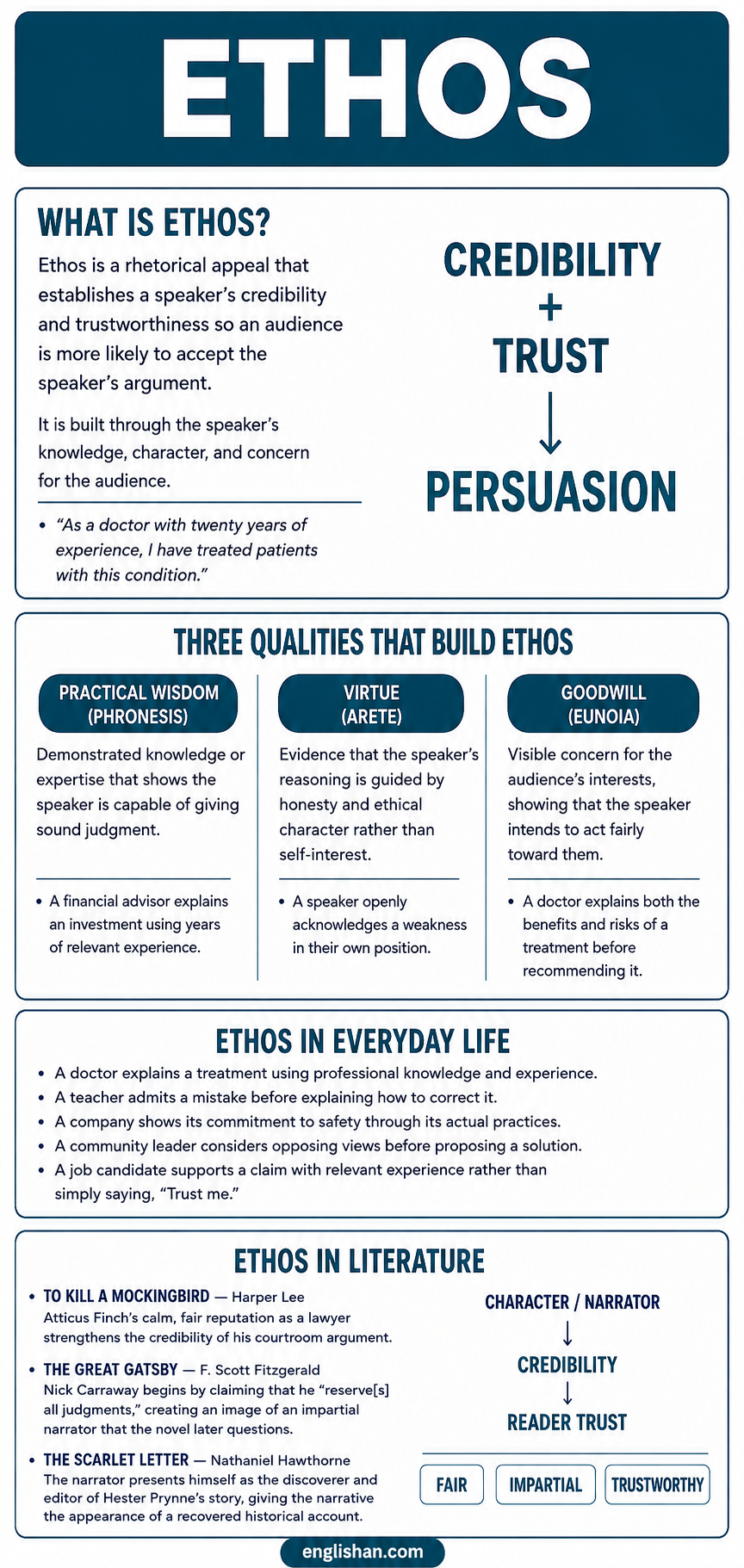
What Is Ethos in Rhetoric
The word comes from the Greek ēthos, meaning character or custom, and it named something specific long before it became a term in English composition classes. Aristotle used it in his work Rhetoric to describe the impression of trustworthiness a speaker projects through the argument itself, not through outside reputation. A speaker establishes it by sounding knowledgeable, fair, and well-intentioned within the speech, which is a different claim from being famous or powerful beforehand.
This distinction matters because the appeal is a rhetorical construction, not a fixed fact about a person. Rhetoricians give the two sides names: extrinsic ethos is the reputation a speaker brings into the speech, and intrinsic ethos is the credibility the speech itself creates.
A Nobel laureate can lose credibility mid-argument by ignoring an obvious counterpoint. A first-time speaker can gain it in five minutes by demonstrating firsthand knowledge and treating the audience fairly. Readers and listeners constantly ask, without consciously noticing they are doing it, whether the person in front of them deserves belief, and that question is what the term answers.
Ethos Pathos and Logos in Aristotle’s Rhetoric
Aristotle divided persuasion into three appeals, and he argued that a strong argument uses all three rather than relying on only one. Ethos persuades through the character of the speaker, and pathos persuades through the emotional state of the audience. Logos persuades through the internal logic of the argument itself: its evidence, structure, and reasoning. Together the three are often called the rhetorical triangle.
The three were never meant to operate separately. A courtroom lawyer who has logos (a solid case) but no credibility with the jury (a reputation for dishonesty) still loses the case. A speaker with a trustworthy character but no logos sounds sincere while proving nothing.
Aristotle’s point was practical rather than theoretical. A listener’s final judgment forms from all three appeals working together, so a persuasive text develops each one on purpose instead of leaving two of them to chance. Ethos, pathos, and logos form the foundation of a much wider set of rhetorical devices writers and speakers draw on to make an argument land.
Ethos vs Pathos vs Logos
Students and writers often study the three appeals side by side, since a direct comparison shows what each one does and how a writer signals it on the page.
| Appeal | Basis Of Persuasion | Appeals To | Typical Technique |
|---|---|---|---|
| Ethos | The credibility and character of the speaker | Trust | Citing credentials, experience, or a fair, respectful tone |
| Pathos | The emotional state of the audience | Feeling | Vivid imagery, personal stories, and word choice with strong connotation |
| Logos | The internal logic of the argument | Reason | Statistics, evidence, and logical structure |
None of the three is stronger than the others on its own. A charity appeal that relies on pathos alone can feel manipulative without credibility behind it. A policy paper argued through logos alone can feel cold and untrustworthy, with no visible character behind the numbers. The strongest arguments shift the balance depending on the audience and the situation, but rarely abandon any one appeal completely.
The Three Qualities That Build Ethos
Aristotle broke ethos itself down into three qualities a speaker needs to project at once, and losing any one of them weakens the whole appeal even when the other two are intact.
- Practical wisdom (phronesis): Demonstrated expertise, drawn from firsthand experience, credentials, or a track record the audience can verify.
- Virtue (arete): A sense that the speaker’s reasoning is guided by honest, moral intent rather than self-interest disguised as argument.
- Goodwill (eunoia): Visible concern for the audience’s actual interests, not just the speaker’s own, which is what separates a trustworthy expert from a self-serving one.
A financial advisor who shows practical wisdom through credentials but no goodwill, recommending products that benefit the advisor more than the client, loses credibility even while remaining technically qualified. All three qualities have to appear together for the appeal to succeed.
How to Build Ethos in Writing and Speech
A writer builds credibility through choices made throughout a text, not through direct claims. Stating “trust me” outright almost always fails, since audiences distrust anyone who announces trustworthiness instead of demonstrating it.
Citing relevant experience or credentials early gives the audience a reason to keep listening, but only when the credential actually applies to the claim being made. An audience gives real weight to a cardiologist’s opinion on heart medication and none to that same cardiologist’s opinion on tax law, however impressive the medical degree remains.
Sharing a specific, verifiable anecdote does more for a speaker’s standing than a general claim of expertise, because a concrete story is harder to fake, and an audience can judge it for itself. Acknowledging a fair counterargument before answering it has the same effect, since it signals confidence and honesty rather than a one-sided pitch.
Word choice matters as much as content. Precise, field-appropriate diction and word choices tuned to their connotation (calling something a “correction” instead of a “failure,” for instance) shape how trustworthy the writing feels before the reader consciously notices why. A tone that is respectful of the audience and any opposing view reads as more credible than one that mocks or dismisses, even when the underlying argument is identical.
One caution applies here: this trust collapses fast when a speaker oversells it. A résumé of achievements recited past the point the argument needs becomes hubris rather than credibility, and audiences notice the shift from confidence to self-praise almost immediately.
Ethos in Famous Speeches
Political and historical speeches offer some of the most visible cases of the appeal at work, since a speaker’s credibility decides whether the audience accepts anything that follows.
- Martin Luther King Jr., “I Have a Dream” (1963): Opens by invoking Abraham Lincoln and the language of the Declaration of Independence, an allusion that positions the civil rights movement inside the nation’s own founding promises before a single emotional appeal arrives.
- Winston Churchill’s wartime addresses to Parliament: Built credibility through his established record as a wartime leader and his refusal to promise anything beyond hardship, a stance that made his later promises of eventual victory more believable rather than less.
- Barack Obama’s 2008 speech on ending the wars in Iraq and Afghanistan: Grounded the argument in firsthand references to military families and veterans rather than abstract policy language, borrowing credibility from lived experience close to the issue.
Each speaker earns belief through a different route: shared history, a proven record, or firsthand contact with the subject, which shows how flexible the technique actually is.
Ethos in Advertising
Advertising relies on ethos constantly, more directly than literature or political speech, because a brand has seconds rather than minutes to earn belief.
- Dental and health commercials using actors in white coats or the line “more dentists recommend”: Borrow the accumulated credibility of the medical profession, even when no licensed dentist is on screen.
- Athletic brands featuring professional athletes: Transfer the athlete’s competitive record and public reputation directly onto the product, which is why endorsement contracts collapse quickly after a scandal damages that reputation.
- Skincare and supplement packaging printing “dermatologist tested” or a certification seal: Signal expert approval before the customer reads a single ingredient, letting the label do the persuading.
The technique succeeds because viewers rarely have time to evaluate a product’s actual logic mid-commercial, so a fast, visible credibility signal does the work logos would otherwise need to do.
Ethos in Literature
Novelists create ethos through their narrators the same way speakers create it for themselves, and noticing the technique changes how a reader evaluates what a narrator says.
- Atticus Finch’s closing argument: Depends on his standing in Maycomb as a fair, even-tempered lawyer long before he asks the jury to accept his reading of the evidence, in Harper Lee’s To Kill a Mockingbird.
- Nick Carraway’s opening claim to “reserve all judgments”: Establishes him as an impartial narrator at the start of The Great Gatsby, a credibility the novel spends its remaining chapters quietly testing and undercutting.
- The unnamed narrator of Hawthorne’s romance: Frames himself as the discoverer and editor of Hester Prynne’s story rather than its inventor in The Scarlet Letter, borrowing the credibility of a found historical document rather than a work of fiction.
A narrator’s credibility shapes how much a reader trusts everything else in the book, which is why an author who wants a twist to succeed spends real effort establishing it first. A narrator like Nick, whose credibility the novel itself undermines, is called an unreliable narrator.
The Everyday Meaning of Ethos
Outside a rhetoric classroom, ethos keeps a related but broader meaning: the distinguishing character, values, or guiding spirit of a person, group, or institution. A company shows this kind of ethos when environmental responsibility shapes how it operates, not just how it markets. A school shows it in how it treats mistakes and disagreement, not just in its mission statement.
This sense still traces back to the same Greek root and the same underlying idea: a consistent character that others come to recognize, and to trust or distrust because of it.
Punk rock’s rejection of commercial polish and insistence on self-production is one instance, and the Olympic commitment to fair competition is another. Both name a value system so consistent it becomes identifiable from the outside. That is the same quality Aristotle located in a single persuasive speaker, scaled up to a whole culture or community.
FAQs
Ethos is the appeal to a speaker’s or writer’s credibility and character, one of the three persuasive appeals Aristotle identified alongside pathos and logos. It gives an audience a reason to trust the person making an argument, separate from the logic or emotion of the argument itself.
The word is pronounced EE-thos, with the stress on the first syllable, and it comes directly from the Greek word for character or custom.
The difference is what each one appeals to: ethos appeals to credibility, pathos to emotion, and logos to logic and evidence. A persuasive argument uses all three together, though the balance shifts depending on the audience and the situation.
A common example of ethos is a doctor recommending a treatment based on medical training. The audience trusts the recommendation because of the doctor’s expertise rather than any emotional appeal or statistical proof offered in the moment. A political candidate citing years of relevant experience before stating a policy position works the same way.
Outside rhetoric, ethos refers to the characteristic spirit, values, or guiding beliefs of a person, community, or organization, such as a company’s stated commitment to transparency or a team’s competitive spirit.