Rhetorical devices are the techniques that turn plain statements into persuasion: repetition that builds pressure, comparisons that transfer feeling, contradictions that trap attention, and appeals aimed at trust, emotion, or logic. Aristotle cataloged them twenty-three centuries ago, every famous speech since has run on them, and you already use a dozen daily without their names. The names are worth having, because a device you can name is a device you can deploy on purpose, and this reference organizes the 65+ that do real work in modern English by the job each family performs.
What Are Rhetorical Devices?
A rhetorical device is a repeatable pattern of language chosen for its effect on an audience. Rhetoric itself is the ancient art of persuasion, and its devices divide by the material they shape: some rearrange sound and rhythm, some compare one subject to another, some inflate or shrink claims, some collide opposites, and some structure the argument itself. The families matter more than the count, because devices inside one family substitute for each other while devices across families combine, which is how a single sentence of a great speech runs four of them at once.
Ethos Pathos and Logos
Aristotle’s three appeals are the foundation under every rhetorical device. Ethos persuades through the speaker’s credibility: a surgeon opening with twenty years of operating experience is building ethos before making a claim. Pathos persuades through emotion: the charity ad lingering on one child’s face aims every device it owns at feeling. Logos persuades through logic and evidence: statistics, syllogisms, and worked examples. Strong rhetoric mixes all three, and weak rhetoric is one appeal doing three jobs; the device families are the tools each appeal reaches for.
Rhetorical Devices That Compare
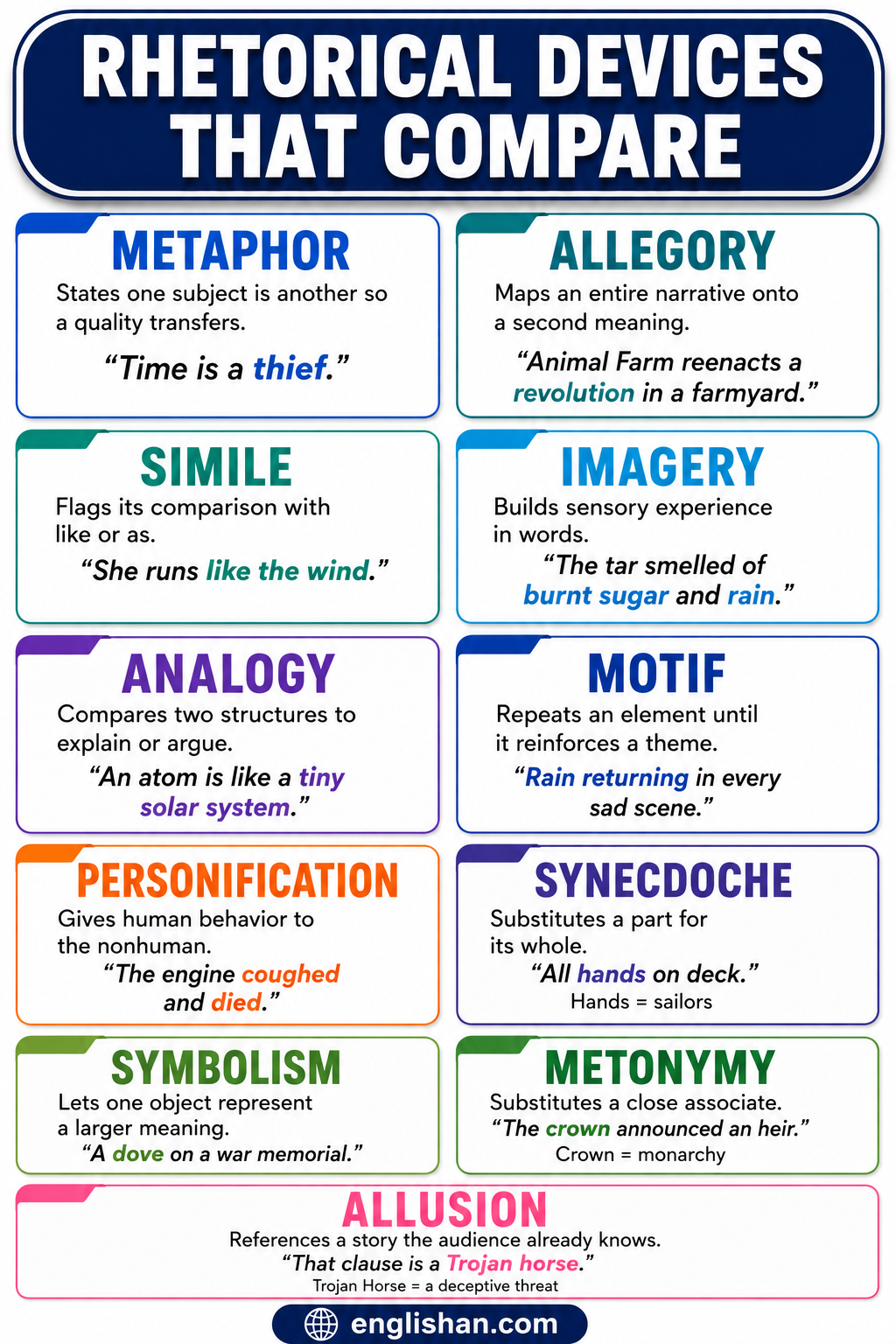
- Metaphor: states one subject is another so a quality transfers. Time is a thief. A full treatment waits in these metaphor examples with meanings.
- Simile: flags its comparison with like or as. She runs like the wind, and these simile example sentences run the pattern a hundred ways.
- Analogy: compares two structures to explain or argue. An atom is like a tiny solar system.
- Personification: gives human behavior to the nonhuman. The engine coughed and died.
- Symbolism: lets one object represent a larger meaning. A dove on a war memorial.
- Allegory: maps an entire narrative onto a second meaning. Animal Farm reenacts a revolution in a farmyard.
- Imagery: builds sensory experience in words. The tar smelled of burnt sugar and rain.
- Motif: repeats an element until it reinforces a theme. Rain returning in every sad scene.
- Synecdoche: substitutes a part for its whole. All hands on deck.
- Metonymy: substitutes a close associate. The crown announced an heir, as these metonymy example sentences show at length.
- Allusion: references a story the audience already knows. That clause is a Trojan horse.
Rhetorical Devices of Sound and Rhythm
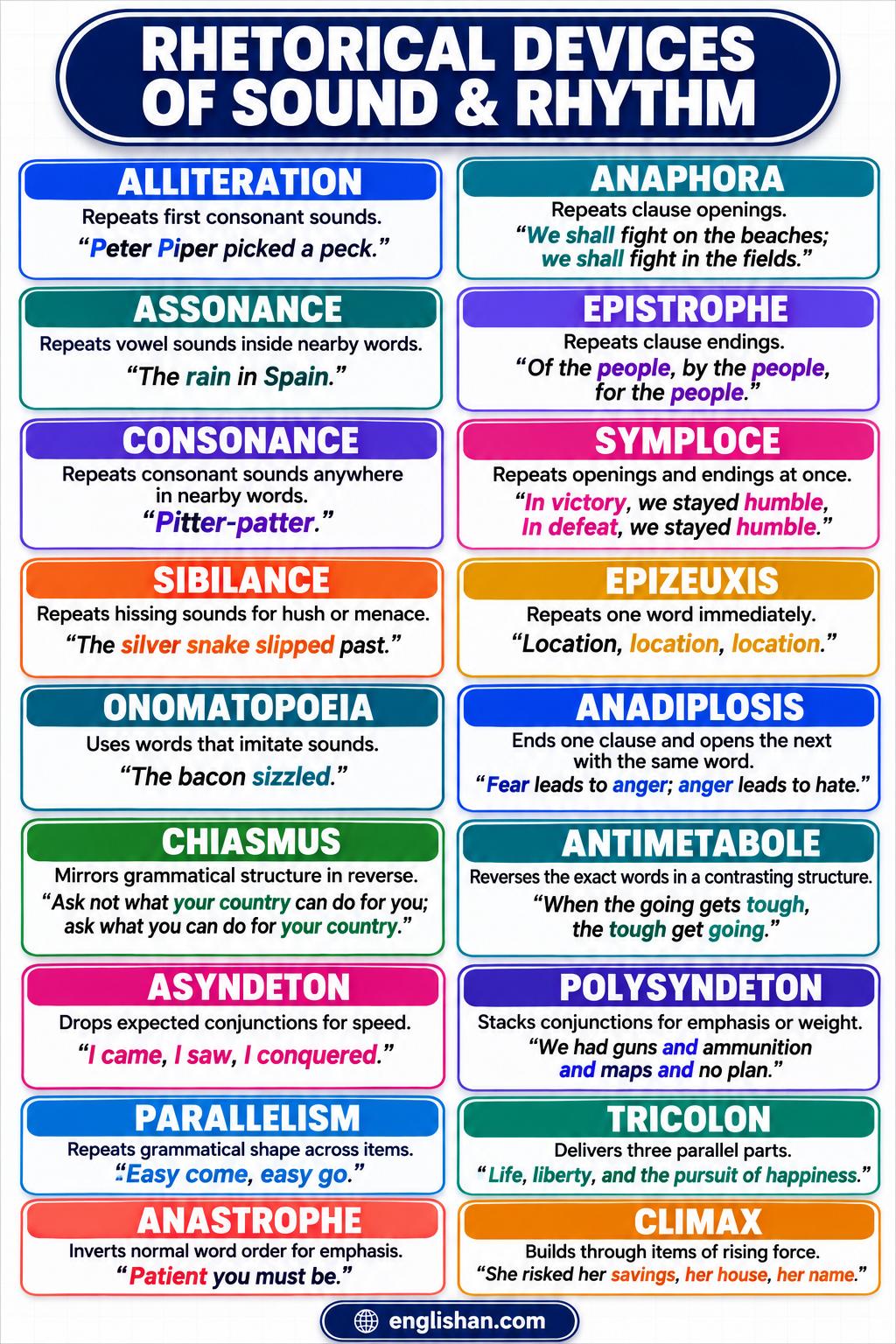
- Alliteration: repeats first consonant sounds. Peter Piper picked a peck.
- Assonance: repeats vowel sounds inside nearby words. The rain in Spain.
- Consonance: repeats consonant sounds anywhere. Pitter-patter.
- Sibilance: repeats hissing sounds for hush or menace. The silver snake slipped past.
- Onomatopoeia: words that imitate their sounds. The bacon sizzled.
- Anaphora: repeats clause openings. We shall fight on the beaches; we shall fight in the fields.
- Epistrophe: repeats clause endings. Of the people, by the people, for the people.
- Symploce: repeats openings and endings at once. In victory, we stayed humble. In defeat, we stayed humble.
- Epizeuxis: repeats one word back to back. Location, location, location.
- Anadiplosis: ends one clause and opens the next with the same word. Fear leads to anger; anger leads to hate.
- Chiasmus: mirrors grammatical structure in reverse. Ask not what your country can do for you; ask what you can do for your country.
- Antimetabole: chiasmus with the exact words reversed. When the going gets tough, the tough get going.
- Asyndeton: drops expected conjunctions for speed. I came, I saw, I conquered.
- Polysyndeton: stacks conjunctions for weight. We had guns and ammunition and maps and no plan at all.
- Parallelism: repeats grammatical shape across items. Easy come, easy go.
- Tricolon: delivers three parallel parts. Life, liberty, and the pursuit of happiness.
- Anastrophe: inverts normal word order for emphasis. Patient you must be.
- Climax: climbs through items of rising force. She risked her savings, her house, her name.
Rhetorical Devices of Exaggeration and Understatement
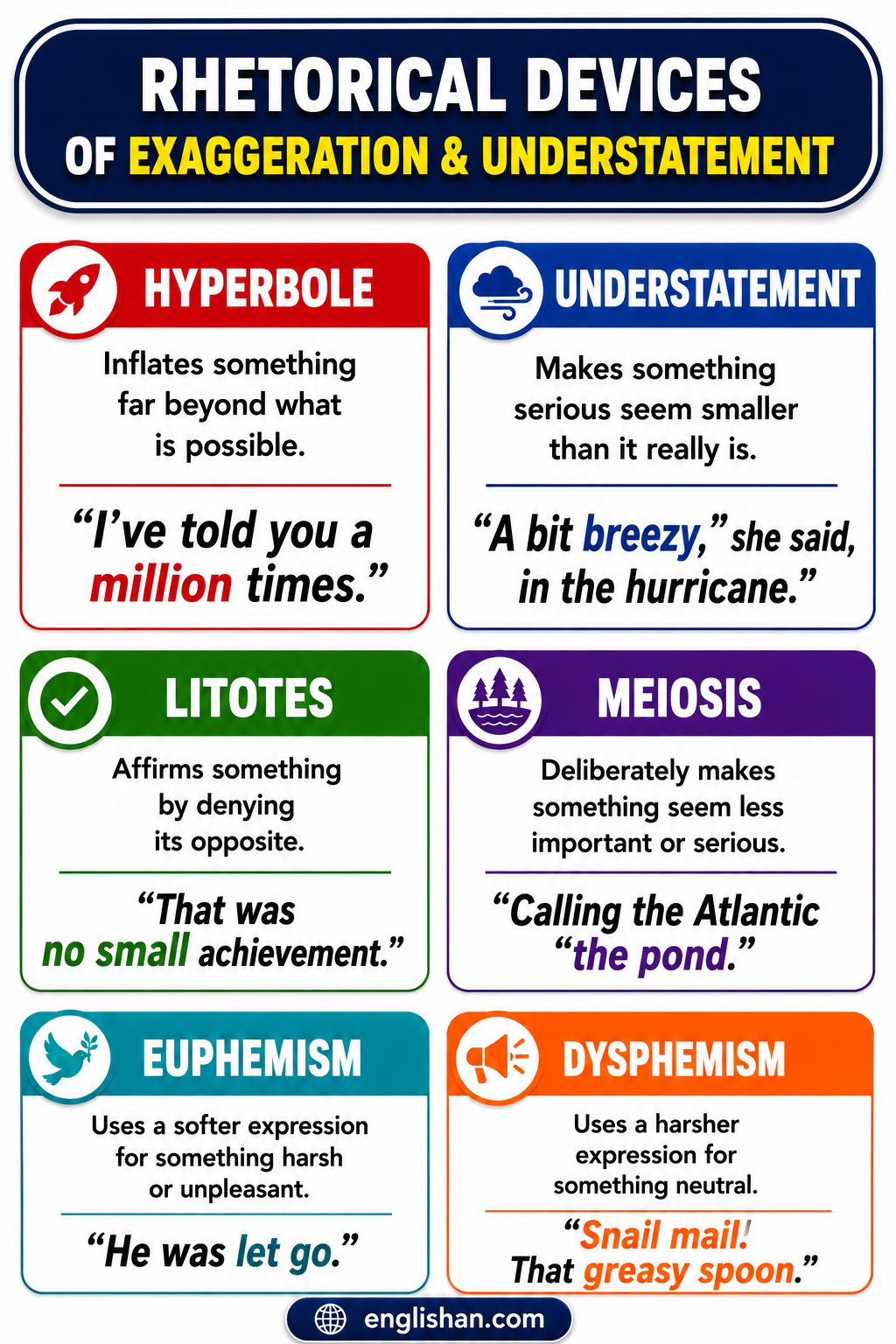
- Hyperbole: inflates far past the possible. I’ve told you a million times, and a hundred more wait in these hyperbole example sentences.
- Understatement: shrinks a serious matter for wry effect. “A bit breezy,” she said, in the hurricane.
- Litotes: affirms by denying the opposite. That was no small achievement.
- Meiosis: belittles on purpose. Calling the Atlantic “the pond.”
- Euphemism: softens a harsh reality. He was let go.
- Dysphemism: hardens a neutral one. Snail mail. That greasy spoon.
Rhetorical Devices of Contrast and Contradiction
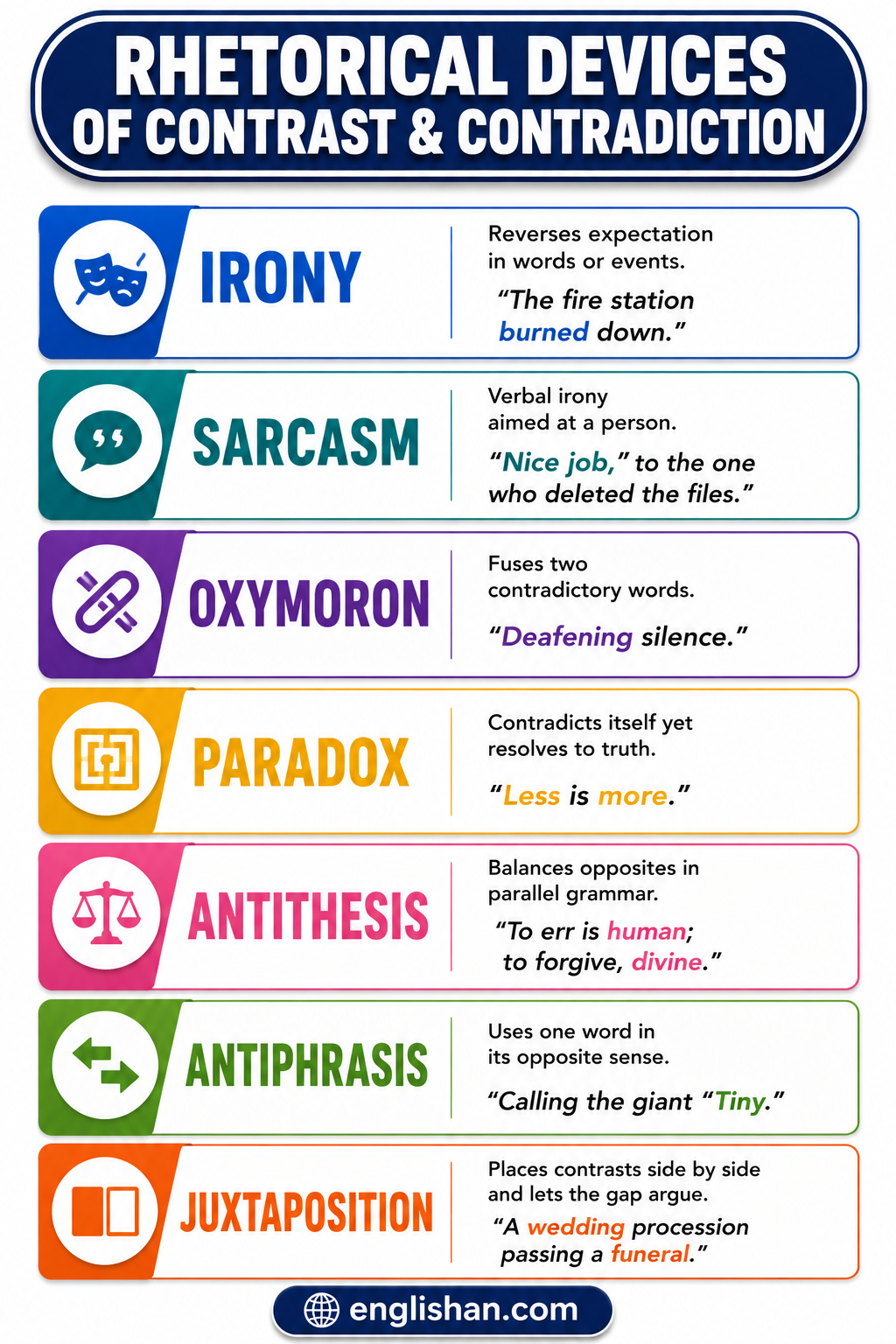
- Irony: reverses expectation in words or events. The fire station burned down.
- Sarcasm: verbal irony aimed at a person. “Nice job,” to the one who deleted the files.
- Oxymoron: fuses two contradictory words. Deafening silence.
- Paradox: contradicts itself yet resolves to truth. Less is more.
- Antithesis: balances opposites in parallel grammar. To err is human; to forgive, divine.
- Antiphrasis: uses one word in its opposite sense. Calling the giant “Tiny.”
- Juxtaposition: places contrasts side by side and lets the gap argue. A wedding procession passing a funeral.
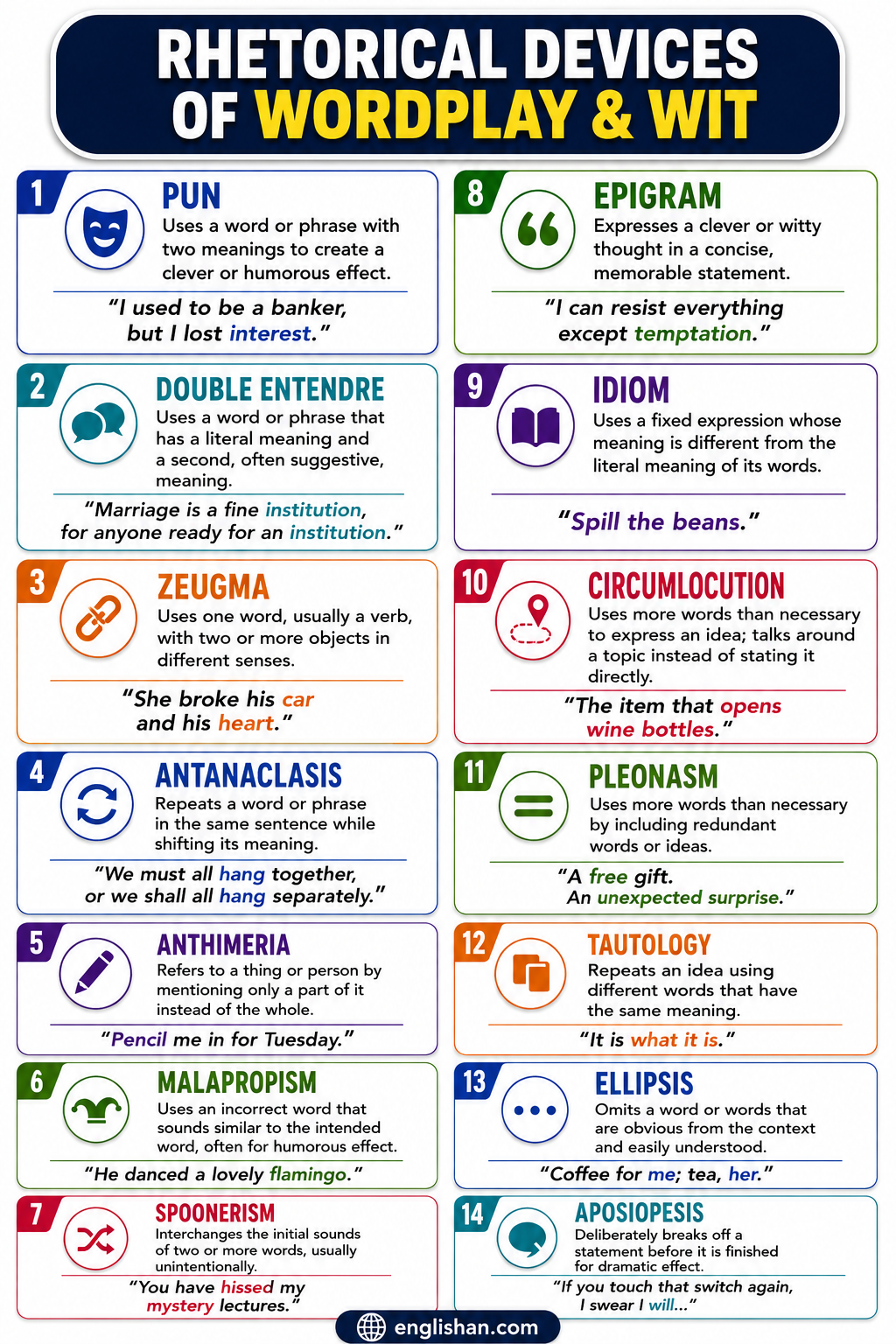
Rhetorical Devices of Wordplay and Wit
- Pun: fires two meanings of one word at once. I used to be a banker, but I lost interest.
- Double entendre: a pun whose second meaning is risqué. Marriage is a fine institution, for anyone ready for an institution.
- Zeugma: yokes one verb to two mismatched objects. She broke his car and his heart.
- Antanaclasis: repeats a word while shifting its meaning. We must all hang together, or we shall all hang separately.
- Anthimeria: uses one part of speech as another. Pencil me in for Tuesday.
- Malapropism: swaps in a similar-sounding wrong word for comedy. He danced a lovely flamingo.
- Spoonerism: swaps opening sounds between words. You have hissed my mystery lectures, the classic classroom case.
- Epigram: compresses wit into one quotable line. I can resist everything except temptation.
- Idiom: a fixed phrase whose meaning ignores its words. Spill the beans.
- Circumlocution: talks around a term instead of naming it. “The item that opens wine bottles.”
- Pleonasm: uses redundant words. A free gift. An unexpected surprise.
- Tautology: says one thing twice in different words. It is what it is.
- Ellipsis: omits words the audience supplies. Coffee for me; tea, her.
- Aposiopesis: breaks off mid-sentence and lets silence finish. If you touch that switch again, I swear I will…
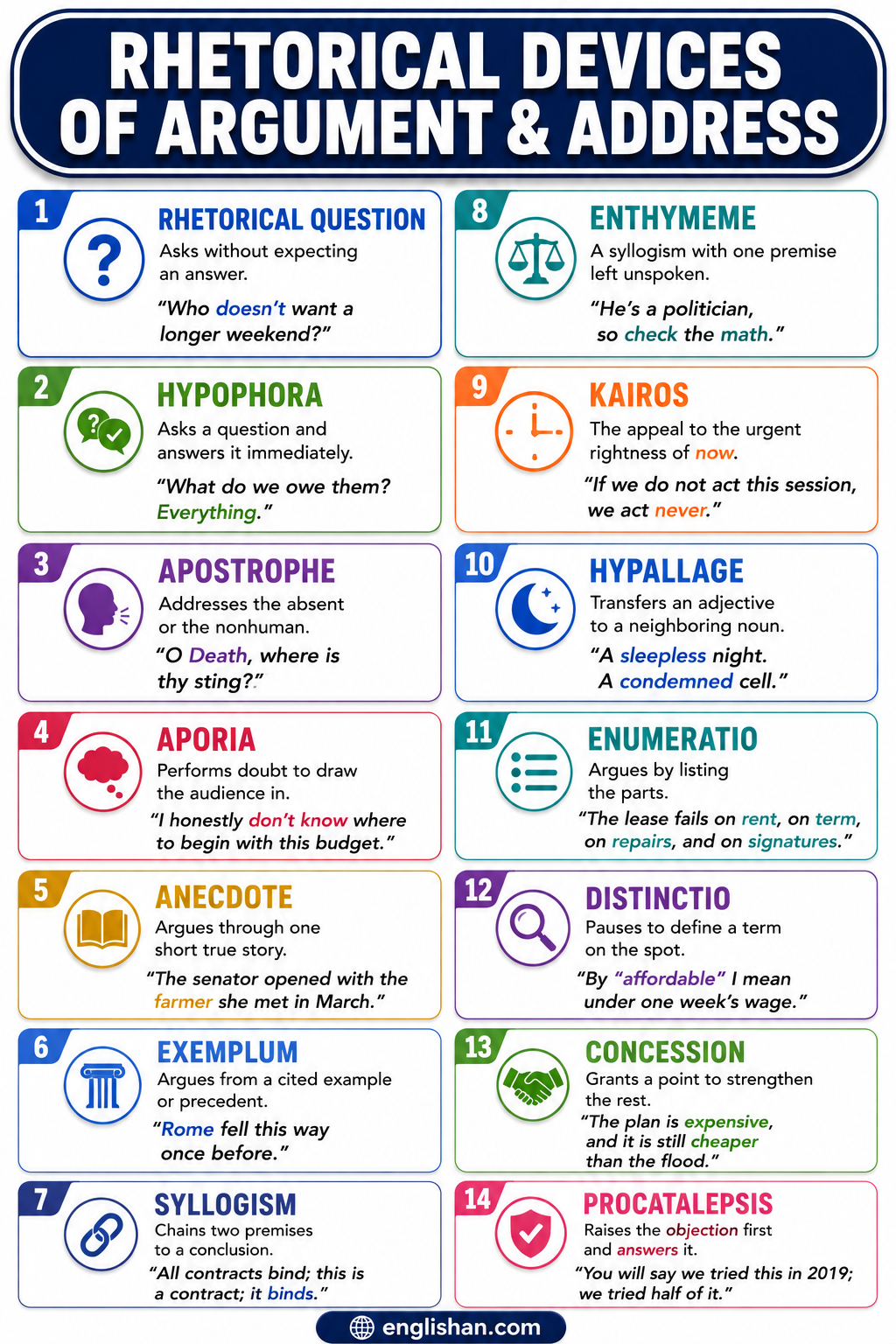
Rhetorical Devices of Argument and Address
- Rhetorical question: asks without expecting an answer. Who doesn’t want a longer weekend?
- Hypophora: asks a question and answers it immediately. What do we owe them? Everything.
- Apostrophe: addresses the absent or the nonhuman. O Death, where is thy sting?
- Aporia: performs doubt to draw the audience in. I honestly don’t know where to begin with this budget.
- Anecdote: argues through one short true story. The senator opened with the farmer she met in March.
- Exemplum: argues from a cited example or precedent. Rome fell this way once before.
- Syllogism: chains two premises to a conclusion. All contracts bind; this is a contract; it binds.
- Enthymeme: a syllogism with one premise left unspoken. He’s a politician, so check the math.
- Kairos: the appeal to the urgent rightness of now. If we do not act this session, we act never.
- Hypallage: transfers an adjective to a neighboring noun. A sleepless night. A condemned cell.
- Enumeratio: argues by listing the parts. The lease fails on rent, on term, on repairs, and on signatures.
- Distinctio: pauses to define a term on the spot. By “affordable” I mean under one week’s wage.
- Concession: grants a point to strengthen the rest. The plan is expensive, and it is still cheaper than the flood.
- Procatalepsis: raises the objection first and answers it. You will say we tried this in 2019; we tried half of it.
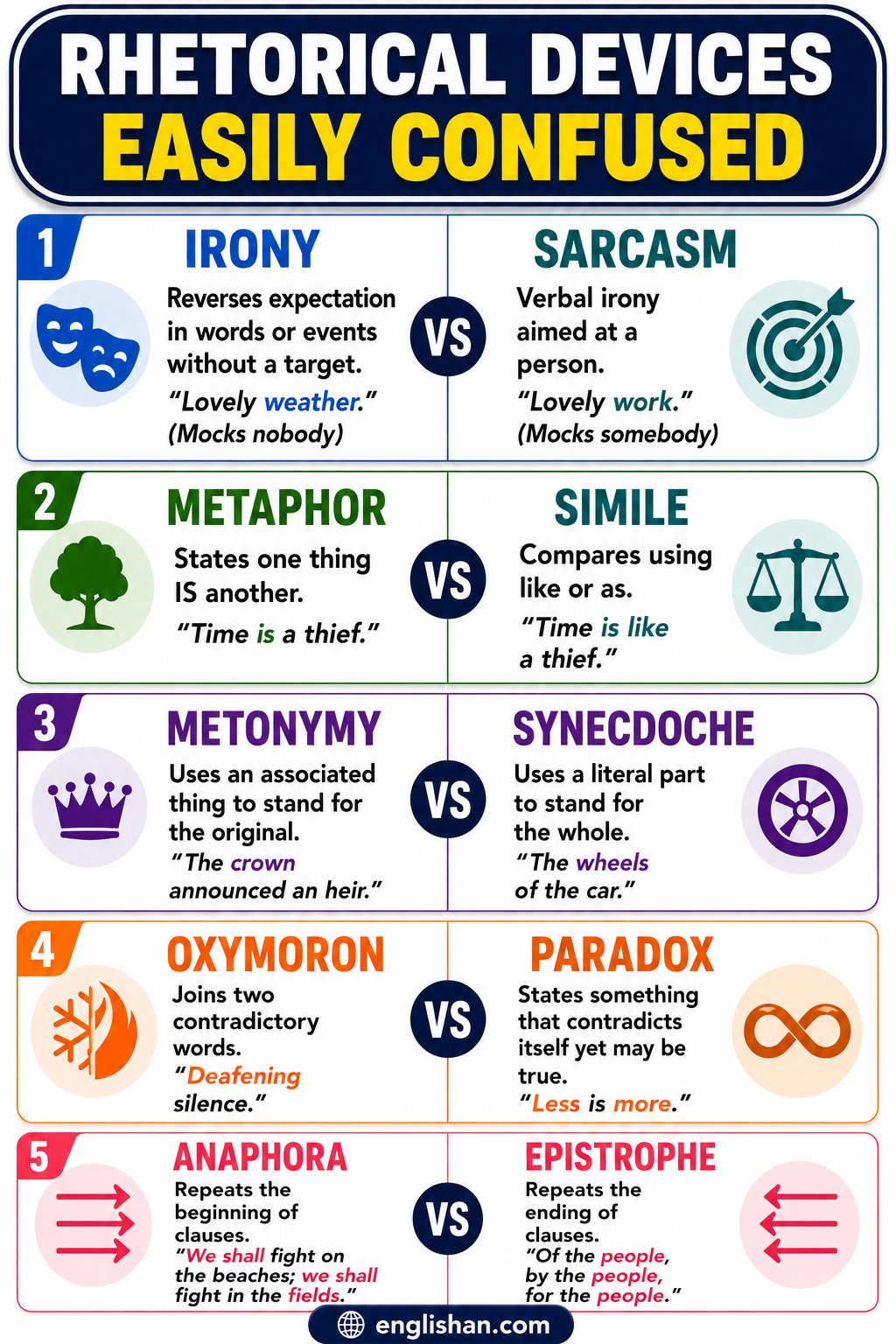
Rhetorical Devices Easily Confused
Five pairs cause most exam and editing mistakes, and one test settles each.
- Irony vs sarcasm: sarcasm is irony with a target; “lovely weather” mocks nobody, “lovely work” mocks somebody.
- Metaphor vs simile: the signal word decides; like or as makes the simile.
- Metonymy vs synecdoche: a literal part (wheels) is synecdoche; an associate (the crown) is metonymy.
- Oxymoron vs paradox: two fused words versus a full self-contradicting claim.
- Anaphora vs epistrophe: repeated openings versus repeated endings; Lincoln’s line ends alike, Churchill’s begins alike.
How to Use Rhetorical Devices in Writing
Devices are seasoning, and the failure mode is the whole jar at once. Choose the device that matches the job: repetition for resolve, comparison for the unfamiliar, understatement for bad news, a rhetorical question for an audience already leaning your way. Place devices at openings, climaxes, and closings, where attention naturally peaks, and let plain sentences do the connective work between them. One device per paragraph reads as craft; five compete, and the audience hears technique instead of conviction.
We shall fight, like lions, with deafening silence, a million times, on the beaches. ❌
We shall fight on the beaches, and we shall not stop there. ✅
The first stacks five devices into noise; the second commits to one repetition and lets it work. The wider family of literary devices with example sentences continues from here into narrative technique.
FAQs
Rhetorical devices are deliberate language techniques used to persuade, emphasize, or move an audience. Anaphora repeats openings (“we shall fight… we shall fight”), hyperbole inflates (“a million times”), and litotes affirms by denial (“no small feat”); each is a named, reusable pattern.
Metaphor, simile, hyperbole, irony, alliteration, personification, rhetorical questions, and anaphora do the heaviest daily work in speech, advertising, and writing. Master those eight and you will recognize a device in nearly every headline you read.
They are Aristotle’s three appeals: ethos persuades through the speaker’s credibility, pathos through the audience’s emotions, and logos through logic and evidence. They are the goals the individual devices serve, so a statistic works for logos while an anecdote about one family works for pathos.
A figure of speech is any expression that departs from literal meaning, while a rhetorical device is any technique, figurative or not, deployed to persuade. Every figure of speech becomes a rhetorical device when used for effect, but devices such as the rhetorical question, concession, and syllogism are not figurative at all.
Classical handbooks named hundreds, and modern references settle on sixty to ninety that do real work in English. The count is less valuable than the families: comparison, sound and rhythm, exaggeration, contradiction, wordplay, and argument, since new devices are learned fastest through the job their family performs.