A doppelganger is a double of a living person. In everyday use that means an uncanny lookalike, while the older sense names a ghostly counterpart said to walk beside someone unseen. The word comes directly from German, where doppel means double and gänger means walker or goer. A doppelganger is literally a double-walker.
English writers only borrowed the term in the nineteenth century. Since then it has carried two senses: a folklore figure whose sighting once warned of death, and a literary device that casts one character as another’s shadow. Both senses still shape how the word gets used today, in fiction and in everyday talk about a stranger’s uncanny resemblance to someone people know.
Doppelganger Meaning and Word Origin
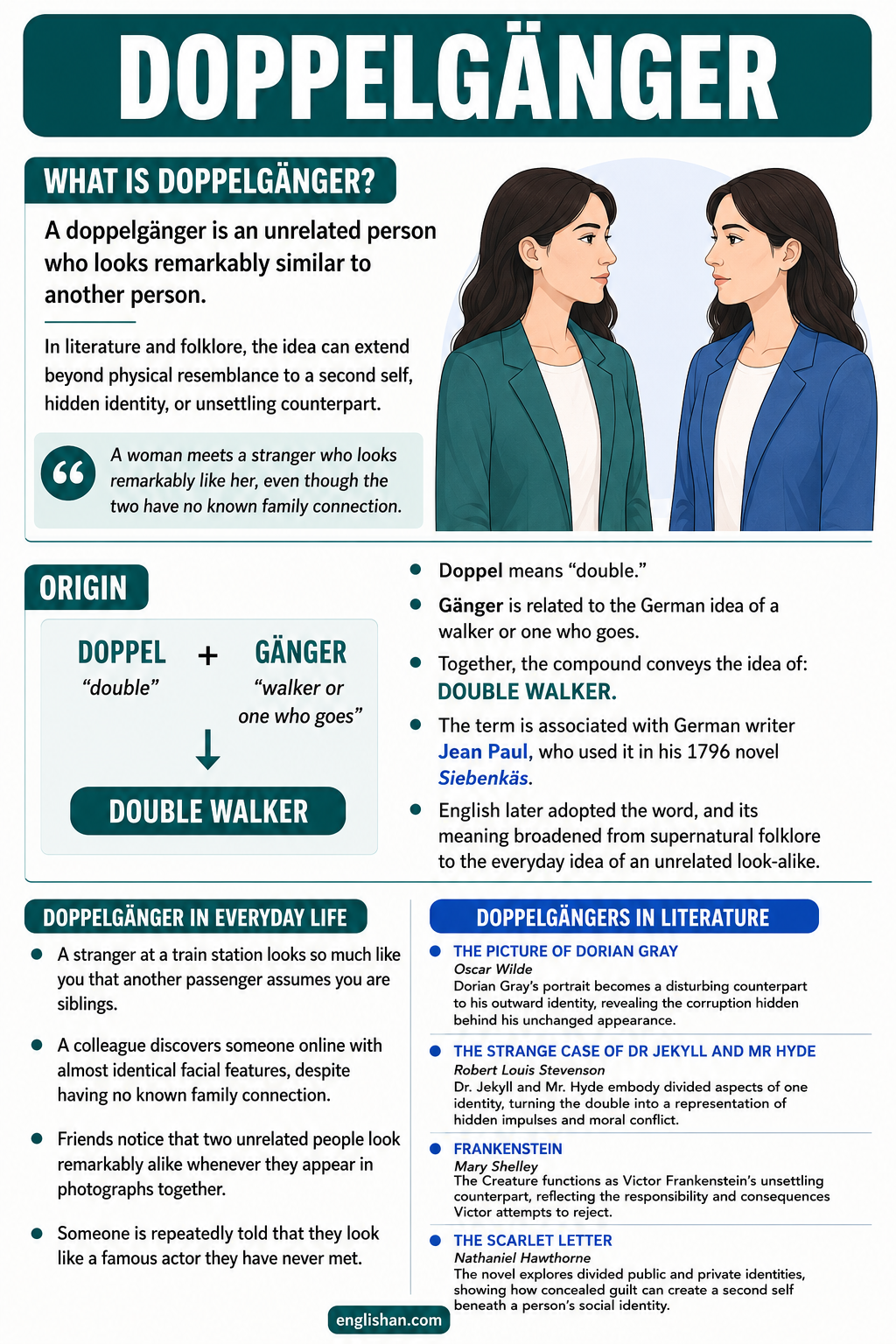
Doppel means double in German, and gänger comes from gehen, to go. The compound reads as double-goer or double-walker. The novelist Jean Paul coined an early form of the word, Doppeltgänger, in his 1796 novel Siebenkäs. He used it for a person’s shadow self and explained the coinage in a footnote. German folklore had already described such figures for generations; Jean Paul gave the idea a name that stuck.
English absorbed the term decades later. The writer Catherine Crowe introduced doppelganger to English readers in her 1848 book on the paranormal, The Night-Side of Nature. Merriam-Webster records the word’s first documented English use at 1851. Before that, English speakers who wanted to describe a ghostly double reached for an older native word: fetch. That word survives in “fetch-light,” the eerie glow some accounts attached to the ghostly double.
Once established in English, doppelganger drifted from a strictly supernatural term toward its present everyday sense. In colloquialism today, calling someone your double means nothing more than a striking resemblance, with none of the folklore’s warning attached. The older, unsettling meaning survives mainly in fiction. It also persists in the word’s connotation: a trace of unease survives even in casual conversation about a stranger who shares your face.
Doppelganger in Folklore and History
Long before Jean Paul named it, cultures across Europe and beyond described a spirit double attached to every living person. In Irish and English folk belief, this figure was called a fetch. Seeing your own fetch, especially in the morning, was read as a sign that death was near.
Nordic traditions cast the double as a forerunner rather than an omen. Norwegian folklore has the vardøger, a double whose footsteps, voice, or shadow arrive at a place minutes or hours before the person themselves does. Finnish tradition names a similar figure the etiäinen, or “firstcomer.”
The idea reaches well beyond Europe. In ancient Egyptian belief, the ka was a spiritual double born alongside every person, sharing their identity into the afterlife. Islamic folklore describes the qarin, a spirit companion of the same age and character as the person it shadows. Depending on which tradition tells the story, a qarin is capable of good or harm.
Real historical figures left behind anecdotes of encountering their own double, and several are documented in the historical record rather than pure legend. The poet John Donne’s biographer, Izaak Walton, claimed Donne saw his wife’s ghostly likeness in Paris on the same night she suffered a stillbirth back in London. The story depends entirely on Walton’s account.
Percy Bysshe Shelley reportedly met his own double on a terrace at Lerici shortly before he drowned in 1822, a sighting later treated as grim foreshadowing of his death.
Two later cases involved many witnesses at once. The French teacher Émilie Sagée was seen by dozens of pupils at a Latvian boarding school in 1845, apparently split into two visible figures at once. Vice-Admiral George Tryon was reportedly seen standing in his London drawing room the same evening his ship, HMS Victoria, collided with another vessel in the Mediterranean. The collision sank the ship and killed him.
Doppelganger as a Literary Device
In literature, a doppelganger is a character built as another character’s double, a figure literary critics also call the double. It takes the shape of an exact physical twin, a hidden second self, or a figure who mirrors someone’s personality while reversing their morals. Criticism has a name for that hidden second self too: the alter ego, a second identity living inside the same person.
Writers use the device to turn an inner conflict into a visible character. Instead of describing a person’s temptation or self-hatred directly, the story gives that hidden half its own body and its own actions.
The technique depends on juxtaposition, setting a character’s public self directly against a version of that self the reader is not meant to see in daylight. That contrast sharpens into a dichotomy the story exposes: reason against impulse, virtue against desire, or the self a character presents against the self they hide.
The device is close to a foil, a character whose contrast brings out another character’s traits. A foil only contrasts, though. A doppelganger goes further and mirrors the very character it exposes.
A well-made double works as symbolism for whatever the story is really about, whether that is guilt, repression, or a fractured sense of identity. The double rarely stays a background trick. By the story’s end, the two figures collide. That collision is the point of the device, proving that the hidden self was never separate from the visible one at all.
Examples of Doppelgangers in Literature
Several works shaped how readers recognize the motif, and each handles the double differently. The earliest belong to Gothic fiction, the nineteenth-century genre of dread, hauntings, and divided selves.
- William Wilson (Edgar Allan Poe, 1839): The narrator is haunted from childhood by another boy who shares his name, face, and voice. This double reappears at every moment William tries to act dishonestly, and killing him in the final scene destroys the narrator’s own conscience along with him.
- Dr. Jekyll and Mr. Hyde (Robert Louis Stevenson, 1886): Dr. Jekyll’s hubris convinces him he can separate his moral and immoral halves with a formula. Mr. Hyde is the result, a second self who commits the acts Jekyll cannot admit to wanting.
- The Double (Fyodor Dostoevsky, 1846): A minor clerk named Golyadkin meets a man who looks exactly like him but acts with all the confidence Golyadkin lacks. The impostor gradually takes over his job and his social standing.
- The Secret Sharer (Joseph Conrad, 1909): A new ship’s captain hides an escaped fugitive in his cabin, a man who resembles him closely enough to pass as his unacknowledged double. Protecting him becomes the captain’s own quiet epiphany about the commander he wants to be.
- A Tale of Two Cities (Charles Dickens, 1859): The lookalikes Charles Darnay and Sydney Carton let Dickens stage a literal swap. Their resemblance lets one man die in the other’s place.
- Despair (Vladimir Nabokov, 1936): A businessman convinces himself a homeless stranger is his exact double and murders the man to fake his own death. The plan later reveals that the resemblance was never as exact as he needed it to be.
Doppelgangers in Film and Television
Filmmakers adopted the device as soon as cinema put two identical figures on screen at once.
- Us (2019): Jordan Peele’s film gives an entire family a set of underground doubles called the Tethered, turning the folklore’s death omen into a literal home invasion.
- The Vampire Diaries (2009 to 2017): The plot depends on a bloodline of doppelgangers who resurface every few centuries. The show uses the ambiguity between its lookalike characters to drive several seasons of mistaken identity.
- The Prestige (2006): Two rival magicians build their careers on illusions of doubling. One uses an actual double, and the other relies on a method the film hides until its final scene.
- Twin Peaks (1990 to 1991, revived 2017): Agent Dale Cooper confronts a double of himself formed inside the show’s supernatural Black Lodge, one of television’s most direct uses of the folklore original.
Correct Spelling of Doppelganger
Doppelgänger, with the umlaut over the a, is the original German spelling. It is still the form listed first in most English dictionaries, including Merriam-Webster and Collins. Doppelganger, without the umlaut, is the more common form in everyday English writing, since English keyboards and most style guides drop accent marks from adopted foreign words. Both spellings are correct in English, and major dictionaries list the unmarked form as an accepted variant rather than an error.
The plural follows the same pattern: doppelgangers or doppelgängers, formed by adding an s, never a borrowed German plural.
| Form | Status |
|---|---|
| Doppelgänger | Original German spelling, listed first in most dictionaries |
| Doppelganger | Standard English variant, umlaut dropped |
| Doppelgangers | Accepted English plural |
News style guides and most published fiction favor the unmarked spelling, since it is faster to type and to search for.
Doppelganger Vs Lookalike
A lookalike is someone who resembles another person by coincidence, with no folklore or fiction attached to the word. Two strangers can be lookalikes without either one knowing the other exists. The term implies nothing beyond physical resemblance.
Doppelganger implies more than that. Even in its modern use, the word still borrows some of its folklore charge. Meeting your double reads as uncanny, the unsettling effect of something familiar turning strange, rather than as plain coincidence. Fiction reinforced that difference for two centuries. It reserved the word specifically for a double that threatens, exposes, or replaces the original, a job the word lookalike never had.
Genetics has recently blurred the line between the two words. A 2022 study based on the photographer François Brunelle’s portrait project paired unrelated lookalikes from around the world. It found that people who resemble each other closely enough to be mistaken for twins share meaningfully more DNA than random strangers do.
The match is not total. Their epigenetic markers, the chemical tags that switch genes on and off, still differ sharply. The resemblance has a real biological basis in at least some cases, even when the two people have no family connection at all.
How to Recognize a Doppelganger in a Story
Not every double in fiction earns the name. A coincidental lookalike shares a face and nothing else, since the resemblance never touches the plot’s meaning. An evil twin explains the rivalry through birth order or jealousy, a conflict that stands on its own rather than growing out of the protagonist’s own nature. A clone explains the double through a lab and a formula, a copy with no claim on who the original person actually is.
A doppelganger does something none of those three do: it mirrors, threatens, or exposes a truth about the character it doubles. Strip away that resemblance and the doppelganger has no reason to exist in the story at all, because its whole function is bound to the original.
Test a double against one question: remove it from the story, and does the theme collapse with it? Remove Mr. Hyde and Jekyll’s argument about a moral self split in two disappears along with him. Remove Golyadkin’s impostor and Dostoevsky’s portrait of a man losing his own place in the world falls apart with it. Remove a random lookalike from a plot built on mistaken identity, and the mechanics survive fine, since that lookalike was never doing thematic work to begin with.
For a writer reaching for the device, that same test becomes a design rule. A double that only shocks the reader in a mirror or a photograph, then vanishes from the plot, was never a doppelganger; it was a scare tactic that borrowed the name.
The double belongs in the story only if it forces the protagonist to face something they were avoiding. That might be the violence they suppress, the ambition they deny, or the public self they defend against the hidden one. A working reveal changes how the reader reads everything that came before it, not just the one scene where the double shows up.
- A detective spends the story chasing a killer, only to find proof that the killer is her own twin, raised apart yet shaped by the same instincts she has spent years controlling in herself. ✅ The reveal forces the detective to face the violence she has suppressed all along, so the double reframes everything the story already showed about her.
- A character opens a closet and finds an identical double standing inside, who screams and vanishes, never mentioned again for the rest of the story. ❌ The double exists only to startle the reader for one scene, with no tie to anything the protagonist wants, fears, or hides, so the moment reads as a gimmick rather than a reveal.
FAQs
No, not in every tradition or story. Folklore is split on the question. Irish and Norse accounts treated a sighting as a warning of death. Other traditions, including some readings of the Islamic qarin, describe the double as neutral or even protective.
Fiction follows the same split. Stevenson’s Hyde and Dostoevsky’s impostor both read as menacing, while Conrad’s secret sharer reads as sympathetic. The evil-twin version became the more memorable and widely copied one.
The difference comes from what each word implies. A lookalike resembles another person purely by physical coincidence, with no folklore or narrative weight attached. Doppelganger implies that the resemblance is uncanny, meaningful, or even threatening, an idea inherited from German folklore.
Both are correct in English. The umlauted form is the original German spelling and the one most dictionaries list first. The unmarked form is more common in everyday English writing and news style.
It means double-walker or double-goer, built from doppel, meaning double, and gänger, a walker or goer, from the verb gehen, to go.
Yes, in a limited sense. A 2022 study of unrelated lookalikes found that people who closely resemble each other frequently share meaningfully more DNA than strangers chosen at random, even without any family relationship. Their gene-expression patterns still differ.