

A motif is a recurring image, phrase, sound, or idea that returns across a work and builds toward its larger meaning. Mentioned once, an object in a novel rarely changes how you read the story. Mentioned in five separate scenes, the same object changes what you notice in every scene after it. That pattern of return separates a motif from ordinary detail.
The word entered English from French in the nineteenth century and has kept its sense of a repeating pattern ever since. A motif differs from a theme, the abstract idea a story communicates, and from a symbol, which can stand for something else in a single appearance.
What Is a Motif?
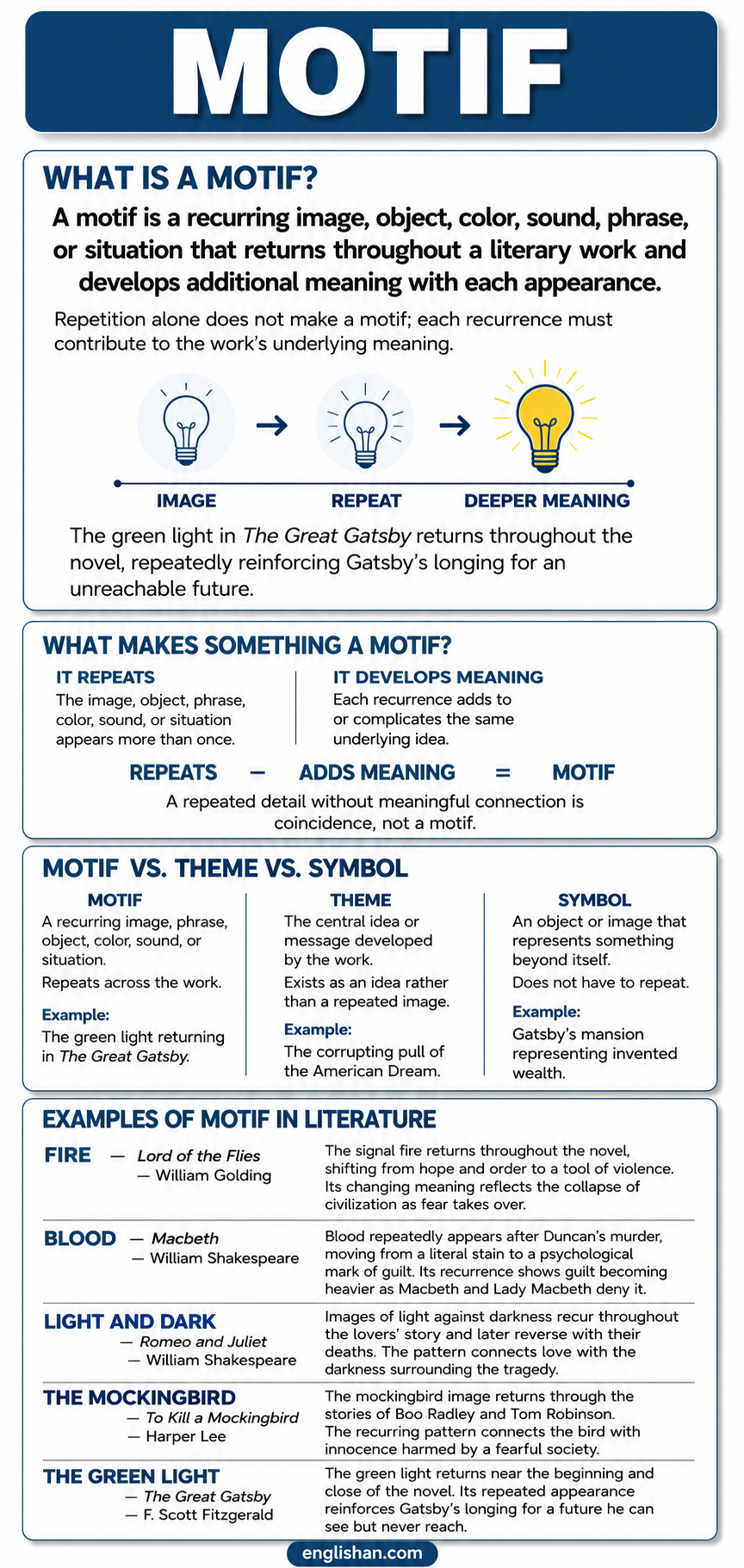
A motif is a recurring image, object, color, sound, phrase, or situation, one that returns more than once in a literary work and takes on symbolic weight with each appearance. A recurring double, or doppelganger, that shadows a main character across a novel counts as a motif for the same reason.
Repetition alone does not make a motif. A word that recurs several times without adding to the meaning is coincidence, not a motif. A recognized motif meets two conditions at once: it repeats, and each repetition adds to, or complicates, the same underlying idea.
In The Great Gatsby, the green light at the end of Daisy’s dock demonstrates the pattern. It appears at the close of the first chapter and again in the closing lines of the novel. With each appearance, the same idea sharpens: a future Gatsby can see but never reach.
A motif accumulates meaning across a whole work rather than delivering it in one place. You notice it gradually, scene by scene, rather than being told directly what it means.
Motif Origin and Meaning
Motif entered English from French in 1848 with the meaning of a dominant, recurring feature in an artistic or dramatic work. The French word comes from the Medieval Latin motivus, meaning moving or impelling, which traces back to the Latin verb movere, to move. That root still suits the literary term, since each reappearance moves the reader’s understanding one step further.
Before literary critics adopted it, the term already belonged to music and the visual arts. Composers use leitmotif for a musical phrase tied to a character or idea and repeated across a score. In textiles and decorative schemes, designers use motif for a repeated shape or pattern. In fiction and poetry, the term kept that core sense of a recurring pattern, now traced through scenes instead of melodies or fabric.
How to Identify a Motif in a Story
Spotting a motif while you read takes real attention, since the text never labels the pattern for you. Four checks separate a genuine motif from an incidental detail.
- Count the repetitions: a single appearance is not enough. Look for the same image, phrase, object, or situation recurring at least three times across separate scenes.
- Watch what changes: a strong motif rarely repeats identically. A color that grows darker or an object that changes hands tracks a character’s development or a shift in the story’s argument.
- Check the placement: authors plant motifs at an opening line, a chapter’s end, or a turning point. A motif planted in a story’s opening lines becomes foreshadowing once the ending confirms it.
- Ask what it adds: a motif points toward a theme. A repeated image that adds nothing to the story’s meaning is a stylistic habit, not a motif.
However striking, a detail that occurs only once is symbolism at that moment rather than a motif. Repetition marks the boundary between the two.
Motif vs Theme vs Symbol
Motif, theme, and symbol name three different features of the same story, and confusing one for another is a common mistake in literary analysis. A motif repeats. A theme is the idea the story argues. A symbol represents something beyond itself, whether or not it repeats.
| Aspect | Motif | Theme | Symbol |
|---|---|---|---|
| What it is | A recurring image, phrase, or object | The central idea or message of a work | An object or image that represents something beyond itself |
| Repeats | Yes, several times across the work | Present across the whole work as an idea, not a repeated image | Not required. A single occurrence works |
| Concrete or abstract | Concrete: something you can point to | Abstract: a statement about life, people, or society | Concrete, but points toward an abstract idea |
| How it is stated | Never stated directly. Built through repetition | Rarely stated directly. Inferred from the whole work | Identifiable from a single scene |
| Example | The green light returning across The Great Gatsby | The corrupting pull of the American Dream | Gatsby’s mansion representing invented wealth |
Motif vs Theme
A theme is what a story is ultimately about: loss, ambition, the cost of denial. A motif is one of the concrete devices that build toward it.
The Great Gatsby uses its green light, its parties, and its obsessive references to time and clocks as motifs. All three point toward the same theme: the American Dream corrupts the people who chase it. Remove the motifs and the theme still exists, stated or implied elsewhere in the plot. Remove the theme and the repetition no longer builds toward anything.
Motif vs Symbol
A symbol requires only one appearance. A dove in the final paragraph of a novel can represent peace without ever showing up earlier in the book. A motif adds repetition on top of that same symbolic weight.
- Symbol: a single mention of a white dove in a novel’s final chapter, since it never recurs.
- Motif: a white dove that reappears at three separate moments across the same novel, since each appearance builds on the last.
Every motif can be read symbolically, but not every symbol repeats enough to count as a motif. Repetition alone separates the two. When practically every detail in a story takes on this second layer of meaning, the whole narrative shifts from motif-driven storytelling into allegory. Each character and event then represents something outside the story.
Examples of Motif in Literature
Fire in Lord of the Flies (William Golding)
The boys who crash-land on the island light a signal fire meant to draw the attention of passing ships. The fire returns again and again across the novel, each time signaling something different.
Early chapters treat it as hope and order, a rule the group agrees to maintain together. By the final chapters the same fire burns out of control, set deliberately to hunt Ralph rather than to save him. The shift in the fire’s meaning with each reappearance tracks Golding’s real question: how quickly a shared civilization collapses once fear takes over.
Blood in Macbeth (William Shakespeare)
Blood returns at nearly every turning point after Macbeth murders Duncan. It moves from a literal stain on his hands to a psychological one Lady Macbeth cannot wash away in her sleepwalking scene. Shakespeare returns to blood in dialogue, stage imagery, and physical action throughout the play, and each appearance marks guilt that grows heavier the more the characters deny it.
Light and Dark in Romeo and Juliet (William Shakespeare)
Romeo repeatedly describes Juliet through images of light against a dark background: a torch in a dark room, the sun rising over night. The juxtaposition recurs across the play’s most quoted scenes and reverses by the ending. The lovers’ deaths bring literal darkness to a story that opened in daylight violence. The pattern reinforces one of the play’s real arguments: love and death follow each other more closely than either family admits.
The Mockingbird in To Kill a Mockingbird (Harper Lee)
Atticus Finch tells his children that it is a sin to kill a mockingbird, since the bird does nothing but sing. The novel returns to that image through Boo Radley and Tom Robinson, two characters who cause no harm and suffer for it regardless. Lee names neither man a mockingbird outright in every scene. Even so, Lee’s pattern of innocence destroyed by a fearful town returns enough times to qualify as a motif.
The Green Light in The Great Gatsby (F. Scott Fitzgerald)
The light at the end of Daisy’s dock shows up at the close of the novel’s first chapter and returns in its closing lines. Fitzgerald uses the same connotation of longing each time it comes back.
Elsewhere in the novel, the color green ties to money and envy, and that connection gives the image a double meaning. Readers see both a private symbol of Daisy and a public one for everything Gatsby’s wealth was built to reach and never touch.
Hospitality in The Odyssey (Homer)
Long before the novel existed as a literary form, Homer built The Odyssey around a motif central to ancient Greek culture: xenia, the obligation to welcome and protect a stranger. Hosts and guests test Odysseus on nearly every island he visits.
How each character treats a visitor becomes the poem’s real measure of civilization against savagery. The suitors who overrun Odysseus’s house and abuse his hospitality violate that same obligation, and the violation signals the poem’s central wrong before a single sword is drawn.
FAQs
Q1. What is the difference between a motif and a symbol?
A symbol represents something beyond itself and needs only one appearance to do it, while a motif needs to recur across a work before its meaning builds. A raven mentioned once in a poem’s final stanza works as a symbol. The same raven appearing throughout a poem, as it does in Poe’s “The Raven,” becomes a motif, since each appearance adds to the last.
Q2. Can a motif also be a symbol?
Yes, and most motifs qualify as symbols too. A motif is built from an object or image that is already a symbol on its own. Repetition turns that single symbolic instance into a pattern you track across the whole work. The green light in The Great Gatsby qualifies as both. It is symbolic in any single scene, and it is a motif because Fitzgerald returns to it at the beginning and the end of the novel.
Q3. How many times does something need to repeat to count as a motif?
Literary scholars teach three separate appearances as the working threshold for a motif, though the number is a teaching convention rather than a fixed rule. A repeated detail counts as a motif only when each occurrence adds meaning instead of repeating what already appeared. One that recurs without developing anything stays a stylistic habit, not a motif.
Q4. Is a motif the same thing as a theme?
No, a motif is not the same as a theme, even though the two work closely together. A theme is the abstract idea a story argues, such as the cost of ambition or the failure of communication. It can be stated in a single sentence without pointing to any specific image. A motif is concrete: a recurring detail you can name and point to inside the text. Motifs build toward a theme, but a theme does not require any single motif to exist.
Q5. What is an example of a motif outside literature?
Public speeches use motifs the same way novels do. Martin Luther King Jr. repeated the phrase “I have a dream” throughout his 1963 address. Each repetition built on the last until the phrase became the speech’s organizing idea.
Composers use the same technique under the name leitmotif: a short musical phrase that returns every time a specific character or idea shows up in a score. In music and in prose, the principle stays the same: repetition that adds meaning with each return.