

An allegory is a story that carries a second meaning beneath its surface plot. A children’s picture book about star-bellied creatures can double as a lesson about prejudice, and a farmyard rebellion can double as the history of a revolution. Writers have used this double-layered technique for thousands of years, from Plato’s philosophy to George Orwell’s fiction.
The technique lets a writer argue one case while telling a different story on the surface. Animal Farm is one of its most studied modern examples.
What Is an Allegory?
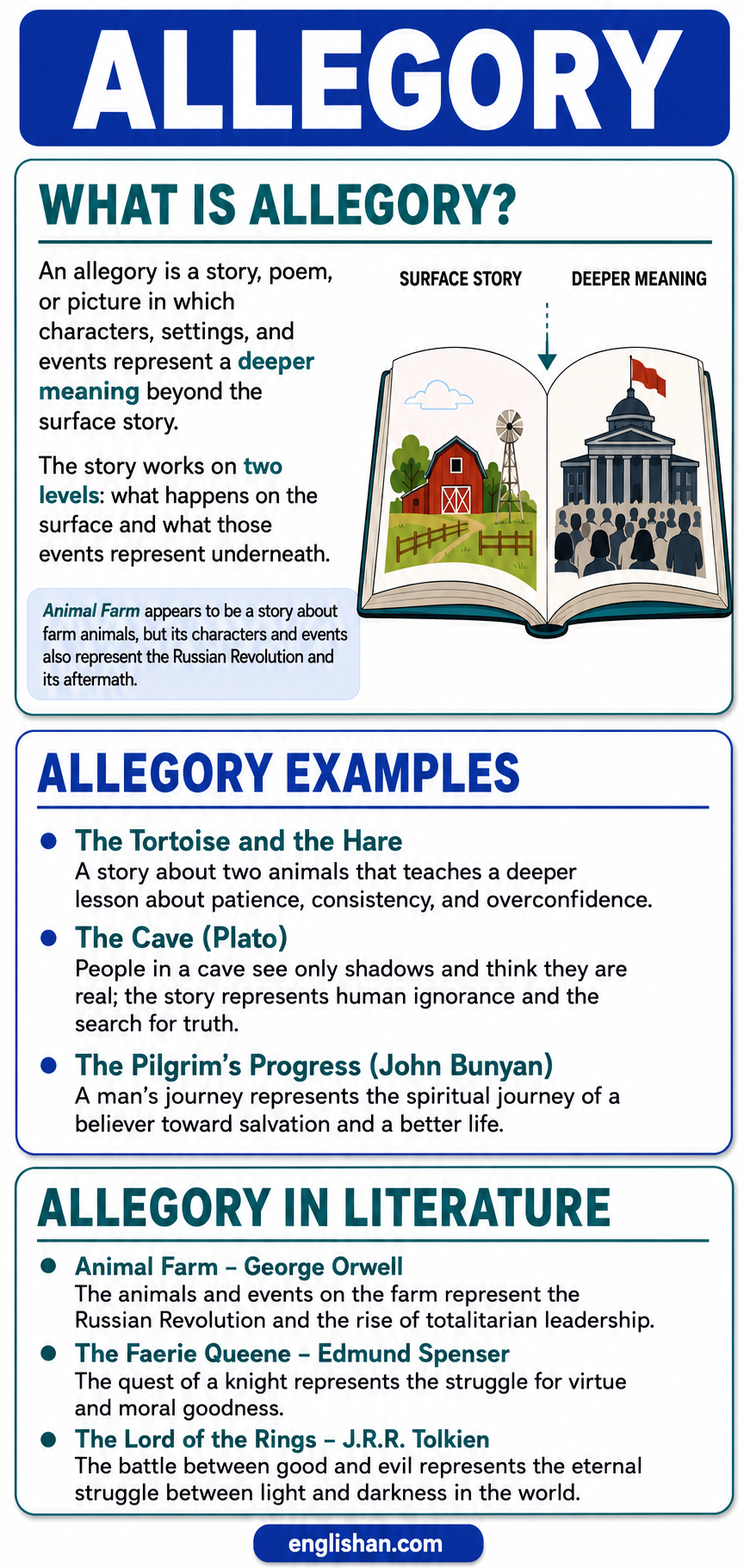
An allegory is a story, poem, or picture in which the characters, setting, and events stand for a second, deeper meaning beyond the surface plot. The surface story works on its own. But every major part of it also maps onto something else: a historical event, a moral lesson, a political system, or a spiritual journey.
Animal Farm reads as a story about farm animals. At the same time, it reads as an account of the Russian Revolution. That second, hidden layer is what separates an allegory from a story that happens to contain a symbol or two.
Types of Allegory
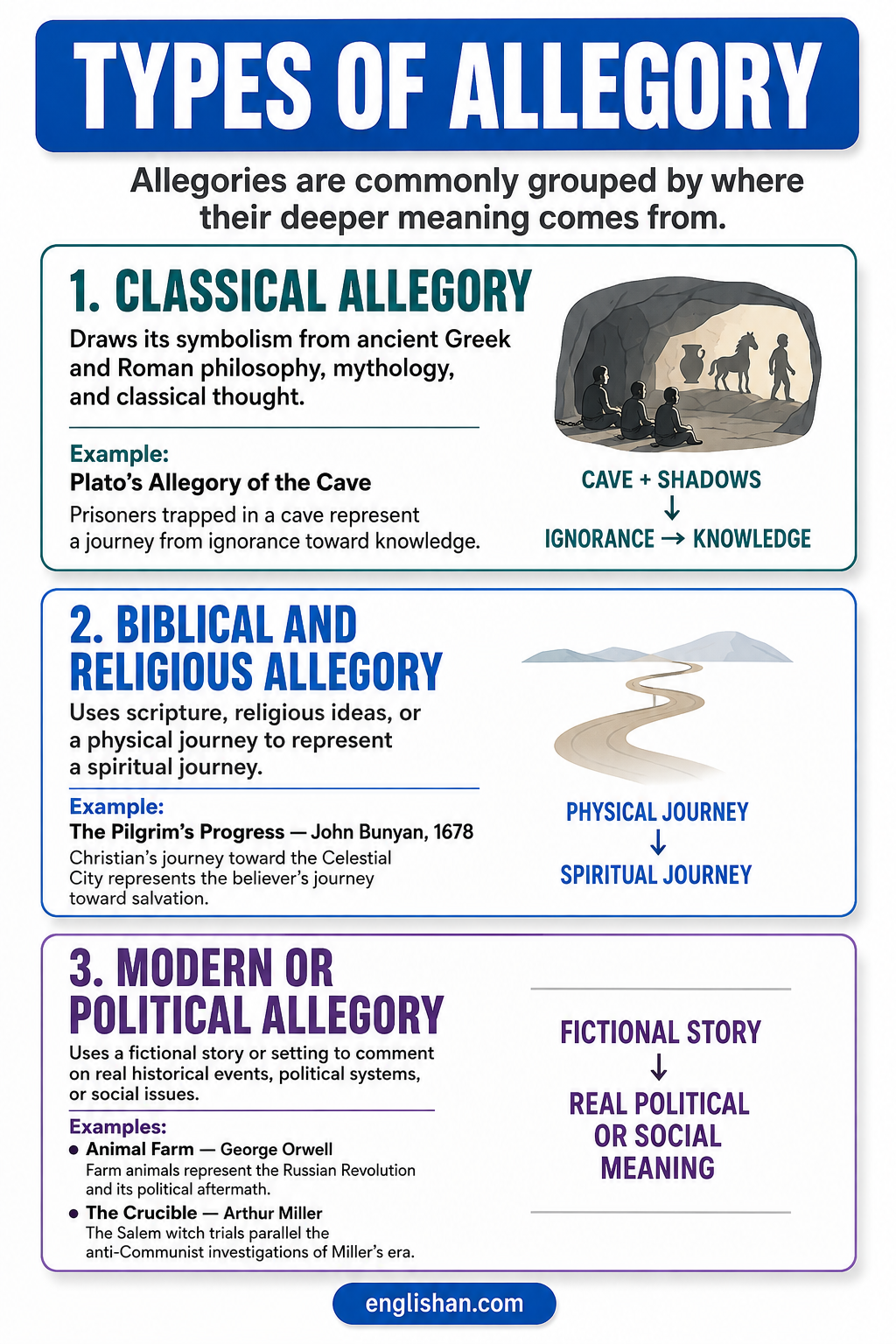
Scholars and teachers commonly group allegories into three broad categories. Each type is named for where its hidden meaning comes from.
Classical allegory draws its symbolism from ancient Greek and Roman philosophy and mythology. Plato’s Allegory of the Cave, from his book Republic, is the best-known example. It uses prisoners trapped in an underground cave to represent a journey from ignorance toward knowledge.
Biblical and religious allegory takes its symbolism from scripture and doctrine. It uses a physical journey to represent a spiritual one. John Bunyan’s The Pilgrim’s Progress, published in 1678, is the classic case, following a character named Christian as he travels toward salvation.
Modern or political allegory uses a fictional setting to comment on real historical events or social systems, with no religious framework. George Orwell’s Animal Farm and Arthur Miller’s The Crucible both belong here. One uses farm animals and the other a witch trial to comment on twentieth-century politics.
How an Allegory Works
The word allegory comes from the Greek allos, meaning “other,” and agoreuein, meaning “to speak openly.” Put together, the term literally means speaking about one thing while meaning another. That double movement is exactly how the device works in practice. A writer creates two systems at once. One is a literal narrative you can follow with no background knowledge. The other is a system of correspondences in which nearly every character, object, or event represents something in the real world.
In Animal Farm, the literal system is a group of farm animals overthrowing their farmer. The second system operates beneath it: Napoleon maps onto Joseph Stalin, Snowball onto Leon Trotsky, and the pigs’ broken promises onto the corruption of the new Soviet government. The two systems operate in constant juxtaposition from beginning to end. That constant pairing is what separates allegory from a single symbolic image dropped into an otherwise ordinary story.
Why Writers Use Allegory
Allegory gives writers a way to discuss a dangerous or difficult issue without stating it outright. Publishing a direct attack on the Soviet government in 1945 carried serious risk, so Orwell built his critique into a story about pigs and horses instead. That story passed the censors and still reached its 1945 audience, who recognized the real target for themselves.
The same distance works for moral and religious teaching. A story about temptation stays in the memory longer than a direct instruction to resist it, because you have to work out the lesson rather than receive it. Allegory also lets a writer combine several purposes inside one narrative. A single story can deliver a political argument, a moral warning, and an entertaining plot together. That combination is why the device has survived from ancient Greek philosophy through Puritan religious writing to today’s film industry.
How to Identify an Allegory
Spotting an allegory while reading takes closer attention than following a plot, since the hidden meaning is never announced outright. Four questions separate a genuine allegory from a story that merely has a symbol or two.
Does every major character or place correspond to something outside the story? A single symbolic object, such as a green light standing for hope, does not make a novel an allegory. An allegory needs a full system of correspondences. Nearly every significant character, setting, and event has to map onto something in the real system being described.
Does the surface story still work as a story on its own? A genuine allegory can be read and enjoyed with no knowledge of its hidden meaning. Animal Farm succeeds as a story about farm animals even if you have never heard of the Russian Revolution.
Does the deeper meaning stay consistent from beginning to end? The correspondences in an allegory stay consistent through the whole narrative. They do not appear in one chapter and disappear in the next.
Was the double meaning built in from the start, or applied afterward? Some allegories are constructed deliberately. Bunyan shaped The Pilgrim’s Progress around Christian doctrine on purpose.
Others become allegorical through later interpretation. Critics have read Lord of the Flies as a comment on human nature, even though William Golding never framed the novel that way himself. Both count as allegory, though the second kind goes by its own name, allegoresis, meaning an allegorical reading applied to a text rather than written into it from the start.
Allegory Examples in Literature
Animal Farm (George Orwell, 1945) maps its farmyard rebellion onto the Russian Revolution and its aftermath in close, specific detail. Beyond Napoleon and Snowball, the workhorse Boxer represents the exploited working class. The Seven Commandments repainted on the barn wall function as a recurring motif, tracking exactly how far the new regime has drifted from its founding promises.
Plato’s Allegory of the Cave (Plato, Republic) describes prisoners who have spent their whole lives chained in a cave, watching shadows cast on a wall and believing the shadows are reality. One prisoner is freed and dragged into the sunlight. His epiphany, the sudden recognition that the shadows were never the real world, represents the philosopher’s move from ignorance to genuine knowledge.
The Pilgrim’s Progress (John Bunyan, 1678) follows a man named Christian as he flees the City of Destruction and travels toward the Celestial City. He passes through places named for spiritual states: the Slough of Despond for doubt, Vanity Fair for worldly temptation. Every location is a stage in a believer’s spiritual life rather than a real geography.
The Faerie Queene (Edmund Spenser, 1590) honors Queen Elizabeth I through knights who represent virtues such as holiness and temperance. These knights battle monsters that represent vices. Spenser left the poem unfinished, but the six surviving books remain one of the longest sustained allegories in English literature.
Lord of the Flies (William Golding, 1954) follows schoolboys stranded on a deserted island as cooperation slides into violence. The island’s collapse into savagery is widely read as a dichotomy between civilization and the darker instincts that surface once social rules disappear.
The Scarlet Letter (Nathaniel Hawthorne, 1850) forces Hester Prynne to wear a scarlet A after her conviction for adultery in Puritan Boston. The letter’s meaning shifts across the novel, moving from Adultery toward Able. That shift tracks how the community’s judgment of her changes over time.
The Chronicles of Narnia (C. S. Lewis) stages the lion Aslan’s sacrifice and return to life to save Narnia from the White Witch. Many critics take this sequence as a Christian allegory for the crucifixion and resurrection. Lewis himself preferred to call the parallel a “supposal” rather than a strict allegory, but the correspondence is close enough that most teachers still treat the series as allegorical.
The Crucible (Arthur Miller, 1953) dramatizes the Salem witch trials of 1692. Miller wrote and staged the play during the height of the anti-Communist hearings led by Senator Joseph McCarthy. The parallel between witch hunts and the era’s search for suspected Communists was unmistakable to its original audience.
Allegory Examples in Film and Everyday Life
Allegory appears in film and everyday storytelling as well as in novels and poems. Modern filmmakers, and even everyday storytellers, use the same double-layered structure to comment on real issues without stating them outright.
Wall-E (Pixar, 2008) follows a lonely robot cleaning up a trash-covered Earth. The abandoned planet is a warning about consumer waste, aimed as much at the adults in the audience as the children.
Get Out (Jordan Peele, 2017) uses a horror plot, a Black man visiting his white girlfriend’s family, to dramatize the exploitation Black Americans can face inside institutions that present themselves as welcoming.
The Matrix (The Wachowskis, 1999) was long read as an allegory for questioning an oppressive system. In 2020, co-director Lilly Wachowski confirmed that the film was also conceived as an allegory for the transgender experience, with Neo’s transformation echoing a change she had lived through herself.
Allegory shows up outside fiction too. Aesop’s fable of the tortoise and the hare is really an allegory for the value of steady effort over overconfident speed. Dr. Seuss’s The Sneetches, in which star-bellied creatures look down on plain-bellied ones, is a children’s allegory for prejudice and the arbitrariness of the traits people use to divide each other.
Allegory vs Other Literary Devices
Allegory shares territory with several other literary devices. Mixing them up is one of the most common mistakes you can make when discussing a text.
Allegory vs Metaphor
A metaphor states that one thing is another in a single phrase or sentence, and the comparison ends there: time is a thief, the classroom was a zoo. An allegory stretches that same comparison across an entire narrative, giving it a whole cast of characters and a full plot rather than a single image.
Every allegory relies on metaphor for its individual comparisons, which is why some writers describe it as an extended or sustained metaphor. A metaphor alone, though, never needs a full story to make its point.
Allegory vs Symbolism
Symbolism is the use of an individual object, color, or image to represent an idea, such as a dove standing for peace within an otherwise realistic story. Allegory is built from many linked symbols working together as one coherent system across the whole narrative.
A novel can use symbolism without becoming an allegory. The Great Gatsby uses the green light as a symbol of Gatsby’s hope. Yet the novel as a whole is not a strict allegory, since most of its characters and events never map onto a second, parallel system.
Allegory vs Parable
A parable is a short, plain story of just a few sentences, told to teach a single moral or spiritual lesson directly. Jesus’s parable of the mustard seed teaches that small beginnings can grow into something significant.
An allegory is longer and more elaborate, with named characters, developed settings, and a full plot that mirrors a real system in detail. Every parable makes its point through a brief comparison, but not every allegory stays brief enough to count as a parable.
Allegory vs Analogy
An analogy draws a direct comparison to explain or argue a point, stated in a single sentence, such as a teacher explaining that the human eye works like a camera. It exists to explain a point, not to tell a story. An allegory does the opposite. It is a complete narrative first, and the comparison to something else emerges from that narrative rather than being stated outright.
FAQs
Not exactly, though the two overlap closely. An allegory does act as an extended metaphor, since it sustains one comparison across an entire narrative. But the term allegory specifically describes a complete story with its own plot and characters. An extended metaphor can describe any comparison stretched across several lines without needing a full narrative structure.
No, an allegory does not have to be planned by the author from the start. Some allegories, such as Bunyan’s The Pilgrim’s Progress, are designed deliberately around a hidden meaning.
Others gain their allegorical reading later. Critics have read Lord of the Flies as a statement about human nature, even though William Golding never described the novel that way himself. A meaning added afterward through interpretation goes by its own name, allegoresis, rather than allegory in the strict sense, but both are commonly taught as allegorical reading.
The most widely taught reading comes from historian Henry Littlefield, who argued in 1964 that L. Frank Baum’s 1900 novel reflects the Populist political movement of the 1890s. In this reading, the Yellow Brick Road represents the gold standard, and Dorothy’s silver slippers represent the silver standard Populists favored. Not every scholar accepts this reading as Baum’s intended meaning, but it remains the best-known allegorical interpretation of the story.
Yes, film uses the same double-layered structure that literature does. Wall-E is an allegory for environmental neglect. Get Out is an allegory for racism hidden inside institutions that present themselves as welcoming. Both run a surface plot that makes sense on its own while a second, symbolic system operates beneath it.
Allegory is pronounced AL-uh-gor-ee, with the stress on the first syllable. The word entered English in the late fourteenth century from Old French, which had itself taken it from the Greek allegoria.
A parable is short and direct, just a few sentences around a single moral or spiritual point. An allegory is a longer, fuller narrative in which nearly every character and event corresponds to something in a real system. Jesus’s parables teach one lesson quickly. An allegory like Animal Farm develops an entire plot around dozens of matching correspondences.
The word comes from the Greek allegoria, formed from allos, meaning other, and agoreuein, meaning to speak openly. Put together, the term literally means speaking about one thing while meaning another, which is exactly how the literary device works.