Dramatic irony is a gap in knowledge between an audience and a character: the audience holds a fact the character lacks, and the character acts without it. Romeo believes Juliet dead while the audience knows she sleeps, and he drinks the poison anyway. Every line he speaks in the tomb carries a second meaning for the audience and none for him.
What Is Dramatic Irony?
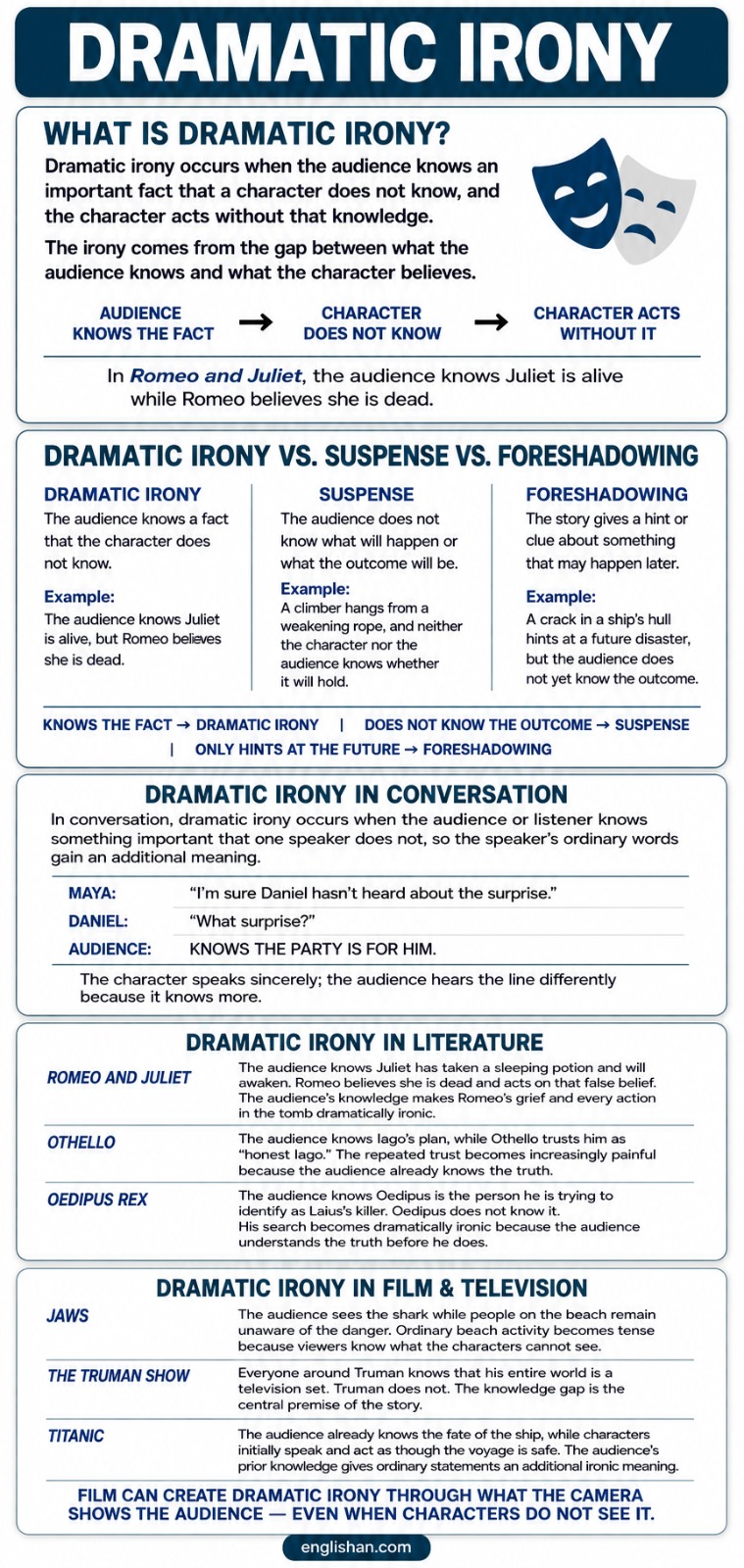
The gap has two halves, and dramatic irony needs both. The audience has to hold the fact, and the character has to act without it, because a secret nobody in the story acts against is exposition rather than irony.
The device arranges three positions: a writer who states the fact, an audience who learns it, and a character who never hears it. Greek tragedy filled those positions first, and screenwriters fill them in comedies every week.
A character speaks an ordinary line and means it straight. Romeo’s line about the colour in Juliet’s cheek reads as grief to him and as agony to an audience who knows she will wake in three minutes.
The Gap Between Audience and Character
All three phases of dramatic irony fit inside one sentence.
Dramatic irony opens a gap in knowledge between the audience and a character, held open by the writer while the character acts without the missing fact, and closed inside the story.
Opened, held and closed are those three phases, and each makes its own demand on the writer.
Readers new to the device treat the gap as a measure of intelligence. Knowledge alone sets the measure, and the cleverest character in a story can still lack the fact. Othello ranks among the sharpest minds Shakespeare wrote, and Iago still keeps him ignorant for five acts.
The Three Phases of Dramatic Irony
Romeo enters the Capulet tomb, finds Juliet still and cold, and swallows the poison he bought in Mantua. Shakespeare made three moves to bring Romeo to that position, and each move belongs to a different phase.
- Phase one, the opening: the writer hands the audience a fact and keeps it from the character. Shakespeare stages Friar Laurence’s plan and Juliet drinking the sleeping draught, so the audience already knows she will wake before Romeo reaches the tomb.
- Phase two, the use: the writer makes the character act without that fact, again and again, while the gap stays open. Romeo speaks over Juliet’s body, praises the colour still in her lips, and every line means the opposite of what he intends.
- Phase three, the close: the character learns the fact and the gap shuts. Juliet wakes, sees Romeo dead, and the audience loses its advantage at the moment she gains her knowledge.
Suspension is the usual name for the middle phase, and the name misleads by pointing at time. Time alone changes nothing, and a gap left alone is withheld knowledge that no reader feels tension over.
The middle phase asks for pressure rather than patience. Pressure means a line the character intends one way and the audience hears another, or a character choosing wrongly while the audience watches. Another move, the near miss where a character almost finds out, counts too, and Shakespeare runs all three inside one tomb scene.
Where the Audience’s Extra Knowledge Comes From
How can a writer place an audience ahead of a character in the first place? A writer has four routes, and picks one before drafting the scene.
- The narrator states it: a third-person voice tells the reader outright what the character never learns.
- A character says it alone: a soliloquy or a private conversation puts the audience inside a plan the victim never hears. Iago announces his whole design in the first scene of Othello, and Othello hears none of it.
- The camera or the chapter break shows it: the story cuts away from the character to a scene he misses, and the audience watches it instead.
- The audience already knows: a story drawn from myth, history or a famous novel already has its ending attached.
The fourth route asks nothing of the writer at all, and Greek tragedy leaned on it entirely. Greek audiences walked into the theatre already knowing the fate of Oedipus.
Told Outright or Left to Infer
Students stall on a novel where the narrator never states the secret and every scene leans the same way. Such a passage stays dramatic irony, since the device asks for the reader’s certainty rather than the narrator’s explicitness.
Two conditions belong to the reader, who has to be sure of the fact and equally sure the character has not heard it. Miss either and the passage stops counting as dramatic irony.
A hint that leaves you guessing has opened nothing. Guessing leaves the reader beside the character rather than over him, and a text built on guesswork trades on ambiguity instead.
- Every neighbour on the street speaks of the narrator’s brother in the past tense. ✅ Nobody states that the brother has died, and the reader still knows it firmly enough to watch the narrator plan a welcome home.
- A stranger in the crowd glances twice at the narrator’s brother. ❌ A reader who suspects trouble learns nothing yet, so no gap has opened for anybody to act against.
Why Dramatic Irony Does Not Need a Stage
The word dramatic sends students hunting for a play. Hunting for a play wastes the effort, because the word marks where critics first described the pattern rather than naming a condition. Critics found the pattern in Greek and Elizabethan drama, and a novelist opens the same gap with no stage, no actors and no script.
The real requirement comes in two halves: a character present and acting, and an audience who already has the missing fact. Both halves together make dramatic irony in any medium at all. A novelist opens the gap through a narrator, a director through the cut, and a television writer across whole seasons of a story.
Testing a medium: ask whether the form can withhold a fact from a character while handing it to the audience. Storytellers do that in every narrative form, and no medium is closed to the device.
Dramatic Irony vs Suspense
Suspense and dramatic irony fill the same scenes so regularly that you can mistake them for one device. They part for good once you ask who is missing something.
In suspense the audience lacks the outcome. In dramatic irony the character lacks a fact the audience already holds.
Missing an outcome files a scene in the suspense column: a rope frays over a climber’s head, and nobody, audience included, can tell whether it will hold. One shot of the frayed strand, unseen by the climber, converts the same rope into dramatic irony.
Alfred Hitchcock explained the neighbouring case with a bomb under a table. Under that table the bomb waits while two men talk baseball for five minutes, and the explosion buys the audience fifteen seconds of shock. Reveal the bomb and the clock to the audience beforehand, and the same five minutes of baseball talk becomes unbearable.
Hitchcock drew his contrast between suspense and surprise. Both scenes depend on dramatic irony: the audience knows a fact about the bomb that the two talkers lack.
Either device runs without the other, in both directions. Suspense runs alone in a scene where nobody can say whether the rope holds. Irony runs alone in a comedy whose ending nobody doubts, where the audience still watches a man insist on something false.
- The audience has watched the burglar climb into the wardrobe, and Maya opens her bedroom door. ✅ Maya walks in without a fact the audience already has, which makes the beat dramatic irony.
- Nobody, audience included, knows what waits behind Maya’s bedroom door. ❌ Withholding from everyone is suspense alone, because no character is caught inside a gap the audience can watch.
Dramatic Irony vs Foreshadowing
Foreshadowing plants a hint about a later event, while dramatic irony hands the audience the fact and lets them watch. Foreshadowing and dramatic irony pair constantly, and foreshadowing sets up much of the dramatic irony in fiction. Neither term swallows the other.
Sort any passage with two questions: does the audience know the fact, or only suspect it, and does a character act without it? A hint with no ignorant character beside it foreshadows and stops there.
A hint hardens into dramatic irony the moment the audience stops guessing. Guessing ends in the opening chorus of Romeo and Juliet, where Shakespeare announces that both lovers will die. One announcement converts the entire play into a single held gap rather than a run of hints.
- Ana notices a hairline crack along the hull as the ship leaves port. ❌ Readers suspect trouble and know nothing, so the crack foreshadows the wreck without opening a gap at all.
- The captain assures the passengers the hull is sound, three pages after the engineer’s report told readers otherwise. ✅ Readers know the fact outright, the captain speaks without it, and one line performs the opening and the middle phase together.
Dramatic Irony vs Verbal and Situational Irony
Sort the three kinds of irony by asking who lacks the knowledge, never by tone. Nobody lacks anything in verbal irony, since the speaker means the opposite of the words and expects a listener to catch it. Everybody lacks it in situational irony, audience included, until an outcome contradicts what everyone expected. The character alone lacks it in dramatic irony, and the audience watches from outside his ignorance.
A bitter line and a cheerful line both belong to any of the three, so tone sorts nothing.
Tragic Irony and Comic Irony
Oedipus stands before the city of Thebes and swears to hunt down the murderer of King Laius, promising exile and a curse on anyone sheltering him. Oedipus is describing himself, and the audience knows it. His own oath becomes his sentence, and Sophocles never lets the audience forget it.
Killing Laius and marrying Jocasta belong to situational irony. Sophocles places the dramatic irony in the curse, spoken on stage by a man with no idea he is naming himself.
- Tragic irony: the same gap with fatal stakes, where a character’s ignorance drives the fall.
- Comic irony: the same gap with harmless stakes, where the audience laughs at a character’s ignorance rather than pitying him. Shakespeare builds Twelfth Night out of it, since Viola wears men’s clothes while Olivia falls in love with her.
Tragic irony pairs with hubris in Greek tragedy, because the overreaching that blinds a hero also keeps the gap open. Blinded that way, Oedipus dismisses the prophet Tiresias, who has told him the truth to his face.
Classical criticism names the closing phase anagnorisis, the recognition scene where a character finally sees what the audience has known all along. Oedipus recognises his parents in the herdsman’s testimony and blinds himself. The same recognition goes by epiphany in modern fiction, and readers should look for it in the closing phase of any held gap.
A sad ending is not tragic irony by itself. Tragic irony needs the gap itself to cause the fall, so a hero killed by a stray arrow nobody predicted dies outside the device.
Reading a recognition scene: treat it as the close of the gap, then ask how the character acts on the new knowledge. A character who learns the fact and changes nothing has ended the irony without any reversal.
Dramatic Irony Examples in Literature
Three tragedies open the gap three different ways and close it too late to save anybody.
Shakespeare installs the gap in Romeo and Juliet through a plan the audience watches being made. Friar Laurence makes the plan, his sleeping draught lays Juliet in the tomb, and his letter to Mantua goes astray. Romeo learns neither fact, and the audience learns both. Romeo then acts without the fact for forty lines, reading death into a face that has already begun to warm. His grief moves readers as pathos, because they already know Juliet will wake.
Iago opens the gap in Othello by addressing the audience directly. He announces his design in soliloquy before speaking a word to Othello, so every later scene of trust plays as damage. One repeated adjective runs the whole middle phase: Othello calls Iago honest more than a dozen times. Honest cuts harder each time for an audience who heard the plan, and the word becomes a bitter motif.
Shakespeare keeps a shorter and crueller gap open over Duncan in Macbeth. Duncan arrives at the castle praising its sweet air and its gracious hostess, minutes after the audience has heard Lady Macbeth plan his murder.
Dramatic Irony in Film and Television
Can a screen open the gap the same way a page can? A page narrates while a screen films, so the cut states what a narrator states in prose.
Jaws opens the gap with the camera alone. The camera films the shark killing a swimmer in the opening minutes, so every later shot of a crowded beach means danger the swimmers cannot see. The beach crowd never finds out either, and Chief Brody argues with a mayor who has seen nothing.
Titanic borrows the gap from outside the film. Outside the film everybody has heard how the voyage ends, so Cameron lets a passenger call the ship unsinkable and lets the line do its damage unassisted.
The Truman Show makes the gap its premise. Every character except Truman knows he lives inside a broadcast, and the audience joins the cast rather than the hero.
Horror keeps a permanent gap open as a matter of genre. Genre writers keep the audience ahead deliberately: the audience has seen what waits in the basement and the character has not. Such a permanent gap makes shouting at the screen the intended response rather than a failure of the film.
How to Write Dramatic Irony
A writer chooses the route, the length and the order of discovery before drafting an ironic scene.
Choose the route first, since each opens the gap at a different speed. The narrator’s route does it at once, a soliloquy keeps the reader inside one character’s plan, and a cut hands the reader knowledge nobody in the scene has.
Choose the length second, because distance sets the tone. One page of distance raises a laugh, and a whole novel of it raises dread.
Choose the order of discovery third. Let the character learn the fact while the wrong person watches, and the closing phase becomes a scene rather than an announcement. Such a scene repays the whole gap, and a bare announcement wastes it.
One failure precedes all three choices: installing a gap and then leaving it alone. A writer who does that has withheld knowledge without making irony, and the pages go flat. Instead, write the character a double-meaning line, or a choice the reader watches going wrong, or a near miss, and repeat the move at intervals.
Dramatic Irony on a Second Reading
Knowing the ending supposedly ruins a story. Knowing it helps dramatic irony instead, since a reader returning to a novel already knows every fact the characters spend the book failing to see.
A neutral line stays neutral on a first reading. On a second reading the reader knows what the character misses, and the neutral line now reads as irony. Every reader in a Greek theatre had that advantage permanently, since Sophocles wrote for people who had known the myth of Oedipus since childhood.
A writer borrows the effect deliberately through allusion, naming a story the reader has already read so that its ending precedes the first page.
On a reread, mark the lines that fell flat the first time and cut deep the second, since the writer planted them for a returning reader.
How to Spot Dramatic Irony While Reading
Three questions identify dramatic irony in a text you have never seen, and the order of the questions matters.
Question one: name the fact. A fact you cannot state in one sentence has not opened any gap.
Question two: name who knows it. Certainty is the condition, and the audience knows the fact whether a narrator stated it or the reader inferred it.
Question three: name who acts without it. Acting without the fact means a character speaks or moves in a way the fact would change.
Readers fail at the third question and point at the wrong line. The irony is in the line the ignorant character speaks, not in the sentence where the reader was told the secret. That earlier sentence belongs to the opening phase, where no irony has begun.
- Friar Laurence explains the sleeping draught to Juliet. ❌ The line opens the gap and nobody acts in ignorance yet, so it belongs to the setup.
- Romeo stands over Juliet and says death has had no power upon her beauty. ✅
Frequently Asked Questions
Q1. What is the difference between dramatic irony and suspense?
The difference lies in who is missing something. Something missing on the audience’s side is suspense, so nobody in the cinema can tell whether the rope will hold. Something missing on the character’s side is dramatic irony, and the tension grows out of watching him act without a fact the audience already knows. Both devices overlap constantly, because a reader feels tension while the gap stays open.
Q2. Is foreshadowing dramatic irony?
No, though foreshadowing sets up a great deal of the dramatic irony in fiction. Foreshadowing leaves the reader suspecting, and dramatic irony needs the reader to know. Ask two questions: has the reader learned the fact outright, and has a character acted without it? Both answers have to be yes.
Q3. What is tragic irony?
Dramatic irony with fatal stakes is tragic irony, and the gap itself has to cause the character’s fall. Fatal stakes appear in Oedipus Rex, where Oedipus swears to hunt down the murderer of Laius while the audience knows he is cursing himself. Stakes alone are not enough, so a sad ending that no gap caused falls outside the term.
Q4. Does dramatic irony have to be in a play?
No, the word dramatic marks where critics first described the pattern rather than naming any conditions. Only two conditions matter: a character acting, and an audience who already has the missing fact. Both conditions occur in novels, films and television series, so Sophocles and Shakespeare merely wrote first.
Q5. What is an example of dramatic irony in Macbeth?
The standard case is the arrival of Duncan at Macbeth’s castle. Duncan praises the sweet air and the gracious hostess minutes after the audience has heard Lady Macbeth plan his murder, so he thanks the two people arranging his death. Banquo’s warmth toward Macbeth after the coronation runs the same gap again.