A dichotomy splits a single whole into two parts that cannot overlap. Together, the two parts account for everything inside that whole: light and dark, alive and dead, true and false. The word entered English in 1588 from Greek roots that mean “cut in two.” Writers, philosophers, and speakers have turned to that division ever since to sharpen an argument or deepen a character’s conflict.
Not every apparent either-or stands up to a close look, though. Knowing when the split reflects something real, rather than a forced choice between only two options, separates careful reading from careless reading.
What Is a Dichotomy?
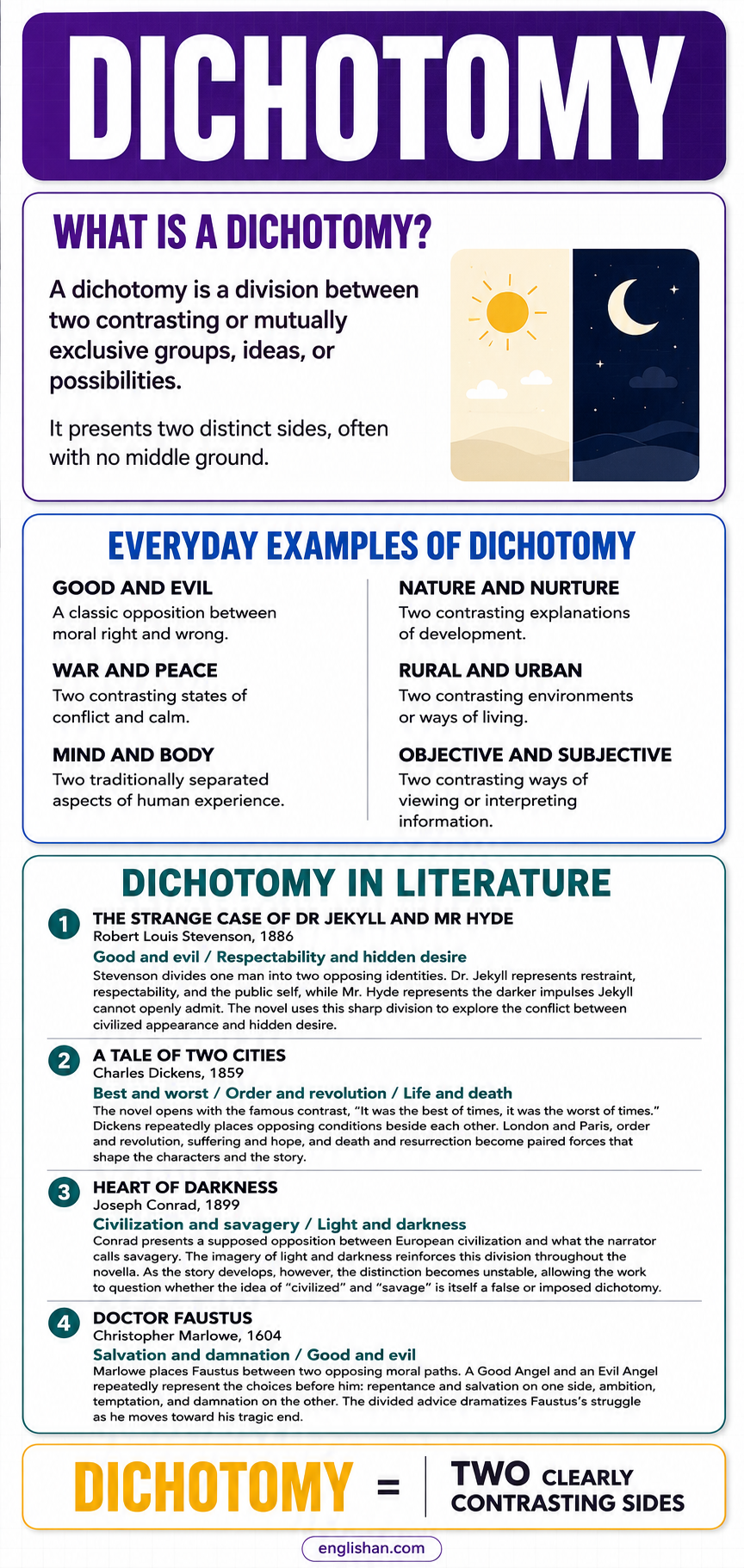
The term comes from the Greek dichotomia, built from dicha, meaning “in two,” and tomē, meaning “a cutting.” Logicians still use it in close to its original sense. A genuine dichotomy splits a set into two parts that are mutually exclusive, so nothing counts as both. It is also jointly exhaustive: the two parts cover every possibility, so nothing is left over.
Every integer is even or odd and never both, which makes the even-odd split a textbook case. A character who is either alive or dead works the same way. That structural precision is exactly why writers use the device when they want a conflict or an argument to feel absolute.
The Greek philosopher Zeno of Elea used the same halving idea for a different purpose roughly 2,500 years ago. To walk any distance, he argued, a person must first cross half of it, then half of what remains, without end. That makes the destination impossible to reach in a finite number of steps. Zeno’s dichotomy paradox has nothing to do with choosing between two options; it argues about dividing one distance forever. The word and the paradox only share a root, not a meaning.
Writers pair two contrasting halves with juxtaposition, setting them directly against each other so the contrast registers in a single glance. A single scene, a single sentence, or an entire novel can contain the pairing. The device works at any of those sizes as long as the two sides stay genuinely separate.
Everyday Examples of Dichotomy
Some divisions repeat constantly in ordinary conversation, so constantly that people stop noticing they are dichotomies at all. Each one draws a hard line between two sides, though a few of them draw that line more honestly than others.
- Mind and Body: Descartes framed thought and physical matter as two separate substances, a split still argued over in philosophy of mind.
- Nature and Nurture: developmental psychology debates whether genes or environment shapes a person more. Most researchers now treat the two as interacting rather than competing.
- Good and Evil: religious and moral writing has relied on this split for centuries to give a story a stake with no middle ground.
- War and Peace: political language treats the two as opposite states, though ceasefires, cold wars, and armed uprisings rarely fit only one side.
- Rural and Urban: census categories and policy debates still sort a country’s population into these two groups despite the wide range of towns in between.
- Objective and Subjective: research methods separate what can be measured from what depends on personal perspective. Philosophers have debated that split for centuries.
Dichotomy in Literature
When the pattern runs through an entire work rather than one scene, critics call it a motif, something the writer returns to on purpose rather than by accident. Critics also call these paired opposites a binary opposition, meaning two contrasting terms that define each other.
The Strange Case of Dr Jekyll and Mr Hyde (Robert Louis Stevenson, 1886)
Stevenson splits one man into two bodies. Dr Jekyll represents restraint and respectability. Mr Hyde acts out every impulse Jekyll cannot admit to in public. The novel treats the two as opposing, mutually exclusive selves rather than one complicated character. The split works as a literal doppelganger, and it lets Stevenson dramatize Victorian anxiety about hidden desires without blurring the two identities into one.
A Tale of Two Cities (Charles Dickens, 1859)
The opening line, “It was the best of times, it was the worst of times,” sets a pattern that runs through the entire novel. London opposes Paris. Order opposes revolution, and resurrection opposes death. Dickens keeps returning to paired opposites, so each city, and each character’s fate, defines itself against the other rather than on its own terms.
Heart of Darkness (Joseph Conrad, 1899)
Conrad builds the novella around a supposed dichotomy between European civilization and what the narrator calls savagery. Light and dark symbolism reinforces that split throughout the Congo setting. Later critics have argued that the book exposes this framing as a colonial invention, not a fact about the people it describes. That makes it a rare case of a novel arguing against its own narrator’s framing.
Doctor Faustus (Christopher Marlowe, 1604)
Marlowe stages Faustus’s conscience as an allegory, with a good angel and an evil angel taking turns to advise him at each turning point in the play. The two figures embody the play’s central divide between salvation and damnation. Faustus’s hubris is what keeps pushing him toward the side that costs him everything.
Dichotomy in Famous Speeches
- Abraham Lincoln’s “House Divided” Speech (1858): Lincoln built the entire address around one hard split. A nation had to become “all one thing or all the other,” free or slave, because a government divided down the middle would not last.
- Martin Luther King Jr’s “I Have a Dream” (1963): King set up a stark contrast between judging people “by the color of their skin” and judging them “by the content of their character.” The whole speech pushes the audience toward the second half of that split.
- Hamlet’s “To Be or Not to Be” Soliloquy (William Shakespeare, circa 1600): Hamlet frames his crisis as a stark choice between existing and not existing. The soliloquy’s force comes from treating that choice as though no third option is available, a framing worth questioning on its own terms.
False Dichotomy Explained
A false dichotomy presents only two options as though they were the only ones available, when a third, fourth, or blended option genuinely exists. Logicians also call it a false dilemma or an either-or fallacy. It is a logical fallacy, an error in reasoning that replaces real evidence with a forced choice. One relative is the non sequitur, where a conclusion does not follow from what came before it at all.
A workplace debate offers one everyday version: “Either you work every weekend, or you don’t care about the team.” That framing ignores every arrangement between full availability and total absence from the team. A sales pitch offers another: “Buy the premium plan, or accept a product that barely works,” ignoring a free or starter tier that does the job fine.
Public debate produces the largest versions. “A country either closes its borders completely, or it loses control of them entirely” erases the entire range of policy between the two extremes.
The trick works by narrowing the field of real options before an argument even starts. An audience ends up weighing two choices instead of the true number available. It also creates the appearance of a logical argument. Real logic rules out alternatives one at a time, the exact task logos depends on.
One question exposes most cases: does a third, fourth, or blended option actually exist? When it does, the speaker has already done the persuading before offering any evidence.
Dichotomy vs Spectrum vs Dilemma
| Term | What It Actually Describes |
|---|---|
| Dichotomy | A whole divided into two parts with no overlap and nothing left over |
| Spectrum | A continuous range with many possible positions, not only two |
| Dilemma | A choice between two options that are both difficult or costly |
| Paradox | A statement that looks self-contradictory yet can still be true |
Confusing these four costs an argument its precision. Gender, political belief, and intelligence, for instance, fall closer to a spectrum than a two-sided split. Real people occupy every position between two extremes rather than one of only two boxes. Treating a spectrum this way is exactly how a false dichotomy starts.
Dilemma causes the most confusion with this idea, but a dilemma is about the discomfort of choosing, not about how many real options exist. A person choosing between two acceptable job offers is in a dilemma, not a two-sided split. A third offer remains entirely possible even though only two are on the table right now.
A paradox looks like the opposite problem. Instead of forcing two options where more exist, it keeps two statements true at once that look like they cannot both be true. The claim that giving something away can make a person richer works this way. A dichotomy keeps both halves separate; a paradox keeps both halves true together.
Rhetoric has a third move beyond both problems. Admitting real uncertainty about which side is right comes closer to aporia than to any dichotomy, false or genuine. A speaker using aporia states the doubt honestly instead of forcing a choice.
Synonyms for Dichotomy
- Duality: Duality names the state of having two opposed parts. Writers use it more loosely than dichotomy, without requiring a complete, non-overlapping split.
- Polarity: Polarity means the pull between two extremes, a sense common in physics and psychology. The term centers on tension rather than on sorting every case into one of two boxes.
- Bifurcation: Bifurcation is a more technical way to say something has split into two branches. The word appears in science, medicine, and law.
- Antithesis: Antithesis is a rhetorical device rather than a stand-alone concept. It places two contrasting phrases inside one sentence through parallel structure so the opposition fits inside a single line.
- Binary Opposition: Binary opposition is the term literary and cultural critics use for the same idea, borrowed from structuralist theory. Critics apply it to pairs such as speech and writing, or self and other.
Ambiguity describes what remains once a hard boundary breaks down. A dichotomy assumes a line with nothing left over on either side. The two words describe opposite reading experiences, even though both show up in the same paragraph of serious writing.
How to Spot a False Dichotomy in an Argument
Run one test on any either-or claim before accepting it. List every option the claim excludes, then ask whether at least one of those options actually exists in the real world.
A genuine dichotomy leaves nothing on that list, since even and odd numbers or alive and dead account for every case between them. A false dichotomy always leaves real options on that list: a partial measure, a mixed position, a delay, or a third path the speaker never named. If naming three excluded options takes less than a minute, the claim was designed to persuade rather than to describe the actual range of choices.
Once the test turns up a missing option, name it out loud instead of picking one of the two sides on offer. Silence about the missing option, in a debate or an essay, reads as agreement with the two-option frame even when the writer meant to reject it.
State the excluded ground directly: “the claim offers only two positions, and a third exists,” then describe what that third position looks like in practice. An essay that names the false dichotomy in a source, and quotes the missing option back at the reader, argues from a strong position. That approach beats arguing for the second option instead of the first.
The goal is not to split the difference for its own sake. It is to restore the full range of choice the speaker tried to erase.
❌ “Either the company cuts every benefit, or it goes bankrupt within a year.” This statement hides every option between total cuts and total collapse, including reduced hours, renegotiated contracts, a smaller round of layoffs, and a short-term loan.
✅ “The company’s shrinking budget puts several options on the table, from trimming a few benefits to closing entire departments, with bankruptcy only at the far end of that range.” This version restores the excluded middle ground and states the real range of choices open to the company.
FAQs
Dichotomy means a division of a whole into two parts that do not overlap and, together, cover every possibility inside that whole. English borrowed the word from Greek dichotomia in 1588, and it still keeps that sense of a complete, non-overlapping split rather than a loose contrast.
Even and odd numbers form one of the sharpest examples, since every integer fits exactly one category and none falls outside both. Good and evil in Doctor Faustus, and the two identities in Dr Jekyll and Mr Hyde, show the same structure at work in literature. A character or a theme gets built around two mutually exclusive halves.
A false dichotomy presents only two options as though they were the only ones available, when a third, fourth, or blended option actually exists. It is also called a false dilemma or an either-or fallacy. It works by narrowing an argument’s real range of choices before any evidence gets weighed.
A dichotomy is a division into two mutually exclusive parts. A dilemma is a situation where someone must choose between two options that are both difficult or costly. A person can face a dilemma with only two offers on the table right now while a third offer remains entirely possible later. That extra possibility is not open to a genuine two-sided split, where no third option exists at all.
Yes, a dichotomy is legitimate whenever the two parts genuinely are mutually exclusive and cover every real possibility, such as alive and dead or even and odd. It turns misleading only when someone applies that all-or-nothing structure to something that works more like a spectrum.