Connotation is the feeling or association a word suggests beyond its literal, dictionary meaning. “Slender” and “skinny” name the same body type, yet one sounds like a compliment and the other sounds like an insult. That extra layer of feeling is each word’s connotation. A writer who ignores it loses control of half of what a sentence actually says.
What Is Connotation
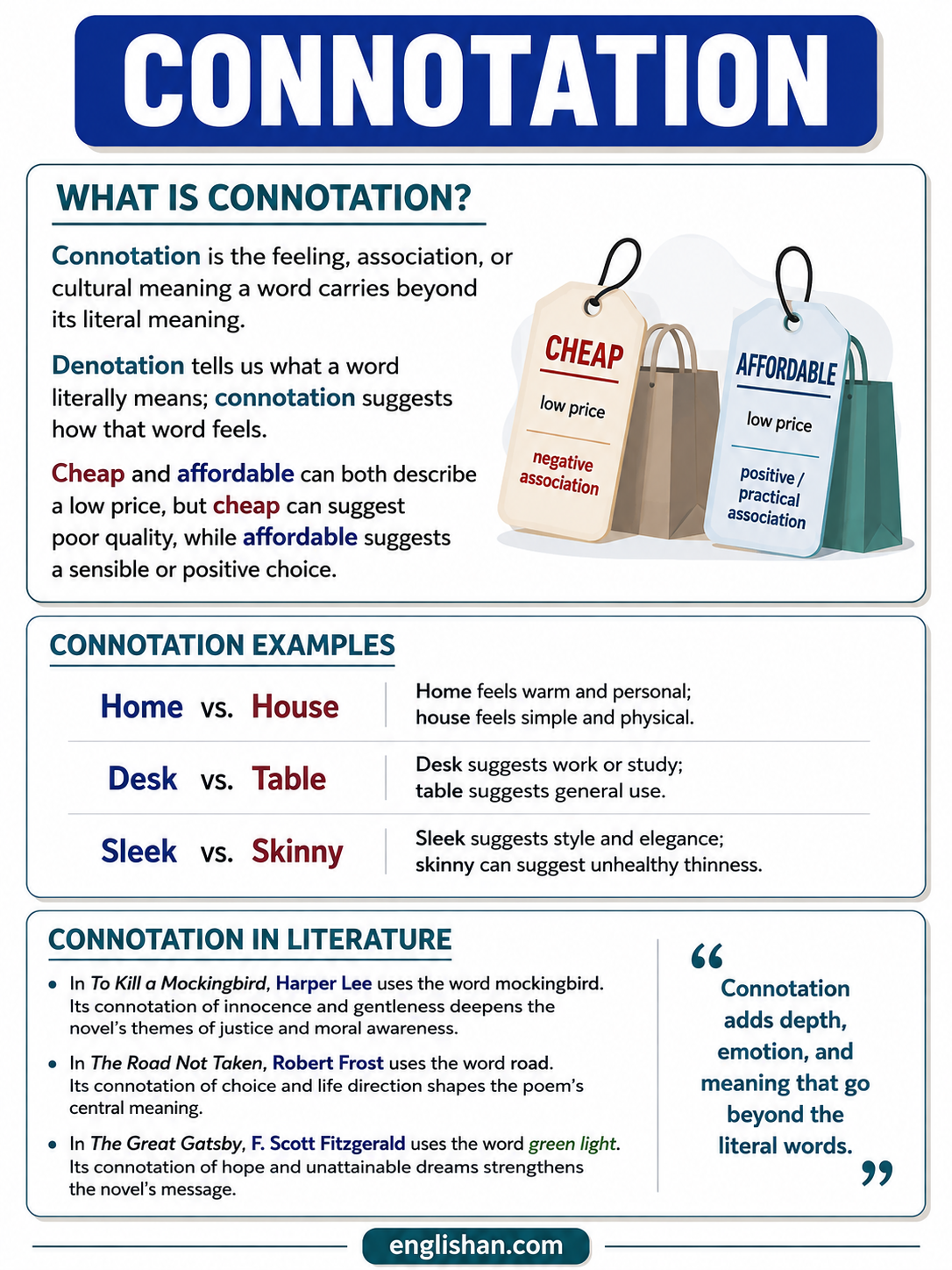
Connotation is the emotional or cultural association a word produces beyond its literal, dictionary meaning. The literal meaning itself has a name too: denotation. “Cheap” and “affordable” both denote a low price, but “cheap” adds a suggestion of poor quality while “affordable” adds a suggestion of good sense. Neither word is wrong. They differ in what they make the reader feel about the price.
The word comes from the Medieval Latin connotare, built from com (“with, together”) and notare (“to mark, to note”). It entered English in the 1530s inside medical writing, where it named a symptom that showed up alongside a main condition. The modern sense keeps that idea of a second meaning attached to a main one.
The philosopher James Mill stated the modern distinction in 1829: a word denotes the main thing it names and connotes something else attached to it. His example was “white” in “white horse,” which denotes the color and connotes the horse itself. Later usage narrowed the term to the emotional weight a word adds, and that is the sense every English class now teaches.
Types Of Connotation
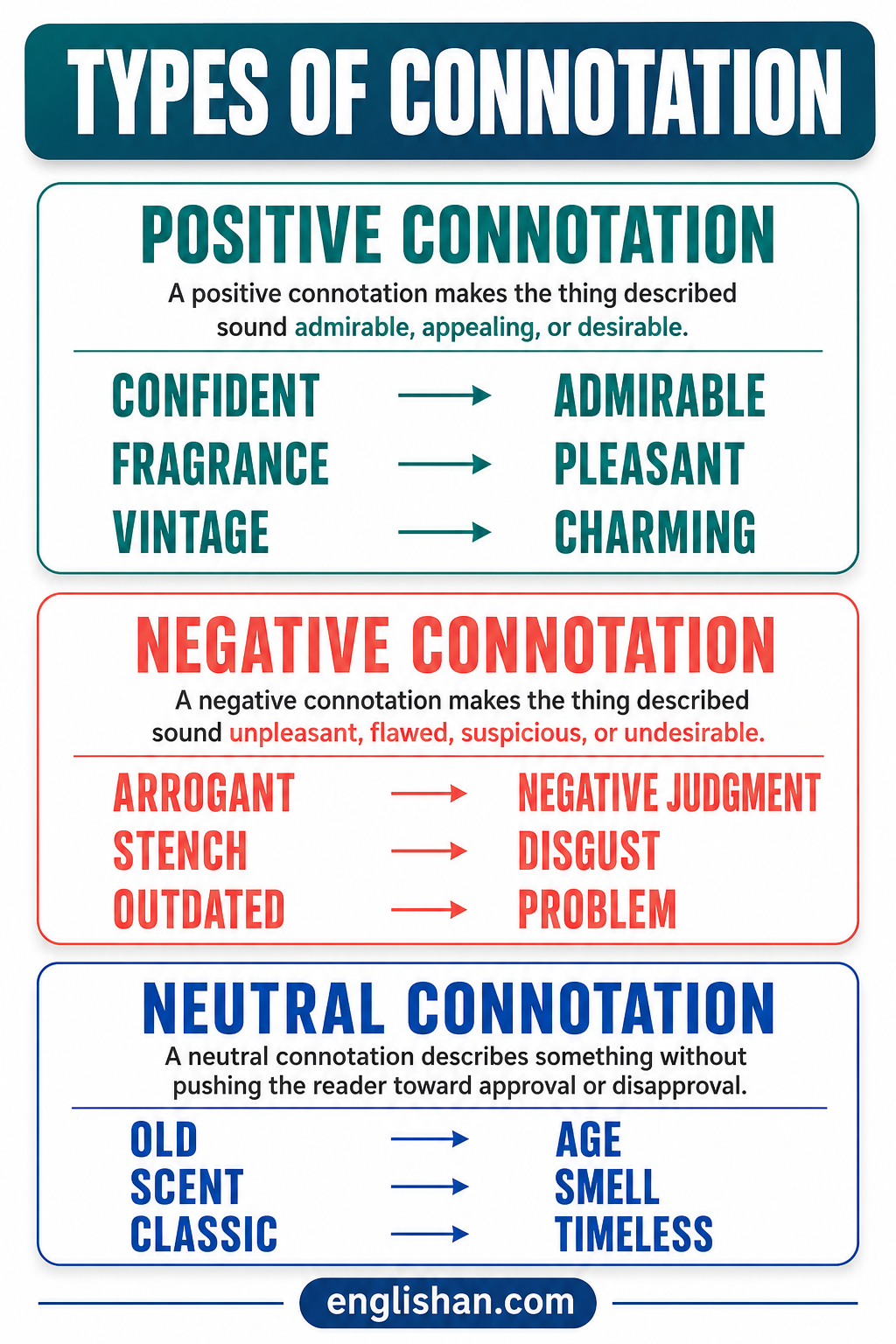
Every connotation falls into one of three ranges: positive, negative, or neutral. The range shows whether a word praises what it describes, criticizes it, or names it without judgment.
Positive connotation: the word makes what it describes sound admirable, appealing, or worth wanting.
- Confident describes someone sure of their own ability and makes that self-belief sound admirable.
- Fragrance names a pleasant smell and suggests something worth breathing in.
- Vintage labels something old and frames the age as charm rather than decay.
Negative connotation: the word makes the same thing sound unpleasant, suspect, or worth avoiding.
- Arrogant describes the same self-belief as confident, but presents it as a flaw.
- Stench names an unpleasant smell and adds a suggestion of something disgusting.
- Outdated labels the same age as vintage, but treats it as a problem to fix.
Neutral connotation: the word states the same thing without pushing the reader toward approval or disapproval.
- Old states an age, with no built-in judgment either way.
- Smell reports the sensation without saying whether it is pleasant or unpleasant.
- Inexpensive states a low price without the negative connotation of cheap or the positive connotation of affordable.
Writers choose among these three ranges every time they pick a word, whether they notice the choice or not. A news report aiming for balance chooses neutral words. A campaign speech chooses positive ones for its own side and negative ones for its opponents.
Connotation Versus Denotation
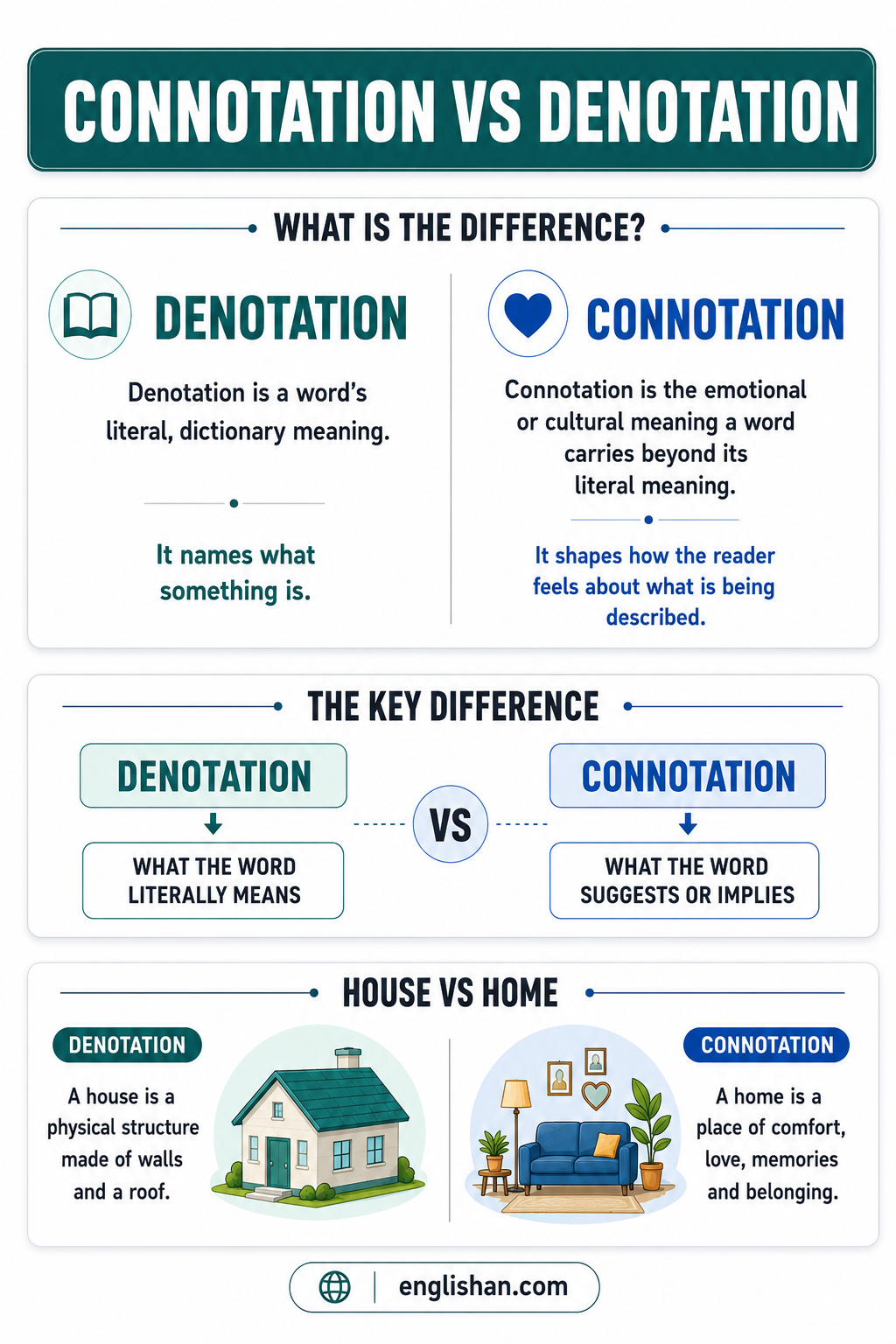
Denotation is the meaning a dictionary prints: fixed, literal, and roughly the same for every reader. Connotation is the meaning a reader supplies on top of that. Culture and personal history shape it, and so do the words placed around it. It can shift from one reader to the next.
A snake denotes a legless reptile for every English speaker, yet it connotes danger or dishonesty for most readers raised on Western folklore. A scientist who studies snakes connects the same word to ordinary fieldwork instead.
| Feature | Denotation | Connotation |
|---|---|---|
| Meaning type | Literal, dictionary definition | Emotional or cultural association |
| Consistency | Fixed across contexts and readers | Shifts by culture, era, and individual reader |
| Source | Stated directly in the word | Built up around the word through use |
| Example word | House (a building people live in) | Home (belonging, comfort, family) |
| Main use | Naming a thing precisely | Shaping how a reader feels about that thing |
The two meanings exist side by side in the same word. “House” and “home” denote the same building, yet “home” adds a feeling of comfort and belonging that “house” leaves out. A diction choice between the two words is really a choice between the bare fact and the feeling a writer wants attached to it.
L
How To Identify Connotation In A Sentence
Spotting a connotation starts with a substitution test. Replace the word with a close synonym, then check whether the sentence’s mood changes even though the literal meaning stays roughly the same. “The committee was frugal with the budget” reads as approval. “The committee was stingy with the budget” reads as criticism. That shift shows that frugal and stingy change the sentence’s tone even though both denote the same low spending.
A second test works on a single word by itself. Ask what image or feeling comes to mind before any context is added. “Childlike” brings wonder and innocence to mind, while “childish” brings a tantrum. Both describe behavior typical of a child, so their denotation is almost the same. Only the felt meaning tells the two words apart.
A word’s usual connotation can still shift once context changes. “Wild” sounds negative in “a wild driver” and positive in “a wild party.” A reader therefore has to weigh the whole sentence rather than judging the word alone.
Connotation Examples In Everyday Words
Word choice rarely changes what is being described. It changes how the reader is meant to feel about it. Each group in this list names roughly the same thing while creating a different feeling.
- Slender, thin, skinny: all describe a low body weight, but slender sounds like praise, thin stays neutral, and skinny sounds critical.
- Assertive, forceful, pushy: all describe someone who states their wants directly, moving from admired to merely noted to disliked.
- Curious, nosy: both describe an interest in other people’s business, yet curious sounds like a virtue and nosy sounds like a fault.
- Unique, weird: both describe something unlike the rest, but unique reads as praise and weird as an insult.
- Frugal, cheap, economical: all describe careful spending, with frugal sounding disciplined, cheap sounding stingy, and economical sounding practical.
- Rich, wealthy, loaded: all describe having a great deal of money, moving from neutral to formal to casual and slightly judgmental.
A writer editing a draft can check a list like this and ask which word matches the feeling the sentence needs, not just the fact it needs to state. Advertising depends on this choice constantly. A product described as “affordable” attracts a different buyer than one described as “cheap,” even when both refer to the same price tag.
Connotation In Literature
Writers use connotation to say more than their sentences state outright. A reader who tracks it catches meaning the plot never spells out.
F. Scott Fitzgerald’s green light in The Great Gatsby denotes nothing more than a lamp at the end of a dock. Its green color suggests money and envy, and it also stands for the future Gatsby wants. The object therefore gains meaning the story never states directly. Repeated across an entire book, one image collects these associations until it becomes a symbol. Connotation supplies the raw material every literary symbol starts from.
Shakespeare uses the same tool inside a single line. Juliet’s line about “a rose by any other name” asks whether the feeling attached to the Montague name, not its literal meaning, makes Romeo her enemy. Novelists choose a character’s descriptive tag with the same care. A recurring phrase attached to a character functions as an epithet, such as Homer’s “cunning Odysseus,” precisely because the words chosen add a judgment the plain name would not.
Poets push this technique even further by placing words with opposing associations next to each other. Setting “home” beside “exile,” or “bloom” beside “rot,” is juxtaposition, and the contrast in feeling stands out more than either word would alone. A writer building a scene of childhood safety chooses words that create nostalgia: porch, supper, screen door. Each word adds a warm association that a neutral synonym would not.
How Connotation Shapes Writing
A sentence with the right facts and the wrong connotation still fails its reader. Journalists learn this early: calling a person a “freedom fighter” instead of a “terrorist” describes the same actions while asking the reader to take opposite sides. Emotionally charged wording chosen to steer the reader’s judgment is called loaded language.
Advertisers, speechwriters, and poets depend on it too. They choose “pre-owned” over “used,” or “passed away” over “died,” because the facts do not change but the feeling attached to them does.
Formal and casual writing put connotation to different use as well. The level of formality a piece of writing takes is called its register. A colloquialism such as “broke” has a blunt, casual undertone that “financially constrained” avoids. That is why a résumé uses the second phrase and a text message uses the first. Matching a word’s emotional weight to its register separates writing that fits its reader from writing that sounds out of place.
This weight also shifts with time and place. A word that once sounded neutral can pick up new associations, and one that once sounded harsh can soften. “Gay” denoted cheerful for centuries before its main sense changed entirely. A writer working across different audiences has to check a word’s current connotation rather than trusting the meaning it had a generation earlier.
Common Confusions With Connotation
The most common mistake treats denotation and connotation as if they always match, when a sentence’s real meaning depends on the gap between them. Calling someone “stubborn” and calling them “determined” denote the same refusal to change course. Confusing the two, or assuming a reader will accept one when the writer meant the other, is where miscommunication starts.
A second mistake assumes this association is fixed and universal, the way denotation mostly is. It is not. “Snake” connotes danger to most Western readers but represents wisdom or rebirth in other traditions. A word’s felt meaning therefore depends on the audience reading it, not on the word alone.
A felt meaning can also suggest two readings at once, and a poorly chosen word then creates real ambiguity. A reader unsure which association the writer intended has lost the sentence’s actual point.
A third mistake treats connotation as decoration added after the real writing is done. It is not an extra layer. The association belongs to the word from the first draft, which is why professional editors weigh a synonym’s feeling as carefully as its literal meaning.
FAQs
Denotation is a word’s literal, dictionary meaning, and it stays fixed across contexts and readers. Connotation is the emotional or cultural association a word adds on top of that literal meaning. It can shift depending on culture, era, and the individual reading it.
The three types are positive, negative, and neutral. A positive connotation makes what a word describes sound appealing, and a negative one makes the same thing sound unappealing. A neutral connotation states it without pushing the reader toward either reaction.
Yes, a single word can have different connotations depending on its context and its audience. “Wild” sounds negative describing a driver and positive describing a party. “Snake” picks up different associations across different cultural traditions, so the surrounding sentence and the reader’s background both shape which connotation applies.
Writers pay attention to connotation because word choice shapes how a reader feels about a fact, not just what the fact states. Choosing “assertive” over “pushy,” or “vintage” over “outdated,” changes the reader’s reaction to the same fact stated twice. That makes it one of the most direct tools a writer has for controlling tone.
A common example swaps frugal for stingy in the same sentence. “She was frugal with her savings” and “she was stingy with her savings” describe the same low level of spending, so their denotation matches exactly. Frugal adds a suggestion of discipline and good sense, while stingy adds a suggestion of meanness. That difference shows how the association alone can flip a reader’s judgment of the same behavior.