The Greek verb meioun means to make smaller, and English inherited it twice. Biology uses meiosis for the cell division that halves a chromosome count before reproduction. Rhetoric uses the very same word, recorded in this sense centuries earlier, for a figure of speech that deliberately shrinks how significant something sounds, turning a fatal wound into a scratch. That deliberate shrinking, not the cell biology, is what the term means in literature and everyday speech.
What Is Meiosis in Rhetoric?
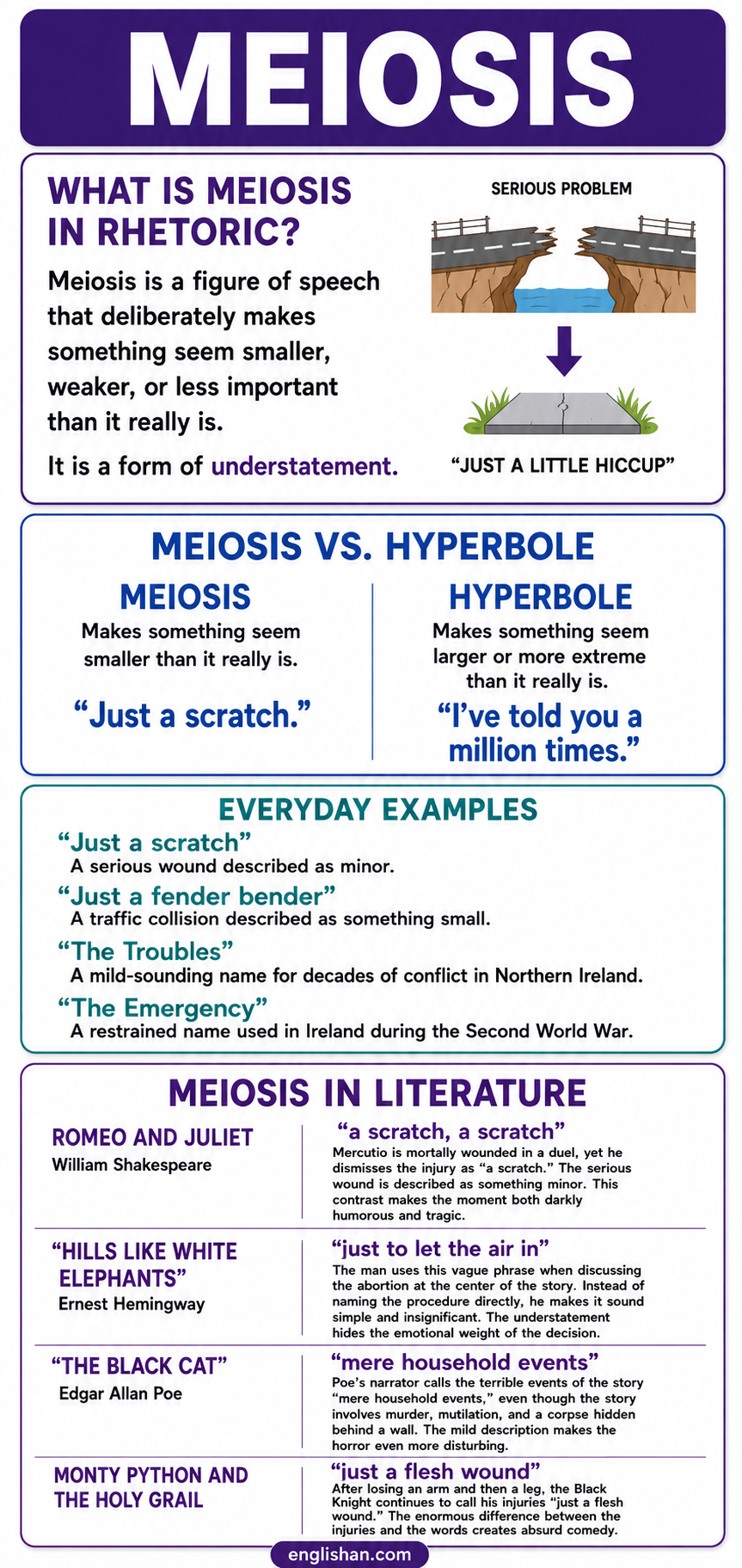
Meiosis is a figure of speech that deliberately describes something as smaller, weaker, or less significant than it truly is. The word is pronounced my-OH-sis, exactly like the cell-division term from biology, and the two share only the Greek root, not the meaning. In grammar and rhetoric handbooks the plural is meioses and the adjective is meiotic.
The device works as the direct opposite of auxesis, the figure that inflates a claim through exaggeration, a move English speakers mostly know by its common name, hyperbole. Where hyperbole calls a suitcase impossibly heavy, this understatement calls a mortal wound a scratch. Some rhetoricians reserve a second name, tapinosis, for the same shrinking used to insult or degrade rather than to soften. Most modern usage treats the two as one figure with two moods. One mood spares a listener’s feelings, and the other belittles on purpose.
The Greek Origin of Meiosis
The word descends from the Greek verb meioun, to lessen or make smaller, itself built on meion, the comparative of mikros, small. Roman rhetoricians translated the same idea into Latin as extenuatio and diminutio, both meaning a lessening, terms that turn up throughout classical guides to style. In 1905, biologists borrowed the identical Greek verb for the cell division that halves a chromosome count. That process also makes something smaller: a full set of chromosomes reduced to half. The rhetorical sense is by far the older of the two, even though a search for the word today returns mostly biology.
Why Writers Use Understatement
A writer uses deliberate understatement to control the emotional weight of a sentence. Playing down a wound, a loss, or a disaster keeps a narrator’s voice steady instead of hysterical, and that restraint unsettles you more than an outright description would. The juxtaposition between the calm word and the real event forces you to supply the missing horror or grief. The same shrinking move works for comedy: calling a minor annoyance a catastrophe would be hyperbole. Calling a genuine catastrophe a minor annoyance earns a laugh instead, precisely because the mismatch is so wide.
Meiosis also spares a listener’s feelings. Softening a blunt fact into an easier phrase, a layoff into a restructuring, a death into a passing, avoids a harsh word without an outright lie. That social use explains why the device depends so heavily on euphemism as its method of delivery. That choice is a matter of diction: two writers describing the same wound choose between naming it plainly and naming it small. The choice alone sets the tone of the entire passage.
Meiosis in Literature
Shakespeare, Hemingway, and Poe each chose this device at the exact moment their scenes turned violent or unbearable, letting restraint do the emotional work instead of description.
- Mercutio, mortally stabbed in a duel, dismisses the wound as “a scratch, a scratch” while joking that his friends will find him “a grave man” by morning. Shakespeare hands a dying character calm, almost comic understatement in Romeo and Juliet. The mismatch between the wound and the word is what makes the moment land as tragedy rather than melodrama.
- In Hemingway’s short story “Hills Like White Elephants,” the man describes an abortion as “just to let the air in.” Neither character names the procedure once in the story, and the small phrase alone creates the entire tension of the story: you understand exactly what it is hiding.
- Poe opens “The Black Cat” by promising to relate a series of “mere household events” before describing murder, mutilation, and a corpse walled up alive. Calling atrocities household events pushes this figure to its darkest edge, and the calm label warns you that the narrator’s own sense of proportion has collapsed.
- In Monty Python and the Holy Grail, the Black Knight loses an arm and then a leg in swordplay and still insists it is “just a flesh wound.” The film turns the same device Shakespeare used for tragedy into slapstick. Shrinking a wound in words reads as heroic understatement or absurd denial, depending only on the scene around it.
Historical and Everyday Examples of Understatement
The same device shows up constantly outside literature, in places where a group needs to live with something too large or too painful to name directly.
- The American South once called slavery “our peculiar institution,” and Confederate sympathizers later called the Civil War “the recent unpleasantness.” Both phrases shrink an atrocity and a war down to the size of an inconvenience. Historians now read the euphemisms themselves as evidence of the discomfort they were built to manage.
- Northern Ireland’s three decades of bombings, shootings, and civil conflict are still known simply as “the Troubles.” Ireland’s official name for the deprivation of the Second World War was “the Emergency.” Each label held for so long that it stopped sounding like understatement at all, which is the fate of most successful meiosis: repetition wears the irony smooth.
- Everyday colloquial job titles work the same trick in miniature. A psychiatrist gets reduced to a “shrink” and a mechanic to a “grease monkey.” Traffic reporters still favor a “fender bender” over a plain collision. None of these has the moral weight of a war euphemism, but each one performs the identical move of making something sound smaller and less serious than it is.
Meiosis vs Litotes
Litotes and meiosis both understate, and both get filed under the same umbrella term, but the mechanism each one uses is different. Litotes states a fact by negating its opposite: calling a brilliant plan “not a bad idea” or a difficult exam “no picnic” uses grammatical negation to say something true through denial. This other figure needs no such negation. It substitutes a smaller, weaker, or gentler word for the real one, calling a fatal wound a scratch with no negation anywhere in the sentence.
The overlap is real enough that some rhetoric handbooks treat litotes as one variety of the same shrinking, built specifically through negation. The broader figure accounts for every other route to the same effect. A sentence can even combine both: “the wound was no small scratch” negates a phrase that is already an understatement on its own.
Euphemism as the Delivery Method
Euphemism and meiosis overlap constantly because writers frequently use a euphemism as the tool that performs the shrinking. Calling death “a passing” achieves that shrinking through euphemism: the softer phrase has a gentler connotation and makes the event sound smaller than it is. The two terms are not identical, though. Euphemism only requires substituting a less unpleasant expression for an unpleasant one, and plenty of euphemisms do that without shrinking anything. “Restroom” replaces “toilet” out of tact, not because a restroom sounds smaller than a toilet, only more polite. The rhetorical device specifically requires that the substitute diminish scale or significance, so every instance that avoids offense counts as a euphemism too, but not every euphemism performs that shrink.
| Device | How It Works | Example |
|---|---|---|
| Meiosis | Substitutes a smaller or weaker word for the real one | A fatal wound called a scratch |
| Litotes | States a fact by negating its opposite | A brilliant plan called not a bad idea |
| Euphemism | Replaces an unpleasant word with a gentler one | Death called a passing |
Meiosis vs the Biology Term
Biology’s meiosis names the two-stage cell division that halves a cell’s chromosome count to produce sperm, eggs, or spores, a process governed by genetics rather than language. The rhetorical device shares nothing with that process beyond the Greek root both fields borrowed for the same idea of lessening. One shrinks a chromosome count, the other a sentence’s emotional weight. A biology textbook and a Shakespeare footnote can print the identical word on facing pages of the same anthology while describing nothing remotely related. Mixing up the two costs exam marks in biology or in literature, whichever one is being graded.
FAQs
Litotes understates specifically through negation, saying “not bad” to mean good. Meiosis substitutes a smaller word for the real one with no negation required, saying “a scratch” for a fatal wound. Some rhetoric handbooks count litotes as one variety of the same device, rather than a fully separate figure.
Auxesis is the opposite of meiosis, inflating something instead of shrinking it, and you know auxesis under its far more common name, hyperbole. Where this figure turns a war into an inconvenience, auxesis turns an inconvenience into a disaster.
Meiosis occurs constantly in everyday conversation, well beyond its use in literature, since slang job titles, traffic-report phrases, and historical euphemisms all rely on the same shrinking trick that novelists use. A grease monkey, a fender bender, and the Troubles all qualify outside any book.
No, the two are unrelated beyond a shared Greek root that means to make smaller. The biology term names a form of cell division that halves a chromosome count. The rhetorical device is a way of choosing words, and no genetic process is involved in either one.