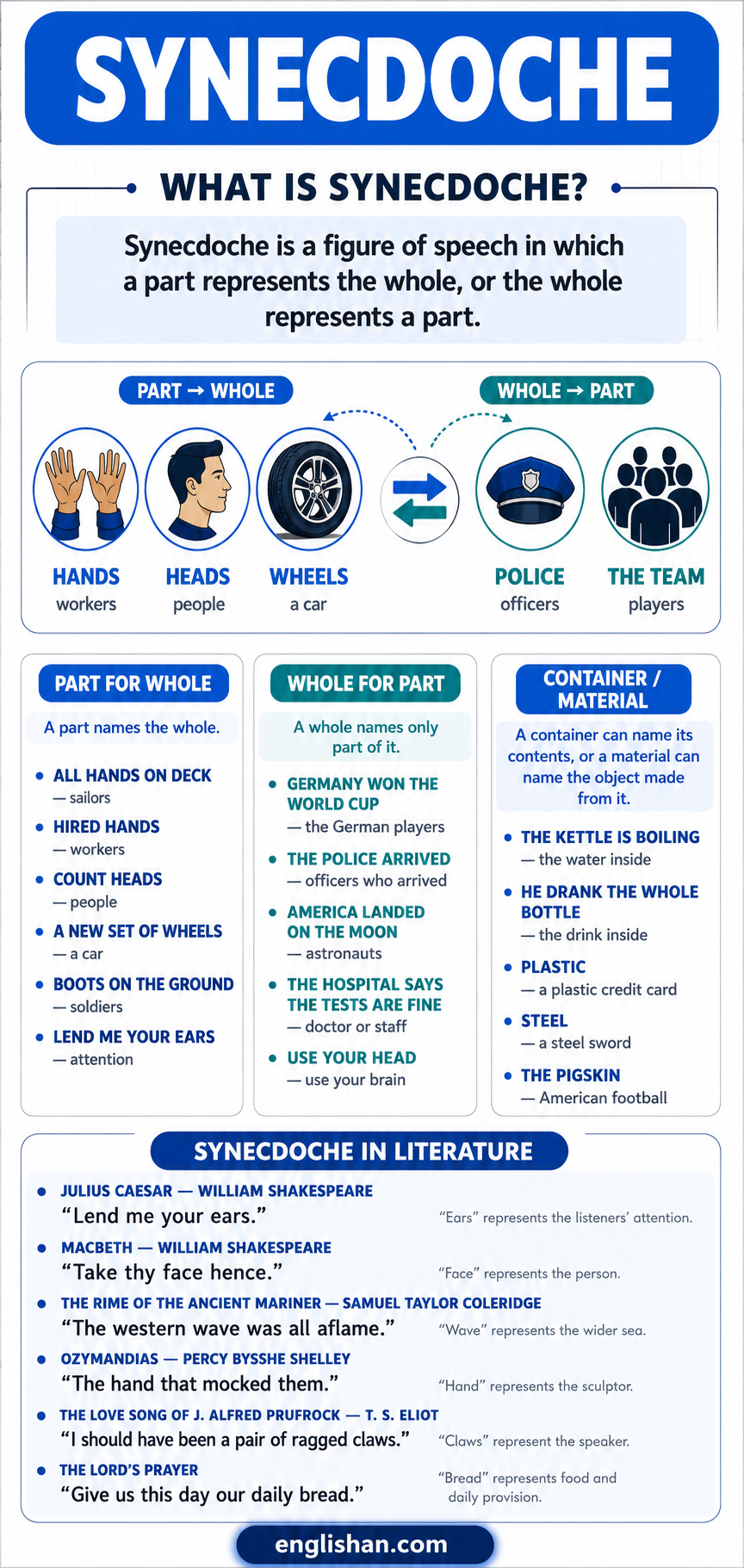
Synecdoche is a figure of speech that names a part of something in place of the whole, or the whole in place of a part: all hands on deck summons sailors by the part that does the hauling, and Germany won the match credits eighty million people with the work of eleven. The device compresses attention onto the detail that does the job, which is why sailors became hands, workers became hired muscle, and a car became a set of wheels. English speakers run it constantly without knowing its name, and the name itself defeats most first attempts to say it.
What Is Synecdoche?
Synecdoche selects the one component that best represents its whole and lets that component do the naming. Call workers hands and the word chooses their labor; call soldiers boots on the ground and the word chooses their presence and their marching. The chosen part is never random, and reading it tells you what the speaker values: mouths need feeding, heads get counted, hearts get won.
The word arrived from the Greek synekdochē, roughly “taking together,” and the taking works in both directions. Part can represent whole, and whole can represent part, as when the police arrived means two constables and a dog. Two smaller patterns complete the family: a container for its contents (the kettle is boiling) and a material for the object made from it (steel for a sword, plastic for a credit card).
How to Pronounce Synecdoche
Synecdoche is pronounced sih-NEK-duh-kee, four syllables with the stress on the second. The ending sounds like duh-key, never like doash: the word rhymes approximately with Schenectady, a coincidence Charlie Kaufman spent an entire film title on when Synecdoche, New York (2008) punned on that city’s name. The film pushed the term into search engines and everyday argument, and the spelling still ambushes almost everyone: s-y-n-e-c-d-o-c-h-e, with the silent trap of a ch said as k.
Part for Whole Synecdoche Examples
The classic direction names the working piece, and each example below shows which piece the language chose.
- All hands on deck: sailors reduced to what they haul with.
- Hired hands: workers named by their labor alone.
- Count heads before the bus leaves: people become the part that gets tallied.
- A new set of wheels: the car named by what moves it.
- Nice threads: clothing named by its fabric.
- Boots on the ground: soldiers named by their presence in the field.
- Mouths to feed: dependents named by what needs filling.
- New faces in the office: people named by what we recognize.
- Lend me your ears: attention requested through its organ.
- The suits upstairs decided: executives named by their uniform.
- Hired muscle: guards named by what they threaten with.
- A roof over your head: the whole house reduced to its shelter.
- Sails on the horizon: ships named by their visible part.
- Veteran arms in the bullpen: pitchers named by what they throw with.
- Two strong backs for the moving job: helpers named by what does the lifting.
- She asked for his hand in marriage: the person promised through the part that wears the ring.
Whole for Part Synecdoche Examples
The reverse direction inflates the actor, and English does it in every newscast.
- Germany won the World Cup: a nation credited with eleven players’ work.
- The police arrived: the whole institution, in the form of two officers.
- The school called about the trip: one secretary speaks as the building.
- America landed on the moon: three astronauts carried a country’s name.
- The hospital says the tests are fine: one doctor becomes the institution.
- The world is watching: some millions are promoted to everyone.
- The office complained about the thermostat: three coworkers become the workplace.
- Use your head: the whole head is asked to do its brain’s job.
Container and Material Synecdoche
Two compact patterns finish the set, and both hide in plain sight.
- A cuppa: the cup names the tea inside it.
- The kettle is boiling: the vessel names the water.
- He drank the whole bottle: glass credited with the wine’s work.
- The dish of the day: the plate names the food.
- Willow: cricket’s bat named by its wood.
- Steel: the sword named by its metal, in every epic.
- Plastic: the credit card named by its material.
- Lead: bullets named by their metal in every western.
- The pigskin: American football named by its old covering.
Synecdoche Examples in Literature
Poets favor the device because the chosen part multiplies meaning.
- Julius Caesar by William Shakespeare: “Friends, Romans, countrymen, lend me your ears.” Antony requests the only part of the crowd he needs, and the speech that follows takes considerably more.
- Macbeth by William Shakespeare: “Take thy face hence” dismisses a whole servant through the part Macbeth cannot stand looking at.
- The Rime of the Ancient Mariner by Samuel Taylor Coleridge: “the western wave was all aflame”: one wave burns for the entire sea at sunset.
- Ozymandias by Percy Bysshe Shelley: “the hand that mocked them” preserves the vanished sculptor as the single part that did the carving.
- The Love Song of J. Alfred Prufrock by T. S. Eliot: “I should have been a pair of ragged claws”: Prufrock shrinks himself past crab to the claws alone, self-erasure by synecdoche.
- The Lord’s Prayer: “give us this day our daily bread” asks for all food, and by extension all provision, through its plainest loaf.
Synecdoche in Sports and Daily News
Broadcast English is a synecdoche factory. Teams absorb nations (England collapsed after tea), squads gain new faces and lose experienced legs, managers want fresh blood, and armies are counted in boots and rifles. One caution keeps the labels honest: the White House announced and the crown ruled are not synecdoche but metonymy, because a building and a hat are associates of power, not parts of the people who wield it. That line deserves its own test.
Synecdoche vs Metonymy
Both devices substitute one name for another, and the relationship between the names decides the label. Synecdoche substitutes along the part-whole axis: wheels are literally part of the car, hands are literally part of the sailor. Metonymy substitutes along the association axis: the crown is not part of the monarch, and Hollywood is not part of the film industry; each merely neighbors its meaning. The single-question test: is the substitute physically a piece of the thing, or the thing a piece of the substitute? Yes makes it synecdoche; no, with a close association instead, makes it metonymy. Classical rhetoricians filed synecdoche as metonymy’s subtype, and the debate continues in linguistics, which is worth knowing when two textbooks disagree.
| Device | Relationship | Example |
|---|---|---|
| Synecdoche | Part and whole | New wheels, all hands, Germany won |
| Metonymy | Association | The crown, the White House, Hollywood |
How to Use Synecdoche in Writing
The craft is choosing the part that argues your point. Mouths to feed pleads need, hands on deck demands work, and faces in the crowd grants anonymity; the same people, three different parts, three different sentences. Choose one telling part and commit to it, because stacked parts collapse into inventory.
All hands, faces, and boots were on deck by dawn. ❌
All hands were on deck by dawn. ✅
The first counts body parts until the crew disappears; the second picks the working part and lets it stand for every sailor.
FAQs
Synecdoche is a figure of speech that substitutes a part of something for the whole, or the whole for a part. “All hands on deck” is the standard case: hands are literally part of the sailors, and the part summons the whole crew.
Say sih-NEK-duh-kee, four syllables with the stress on the second, ending like duh-key. It rhymes loosely with Schenectady, the coincidence behind the film title Synecdoche, New York.
Synecdoche substitutes a literal part for its whole (wheels for a car), while metonymy substitutes an associated name that is not a part (the crown for the monarch). Ask whether the substitute is physically a piece of the thing; a yes is synecdoche, and a close neighbor instead is metonymy.
Yes, and it is the textbook example: hands are a literal part of the sailors they represent, and the phrase orders the whole crew through that part. The same pattern produces hired hands, mouths to feed, and boots on the ground.
The reverse direction names the whole while meaning one piece of it: “Germany won the match” credits a nation with its team’s work, and “the school called” turns one secretary into the building. News and sports English uses this direction hourly.
Classical rhetoric filed it that way, since part-whole is arguably one kind of association, and some modern linguists agree. Working usage keeps them separate because the part-whole test is objective, which is why textbooks teach the pair as two devices with one border.