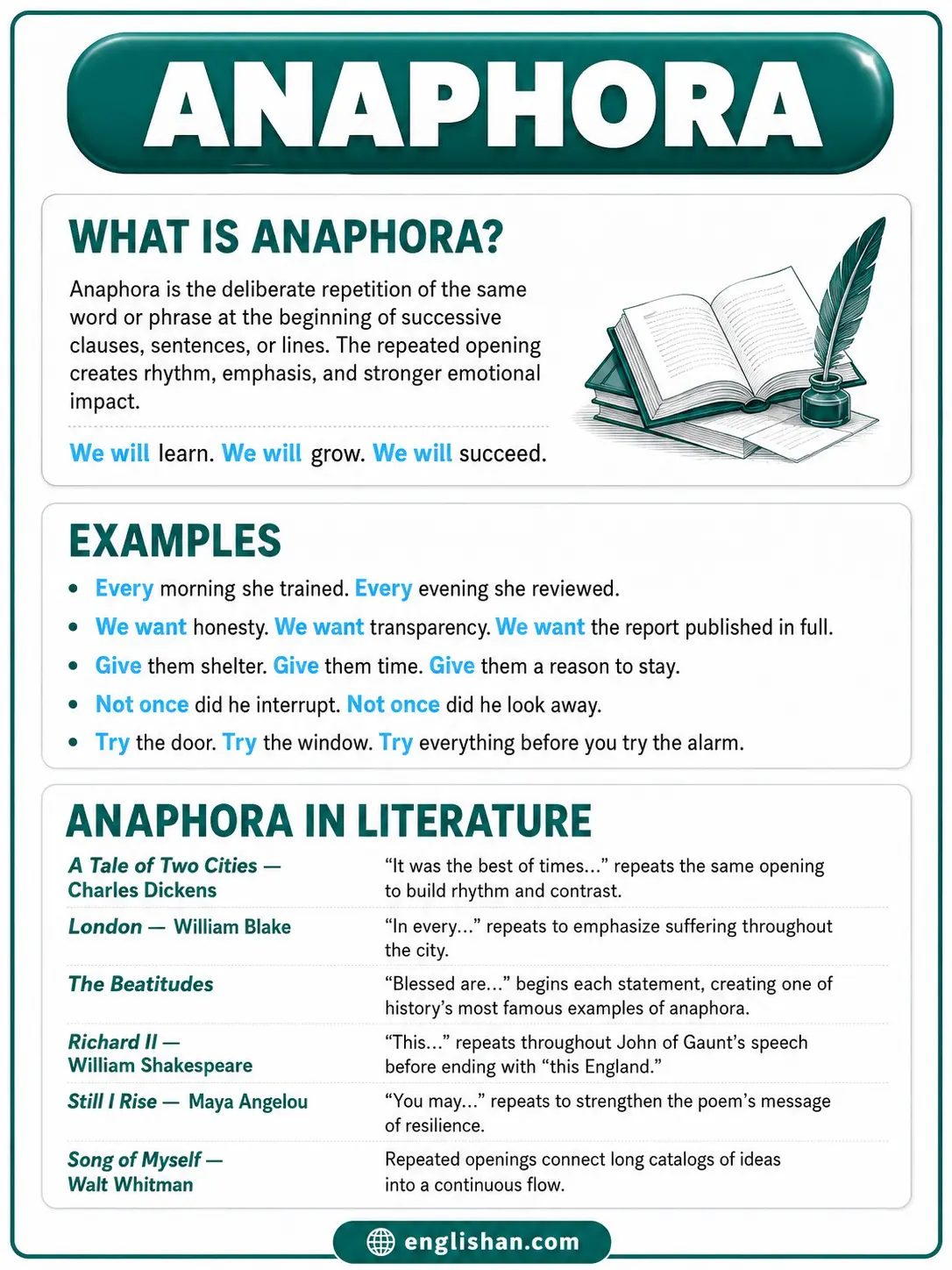
Anaphora is the deliberate repetition of a word or phrase at the beginning of successive clauses, sentences, or lines: I have a dream opened sentence after sentence in Washington, and we shall fight marched through Churchill’s most famous paragraph. The repeated opening turns prose into a drumbeat, and each return of the phrase raises the pressure of the one before. Speechwriters treat the device as their heaviest tool, poets as their oldest, and the term itself does double duty in English, since grammar uses the same word for something entirely different.
What Is Anaphora?
Anaphora binds a passage through its openings. Repeat the first words of successive units and the units become a series, the series becomes a build, and the build aims the reader’s ear toward wherever the repetition breaks. The device needs at least two repetitions to exist, and three is the classic architecture, since the third strike lands as a completed pattern rather than a coincidence.
The word came through Latin from the Greek anapherein, “to carry back,” because each new clause reaches back to the same starting phrase. Say it uh-NAF-er-uh, four syllables with the stress on the second. The repetition itself does the persuading: identical openings tell the audience these items belong to one argument, one grief, or one promise, before a single word of content arrives.
The Two Meanings of Anaphora
The term has a second life in grammar, and students meet both. In rhetoric, anaphora is the repetition device this whole piece describes. In linguistics, anaphora is the way a word refers back to something already mentioned: in “Maria left early because she was exhausted,” the pronoun she is an anaphor reaching back to Maria. The two senses share only the Greek idea of carrying back, one in sound and one in reference. Exam questions about literature want the rhetorical sense; questions about pronouns and reference want the grammatical one, and knowing the split prevents an entire category of wrong answers.
Anaphora Examples in Sentences
Each example repeats its opening so the build is audible.
- Every morning she trained. Every evening she reviewed. Every setback she archived and outgrew.
- We want honesty. We want transparency. We want the report published in full.
- It took one storm to flood the town. It took one committee to rebuild it.
- Without funding, the lab slows. Without trust, it stops.
- No law required it. No court demanded it. No one expected it, which is why it counted.
- She promised to listen. She promised to return. She promised nothing else, and kept both.
- Too late for apologies. Too late for amendments. Too late for anything but the vote.
- If we plant now, we harvest in June. If we wait, we explain in July.
- This team rebuilt the bridge. This team reopened the school. This team is not finished.
- Give them shelter. Give them time. Give them a reason to stay.
- Somewhere a phone is ringing. Somewhere an answer exists.
- Not once did he interrupt. Not once did he look away.
- Because of you, the choir has robes. Because of you, it has somewhere to sing.
- Try the door. Try the window. Try everything before you try the alarm.
- Nothing in the contract forbids it. Nothing in the culture allows it.
- Year after year, the river rose. Year after year, the wall was promised.
Anaphora Examples in Famous Speeches
Public speaking built its greatest moments on the device.
- I Have a Dream by Martin Luther King Jr. (1963): the title phrase opens successive sentences through the speech’s climax, each dream more specific than the last, and the repetition turned a speech into an anthem. King layered further anaphora underneath: “let freedom ring” builds the ending the same way.
- We Shall Fight on the Beaches by Winston Churchill (1940): “we shall fight” opens clause after clause, on the beaches, on the landing grounds, in the fields and in the streets, and the pounding repetition performed the defiance it promised.
- John F. Kennedy’s Inaugural Address (1961): “Let both sides” opens four successive paragraphs of proposals, using the device to stage negotiation as ceremony.
Anaphora Examples in Literature and Poetry
Writers reach for repeated openings when a passage must feel larger than a sentence.
- A Tale of Two Cities by Charles Dickens: “It was the best of times, it was the worst of times, it was the age of wisdom, it was the age of foolishness…” The novel’s opening runs the pattern ten times, the most quoted anaphora in English fiction.
- London by William Blake: “In every cry of every Man, / In every Infant’s cry of fear, / In every voice, in every ban…” The repeated in every turns a walk through the city into an inventory of suffering.
- The Beatitudes: “Blessed are the poor in spirit… Blessed are the meek… Blessed are the merciful…” Nine successive sentences open identically, and the pattern has structured sermons for two thousand years.
- Richard II by William Shakespeare: “This royal throne of kings, this sceptred isle, this earth of majesty… this England.” Gaunt’s dying speech stacks this until the final naming lands like a verdict.
- Still I Rise by Maya Angelou: “You may write me down in history… You may trod me in the very dirt…” The repeated you may hands the aggressor every opening line, so the refusal that follows owns every close.
- Song of Myself by Walt Whitman: Whitman’s catalogs open line after line with the same frames, where and and and I, anaphora sustained longer than any poet before him dared.
Anaphora vs Epistrophe and Symploce
Position sorts the repetition devices in one glance. Anaphora repeats openings. Epistrophe repeats endings: Lincoln’s “of the people, by the people, for the people” closes three phrases on the same word. Symploce does both at once, repeating the opening and the closing while the middle changes: “In victory, we stayed humble. In defeat, we stayed humble.” The three are one family with three addresses, and a skilled speech moves among them so the pattern never goes stale.
| Device | Repeats | Example |
|---|---|---|
| Anaphora | Clause openings | We shall fight on the beaches; we shall fight on the landing grounds. |
| Epistrophe | Clause endings | Of the people, by the people, for the people. |
| Symploce | Openings and endings | In victory, we stayed humble. In defeat, we stayed humble. |
How to Use Anaphora in Writing
Three habits separate a build from a broken record. Escalate the content behind the repeated phrase, since the frame stays fixed precisely so the freight can grow: each I have a dream dreamed bigger. Use three beats as the default architecture and break the pattern deliberately on the last, because the break is where the audience’s attention lands hardest. And reserve the device for peaks, endings, arguments, and vows, since anaphora at full volume in a routine paragraph reads as parody.
I like the beach. I like the mountains. I like parks. ❌
We swam before breakfast. We climbed before noon. We slept before the stars were fully out. ✅
The first repeats without building, a list wearing a costume; the second escalates through the day it describes, and the repetition earns its rhythm.
FAQs
Anaphora is the repetition of a word or phrase at the beginning of successive clauses or sentences. Churchill’s “we shall fight on the beaches, we shall fight on the landing grounds, we shall fight in the fields” repeats its opening to build defiance into rhythm.
Say uh-NAF-er-uh, four syllables with the stress on the second. The adjective is anaphoric, and a single back-referring word in the grammar sense is called an anaphor.
Anaphora repeats the beginnings of successive clauses, while epistrophe repeats the endings. “We shall fight… we shall fight” is anaphora; “of the people, by the people, for the people” is epistrophe. Symploce combines both at once.
In linguistics, anaphora is a word’s reference back to something already mentioned, as when she refers to Maria in “Maria left because she was tired.” The grammar sense shares only its Greek root with the rhetorical repetition device.
Two successive clauses with the same opening establish the device, and three is the classic build, since a third strike confirms the pattern for the listener. Beyond four, the device works only if the content keeps escalating.
Yes, it is the most famous modern example: the phrase opens successive sentences through the climax of King’s 1963 speech, each repetition introducing a more vivid dream. The speech also builds its ending on a second anaphora, “let freedom ring.”