

A pun is a play on words that exploits two meanings or two similar sounds at once, so a single sentence tells two truths and the collision earns the laugh: a banker who lost interest, a bicycle two tired to stand. Rhetoric calls the device paronomasia, comedy calls it the dad joke, and Shakespeare called it irresistible, punning even in death scenes. The groan a pun produces is not failure; it is the sound of a listener processing both meanings and resenting how well the trick worked.
What Is a Pun?
A pun loads one position in a sentence with two readings and makes both fire. In “the calendar’s days are numbered,” numbered means both printed with numerals and approaching an end, and the sentence is engineered so neither reading can be dismissed. That double activation is the whole mechanism; the listener runs the sentence twice, and the second pass is the punchline.
The raw material is English’s enormous stock of sound collisions. Homophones (knight and night), multiple senses of one word (interest, bank, grave), and near-misses close enough to hear (Noah guy for know a guy) all supply working parts. Puns reward vocabulary depth, which is why teachers forgive them and why every pun explained is a small usage lesson in disguise.
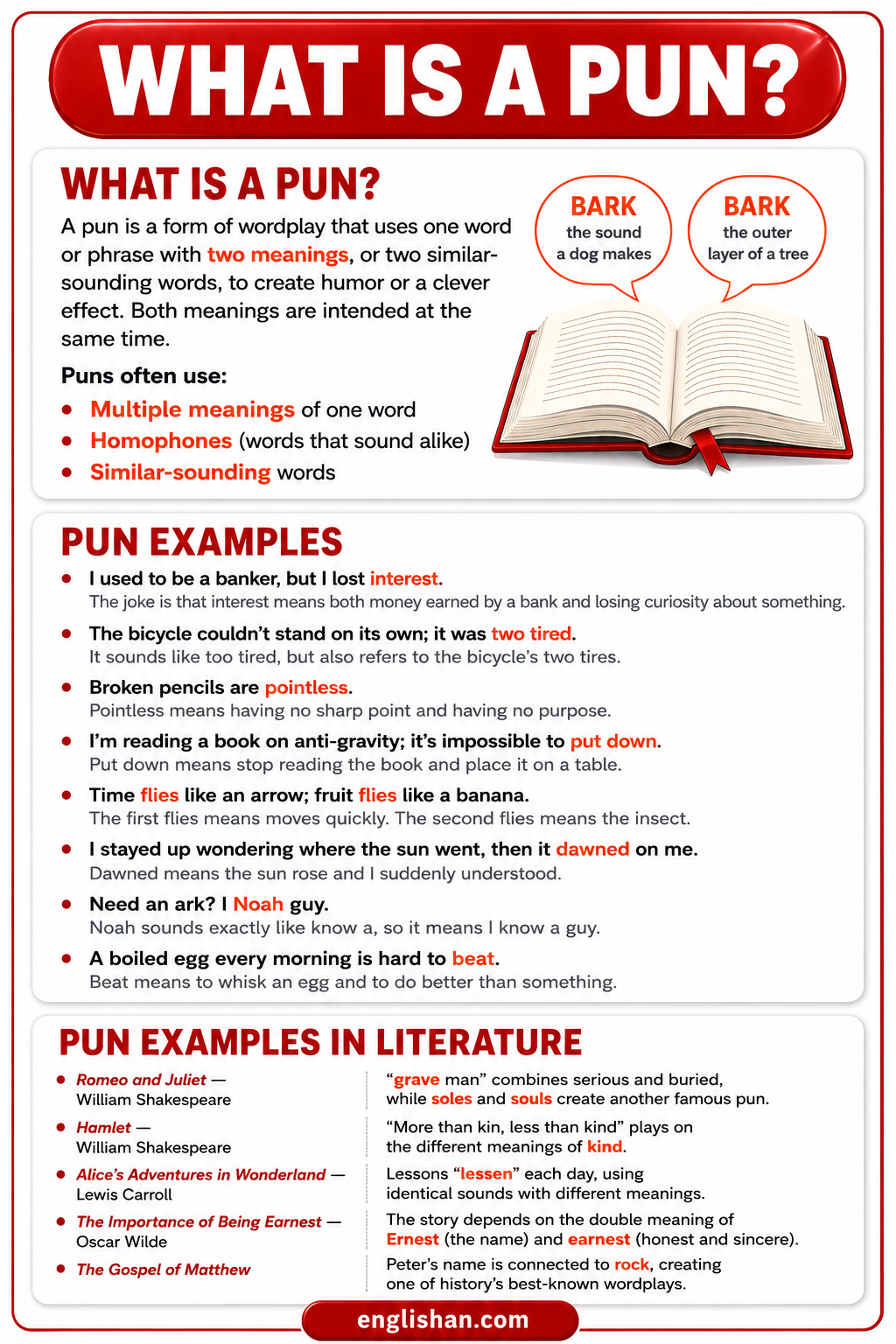
Pun Examples With the Double Meaning Explained
Each pun works because one word does two jobs, and naming both jobs shows the machinery.
- I used to be a banker, but I lost interest: interest is both curiosity and the money a bank pays.
- The bicycle couldn’t stand on its own; it was two tired: two tired sounds as too tired while counting the wheels.
- Broken pencils are pointless: pointless means both tipless and futile.
- The scarecrow won an award for being outstanding in his field: outstanding in his field is both excellence and literal placement in farmland.
- I’m reading a book on anti-gravity; it’s impossible to put down: put down is both to stop reading and to set on a surface.
- Santa’s helpers are subordinate Clauses: Clauses names both grammar units and the family of Claus.
- Time flies like an arrow; fruit flies like a banana: flies flips from verb to insect and like from comparison to appetite.
- The math teacher called in with a problem: a problem is both an ailment and an equation.
- I stayed up wondering where the sun went, then it dawned on me: dawned is both sunrise and realization.
- Velcro: what a rip-off: rip-off is both a swindle and the product’s actual sound.
- The calendar’s days are numbered: numbered is both printed and doomed.
- I bet him the meat on the top shelf, but the steaks were too high: steaks replaces stakes by sound.
- Need an ark? I Noah guy: Noah sounds as know a.
- The chemistry joke got no reaction: reaction is both a response and a chemical event.
- Egg puns crack me up: crack is both to break a shell and to cause laughter.
- I’d like to be a Victorian blacksmith, just to forge ahead: forge is both metalwork and progress.
- The gardener was so good they gave her a raise; now she’s rooting for more: rooting is both plant growth and cheering.
- Claustrophobic people are more productive thinking outside the box: the idiom collapses back into its literal box.
- A boiled egg every morning is hard to beat: beat is both whisking and surpassing.
- The tailor was pressed for time: pressed is both ironing and urgency.
- He stole an invention and made off with the patent; it was clearly a rip-off design: the theft and the fastener share one verdict.
- When the clock struck twelve, it was accused of assault: struck is both chimed and hit.
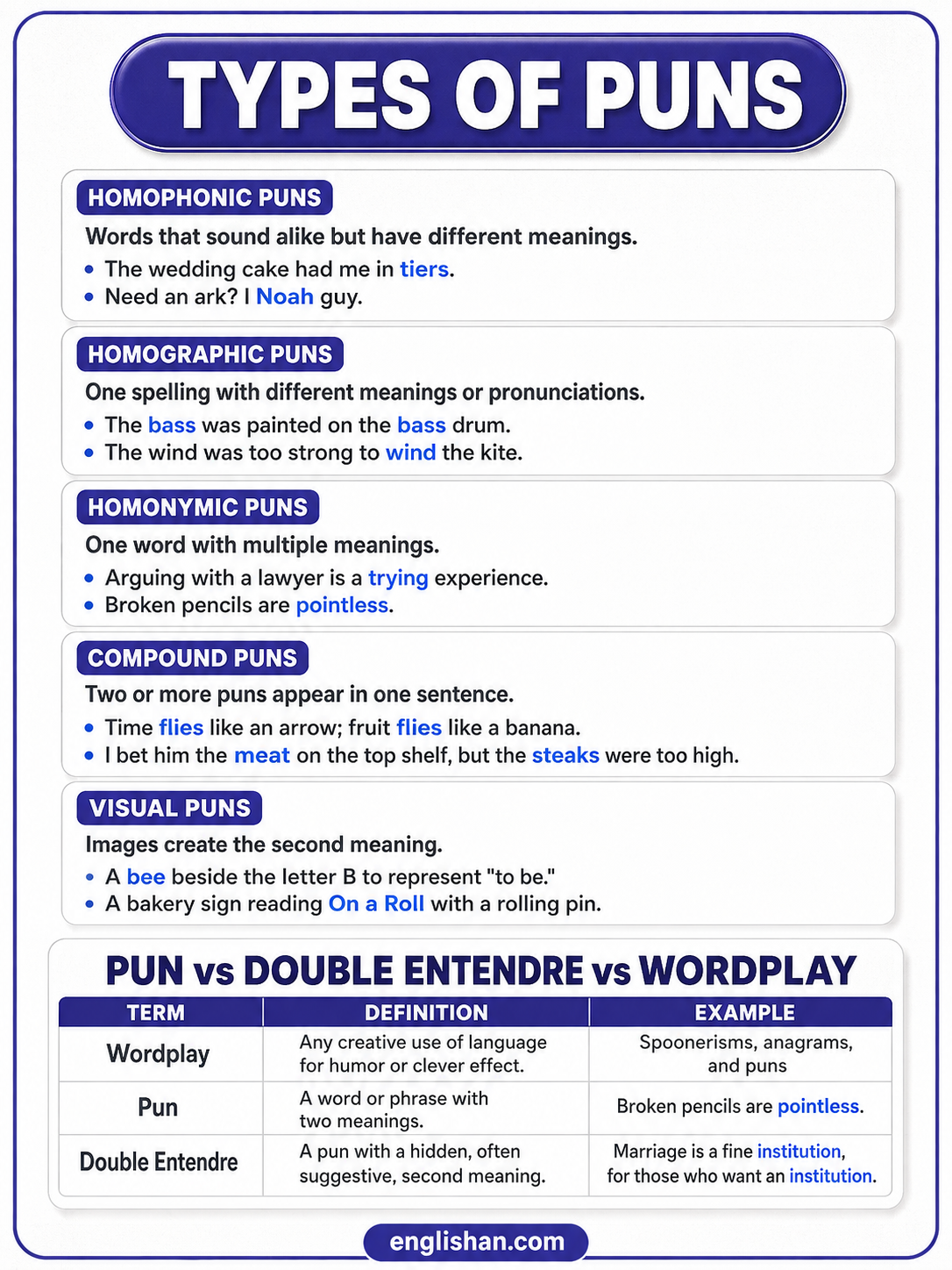
Types of Puns
Four established types sort nearly every pun, and a fifth works without words at all.
Homophonic Puns
Two words sound identical and swap places: “the wedding cake had me in tiers.” Tiers and tears collide in the ear while the spelling picks a side. Sound-alike puns dominate spoken comedy because the ear meets them before the eye can object.
Homographic Puns
One spelling reads two ways: “the bass was painted on the bass drum.” The words match on the page and split in the mouth, which makes homographic puns strongest in print, where both pronunciations stay live until the reader chooses.
Homonymic Puns
One word, one sound, one spelling, two senses: “arguing with a lawyer is a trying experience.” Trying means both attempting and courtroom procedure, and neither meaning outranks the other. Most classic one-liners run on this type.
Compound Puns
Two or more puns interlock in one statement: “time flies like an arrow; fruit flies like a banana” flips two words across two clauses. Compound puns demand the most from listeners and reward them proportionally.
Visual Puns
An image replaces the second meaning: a logo where a bee beside the letter B reads as to be, a bakery sign shaped like a rolling pin over the words “on a roll.” Advertising and rebus puzzles run this type, proof that the mechanism needs two meanings, not necessarily two words.
Pun Examples in Literature
The canon puns more than its reputation admits.
- Romeo and Juliet by William Shakespeare: the dying Mercutio manages “ask for me tomorrow and you shall find me a grave man,” fusing seriousness and burial in his last joke. Earlier, Romeo declines to dance with “you have dancing shoes with nimble soles; I have a soul of lead,” rhyming footwear against spirit.
- Hamlet by William Shakespeare: Hamlet’s first line, “a little more than kin, and less than kind,” puns kind into both kindness and natural kinship, announcing in one word that the family is wrong.
- Alice’s Adventures in Wonderland by Lewis Carroll: the Mock Turtle explains that lessons “lessen from day to day,” ten hours the first day, nine the next, arithmetic built on a pun.
- The Importance of Being Earnest by Oscar Wilde: the entire play balances on Ernest the name against earnest the virtue, and the final line detonates the pun after three acts of setup.
- The Gospel of Matthew: “you are Peter, and on this rock I will build my church” puns on the Greek petros (Peter) and petra (rock), one of the oldest recorded name puns in Western text.
Puns in Brand Names and Shop Signs
Commerce discovered long ago that a pun makes a name unforgettable. John Deere sells on “Nothing runs like a Deere,” a homophone doing national advertising. Hair salons practically compete in the genre: Curl Up and Dye and Shear Madness trade on dye/die and shear/sheer. A fish-and-chips shop named The Codfather sells the joke with the fish, and a florist called Back to the Fuchsia banks on customers hearing the film underneath. The pattern works because decoding the pun takes one second, and the small solved puzzle attaches a small pleasure to the brand.
Why Puns Make Us Groan
The groan is the pun’s native applause. A joke built on surprise gets a laugh; a pun gets a groan because the listener sees exactly how the trick was done the moment it lands, and the transparency reads as audacity. Dad jokes weaponize this: the teller enjoys the groan more than a laugh, since the groan certifies that both meanings arrived. Comedy theorists note that puns force a re-reading, and the effort is the toll; pay it a dozen times in one conversation and irritation is rational. The craft response is rationing, not retirement.
Pun vs Double Entendre and Wordplay
Three labels nest inside each other. Wordplay is the umbrella for every verbal game: puns, spoonerisms, anagrams, malapropisms. A pun is the specific device that fires two meanings through one sound or spelling. A double entendre is a pun with a specialty: its second meaning is risqué or improper, delivered so the speaker keeps deniability. Every double entendre is a pun; most puns, from pointless pencils to grave man, keep both meanings fully respectable.
| Label | Scope | Example |
|---|---|---|
| Wordplay | Every verbal game | Spoonerisms, anagrams, puns |
| Pun | Two meanings in one word | Broken pencils are pointless. |
| Double entendre | Second meaning suggestive | Marriage is a fine institution, for those who want an institution. |
How to Write a Good Pun
Puns are engineered backward from the double word, and four steps build one.
- Pick a word with two live meanings. Bank, interest, grave, tired, pointed: the dictionary’s busiest words make the best hinges.
- Build a sentence where both meanings apply. The setup must genuinely support both readings; a pun with one dead meaning is just a spelling error with ambitions.
- Put the pun word last. The double meaning is the punchline, and punchlines end sentences.
- Say it aloud. Puns work by ear, and a near-homophone that survives print can die in the mouth.
Position is the difference the ear notices first.
Interest was lost by me when I left banking. ❌
I used to be a banker, but I lost interest. ✅
The first buries the hinge mid-sentence in passive wrapping; the second walks the listener to the double word and stops, and the timing does half the comedy.
FAQs
A pun is wordplay that activates two meanings of one word or sound at the same time. “Broken pencils are pointless” works because pointless means both lacking a tip and lacking purpose, and the sentence supports both readings at once.
Homophonic puns use identical sounds with different spellings (tiers/tears), homographic puns use one spelling with two pronunciations (bass), homonymic puns use one word with two senses (trying), and compound puns interlock several plays in one statement. Visual puns, which swap one meaning for an image, are the frequent fifth.
A double entendre is a pun whose second meaning is risqué or improper, delivered with plausible deniability. All double entendres are puns, while most puns keep both meanings innocent, which is why one fits a nursery rhyme and the other an after-hours comedy set.
The insult is old, variously attributed, and contradicted by the record, since Shakespeare, Wilde, and Carroll built celebrated work on puns. The fairer verdict: bad puns are cheap because the mechanism is public, and great puns are hard for exactly the same reason.
A dad joke is a short, wholesome pun delivered with full awareness that the audience will groan, where the groan is the intended reward. “I’m reading a book on anti-gravity; it’s impossible to put down” is the genre in one line.
A visual pun replaces one of the two meanings with an image: a bee beside the letter B reading as to be, or a sign shaped like its own joke. Logos, rebus puzzles, and editorial cartoons run on the type, proving the pun needs two meanings rather than two words.