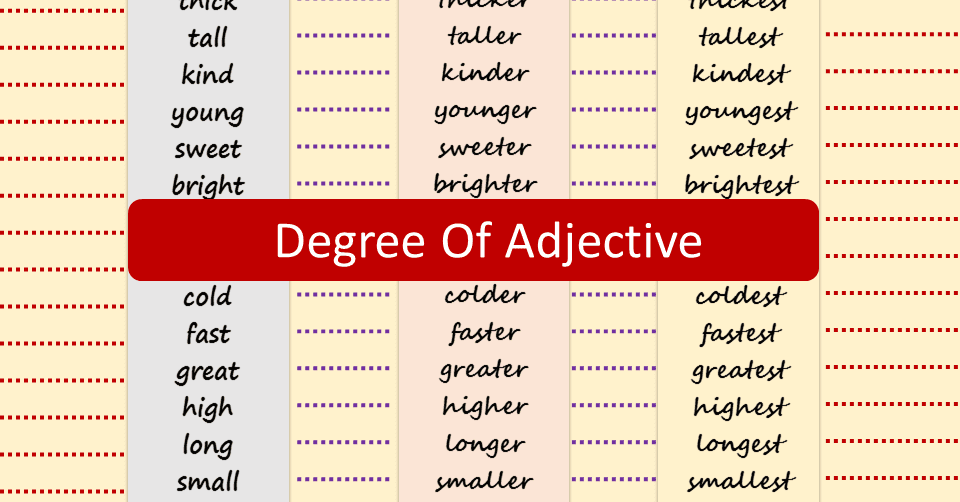
We’re going to learn about something cool called degrees of adjectives. Imagine you have a word like “big.” With degrees of adjectives, you can make it even more interesting. You can say “bigger” when something is a bit larger, and “biggest” when it’s the largest! It’s like adding superpowers to your words. So, let’s dive in and discover how these special words work to make your English conversations and stories more exciting!
What is Adjective?
Adjectives are ‘describing words’. They help describe nouns.
Examples:
Mr. Wendon drives a long car.
Tom’s room is clean.
Your pillow is soft.
Joseph’s baby is cute.
- We use comparative adjectives when we compare two nouns. Comparative adjectives end in ‘er‘. We use the word than with comparative adjectives.
Examples:
Mr. Wendon drives a longer car than Mr. Thompson.
Tom’s room is cleaner than Jim’s.
Your pillow is softer than mine.
Joseph’s baby is cuter than Sam’s.
- We use superlative adjectives when we compare more than two nouns. Superlative adjectives end in ‘est‘.
Examples:
Mr. Wendon drives the longest car in the family.
Tom’s room is the cleanest in the house.
Your pillow is the softest.
Joseph’s baby is the cutest.
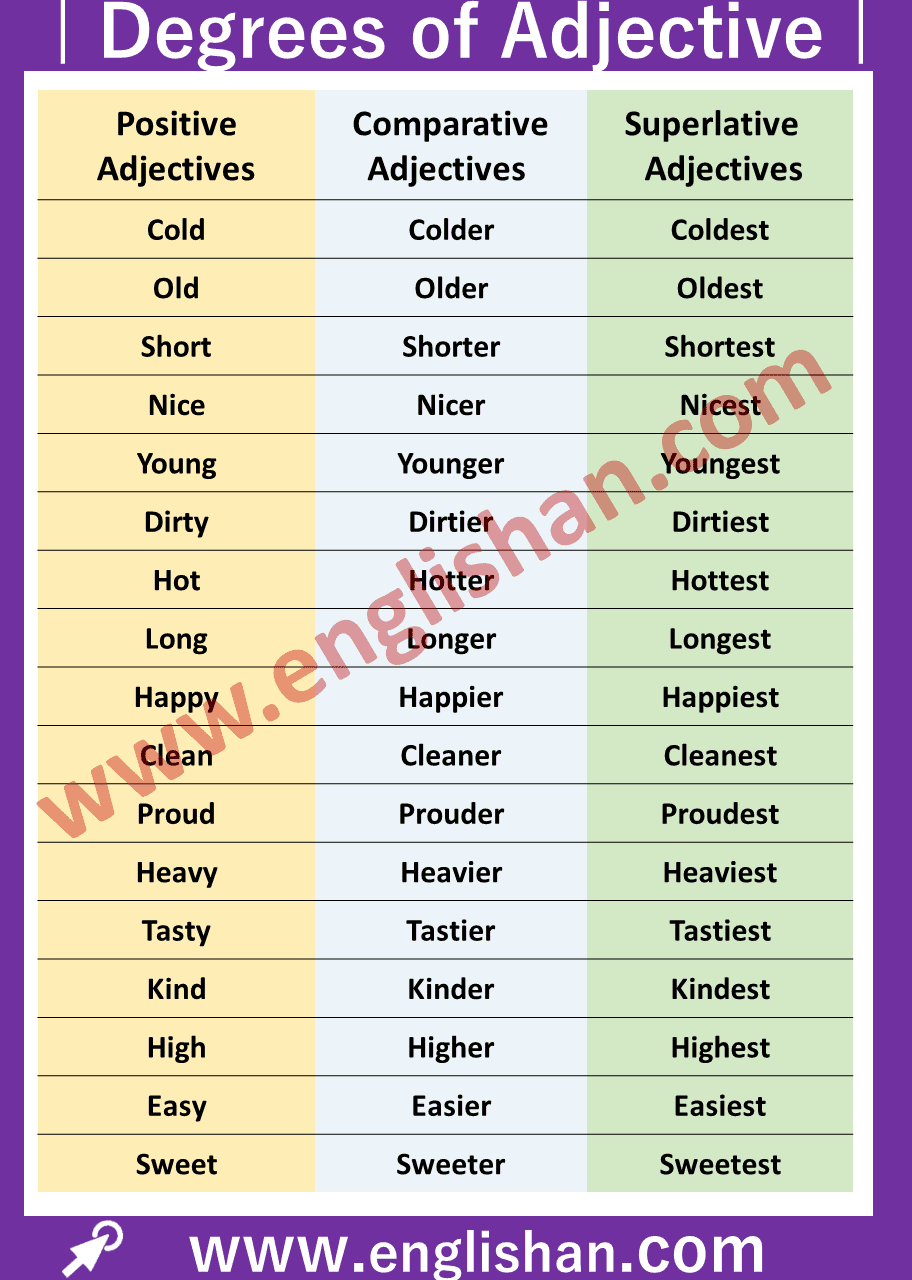
| Adjectives |
Comparative Adjectives |
Superlative Adjectives |
| Cold | Colder | Coldest |
| Old | Older | Oldest |
| Short | Shorter | Shortest |
| Nice | Nicer | Nicest |
| Young | Younger | Youngest |
| Dirty | Dirtier | Dirtiest |
| Hot | Hotter | Hottest |
| Long | Longer | Longest |
| Happy | Happier | Happiest |
| Clean | Cleaner | Cleanest |
| Proud | Prouder | Proudest |
| Heavy | Heavier | Heaviest |
| Tasty | Tastier | Tastiest |
| Kind | Kinder | Kindest |
| High | Higher | Highest |
| Easy | Easier | Easiest |
| Wet | Wetter | Wettest |
| Sweet | Sweeter | Sweetest |
| Hard | Harder | Hardest |
There are some comparative and superlative adjectives that do not end in ‘er‘ and ‘est‘. Instead, when they transform into comparative and superlative forms their spellings change into another word. Such adjectives are called irregular adjectives. There are very few irregular adjectives in the English language.
Examples:
| Irregular Adjective | Comparative Adjectives | Superlative Adjective |
| Good | Better | Best |
| Bad | Worse | Worst |
There are some adjective that do not change into comparative or superlative form at all. For such adjective we have to use the words “more” and “most” to show their comparative and superlative degrees.
Example:
Adjective | Comparative Adjective | Superlative Adjective |
| Beautiful | More beautiful | Most beautiful |
| Dangerous | More dangerous | Most dangerous |
| Worried | More worried | Most worried |
| Careful | More careful | Most careful |
| Boring | More boring | Most boring |
| Difficult | More difficult | Most difficult |
| Important | More important | Most important |
| Delicious | More delicious | Most delicious |
| Powerful | More powerful | Most powerful |
Use in sentences:
- Katherine Hepburn was the most graceful actress in Hollywood.
- The road to the lake is more dangerous than the road to the hill.
- Ronnie makes the most delicious cupcakes in town.
Read More
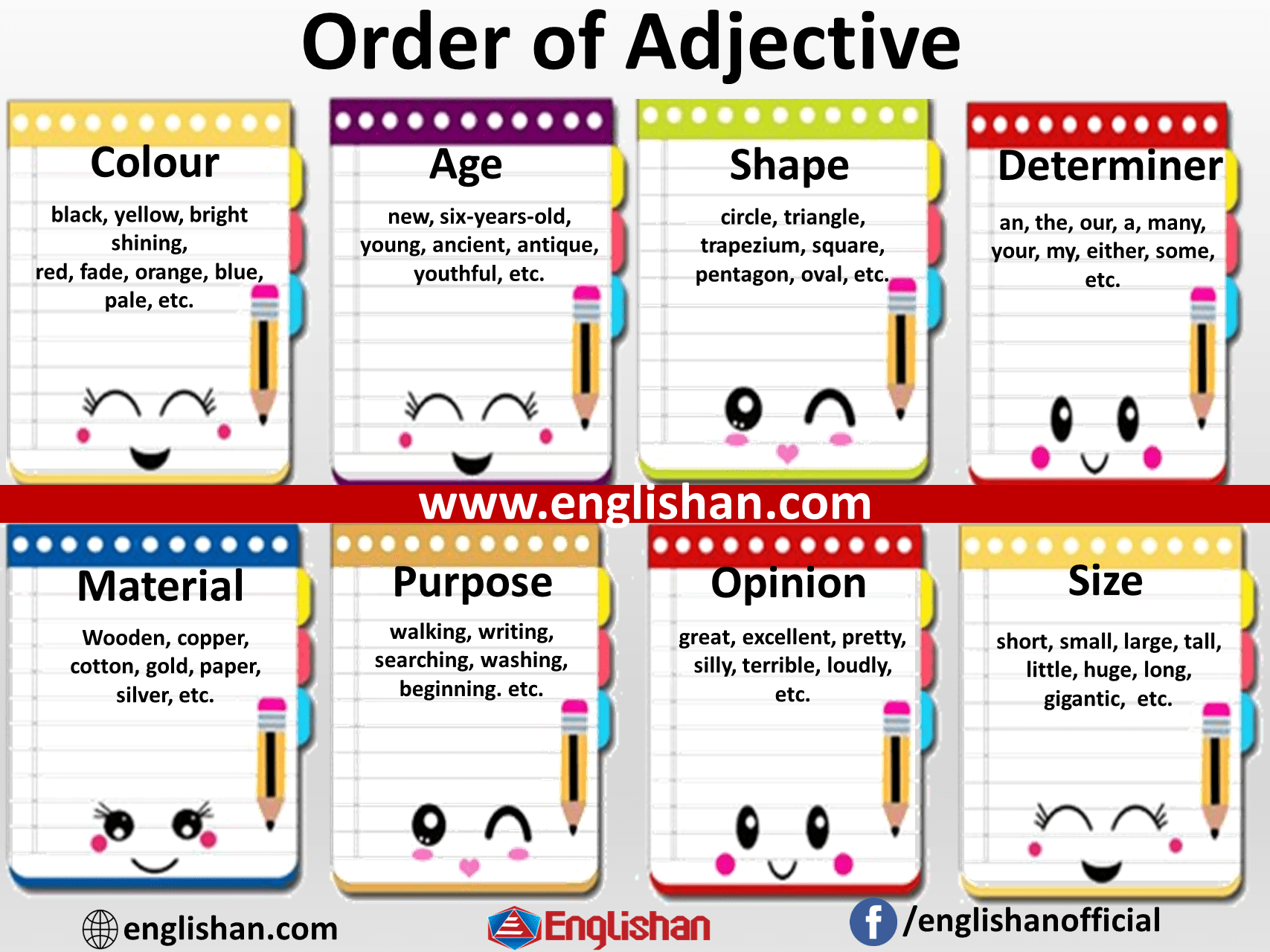
- Order of Adjectives
- Types of Adjectives
- Examples of Adjectives
- Types of Adverb
- Comparative and Superlative Worksheets
Degrees of Adjectives Quiz
Degrees of Adjectives
Choose the comparative.
This box is ___ than that one.
Short adjectives add -er for a two-way comparison.
add -er for the comparative of short adjectives
This box is heavier than that one.
Choose the superlative.
It's the ___ day of the year.
The superlative marks the top of the whole set.
add -est for the superlative of short adjectives
the hottest day of the year
Choose the correct comparative.
This film is ___ than the book.
Longer adjectives take 'more' rather than -er.
use 'more' for the comparative of longer adjectives
This film is more interesting than the book.
Choose the correct form.
Her health is ___ than before.
'Good' has the irregular comparative 'better'.
irregular comparatives: good -> better
better than before
Choose the correct sentence.
'Taller' already carries the comparison.
never combine 'more' with an -er ending
He is taller than me.
Choose the correct form.
She is ___ in the class.
A superlative takes 'the' before it.
the superlative takes 'the'
She is the smartest in the class.
Choose the comparative.
Ben is ___ than his sister.
Short adjectives add -er for the comparative.
short adjectives add -er to compare two
Ben is taller than his sister.
Choose the superlative.
That was the ___ meal of the trip.
'Good' has the irregular superlative 'best'.
good -> better -> best (irregular)
That was the best meal of the trip.
Type the comparative of the word in brackets.
Emma looks ___ (happy) than she did last week.
An adjective ending in consonant + y changes y to i and adds -er.
consonant + y -> -ier
Emma looks happier than she did last week.
Choose the comparative.
This route is ___ than the motorway.
Longer adjectives take 'more' for the comparative.
long adjectives use 'more' to compare two
This route is more beautiful than the motorway.
True or false?
The superlative of 'bad' is 'baddest'.
'Bad' is irregular: bad -> worse -> worst.
bad -> worse -> worst
That was the worst storm in years.
Complete the comparison.
Emma runs faster ___ Jack.
A comparative pairs with 'than' to name the second item.
comparative + than
Emma runs faster than Jack.
Choose the comparative.
This box is ___ than that one.
A short adjective ending in one vowel and one consonant doubles it before -er.
double the final consonant before -er
This box is bigger than that one.
Choose the superlative.
That is the ___ tree in the park.
A short adjective adds -est for the superlative.
short adjectives add -est to top a group
That is the tallest tree in the park.
Type the comparative of the word in brackets.
This task is ___ (easy) than the last.
An adjective ending in consonant + y changes y to i and adds -er.
consonant + y -> -ier
This task is easier than the last.
Choose the superlative.
It was the ___ sunset of the trip.
A long adjective takes 'most' for the superlative.
long adjectives use 'most' for the superlative
It was the most beautiful sunset of the trip.
Choose the comparative.
Her second draft was ___ than the first.
'Good' has the irregular comparative 'better'.
good -> better -> best (irregular)
Her second draft was better than the first.
True or false?
The comparative of 'bad' is 'worse'.
'Bad' is irregular, and its comparative is 'worse'.
bad -> worse -> worst
Today's weather is worse than yesterday's.
Complete the equal comparison.
She is as tall ___ her brother.
'As ... as' marks equality between two things.
as + adjective + as for equality
She is as tall as her brother.
Choose the superlative.
It was the ___ day of the year.
A short adjective adds -est to top the group.
short adjectives add -est for the superlative
It was the longest day of the year.
Turn on JavaScript for the interactive quiz. The full practice set is shown above.