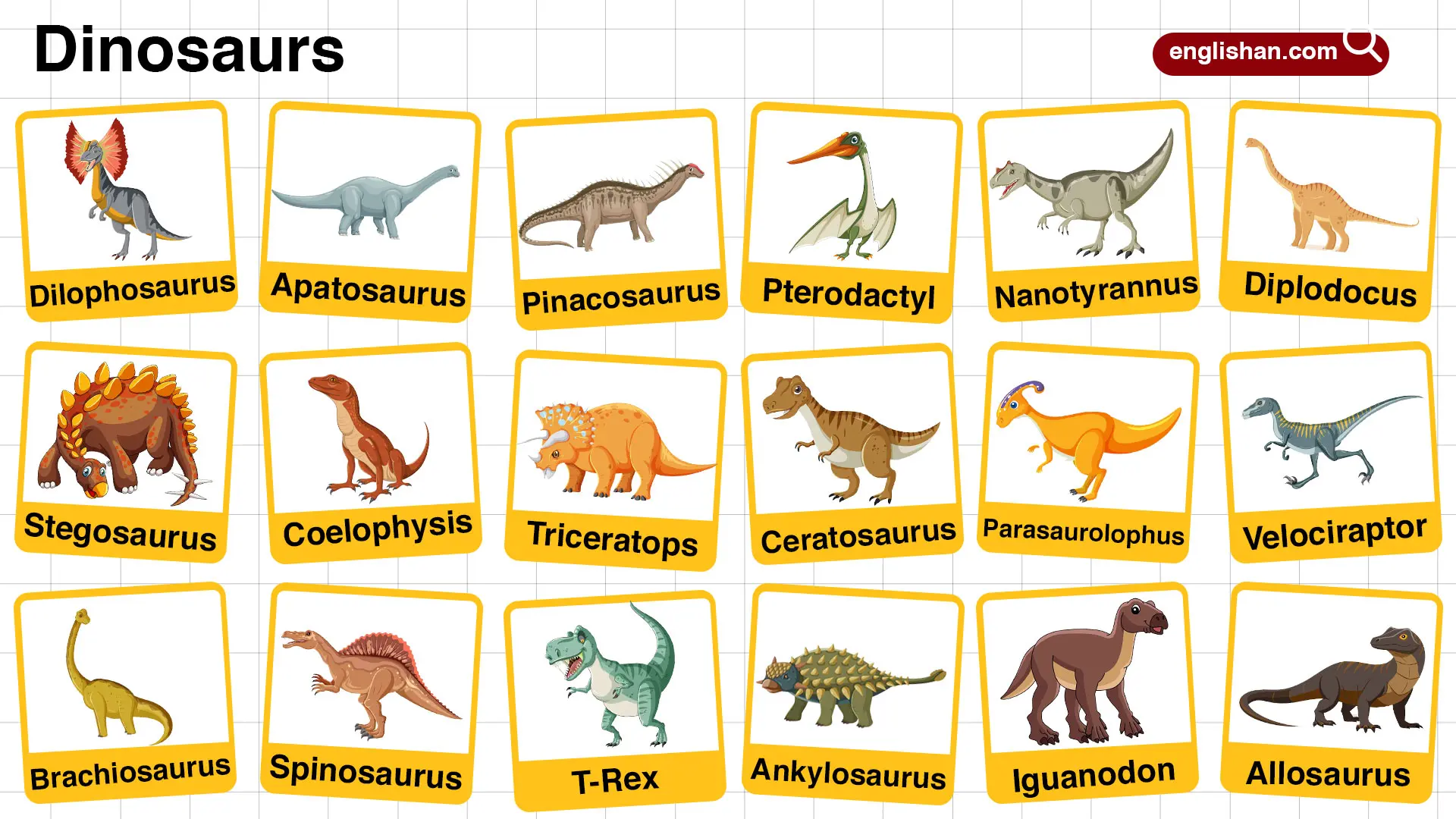
Scientists have named over 700 species of dinosaurs so far, and new ones turn up every year. These prehistoric reptiles ruled the Earth for roughly 165 million years across three geological periods: the Triassic, Jurassic, and Cretaceous. Some were no bigger than a chicken. Others stretched longer than a blue whale. Their names, built from Greek and Latin roots, tell you what each one looked like, where it was found, or who discovered it.
The dinosaur names below are organized by type, with real sizes, time periods, and the feature that made each species stand out.
Dinosaur Names with Pictures
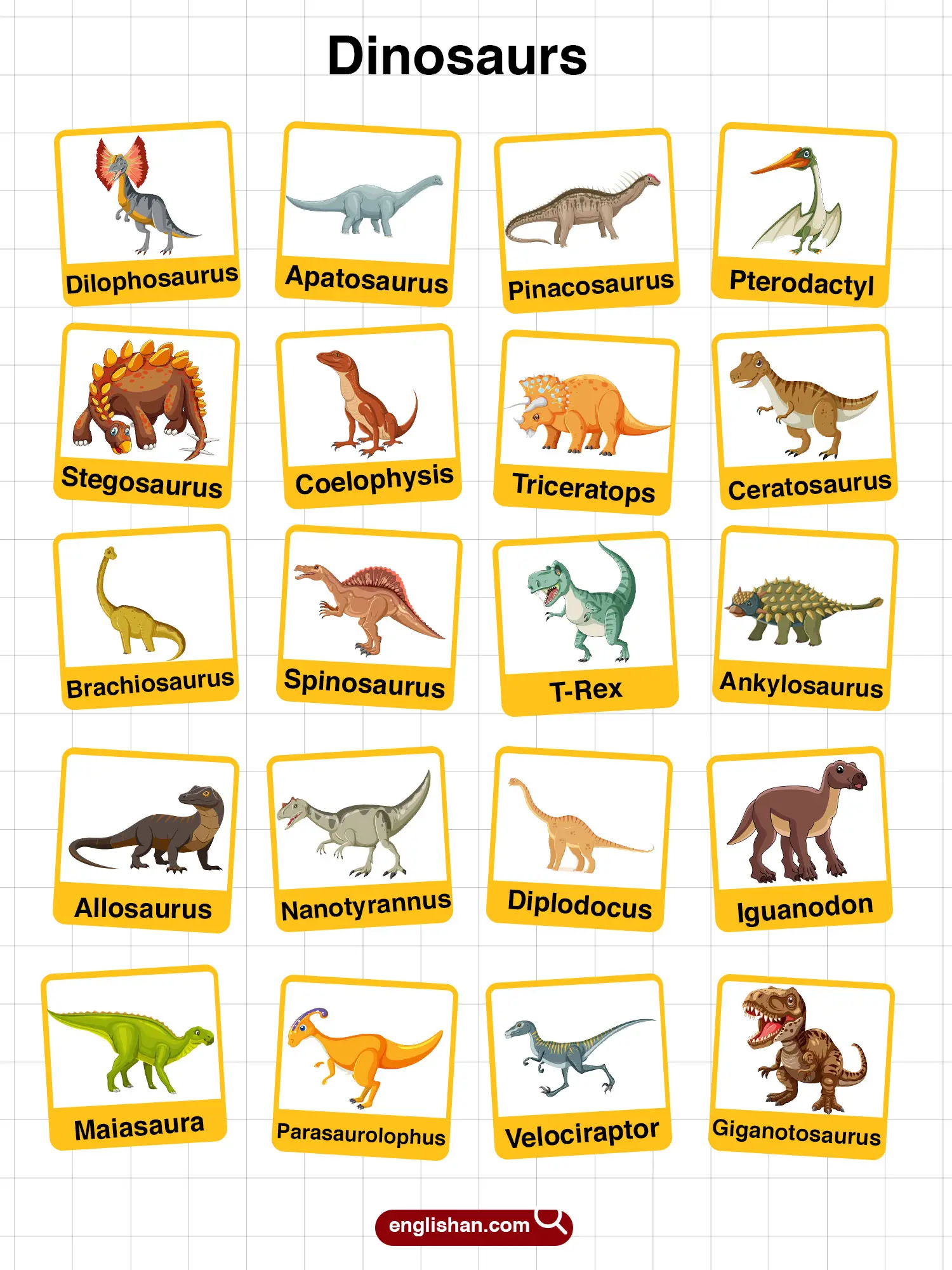
Each species below includes a real size, diet, geological period, and one distinguishing feature. The names are grouped by body type and diet.
How Scientists Name Dinosaurs
Every dinosaur name is built from Greek or Latin word parts that describe something about the animal. Once you know the building blocks, the names stop being tongue-twisters and start making sense.
Tyrannosaurus rex breaks into three pieces: tyrannos (tyrant) + sauros (lizard) + rex (king). The full name means tyrant lizard king. Triceratops comes from tri (three) + ceratops (horned face), giving three-horned face. Velociraptor combines velox (swift) + raptor (thief), giving swift thief.
The scientist who first describes a new species gets to choose the name. That name follows international rules and cannot be changed once published. Some dinosaurs are named after the place where their fossils were found (Argentinosaurus, from Argentina). Others are named for a physical feature (Pachycephalosaurus, thick-headed lizard). A few honor the person who discovered them (Baryonyx walkeri, named after amateur fossil hunter William Walker).
These word parts repeat across many names, so learning a handful of roots unlocks dozens of dinosaur names at once.
| Root | Meaning | Example |
|---|---|---|
| saurus / saura | Lizard | Tyrannosaurus |
| raptor | Thief, seizer | Velociraptor |
| ceratops | Horned face | Triceratops |
| don / odon | Tooth | Iguanodon |
| pteryx | Wing, feather | Archaeopteryx |
| mega | Large, great | Megalosaurus |
| micro | Small | Microraptor |
Carnivorous Dinosaur Names
Carnivorous dinosaurs belonged to a group called theropods, meaning beast foot. They walked on two legs, had sharp claws, and ranged from chicken-sized hunters to the largest land predators in history.
Tyrannosaurus Rex
The most famous dinosaur of all. T. rex measured about 12 meters (40 feet) long and weighed up to 8 metric tonnes. It lived during the Late Cretaceous, about 68 to 66 million years ago, in what is now North America.
Its skull alone could reach 1.5 meters (5 feet) in length, and its bite force is estimated at over 12,000 pounds, the strongest of any land animal ever tested. The name means tyrant lizard king.
Velociraptor
Much smaller than movies suggest. The real Velociraptor stood about 0.5 meters (1.6 feet) tall at the hip and measured roughly 2 meters (6.5 feet) long, about the size of a large turkey. It lived during the Late Cretaceous in what is now Mongolia.
Fossil evidence shows it had feathers. The name means swift thief.
Spinosaurus
The longest known carnivorous dinosaur, reaching an estimated 15 to 18 meters (49 to 59 feet). Spinosaurus lived during the mid-Cretaceous in North Africa. A tall sail made of vertebral spines ran along its back, and its crocodile-like snout was adapted for catching fish.
Recent research suggests it spent much of its life in water, making it the only known semi-aquatic dinosaur. The name means spine lizard.
Allosaurus
The top predator of the Late Jurassic, about 155 to 150 million years ago. Allosaurus reached 8.5 meters (28 feet) long and had distinctive bony ridges above its eyes. It hunted large herbivores like Stegosaurus and young sauropods. The name means different lizard, because its vertebrae were different from those of other dinosaurs known at the time.
Giganotosaurus
One of the largest predators ever, measured at roughly 12 to 13 meters (39 to 43 feet) long. It lived during the Late Cretaceous in what is now Argentina, several million years before T. rex appeared. The name means giant southern lizard.
Carnotaurus
A fast-moving predator from Late Cretaceous South America, about 8 meters (26 feet) long. Carnotaurus had a deep skull with two prominent horns above its eyes and unusually tiny arms, even smaller than those of T. rex. The name means meat-eating bull.
Dilophosaurus
An Early Jurassic predator, about 6 meters (20 feet) long. It had two thin bony crests on its skull. Despite its portrayal in Jurassic Park, there is no fossil evidence that Dilophosaurus had a neck frill or spat venom. The name means two-crested lizard.
Compsognathus
One of the smallest known dinosaurs. Compsognathus measured only about 1 meter (3.3 feet) long and weighed roughly 3 kilograms (6.6 pounds). It lived during the Late Jurassic in Europe and ate small lizards and insects. The name means elegant jaw.
Deinonychus
A mid-sized raptor from the Early Cretaceous of North America, about 3.4 meters (11 feet) long. Each foot carried a large, curved killing claw. The discovery of Deinonychus in the 1960s changed how scientists thought about dinosaur intelligence and activity levels. The name means terrible claw.
Herbivorous Dinosaur Names
Herbivorous dinosaurs came in an enormous range of shapes, from bipedal runners to massive four-legged tanks. They made up the majority of all dinosaur species.
Triceratops
One of the last and most recognizable dinosaurs, measuring about 9 meters (30 feet) long and weighing up to 12 tonnes. Its three facial horns (two long brow horns and a shorter nose horn) and wide bony frill made it unmistakable.
Triceratops lived during the Late Cretaceous in North America, at the same time as T. rex. The name means three-horned face.
Stegosaurus
Famous for the two rows of bony plates along its back and the four sharp tail spikes (a formation paleontologists call a thagomizer). Stegosaurus measured about 9 meters (30 feet) long and lived during the Late Jurassic. Its brain was roughly the size of a walnut relative to its body. The name means roof lizard.
Iguanodon
One of the first dinosaurs ever identified, back in 1825. Iguanodon measured about 10 meters (33 feet) long and had a distinctive conical thumb spike on each hand, used for defense. It lived during the Early Cretaceous and was a bipedal and quadrupedal herbivore. The name means iguana tooth, because its teeth resembled those of a modern iguana.
Pachycephalosaurus
A Late Cretaceous herbivore known for its dome-shaped skull, which was up to 25 centimeters (10 inches) thick. It measured about 4.5 meters (15 feet) long. Scientists debate whether the thick skull was used for head-butting rivals or flank-butting. The name means thick-headed lizard.
Maiasaura
A Late Cretaceous hadrosaur from Montana. Maiasaura is famous because fossils of nests, eggs, and babies were found together, providing the first strong evidence that some dinosaurs cared for their young. It measured about 9 meters (30 feet) long. The name means good mother lizard.
Long Neck Dinosaur Names
Sauropods were the giants of the dinosaur world: four-legged herbivores with long necks, long tails, small heads, and barrel-shaped bodies. They include the largest land animals that ever lived.
Brachiosaurus
One of the tallest dinosaurs, with front legs longer than its hind legs (unusual for sauropods). Brachiosaurus could raise its head to about 13 meters (43 feet) above the ground. It lived during the Late Jurassic and weighed an estimated 56 tonnes. The name means arm lizard.
Diplodocus
One of the longest dinosaurs, measuring up to 27 meters (89 feet) from nose to tail tip. Its tail was remarkably long and whip-like, used for defense or communication. Diplodocus lived during the Late Jurassic in North America. The name means double beam, referring to the shape of the bones on the underside of its tail.
Apatosaurus
A massive sauropod once known as Brontosaurus (a name that has since been reinstated as a separate genus by some researchers). Apatosaurus measured about 21 to 23 meters (69 to 75 feet) long and weighed roughly 20 tonnes. It lived during the Late Jurassic. The name means deceptive lizard.
Argentinosaurus
A contender for the largest dinosaur ever. Estimated at 30 to 35 meters (98 to 115 feet) long and weighing up to 70 tonnes, Argentinosaurus lived during the Late Cretaceous in what is now Argentina. Only partial fossils have been found, so its exact size remains debated. The name means Argentine lizard.
Patagotitan
Another colossal sauropod from Argentina, described in 2017. Patagotitan is estimated at 31 meters (102 feet) long and roughly 69 tonnes. It lived during the Early Cretaceous. The name means Patagonian titan.
Supersaurus
Among the longest sauropods, with length estimates reaching 33 to 34 meters (108 to 112 feet). It lived during the Late Jurassic in western North America. The name is straightforward: super lizard.
Armored Dinosaur Names
Two major groups of dinosaurs developed heavy body armor or impressive horns: ankylosaurs (covered in bony plates with club tails) and ceratopsians (facial horns and bony frills).
Ankylosaurus
The largest known ankylosaur, about 10 meters (33 feet) long and covered head to tail in bony plates called osteoderms. Its tail ended in a massive club of fused bone that could shatter the legs of an attacking predator. It lived during the Late Cretaceous. The name means fused lizard.
Styracosaurus
A ceratopsian with a dramatic frill lined with long, pointed spikes. It measured about 5.5 meters (18 feet) long and had a single large horn on its nose. It lived during the Late Cretaceous in North America. The name means spiked lizard.
Euoplocephalus
A heavily armored ankylosaur with bony plates covering even its eyelids. It measured about 6 meters (20 feet) long and had a tail club. It lived during the Late Cretaceous. The name means well-armored head.
Protoceratops
A small ceratopsian from the Late Cretaceous of Mongolia, about 1.8 meters (6 feet) long. Protoceratops had a prominent neck frill but no true horns. Famous fossils show Protoceratops locked in combat with a Velociraptor. The name means first horned face.
Duck-Billed Dinosaur Names
Hadrosaurs were large herbivores with broad, flat snouts shaped like a duck’s bill. Many had elaborate head crests that produced deep, resonant calls or attracted mates.
Parasaurolophus
Recognized by its long, backward-curving tubular crest, which could reach over 1 meter long. Scientists believe the hollow crest produced deep, resonant calls. Parasaurolophus (pronounced par-ah-SOAR-oh-LOAF-us) measured about 10 meters (33 feet) long and lived during the Late Cretaceous. The name means near crested lizard.
Corythosaurus
A hadrosaur with a tall, helmet-shaped crest on its head. It measured about 9 meters (30 feet) long. Fossils have preserved skin impressions showing a pebbly, bumpy texture. It lived during the Late Cretaceous in North America. The name means helmet lizard.
Edmontosaurus
One of the largest hadrosaurs, reaching 12 meters (39 feet) long. Edmontosaurus had no crest but had a wide, flat beak with hundreds of small teeth packed into dental batteries for grinding tough plants. It lived during the Late Cretaceous in North America. The name comes from Edmonton, Alberta, where the fossils were found.
Feathered Dinosaur Names
Not all dinosaurs had scaly skin. Many theropods, including close relatives of T. rex, had feathers. These feathered species are the direct ancestors of modern birds.
Archaeopteryx
Widely regarded as the oldest known bird, dating to the Late Jurassic, about 150 million years ago. Archaeopteryx had feathered wings, but also teeth, clawed fingers, and a bony tail like a small dinosaur. It was about the size of a raven. The name means ancient wing.
Microraptor
A four-winged feathered dinosaur from the Early Cretaceous of China. Microraptor had flight feathers on both its arms and legs, giving it four lifting surfaces for gliding. Fossils show iridescent black feathers similar to a crow’s. It was about 77 centimeters (2.5 feet) long. The name means small thief.
Sinosauropteryx
The first dinosaur found with clear fossil evidence of feathers, discovered in China in 1996. Sinosauropteryx was a small predator about 1 meter (3.3 feet) long, and fossil analysis revealed its color pattern: a reddish-brown body with a striped tail. The name means Chinese reptilian wing.
Yutyrannus
The largest known feathered dinosaur, a tyrannosaur from the Early Cretaceous of China. Yutyrannus measured about 9 meters (30 feet) long and weighed roughly 1.4 tonnes. Long, filament-like feathers covered its body. The name combines Mandarin yu (feathered) with Latin tyrannus (tyrant).
Small and Fast Dinosaurs
Not every dinosaur was a giant. Some of the most successful species were small, fast, and agile.
Gallimimus
An ornithomimid (bird mimic) from the Late Cretaceous of Mongolia. Gallimimus was one of the fastest dinosaurs, with estimated speeds of 40 to 56 kph (25 to 35 mph). It measured about 6 meters (20 feet) long and had a toothless beak. The name means chicken mimic.
Coelophysis
One of the earliest well-known dinosaurs, from the Late Triassic, about 215 million years ago. Coelophysis was slender, about 3 meters (10 feet) long, and weighed roughly 20 kilograms. Hundreds of specimens have been found together in New Mexico, suggesting it lived in groups. The name means hollow form, referring to its hollow bones.
Oviraptor
A small feathered theropod from the Late Cretaceous of Mongolia, about 1.6 meters (5.2 feet) long. Originally named egg thief because the first fossil was found near a nest and scientists thought it was stealing eggs. Later research proved the eggs were its own, and it was actually brooding them.
Dryosaurus
A fast-running herbivore from the Late Jurassic, about 3 to 4 meters (10 to 13 feet) long. Dryosaurus had long hind legs built for speed and lived in North America and Africa. The name means oak lizard.
Biggest Dinosaurs Ever Discovered
The largest dinosaurs were all sauropods, long-necked herbivores that ate vast quantities of plants to fuel their enormous bodies.
Argentinosaurus remains one of the top contenders, estimated at 30 to 35 meters (98 to 115 feet) long and up to 70 tonnes. Patagotitan, described in 2017, rivals it at roughly 31 meters and 69 tonnes. Dreadnoughtus, named in 2014 from fossils in Argentina, is estimated at about 26 meters (85 feet) long and 59 tonnes, making it one of the most massive dinosaurs with a well-documented fossil record. Its name means fears nothing.
For comparison, a blue whale (the largest living animal) reaches about 30 meters long and 150 tonnes. The heaviest sauropods approached half a blue whale’s weight, but on land, nothing has come close since.
Dinosaurs by Time Period
Dinosaurs lived through three geological periods within the Mesozoic Era. Each period had its own dominant species.
Triassic Period (252 to 201 Million Years Ago)
The first dinosaurs appeared during the Late Triassic. They were small and not yet dominant.
Eoraptor One of the earliest known dinosaurs, about 1 meter (3.3 feet) long, from Argentina. The name means dawn thief.
Herrerasaurus A larger early predator, about 3 to 6 meters (10 to 20 feet) long, also from Argentina. The name honors rancher Victorino Herrera, who discovered the first fossil.
Coelophysis A slender, fast predator from what is now the southwestern United States.
Jurassic Period (201 to 145 Million Years Ago)
Dinosaurs reached their greatest diversity during the Jurassic. Giant sauropods, armored stegosaurs, and large theropods all thrived. Prominent Jurassic species include Allosaurus, Stegosaurus, Brachiosaurus, Diplodocus, and Archaeopteryx.
Cretaceous Period (145 to 66 Million Years Ago)
The Cretaceous was the final and longest period of the Mesozoic. It ended with the mass extinction event 66 million years ago, when an asteroid struck what is now Mexico’s Yucatán Peninsula. This event wiped out all non-avian dinosaurs along with roughly 75% of all species on Earth.
Prominent Cretaceous species include T. rex, Triceratops, Velociraptor, Spinosaurus, Ankylosaurus, and Parasaurolophus.
Dinosaur Names and Sizes at a Glance
| Name | Length | Diet | Period |
|---|---|---|---|
| Argentinosaurus | 30–35 m (98–115 ft) | Herbivore | Late Cretaceous |
| Supersaurus | 33–34 m (108–112 ft) | Herbivore | Late Jurassic |
| Patagotitan | 31 m (102 ft) | Herbivore | Early Cretaceous |
| Diplodocus | 27 m (89 ft) | Herbivore | Late Jurassic |
| Dreadnoughtus | 26 m (85 ft) | Herbivore | Late Cretaceous |
| Apatosaurus | 21–23 m (69–75 ft) | Herbivore | Late Jurassic |
| Spinosaurus | 15–18 m (49–59 ft) | Carnivore (fish) | Mid-Cretaceous |
| Brachiosaurus | 13 m tall (43 ft) | Herbivore | Late Jurassic |
| Giganotosaurus | 12–13 m (39–43 ft) | Carnivore | Late Cretaceous |
| Tyrannosaurus Rex | 12 m (40 ft) | Carnivore | Late Cretaceous |
| Edmontosaurus | 12 m (39 ft) | Herbivore | Late Cretaceous |
| Ankylosaurus | 10 m (33 ft) | Herbivore | Late Cretaceous |
| Iguanodon | 10 m (33 ft) | Herbivore | Early Cretaceous |
| Parasaurolophus | 10 m (33 ft) | Herbivore | Late Cretaceous |
| Triceratops | 9 m (30 ft) | Herbivore | Late Cretaceous |
| Stegosaurus | 9 m (30 ft) | Herbivore | Late Jurassic |
| Maiasaura | 9 m (30 ft) | Herbivore | Late Cretaceous |
| Corythosaurus | 9 m (30 ft) | Herbivore | Late Cretaceous |
| Yutyrannus | 9 m (30 ft) | Carnivore | Early Cretaceous |
| Allosaurus | 8.5 m (28 ft) | Carnivore | Late Jurassic |
| Carnotaurus | 8 m (26 ft) | Carnivore | Late Cretaceous |
| Gallimimus | 6 m (20 ft) | Omnivore | Late Cretaceous |
| Dilophosaurus | 6 m (20 ft) | Carnivore | Early Jurassic |
| Euoplocephalus | 6 m (20 ft) | Herbivore | Late Cretaceous |
| Styracosaurus | 5.5 m (18 ft) | Herbivore | Late Cretaceous |
| Pachycephalosaurus | 4.5 m (15 ft) | Herbivore | Late Cretaceous |
| Dryosaurus | 3–4 m (10–13 ft) | Herbivore | Late Jurassic |
| Deinonychus | 3.4 m (11 ft) | Carnivore | Early Cretaceous |
| Herrerasaurus | 3–6 m (10–20 ft) | Carnivore | Late Triassic |
| Coelophysis | 3 m (10 ft) | Carnivore | Late Triassic |
| Velociraptor | 2 m (6.5 ft) | Carnivore | Late Cretaceous |
| Protoceratops | 1.8 m (6 ft) | Herbivore | Late Cretaceous |
| Oviraptor | 1.6 m (5.2 ft) | Omnivore | Late Cretaceous |
| Eoraptor | 1 m (3.3 ft) | Omnivore | Late Triassic |
| Compsognathus | 1 m (3.3 ft) | Carnivore | Late Jurassic |
| Sinosauropteryx | 1 m (3.3 ft) | Carnivore | Early Cretaceous |
| Microraptor | 0.77 m (2.5 ft) | Carnivore | Early Cretaceous |
FAQs
The word dinosaur comes from Greek: deinos (terrible or fearfully great) + sauros (lizard). Sir Richard Owen coined the term in 1842 to describe the group of large, extinct reptiles whose fossils were being discovered in England. The name means terrible lizard, though dinosaurs were not actually lizards.
Scientists have named over 700 valid dinosaur species as of 2026. New species are described at a rate of roughly 40 to 50 per year, and thousands more fossils remain unstudied or unclassified.
Tyrannosaurus rex consistently ranks as the most recognized dinosaur worldwide. Its combination of enormous size, powerful bite, tiny arms, and frequent appearances in movies, books, and museums has made it the face of the dinosaur world for over a century.
An asteroid roughly 10 to 15 kilometers (6 to 9 miles) wide struck the Yucatán Peninsula in Mexico about 66 million years ago. The impact triggered fires, tsunamis, and a prolonged “nuclear winter” effect that blocked sunlight for months. This event, called the Cretaceous-Paleogene extinction, wiped out all non-avian dinosaurs along with roughly 75% of all species on Earth. Birds, the living descendants of small theropod dinosaurs, survived.
Argentinosaurus and Patagotitan are the leading contenders for the largest dinosaur, both estimated at over 30 meters (100 feet) long and 60 to 70 tonnes. Both were sauropods from what is now Argentina. Because neither has a complete fossil skeleton, the exact answer remains debated, but both were among the largest land animals in Earth’s history.
You May Also Like