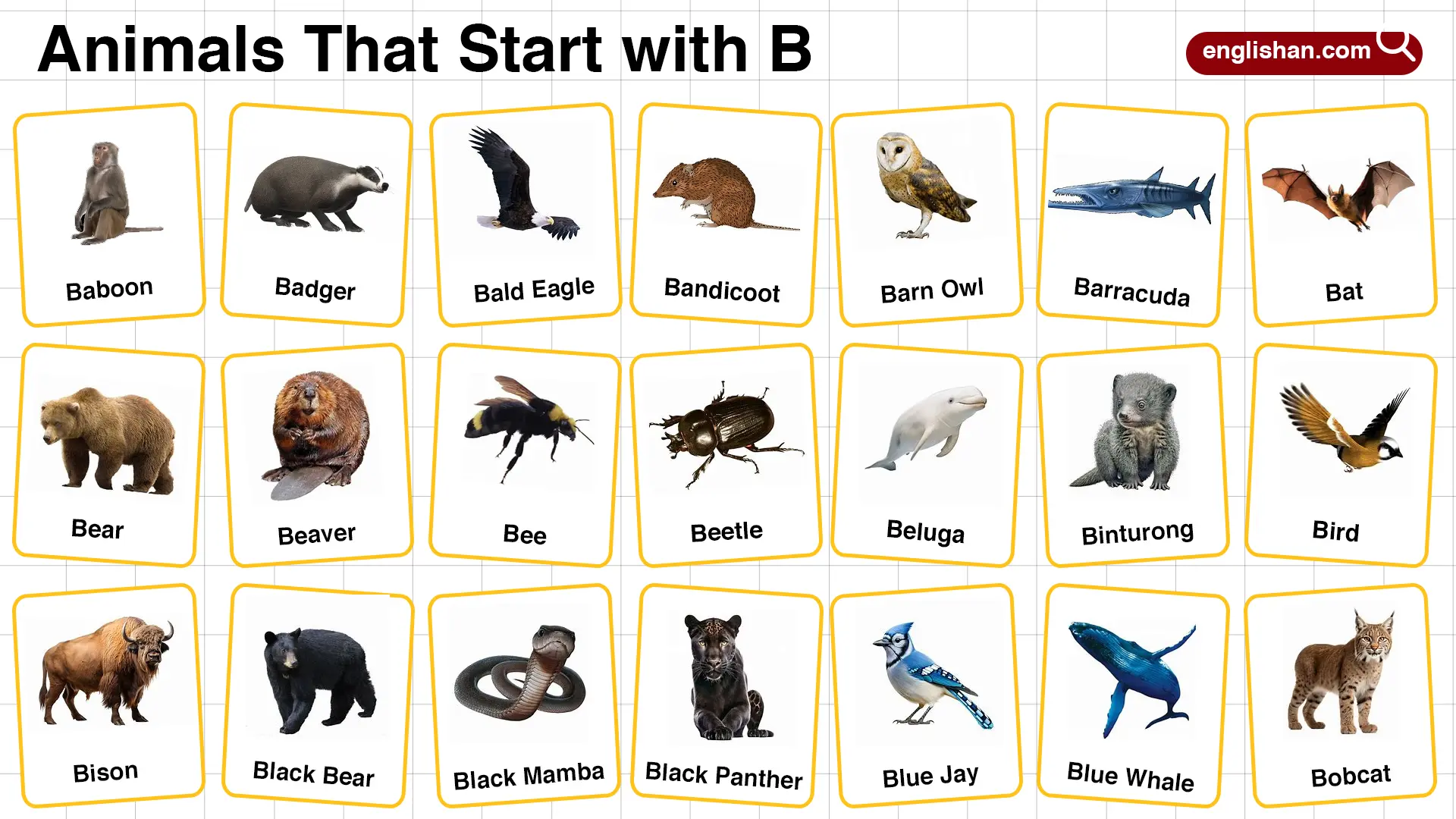
B gives English more animal names than almost any other letter. The blue whale begins with it, and so does an Asian tree-dweller whose fur smells of hot popcorn.
Animals that start with B reach across every group on earth, from the largest creature that ever lived down to insects a few millimetres long. Most people name the bear without thinking. Far fewer can picture a binturong.
The familiar names make the best starting place, and the rarer ones follow from there.
List Of Animals That Start With B
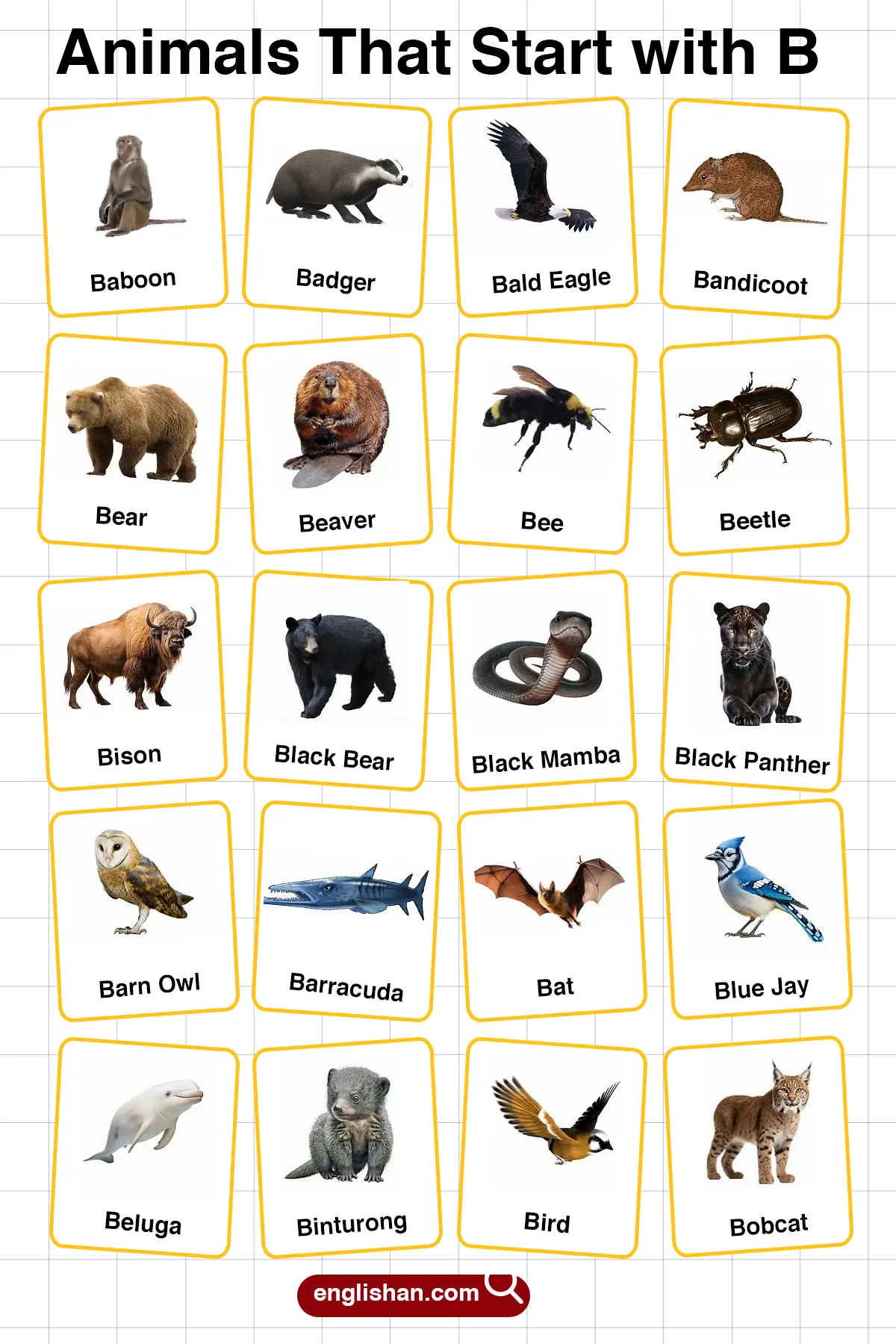
More than 150 animals have names beginning with B, across mammals, birds, fish, reptiles, amphibians and insects. The everyday ones are the bear, bat, bee, bison and butterfly. The blue whale outgrows every one of them, and every animal that has ever lived, at over 30 metres and roughly 150 tonnes.
| Babirusa | Bighorn sheep | Bobolink |
| Baboon | Bilby | Boer goat |
| Backswimmer | Billy goat | Bombardier beetle |
| Bactrian camel | Binturong | Bombay cat |
| Badger | Bird of paradise | Bongo |
| Bald eagle | Bird-eating spider | Bonnethead shark |
| Bald ibis | Birdwing butterfly | Bonobo |
| Bald uakari | Bishop bird | Booby |
| Baleen whale | Bison | Boomslang |
| Ball python | Bittern | Border collie |
| Banded krait | Black bear | Borneo bay cat |
| Banded mongoose | Black caiman | Bottlenose dolphin |
| Bandicoot | Black mamba | Bowerbird |
| Bantam chicken | Black rhino | Bowhead whale |
| Banteng | Black swan | Box jellyfish |
| Bar-headed goose | Black vulture | Box turtle |
| Barbary macaque | Black widow spider | Boxer |
| Barbet | Black-backed jackal | Brahman cattle |
| Bark beetle | Black-crowned night heron | Brambling |
| Bark scorpion | Black-footed cat | Bream |
| Barn owl | Black-footed ferret | Brine shrimp |
| Barn swallow | Black-tailed deer | Brittle star |
| Barnacle | Blackbird | Brolga |
| Barracuda | Blackbuck | Brown bear |
| Barramundi | Blacktip reef shark | Brown hyena |
| Basenji | Blanket octopus | Brush-tailed possum |
| Basilisk lizard | Blesbok | Budgerigar |
| Basking shark | Blister beetle | Buffalo |
| Bass | Blobfish | Bufflehead |
| Bat | Bloodhound | Bulbul |
| Bat-eared fox | Blowfly | Bull |
| Beagle | Blue crab | Bull shark |
| Beaked sea snake | Blue jay | Bull terrier |
| Bear | Blue morpho butterfly | Bulldog |
| Bearded dragon | Blue shark | Bullet ant |
| Bearded seal | Blue tit | Bullfrog |
| Bearded vulture | Blue whale | Bullhead |
| Beaver | Blue wildebeest | Bullmastiff |
| Bedbug | Blue-footed booby | Bumblebee |
| Bee | Blue-ringed octopus | Bunting |
| Bee hummingbird | Blue-tongued skink | Burmese python |
| Bee-eater | Bluebird | Burro |
| Beetle | Bluebottle | Burrowing owl |
| Belgian horse | Bluebuck | Bush cricket |
| Beluga | Bluefin tuna | Bush dog |
| Bengal cat | Bluefish | Bushbaby |
| Bengal tiger | Bluegill | Bushbuck |
| Bernese mountain dog | Bluethroat | Bushmaster |
| Bettong | Boa constrictor | Bushpig |
| Bewick’s swan | Boar | Bustard |
| Bharal | Boat-billed heron | Butterfly |
| Bichir | Bobbit worm | Butterflyfish |
| Bichon frise | Bobcat | Buzzard |
Common Animals That Start With B
You already know these twelve. Each one earns its place through a trait you can spot in a single photograph, which makes them the fastest way into the letter.
Bear
Eight bear species survive worldwide, and the brown bear and American black bear account for almost every sighting in North America and Europe. Bears walk flat-footed on the whole sole, the way people do, which is why a standing bear looks so unsettlingly human. A brown bear reaches 350 kilograms and still sprints at 50 km/h over short ground.
Bat
Bats are the only mammals capable of true sustained flight, and more than 1,500 species now carry the name. Across the whole class of mammals, one species in five is a bat. The smallest, Kitti’s hog-nosed bat, weighs 2 grams. The largest, the giant golden-crowned flying fox, opens wings 1.6 metres across.
Most hunt by echolocation, firing calls and reading the returning echoes to map moths in total darkness.
Bee
Around 20,000 bee species pollinate plants worldwide, and only a handful of them make honey. A honeybee visits up to 2,000 flowers a day and communicates the direction of a food source by dancing a figure of eight on the comb. The angle of the dance names the angle to the sun.
Bison
American bison weigh up to 900 kilograms and charge at 50 km/h, which makes them the heaviest land animal in the Americas. The shoulder hump is pure muscle, built to power the head through deep snow while grazing. Some 30 million once roamed the plains; hunting cut that to fewer than 600 by 1889.
Baboon
Five baboon species range across Africa and Arabia, moving in troops of up to 150 under a social order that daughters inherit from their mothers. A baboon yawn is a threat display rather than tiredness, since it puts the canine teeth on show. Those canines grow longer than a leopard’s.
Beaver
Beavers are the only animals besides humans that reshape whole landscapes to suit themselves. Their teeth never stop growing, and iron in the enamel gives the front surface its orange colour and its cutting edge. One Canadian beaver dam stretches 850 metres, long enough to be visible from space.
Blue whale
The blue whale outgrows every animal that has ever lived, reaching over 30 metres and roughly 150 tonnes. Inside it, a heart of about 400 pounds pumps 60 gallons of blood with every beat. A calf gains 90 kilograms a day on nothing but milk.
It feeds almost entirely on krill, taking up to four tonnes a day in the Antarctic summer.
Bald eagle
The bald eagle was never bald, and the name comes from an older sense of the word meaning white-headed. That white head arrives only at four or five years old; young birds stay mottled brown. For a nest, adults build the largest in tree-nesting North America, returning to the same one for decades until it weighs a tonne.
- Butterfly: roughly 18,500 species flutter worldwide, tasting with their feet and drinking nectar through a coiled tube that uncurls only at the flower.
- Bobcat: short bobbed tail, twice the weight of a house cat.
- Badger: European badgers dig tunnel systems called setts, and the largest run to a hundred entrances and thirty chambers handed down through generations of one family.
- Buffalo: true buffalo live in Africa and Asia, so the American bison never qualified.
Keeping buffalo for the African and Asian species that own the name ✅
Calling an American bison a buffalo ❌
Mammals That Start With B
Beyond the famous names, eighteen mammals begin with B and most never appear in a school project.
Binturong
The binturong smells of hot buttered popcorn, and the chemistry behind it is settled. A compound called 2-acetyl-1-pyrroline in its urine matches the compound that forms when popcorn is heated. Nicknamed the bearcat, this Southeast Asian tree-dweller weighs 9 to 20 kilograms and grips branches with a prehensile tail almost as long as its body. The IUCN lists it as Vulnerable.
Bilby
The greater bilby digs burrows up to 3 metres deep across the Australian outback, spiralling them so predators cannot see straight down. Enormous rabbit-like ears shed heat and pick up insects moving under the sand. Australia now sells chocolate bilbies at Easter instead of rabbits, since the introduced rabbit helped push this marsupial toward extinction.
Black rhino
Poaching cut the black rhino to fewer than 2,500 animals by 1995, a fall of 98 percent in 35 years. Under protection the number has climbed back to almost 6,500, though the IUCN still lists the species as Critically Endangered. A hooked upper lip separates it from the white rhino: the black rhino browses leaves from bushes, while the white rhino grazes grass.
Black-footed ferret
Declared extinct twice, the black-footed ferret came back both times. A Wyoming ranch dog carried a dead one home in 1981, revealing the last surviving colony, and every animal alive today descends from seven of those survivors. It hunts prairie dogs almost exclusively and sleeps in their burrows.
- Bandicoot: twelve days from conception to birth, the shortest pregnancy of any mammal alive.
- Bongo: ten to fifteen white stripes run down a chestnut coat, and both sexes of the largest forest antelope grow horns that spiral back over the shoulders.
- Bonobo: shares 98.7 percent of human DNA and settles a dispute through social bonding rather than a fight.
- Babirusa: male Indonesian pigs grow upper tusks that pierce straight through the snout and curve back toward the skull.
- Bat-eared fox: termites make up 80 percent of the diet, tracked by ears 13 centimetres tall.
- Black-backed jackal: a silver saddle down the back, a mate for life, a territory defended by both.
- Black bear: climbs better than any other bear and eats mostly plants.
- Brown bear: grizzlies and Kodiaks belong to one species, and coastal Kodiak males reach 680 kilograms on a salmon diet that runs half the year.
- Boar: wild ancestor of every domestic pig, still roaming Europe and Asia.
- Bushbaby: night vision and a 2-metre leap between branches, powered by eyes too large to rotate in their sockets.
- Bactrian camel: two humps store fat, never water, which takes this Central Asian camel through swings from minus 40 to plus 40 degrees.
- Banded mongoose: troops of forty forage together, and every female gives birth on the same night.
- Borneo bay cat: photographed alive fewer than a dozen times.
- Black-footed cat: under 2 kilograms, yet it kills more prey in a night than a leopard does.
Birds That Start With B
Fourteen birds beginning with B range across every continent, and one of them builds a structure no other animal makes.
Bowerbird
A male bowerbird builds a bower, then decorates it with berries, beetle wings, flowers and stolen bottle tops, arranging everything by colour. Satin bowerbirds collect blue almost exclusively. The bower is not a nest: females inspect it, judge the display, then leave to build a plain nest elsewhere. Around 20 species build them across Australia and New Guinea.
Barn owl
The barn owl hunts by sound alone, and the heart-shaped face works as a dish that funnels noise toward its ears. Because those ears sit at different heights on the skull, sound reaches one a fraction before the other, and the bird reads that gap as direction. It swallows prey whole, then coughs up the bones in a pellet.
- Blue jay: mimics a hawk call to clear a feeder, then lands on it alone.
- Budgerigar: wild flocks cross Australia in their thousands, while captive budgies learn hundreds of words and the record holder knew more than 1,700.
- Blue tit: small, acrobatic, and famous across Britain for learning to open milk-bottle foil.
- Blackbird: a yellow eye-ring and an orange bill separate the male from every other black European songbird.
- Black vulture: finds carrion by sight rather than smell, then follows turkey vultures to what their noses located first.
- Buzzard: Britain’s most numerous bird of prey, calling with a thin cat-like mew.
- Barn swallow: 10,000 kilometres each year between Europe and southern Africa.
- Burrowing owl: old prairie dog tunnels become the nest, and unlike most owls this one hunts through daylight.
- Bee-eater: beats a captured bee against a branch until the sting comes away, then swallows it.
- Bittern: points its bill straight up when threatened, and the streaked neck vanishes into the reeds.
- Booby: brighter blue feet signal a better diet, and blue-footed females choose accordingly.
- Bewick’s swan: every bill wears a yellow-and-black pattern as individual as a fingerprint, which is how researchers at Slimbridge have tracked single birds across a whole lifetime.
Sea Animals That Start With B
Sixteen sea animals begin with B, and several of them are the largest, deadliest or strangest of their kind.
Blue-ringed octopus
No animal this small kills as efficiently. At 12 to 20 centimetres across, a blue-ringed octopus carries enough tetrodotoxin to kill more than 20 adults within minutes. No antivenom exists. Provoked, it flashes 50 to 60 iridescent blue rings in under a third of a second. That flash is the only warning it gives.
Basking shark
The basking shark grows past 12 metres, second in size only to the whale shark among all fish. Feeding entirely on plankton, it cruises with its mouth open and strains up to 450 tonnes of water an hour through its gill rakers. The IUCN lists it as Endangered.
- Beluga: the only whale that can turn its head, under white skin and a flexible melon on the forehead.
- Barracuda: torpedo body, dagger teeth, short attacks at 40 km/h.
- Blobfish: at depth it looks ordinary, and only the pressure change on hauling it up produces the famous drooping face.
- Box jellyfish: tentacles 3 metres long carry venom that stops a human heart faster than any other sting in the sea.
- Bottlenose dolphin: each animal uses a signature whistle as a name, and others copy that whistle to call it back.
- Bull shark: swims far up rivers, and one specimen turned up 4,000 kilometres along the Amazon.
- Barnacle: cemented head-down to rock for life, kicking food into its shell with modified legs.
- Bobbit worm: buried in the seabed, this predator reaches 3 metres and snaps prey in half with spring-loaded jaws that close before the fish registers anything.
- Bowhead whale: past 200 years of age, longer than any other mammal.
- Bluefin tuna: warm-blooded, built for 70 km/h, crossing oceans in weeks.
- Barramundi: every one hatches male and turns female around four.
- Butterflyfish: a false eyespot near the tail sends reef predators lunging at the wrong end of the fish.
- Blue crab: paddle-shaped rear legs make the Atlantic blue crab one of the few crabs that genuinely swims.
- Beaked sea snake: responsible for most sea-snake bites worldwide, hunting catfish and prawns across shallow Asian coasts.
Reptiles And Amphibians With B
Ten cold-blooded species begin with B, and the first is the fastest snake in Africa.
Black mamba
The black mamba takes its name from the inside of its mouth, not its skin, which runs olive to grey. When threatened it gapes to show a lining so dark it reads as black.
Adults reach 3 metres and exceed 4 metres at the extreme, making it the longest venomous snake in Africa. Its top speed of 16 km/h is fast for a snake, though the widely repeated 20 km/h figure overstates it.
- Boa constrictor: tightens with each exhale until blood flow stops, rather than crushing bone.
- Bullfrog: the American species swallows anything that fits, birds and snakes and other frogs among it.
- Bearded dragon: a spiny throat pouch puffs black under threat, and one waved arm signals submission instead.
- Box turtle: hinged shell plates close the animal away completely, and wild box turtles reach 100 years.
- Basilisk lizard: fringed toes carry it across open water.
- Boomslang: haemotoxic venom stops blood from clotting, and enormous eyes give this African tree snake vision sharper than almost any snake on the continent.
- Ball python: curls into a tight ball with the head tucked inside.
- Blue-tongued skink: that bright blue tongue flashes as pure bluff, since the skink has no venom at all and nothing else to try.
- Banded krait: black and yellow bands warn predators off, and this Asian snake spends the night hunting other snakes.
Insects And Spiders With B
Ten invertebrates beginning with B show how much the letter reaches at the small end.
Bombardier beetle
The bombardier beetle sprays a boiling chemical jet from its abdomen at any attacker. Two harmless chemicals sit in separate chambers and mix only on firing, producing a 100-degree spray released in pulses of around 500 a second. The beetle aims it in almost any direction and walks away unharmed.
- Beetle: roughly 400,000 named species make beetles one animal in four on earth.
- Bumblebee: furry bodies and the ability to shiver let bumblebees fly in cold that grounds a honeybee.
- Blue morpho butterfly: microscopic scales bounce light into that blue, so no pigment exists to fade and a dead specimen keeps its colour indefinitely on a museum pin.
- Bullet ant: highest sting on the Schmidt pain index.
- Black widow spider: a red hourglass marks the female, whose venom runs 15 times stronger than a rattlesnake’s by volume.
- Bird-eating spider: 30 centimetres across the legs, though the Goliath birdeater eats insects and worms far more than it ever eats birds.
- Backswimmer: swims upside down, rowing with hair-fringed hind legs and taking tadpoles from below.
- Bark scorpion: ultraviolet light turns the Arizona species blue-green, as it does every scorpion.
- Blowfly: metallic green and drawn to carrion, blowflies let forensic scientists read time of death from the stage the larvae have reached.
Wild Animals That Start With B
Ten larger wild animals begin with B, and most of them draw searches on their own.
- Bengal tiger: India shelters roughly 75 percent of the world’s wild tigers, and every stripe pattern differs like a fingerprint.
- Blue wildebeest: over a million cross the Serengeti each year in the largest land migration on earth.
- Brown hyena: rarest of the four hyenas, scavenging seal carcasses along the Namib shoreline.
- Barbary macaque: Europe’s only wild monkeys live on Gibraltar, and males help raise infants that are not their own.
- Bushbuck: freezes rather than runs when a predator passes.
- Banteng: wild cattle of Southeast Asia, bulls turning dark chestnut while cows stay tan.
- Black caiman: 5 metres of Amazonian predator, hunting capybara and piranha after dark.
- Bald uakari: a bright red bare face signals health in this Amazonian monkey, since malaria drains the colour and leaves a pale one that other monkeys avoid.
- Blackbuck: India’s fastest antelope runs at 80 km/h, and males carry spiralling horns above a black-and-white coat.
- Bharal: the blue sheep of the Himalayas grazes at 5,500 metres and feeds more snow leopards than any other prey.
Farm And Pet Animals With B
Eight domestic animals begin with B, and one of them names a job rather than a species.
- Bull: any uncastrated male of the cattle family, up to 1,100 kilograms.
- Bantam chicken: miniature breeds weigh a quarter of a standard hen and lay at the same rate.
- Border collie: bred on the Scottish borders for herding, and rated the most trainable dog alive.
- Beagle: around 220 million scent receptors, which is why a beagle tracks by nose almost to the exclusion of whatever its eyes are reporting at the same moment.
- Bulldog: flattened faces bring breathing trouble, and breed standards have shifted in response.
- Boer goat: South African meat breed, gaining weight faster than any other goat.
- Belgian horse: among the strongest draft breeds, a Belgian pulls over 3,000 kilograms in competition.
- Bombay cat: solid black coat, copper eyes, panther in miniature.
How To Pronounce B Animal Names
Several of these names trip you up on first reading, because the stress falls where you would not expect it. Say the capitalised part louder.
| Animal | Say it as |
|---|---|
| Babirusa | bab-ih-ROO-suh |
| Bandicoot | BAN-dee-koot |
| Banteng | BAN-teng |
| Barracuda | bah-ruh-KOO-duh |
| Bettong | BET-ong |
| Bharal | BUH-rul |
| Bilby | BILL-bee |
| Binturong | BIN-tuh-rong |
| Bongo | BONG-goh |
| Bonobo | buh-NOH-boh |
| Boomslang | BOOM-slang |
| Bowerbird | BOW-er-bird |
| Budgerigar | BUJ-uh-ree-gar |
| Bulbul | BUL-bul |
Three names cause more trouble than the rest.
Budgerigar shortens to budgie in everyday speech, which is why the full form looks unfamiliar to people who use the bird’s name daily. Bowerbird takes the vowel of bough, not of bow as in a ribbon. And bonobo puts the stress on the middle syllable, so buh-NOH-boh rather than BON-oh-boh.
The same problem turns up across the alphabet. Hard names cluster wherever a letter borrows heavily from other languages, which is why animals with O causes learners the same trouble with okapi and oryx.
Surprising Facts About B Animals
Every figure here comes from a documented measurement rather than an estimate.
- Largest ever: blue whales pass 30 metres and 150 tonnes, outgrowing every animal in the history of the planet.
- Biggest heart: that same whale’s heart weighs around 400 pounds and moves 60 gallons of blood per beat.
- Longest-lived: bowheads reach past 200 years.
- Only flying mammal: bats hold that title alone, across more than 1,500 species.
- Fifth of all mammals: one mammal species in five is a bat.
- Second-largest fish: basking sharks grow past 12 metres and strain 450 tonnes of water an hour through their gill rakers, on plankton alone.
- Hottest defence: bombardier beetles fire a 100-degree chemical spray in pulses of roughly 500 a second, aimed in almost any direction.
- Shortest pregnancy: bandicoots gestate in 12 days.
- Most venom for its size: a blue-ringed octopus the length of your hand packs enough tetrodotoxin to kill more than 20 adults, and no antivenom exists.
- Fastest antelope: blackbucks run at 80 km/h across the Indian plains.
A black panther is not a species. The name describes a melanistic leopard in Asia and Africa, or a melanistic jaguar in the Americas. Under bright light the rosettes stay visible through the dark coat.
Endangered Animals That Start With B
Five of these species are threatened, and the IUCN status behind each one comes from its current Red List assessment.
- Black rhino: Critically Endangered. Poaching cut the population to fewer than 2,500 by 1995, and protection has since carried it back to almost 6,500.
- Black-footed ferret: every animal alive descends from seven survivors found on a Wyoming ranch in 1981, which is why the Red List keeps the species at Endangered.
- Blue whale: between 10,000 and 25,000 remain against roughly 300,000 before industrial whaling, so the species stays Endangered.
- Basking shark: fished for liver oil and fins, now Endangered.
- Binturong: palm oil and logging keep taking Southeast Asian forest, and the IUCN lists this tree-dweller as Vulnerable.
The bilby runs the other way. Captive breeding and predator-proof fencing have returned greater bilbies to sites across Australia where they had been absent for a century. Easter chocolate bilbies now fund that work directly.
Animals That Start With B For Kids
Younger children learn the letter fastest through animals they can picture straight away. Start with these eight.
- Bear: big, furry, and asleep all winter.
- Bee: it buzzes from flower to flower, and the honey on your toast came out of a hive like the one it lives in.
- Bat: hangs upside down and flies at night.
- Bird: feathers, a nest, and eggs to sit on.
- Butterfly: starts life as a caterpillar, then grows bright wings and flies away from the leaf it was eating.
- Bunny: long ears, a fluffy tail, and a hop instead of a walk.
- Bull: a big farm animal with horns, and the loudest one in the field.
- Beaver: orange teeth cut down small trees, and the sticks build a dam right across the stream.
Say each name out loud and press the B at the front. Bee and bat come easiest to a young ear. Both take one short syllable, and both name an animal a child has already met in a picture book.
FAQs
Q1. What animals start with B?
Animals that start with B open with the bear, bat, bee, bison and butterfly among the familiar names. Rarer B names add the binturong, the bilby, the babirusa and the bowerbird. More than 150 of them turn up regularly enough to recognise across every animal group.
Q2. What is the biggest animal starting with B?
The blue whale takes that title, and not only among B animals. At over 30 metres and roughly 150 tonnes, it outgrows every animal that has ever lived on earth. On land the bison leads at 900 kilograms.
Q3. Are bats mammals?
Yes, bats are mammals, and they are the only mammals capable of true sustained flight. Flying squirrels and sugar gliders glide rather than fly. More than 1,500 bat species exist, which makes roughly one mammal species in five a bat.
Q4. What sea animal starts with B?
The blue whale is the best-known sea animal starting with B. The group also takes in the beluga, barracuda, bull shark, basking shark and bottlenose dolphin. Smaller ones are the blue-ringed octopus, the box jellyfish and the barnacle.
Q5. What bird starts with B?
The bald eagle leads every list of birds beginning with B. Behind it come the barn owl, blue jay, blackbird, buzzard and budgerigar. The bowerbird is the most unusual of them, since males build decorated structures purely for courtship.
Q6. What are wild animals that start with B?
Wild animals that start with B cover the bear, bison, baboon, bobcat and Bengal tiger. Less familiar species add the bongo, banteng, bharal and blue wildebeest. Most of them roam Africa, Asia or the Americas.
Q7. Is a black panther a real animal?
No, the black panther is not a separate species. The name describes a leopard or a jaguar born with melanism, a genetic condition that floods the coat with dark pigment. The usual rosettes remain, and strong light still reveals them.
Q8. What is the cutest animal that starts with B?
The bilby takes that title for most people, helped by rabbit-like ears and a silky grey coat. Close behind come bunnies and baby bears. The bushbaby takes nearly as many votes, mostly for the enormous eyes.
You May Also Like