Animals and Their Footprints reveal how every animal that walks across soft ground leaves behind a record of where it went and, often, what it was doing. Reading that record is called tracking, and it works across almost every group of animals. Mammals, birds, and reptiles each leave footprints with distinctive shapes, spacing, and identifying features that can help determine the species.
This article explores animals and their footprints with names in detail, covering the major types of tracks and answering the most common questions people ask when trying to identify an animal’s footprints.
What a Footprint Actually Tells You?
A track is more than a random mark in the mud. Four pieces of information make up nearly every identification:
- Shape and outline, meaning the overall form of the paw, hoof, or foot
- Toe count and claw marks, since the number of toes and whether claws show up narrows down the species fast
- Size, usually measured in inches or centimeters from heel to the tip of the longest toe
- Trail pattern, meaning how the tracks are spaced and arranged as the animal moved, which reveals gait and often species on its own
Track identification also depends heavily on gait, the pattern an animal’s legs follow while moving. Four gait families cover almost every land animal:
- Diagonal walkers (deer, foxes, most cats) place feet in a nearly straight line, with the back foot often landing close to or inside the front print.
- Bounders (weasels, minks, otters) push off with their back legs and land with both front feet together, then both back feet together, creating repeating pairs of prints.
- Waddlers, or pacers, (raccoons, opossums, skunks, bears) move both legs on the same side of the body together, producing a side-to-side, staggered trail.
- Hoppers (rabbits, squirrels) land with their larger hind feet ahead of their smaller front feet, since their back legs do most of the propulsion.
Explore more animals that start with different letters:
A | B | C | D | E | F | G | H | I | J | K | L | M | N | O | P | Q | R | S | T | U | V | W | X | Y | Z
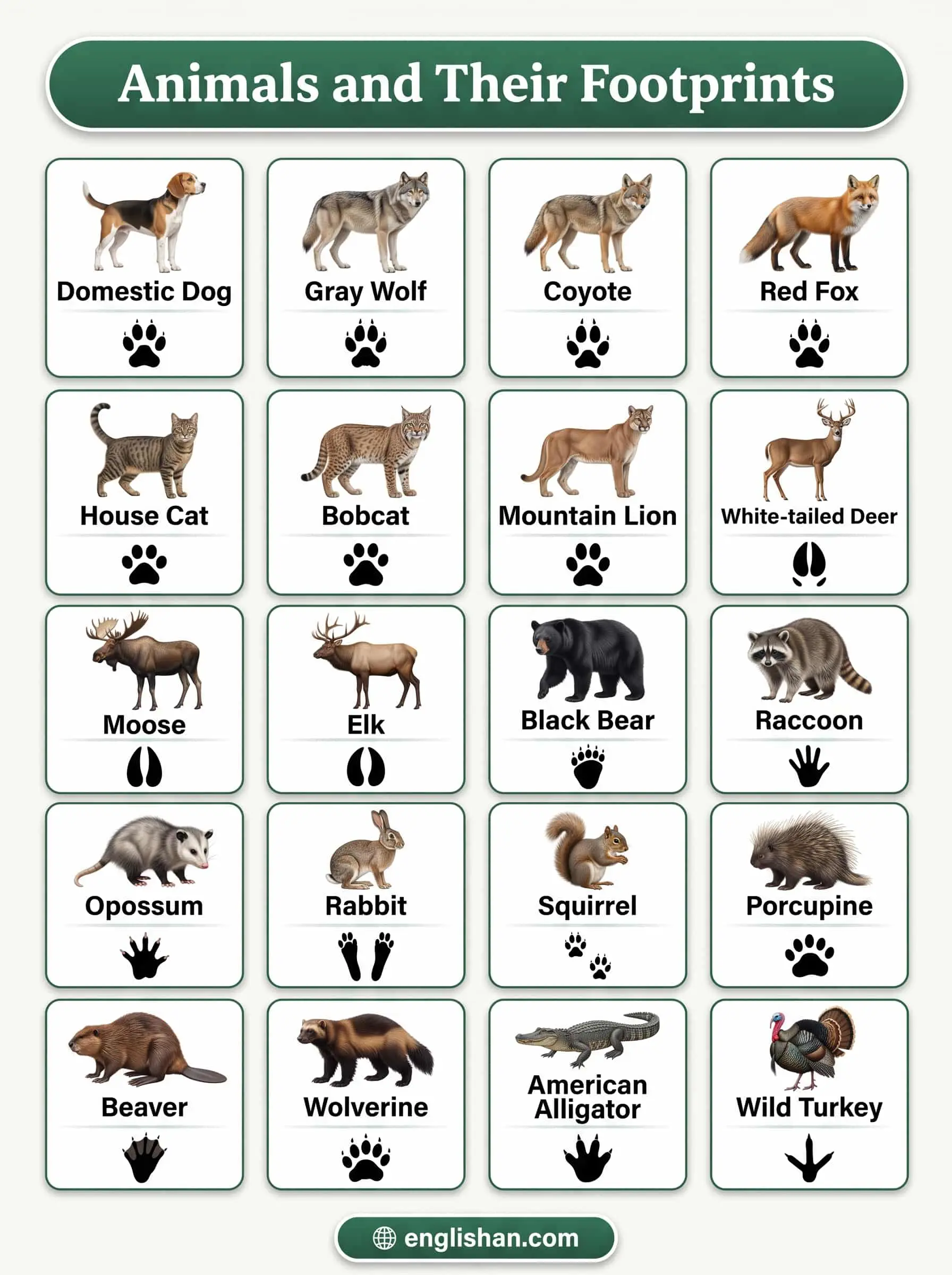
List of Animals and Their Footprints with Pictures
Here’s a fast overview of common tracks, useful if you just need a general answer without reading through every section.
- Domestic dog – four toes, visible claws, 2 to 4 inches, variable trail depending on breed
- Gray wolf – four toes, visible claws, 4 to 5 inches, straight and efficient trail
- Coyote – four toes, visible claws, 2 to 2.75 inches, narrower and more oval than a dog print
- Red fox – four toes, visible claws, 1.5 to 2 inches, small and neatly spaced
- House cat – four toes, no claw marks, under 1.5 inches, round shape
- Bobcat – four toes, no claw marks, 1.5 to 2 inches, round with a two-lobed heel pad
- Mountain lion – four toes, no claw marks, 3 to 4 inches, largest common feline print
- White-tailed deer – two-toed split hoof, 2 to 3 inches, teardrop shape
- Moose – two-toed split hoof, 5 to 7 inches, oversized version of a deer track
- Elk – two-toed split hoof, 4 to 5 inches, rounder than a deer print
- Black bear – five toes, visible claws, hind print is long and human-like
- Raccoon – five toes, front print resembles a tiny human hand
- Opossum – five toes, hind foot has a sideways-pointing “thumb”
- Rabbit – large elongated hind prints ahead of small round front prints
- Squirrel – small hopping pattern, usually found near tree trunks
- Porcupine – pigeon-toed stance, large rounded pads, tail-drag marks in snow
- Beaver – webbed hind feet, tracks often smudged by a dragging tail
- Wolverine – five toes, thickly furred paws, print size rivals a wolf’s
- Alligator – clawed feet flanking a wide tail-drag groove
- Wild turkey – three toes forward, one toe back, 4 to 5 inches
Canine Tracks: Dogs, Wolves, Coyotes, and Foxes
All canines share the same basic four-toed print with visible claw marks, since dogs and their wild relatives cannot retract their claws the way cats can. The main way to tell them apart is size and trail behavior.
| Animal | Print Size | Distinguishing Feature |
|---|---|---|
| Domestic dog | 2 to 4 inches | Wandering trail, size varies by breed |
| Coyote | 2 to 2.75 inches | Narrower, more oval than a dog print |
| Gray wolf | 4 to 5 inches | Much larger, walks in a very direct line |
| Red fox | 1.5 to 2 inches | Small and neat, often almost perfectly straight |
Wild canines tend to walk in a straighter line than domestic dogs. A coyote or fox burns energy it needs for hunting with every step, so its trail is efficient and direct, while a pet dog often wanders off-path to sniff and explore, leaving a messier trail even when the individual prints look nearly identical.
Feline Tracks: House Cats, Bobcats, and Mountain Lions
Cat prints are rounder than canine prints and almost never show claw marks, since most cats retract their claws while walking. The heel pad is the fastest way to confirm a feline track: it shows two lobes at the front and three at the back, compared to the single-lobed triangular heel pad of a canine.
| Animal | Print Size | Distinguishing Feature |
|---|---|---|
| House cat | Under 1.5 inches | Small, round, faint trail |
| Bobcat | 1.5 to 2 inches | Slightly asymmetrical, no claws |
| Mountain lion | 3 to 4 inches | Largest feline print, still claw-free |
| Canada lynx | 3.5 to 4.5 inches | Unusually large, fur-padded feet spread weight in snow |
Hoofed Animal Tracks: Deer, Elk, Moose, and Wild Boar
Hoofed mammals, also called ungulates, leave a split, two-lobed print shaped like a pair of teardrops facing each other. Size and depth are the main clues to species.
- White-tailed deer leaves a 2 to 3 inch print, and the rear dewclaw marks often show up behind the main hoofprint when the deer was running or moving through soft ground.
- Elk tracks are rounder and larger than deer tracks, typically 4 to 5 inches long.
- Moose tracks can reach 5 to 7 inches, nearly double the size of a deer’s, and often show deep dewclaw impressions even during a normal walk because of the animal’s sheer body weight.
- Wild boar tracks look similar to deer tracks but are rounder and more spread apart, with toe marks that splay outward more than a deer’s.
Small Mammal Tracks: Rabbits, Squirrels, Raccoons, and More
❶ Rabbit
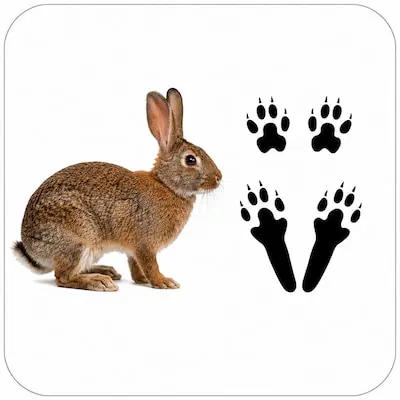
Rabbit tracks follow the classic hopping pattern: two small, round front prints close together, followed by two larger, elongated hind prints side by side just ahead of them.
❷ Squirrel
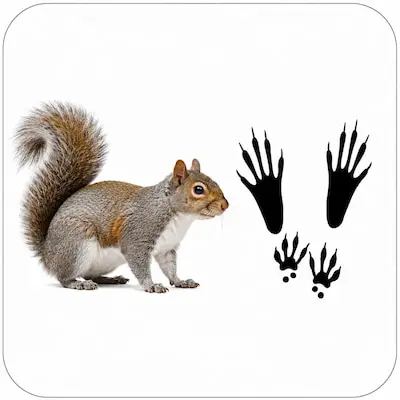
Squirrel tracks are a miniature version of the rabbit pattern, with four-toed front feet landing behind five-toed hind feet. They’re most often found near the base of trees or leading straight up a trunk.
❸ Raccoon
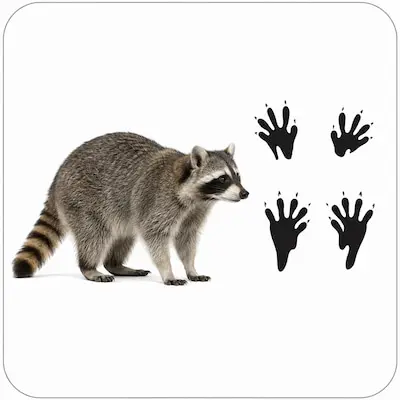
Raccoon front prints look like a tiny human handprint, with five long, slender toes. The hind print is more elongated and resembles a small human foot.
❹ Opossum
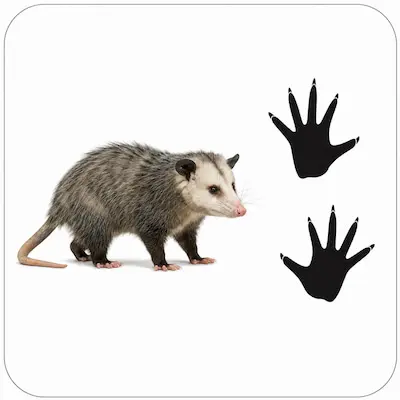
Opossum tracks are one of the easiest small mammal tracks to identify, since the opossum is the only North American mammal with an opposable “thumb” on its hind foot, sticking out almost at a right angle from the rest of the toes.
❺ Skunk
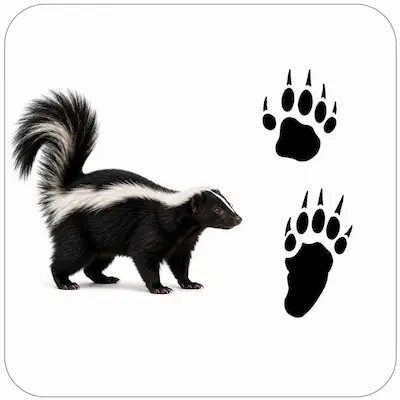
Skunk tracks show five toes on both front and back feet, with long claws on the front feet built for digging. Their pacing gait creates a slightly staggered, side-to-side trail similar to a raccoon’s.
❻ Porcupine
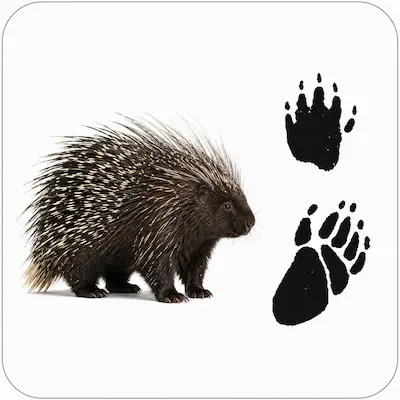
Porcupine tracks look pigeon-toed, angled slightly inward, with large rounded pads. In snow or soft dirt, a faint drag mark from the quill-covered tail often runs between the footprints.
Large Mammal Tracks: Bears, Beavers, and Wolverines
❶ Black Bear
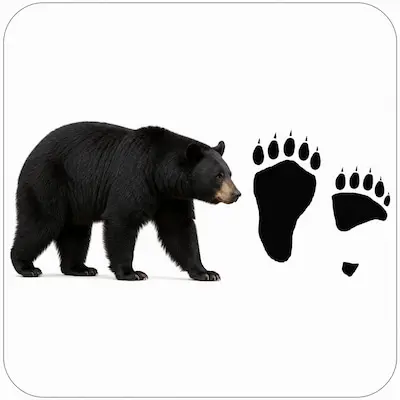
Black bear tracks show five toes on both front and hind feet, with claw marks positioned well ahead of the toe pads. The hind print is long, flat, and surprisingly close in shape to a human footprint.
❷ Beaver
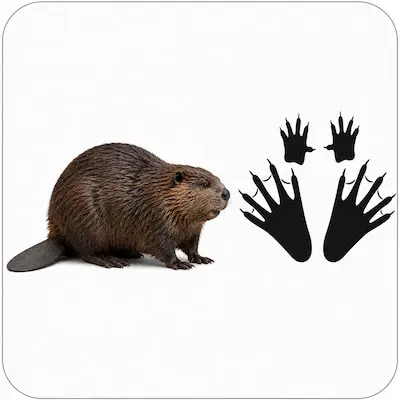
Beaver tracks are often incomplete, since the animal’s large, webbed hind feet leave broad prints that its flat, paddle-shaped tail then drags directly across, smudging or erasing much of the trail.
❸ Wolverine
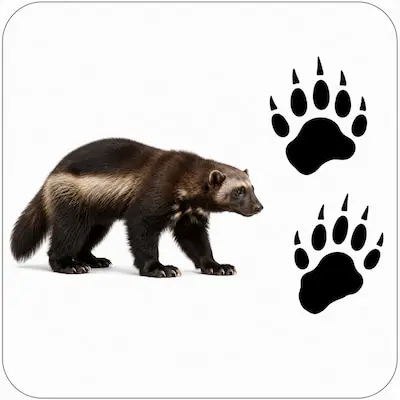
Wolverine tracks are rare finds, since the animal favors remote terrain, but they’re identifiable by five toes on both front and back feet and a print size that can rival a wolf’s despite the wolverine’s smaller body, thanks to large, thickly furred paws built for deep snow.
Bird Tracks
Most birds share a basic pattern: three toes pointing forward and one pointing back. The differences show up in size, depth, and extra details:
- Songbirds leave small, delicate prints, often in pairs from hopping rather than walking.
- Wading birds, like herons, leave long-toed prints built for balancing on soft mud.
- Waterfowl, like ducks and geese, show webbing between their toes, which appears as a fan-shaped impression.
- Birds of prey, like hawks and owls, leave prints with sharp, deep claw punctures from their talons.
- Wild turkey tracks are large for a bird, 4 to 5 inches, with thick, well-spread toes.
Reptile Tracks
Reptile trails look distinct from mammal trails mainly because of the tail.
- Turtles leave a straight line down the center of their trail from their shell or tail dragging through the dirt, flanked by small clawed footprints on either side.
- Alligators vs crocodiles leave a wide, heavy tail-drag groove between clawed footprints, most often found near riverbanks and swampy shorelines.
- Snakes don’t leave footprints at all, but their S-shaped body trail is just as identifiable, often with visible belly-scale ridges pressed into fine sand.
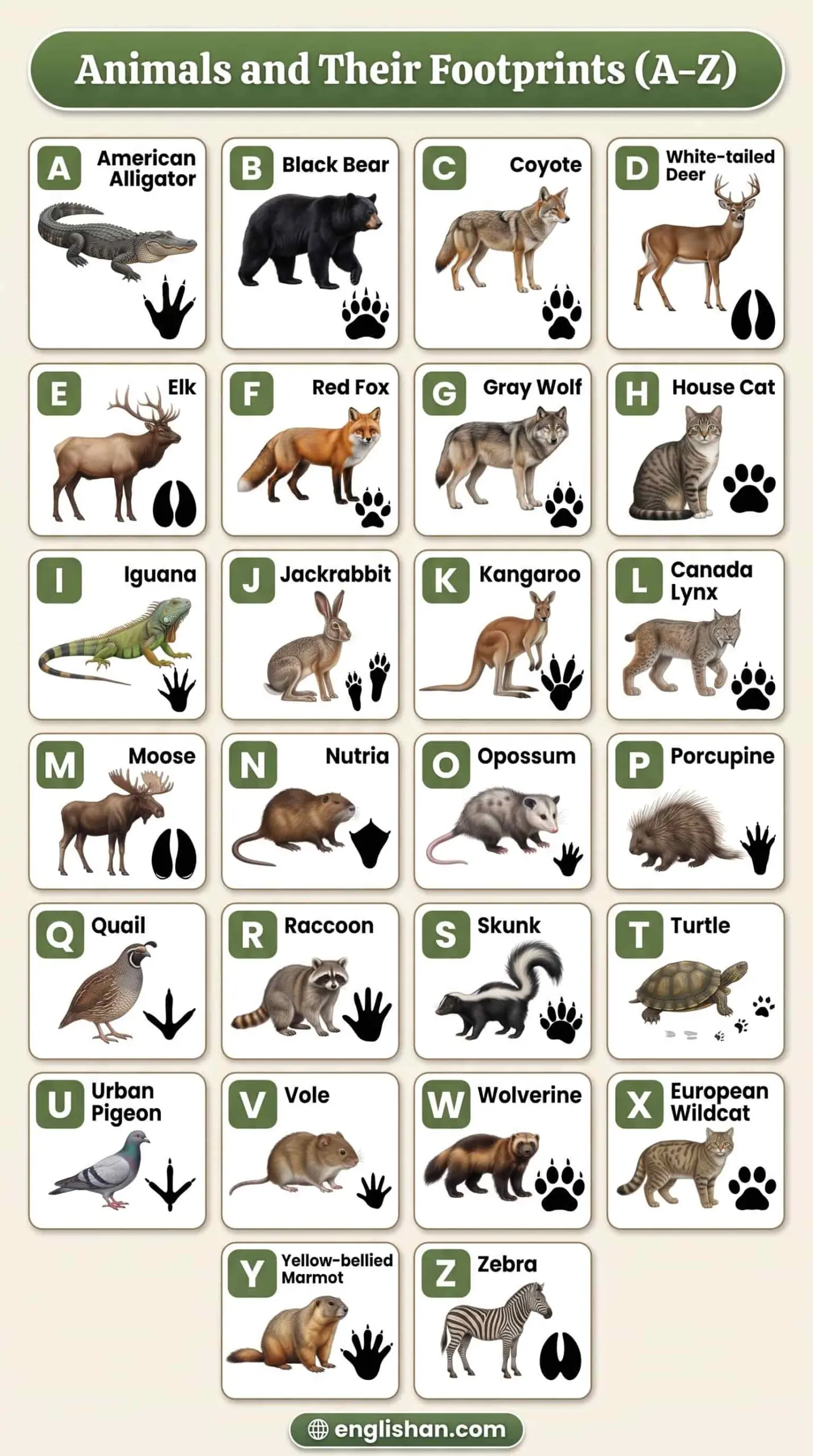
Animals and Their Footprints (A to Z)
- A – Alligator: Heavy tail-drag groove flanked by clawed prints.
- B – Black Bear: Five toes with claws well ahead of the toe pads.
- C – Coyote: Narrow, oval, four-toed print with visible claws.
- D – Deer: Split, teardrop-shaped hoofprint.
- E – Elk: Large, rounded split hoofprint.
- F – Red Fox: Small, neat, four-toed print in a straight line.
- G – Gray Wolf: Large canine print that follows a direct trail.
- H – House Cat: Small, round, claw-free print.
- I – Iguana: Five clawed toes with a light tail drag in sand.
- J – Jackrabbit: Elongated hind prints ahead of smaller front prints.
- K – Kangaroo (Native Range): Large, narrow hind prints from a hopping gait, with a tail drag between hops.
- L – Canada Lynx: Large, fur-padded feet that spread out in snow.
- M – Moose: Oversized split hoofprint, often 5–7 inches long.
- N – Nutria: Webbed hind feet paired with unwebbed front feet.
- O – Opossum: Hind foot shows a sideways-pointing opposable toe.
- P – Porcupine: Pigeon-toed stance with a tail-drag mark.
- Q – Quail: Small bird print with three toes pointing forward.
- R – Raccoon: Front print resembles a tiny human hand.
- S – Skunk: Five toes with long digging claws on the front feet.
- T – Turtle: Shell or tail drag line between small footprints.
- U – Urban Pigeon: Small, three-toe-forward print commonly found on soft city ground.
- V – Vole: Tiny four-toed front and five-toed hind prints, often seen in snow tunnels.
- W – Wolverine: Large, five-toed print from a thickly furred paw.
- X – No Commonly Tracked Animal: No commonly tracked animal starts with X. European wildcat prints are sometimes searched under this letter by mistake and have the same round, clawless shape as other wild cats.
- Y – Yellow-Bellied Marmot: Broad, five-toed prints near burrow entrances.
- Z – Zebra (Native Range): Single-toed hoofprint that is rounder than a horse’s.
Animals That Are Hard to Track by Footprint Alone
Not every animal leaves a print worth following. A few groups are notoriously difficult:
- Arboreal animals, like most squirrels, primates, and tree-dwelling opossums, spend most of their time off the ground, so tracks only appear where they touch down.
- Aquatic mammals, like dolphins, whales, and seals in open water, leave no ground tracks at all, though seals and otters can leave belly-slide trails on mud or snow near shorelines.
- Flying birds only leave tracks when landing, feeding, or walking, so many species are tracked more by feathers, nests, and calls than by footprints.
- Snakes leave no footprints by definition, but their body-drag trail is often just as reliable for identification once you know what to look for.
Record-Breaking Animals Tracks
A few tracks stand out for their extremes, and these come up often in searches:
- Largest land mammal track: the African elephant, whose rear footprint can exceed 15 inches across
- Smallest common mammal track: shrews and mice, whose prints can be smaller than a fingernail
- Deepest snow specialist: the snowshoe hare, whose oversized, fur-covered hind feet act like natural snowshoes to avoid sinking
- Longest tracked migration trail: caribou, which can travel over 3,000 miles a year, leaving trails across enormous stretches of tundra
- Fastest sprinting trail: the cheetah, whose stride length can exceed 20 feet at full speed, creating widely spaced prints unlike any other cat
How to Identify a Track Step by Step
- Measure the length and width using a ruler, tape measure, or even a coin for scale in a photo.
- Count the toes. Most canines and felines show four, while raccoons, opossums, skunks, and bears show five.
- Check for claw marks. Canines almost always show them since their claws can’t retract; cats almost never do.
- Study the heel pad shape. A single-lobed, triangular heel points to a canine; a heel with two lobes at front and three at back points to a cat.
- Follow the trail, not just one print. Spacing and pattern confirm gait, and gait narrows the species list faster than shape alone.
- Factor in the surface. Snow, mud, sand, and dust all record detail differently, and a track can look larger or blurrier than the actual foot depending on how soft or wet the ground was.
Tools for Tracking Animals
- Plaster casting creates a permanent 3D copy of a track using plaster of Paris, ideal for clear prints in mud or firm dirt.
- Field guides, either printed or app-based, let you compare a print against regional species likely to be in the area.
- A simple ruler or tape measure is often the single most useful item, since size alone eliminates most wrong guesses.
- A camera with something for scale (a coin, a shoe, a hand) captures detail you can study later without disturbing the print.
Common Misconceptions About Animal Tracking
“Bigger prints always mean an older or more dangerous animal.” Not necessarily. Print size mostly reflects species and individual body size, and a wet or soft surface can make an ordinary print look larger than the actual foot.
“You need snow to track animals.” Mud, wet sand, and dust hold prints just as well, and some trackers prefer soft dirt because it captures finer detail than snow, which blurs as it melts and refreezes.
“Claw marks always mean a dangerous predator made the track.” Claw visibility mostly comes down to anatomy. Canines can’t retract their claws, so their tracks show claws regardless of the animal’s actual size or danger level.
“You can always tell an animal’s age or sex from its tracks.” Not reliably. Size gives a rough sense of the animal, but confirming age or sex usually requires other clues, like stride length or young traveling alongside an adult.
Animal Tracking for Kids: Activities and Tips
Tracking turns an ordinary walk into a detective game, which makes it one of the easiest ways to get kids interested in wildlife.
- Track matching games, using printed or hand-drawn footprint cards, build recognition skills before a child even heads outside.
- Backyard scavenger hunts near a garden hose, sandbox, or puddle edge after rain often turn up real tracks without a big hike.
- Plaster casting lets kids keep a 3D souvenir of a track they found, and works especially well with clear deer, dog, or raccoon prints.
- Track journaling, where kids sketch a print, note its size, and guess the animal before checking a guide, builds observation skills that carry over into other subjects.
A few safety basics are worth teaching alongside the fun: never approach a wild animal even if fresh tracks suggest it’s close by, avoid handling scat, and treat any large or fresh predator track, like a bear or mountain lion, as a reason to leave the area rather than follow the trail further.
Final Thoughts
Every track tells a story about the animal that left it. Animals and Their Footprints with Names make it easier to identify the species, estimate its size, and understand how it moved through its habitat. By learning the basics, such as footprint size, toe count, claw marks, heel shape, and trail pattern, you can recognize many common animal tracks with confidence. Whether you are exploring a forest, walking across an open field, or looking around your own backyard, each set of footprints offers a glimpse into the wildlife that passed by, often unnoticed.
FAQs
A track is a single footprint. A trail, sometimes called a trackway, is the full sequence of prints an animal leaves as it moves, and it’s the trail, not any one print, that most reliably confirms species and gait.
Size and trail behavior are the biggest clues. Wild canines walk in a straighter, more efficient line than most domestic dogs, and wolf prints run noticeably larger than coyote or average dog prints.
Almost never. Most cats, including bobcats and mountain lions, retract their claws while walking, so their prints are round and claw-free compared to canine tracks.
Yes, to a degree. Wider spacing between prints and deeper impressions usually indicate running rather than walking, and in some animals, like cheetahs, the stride length at full speed is dramatically longer than at a walk.
Soft mud, fresh snow, and wet sand all hold detail well. Mud right after rain is often considered the most reliable, since it captures fine detail without the blurring that comes as snow melts and refreezes.
No. Fresh, large tracks from animals like bears or mountain lions are a signal to leave the area rather than continue tracking, since it means the animal is likely nearby.
Yes. While snakes have no feet, their S-shaped body movement presses a clear, identifiable trail into sand or dust, often with visible ridges from their belly scales.
Fresh tracks have crisp, well-defined edges, while older tracks show signs of erosion from wind, rain, or melting snow. Checking recent weather is one of the fastest ways to estimate a track’s age in the field.
You May Also Like
- 200+ Animals and Their Scientific Names
- 70+ Animals and Their Lifespan with Pictures
- 112+ Animals and Their Food with Pictures
Animals and Their Footprints Quiz
Animals and Their Footprints
What does 'plantigrade' mean?
Bears, badgers and humans all leave a long print with a heel mark.
Plantigrade, digitigrade, unguligrade — foot, toes, tips.
A bear print looks unsettlingly human.
How can you tell a cat print from a dog print?
Retractable claws stay lifted while walking; a dog's are always down.
Claw marks point to dog; their absence points to cat.
Four toes and no claws suggests a cat.
Name the term.
The tracks and signs an animal leaves behind are collectively called its ___.
Spoor covers droppings, hair and feeding signs as well as footprints.
Tracking reads the whole set of signs, not prints alone.
The spoor led towards the water.
What is a cloven hoof?
Deer, cattle, sheep, goats and pigs all leave a paired print.
One toe means a horse; two means a ruminant or a pig.
A deer's slot shows two clear halves.
Why does a camel leave a broad flat print?
A wide soft pad distributes weight the way a snowshoe does.
Soft ground rewards a wide foot.
The pad spreads on contact and lifts clear cleanly.
Turn on JavaScript for the interactive quiz. The full practice set is shown above.