Alligator vs Crocodile is one of the most common wildlife comparisons because these reptiles look remarkably similar at first glance. Both are large, armored predators with powerful jaws, both spend much of their time near water, and both have survived largely unchanged since the age of dinosaurs. They belong to the order Crocodilia and share a distant common ancestor, but millions of years of separate evolution have shaped them into distinct animals with different bodies, habitats, behaviors, and survival strategies.
This article explores every major difference between alligators and crocodiles before taking a closer look at each animal individually. You’ll learn about their species, anatomy, habitat, diet, behavior, reproduction, lifespan, and conservation status, along with the characteristics that make each reptile unique.
Quick Differences Between Alligators and Crocodiles
Alligators have a wide, U shaped snout, dark blackish grey skin, and are found almost exclusively in the southeastern United States and parts of China. Crocodiles have a narrower, V shaped snout, lighter olive or tan coloring, a visible fourth tooth even when the mouth is shut, and live across Africa, Asia, Australia, and the Americas. Crocodiles also tend to be larger, more tolerant of saltwater, and more aggressive toward humans.
That is the short version. Now let’s go through every difference in detail before taking a closer look at each animal individually.
Explore more animals that start with different letters
A | B | C | D | E | F | G | H | I | J | K | L | M | N | O | P | Q | R | S | T | U | V | W | X | Y | Z
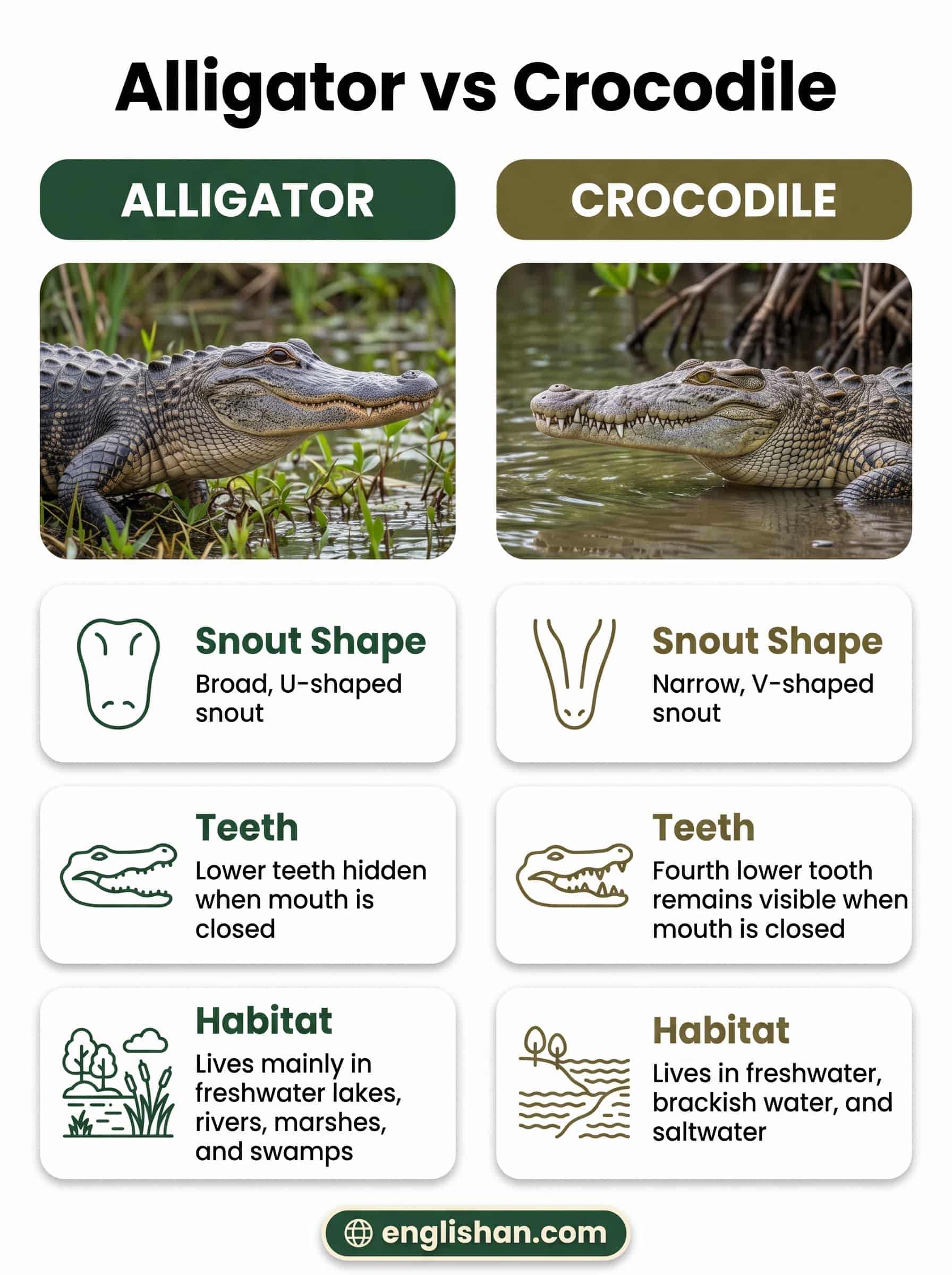
Detailed Differences Between Alligators and Crocodiles
Snout Shape
The single most reliable way to identify an alligator versus a crocodile is snout shape.
The alligator snout is broad, rounded, and shaped like the letter U. This wider shape distributes bite force across a larger surface area, giving alligators a crushing bite well suited to breaking through the hard shells of turtles, one of their favorite prey items.
The crocodile snout is narrower and more tapered, shaped like the letter V. This design is lighter and quicker to snap shut, making it more efficient for catching fast moving prey such as fish.
Teeth and Jaw Line
When an alligator closes its mouth, the upper jaw is wider than the lower jaw, so the lower teeth slot into sockets in the upper jaw and are almost completely hidden from view.
When a crocodile closes its mouth, the upper and lower jaws are nearly the same width, so the fourth tooth on the lower jaw remains visible, sticking out over the upper lip even with the mouth fully shut. This exposed tooth is one of the fastest visual cues experts use to identify a crocodile.
Color and Camouflage
Alligators are typically dark blackish grey or nearly black, a coloring that helps them blend into the murky, tannin stained freshwater swamps and marshes they call home.
Crocodiles tend to be lighter, ranging from olive green to greyish brown or sandy tan, often patterned with dark blotches or banding. This lighter coloring works well for blending into the sandy riverbanks, estuaries, and coastal waters that many crocodile species inhabit.
Habitat Preferences
Alligators strongly prefer freshwater environments such as swamps, marshes, rivers, and lakes, and they are more cold tolerant than crocodiles, allowing them to survive in temperate climates and even brumate, a reptilian form of dormancy, during colder months.
Crocodiles are far more habitat flexible. Many species have specialized glands on their tongue that excrete excess salt, allowing them to tolerate brackish and even full saltwater environments. This is why crocodiles are regularly seen in coastal estuaries, mangrove swamps, and occasionally far out at sea.
Geographic Range
Alligators have an extremely limited natural range. There are only two living species:
- The American alligator, found throughout the southeastern United States, especially Florida and Louisiana.
- The Chinese alligator, a smaller, critically endangered species restricted to the Yangtze River basin in eastern China.
Crocodiles are far more widespread, with somewhere between 14 and 17 recognized species depending on classification. They are found across sub-Saharan Africa, South and Southeast Asia, northern Australia, and Central and South America.
Size
Size varies a great deal depending on species, but here is a general comparison:
- American alligator: Typically 10 to 15 feet long, with large males occasionally exceeding this.
- Saltwater crocodile (the largest living reptile): Can reach over 20 feet in exceptional cases, with mature males commonly reaching 14 to 17 feet.
- Nile crocodile: Often 11 to 16 feet long.
As a general rule, the largest crocodile species outgrow the largest alligator species, though there is overlap depending on which specific species you compare.
Behavior and Temperament
Crocodiles have a reputation for being more aggressive than alligators, and there is truth to this. Species such as the saltwater crocodile and Nile crocodile are considered highly dangerous and have been responsible for a significant number of attacks on humans and livestock.
Alligators are generally more reserved. They tend to avoid humans and will usually retreat rather than confront a person unless they feel cornered, are protecting a nest, or have become habituated to human presence through feeding.
That said, both animals are wild predators and should never be approached, fed, or provoked.
Bite Force
Both animals have among the strongest bites in the animal kingdom, but crocodiles generally edge out alligators.
Studies have measured the bite force of large saltwater crocodiles at over 3,700 pounds per square inch, one of the strongest bites ever recorded in a living animal. American alligators have been measured at around 2,000 to 2,900 pounds per square inch, still extraordinarily powerful, but typically lower than the largest crocodile species.
Nesting Style
Alligators typically build mound nests from vegetation, mud, and soil. As the plant material decomposes, it generates heat that helps incubate the eggs.
Crocodiles use a mix of strategies depending on species. Some build mound nests similar to alligators, while others dig hole nests directly into sandy riverbanks or beaches. In both alligators and crocodiles, incubation temperature determines the sex of the hatchlings, a process known as temperature dependent sex determination.
Sensory Pits
Crocodile skin, especially along the jawline, is covered in small dark pits called integumentary sensory organs. These pits detect tiny changes in water pressure and vibration, allowing crocodiles to sense prey even in total darkness or murky water.
Alligators have similar organs, but they are concentrated mainly around the jaw rather than spread across the entire body as they are in most crocodile species.
Evolutionary Family
Alligators and crocodiles both belong to the order Crocodilia, but they diverged into separate families tens of millions of years ago. Alligators, along with caimans, belong to the family Alligatoridae. True crocodiles belong to the family Crocodylidae. This means an alligator is actually more closely related to a caiman than it is to a crocodile, despite the strong outward resemblance between alligators and crocodiles.
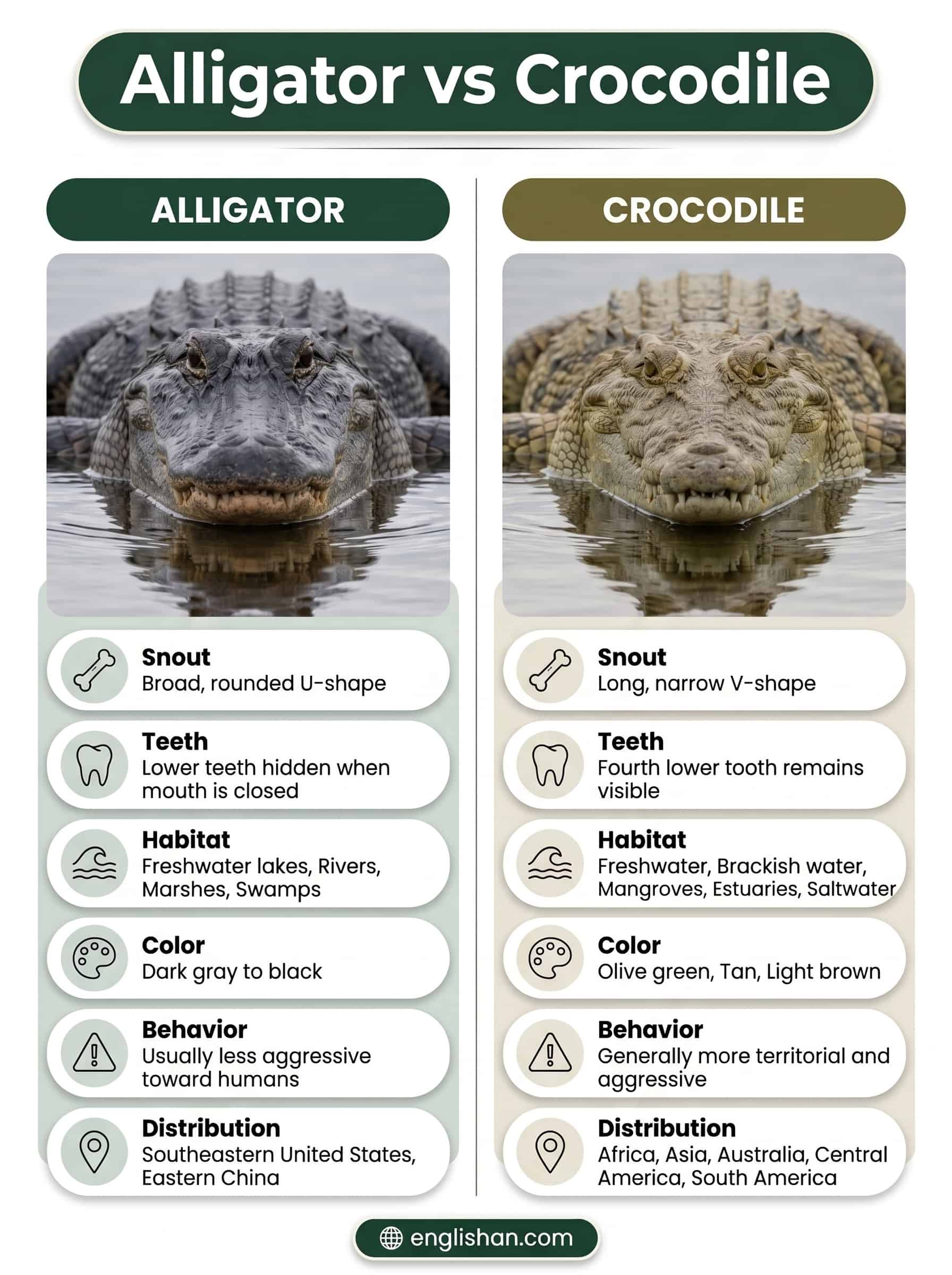
Alligator vs Crocodile Comparison Table
| Feature | Alligator | Crocodile |
|---|---|---|
| Snout shape | Wide, U shaped | Narrow, V shaped |
| Visible teeth when mouth closed | No, lower teeth hidden | Yes, fourth tooth visible |
| Typical color | Dark blackish grey | Olive green to tan |
| Habitat | Freshwater | Freshwater, saltwater, brackish |
| Salt gland | Absent or non-functional | Present and functional |
| Range | United States, China | Africa, Asia, Australia, Americas |
| Number of species | 2 | Around 14 to 17 |
| Cold tolerance | Higher | Lower |
| Temperament | Generally less aggressive | Generally more aggressive |
| Bite force | Very strong | Among the strongest recorded |
| Family | Alligatoridae | Crocodylidae |
A Closer Look at Alligators

- Species of Alligator: Only two species exist. The American alligator lives throughout the southeastern United States, especially Florida and Louisiana, and was removed from the endangered species list in 1987 after a major conservation comeback. The Chinese alligator is smaller, rarely exceeding 7 feet, found only in China’s Yangtze River basin, and remains critically endangered with just a few hundred left in the wild.
- Physical Characteristics: Alligators have thick, muscular bodies and a broad snout with 74 to 80 teeth, replaced continuously throughout life. Their eyes and nostrils sit high on the head, letting them stay almost fully submerged while still seeing and breathing.
- Diet and Hunting Style: Juveniles eat insects, small fish, and amphibians. Adults eat fish, turtles, birds, mammals, and occasionally other alligators. Their wide jaws crush turtle shells easily. They hunt by ambush, staying motionless before striking.
- Behavior and Social Structure: Mostly solitary, though they tolerate each other at shared basking or feeding spots. Males become territorial during breeding season and produce a loud, deep bellow to attract mates and warn off rivals.
- Reproduction: Females build mound nests from vegetation and mud, laying 20 to 50 eggs. They guard the nest for about 65 days and protect hatchlings for up to two years after birth.
- Lifespan: 35 to 50 years in the wild, sometimes past 70 in captivity.
- Conservation Status: American alligator: Least Concern. Chinese alligator: Critically Endangered, with active breeding and reintroduction programs underway.
A Closer Look at Crocodiles
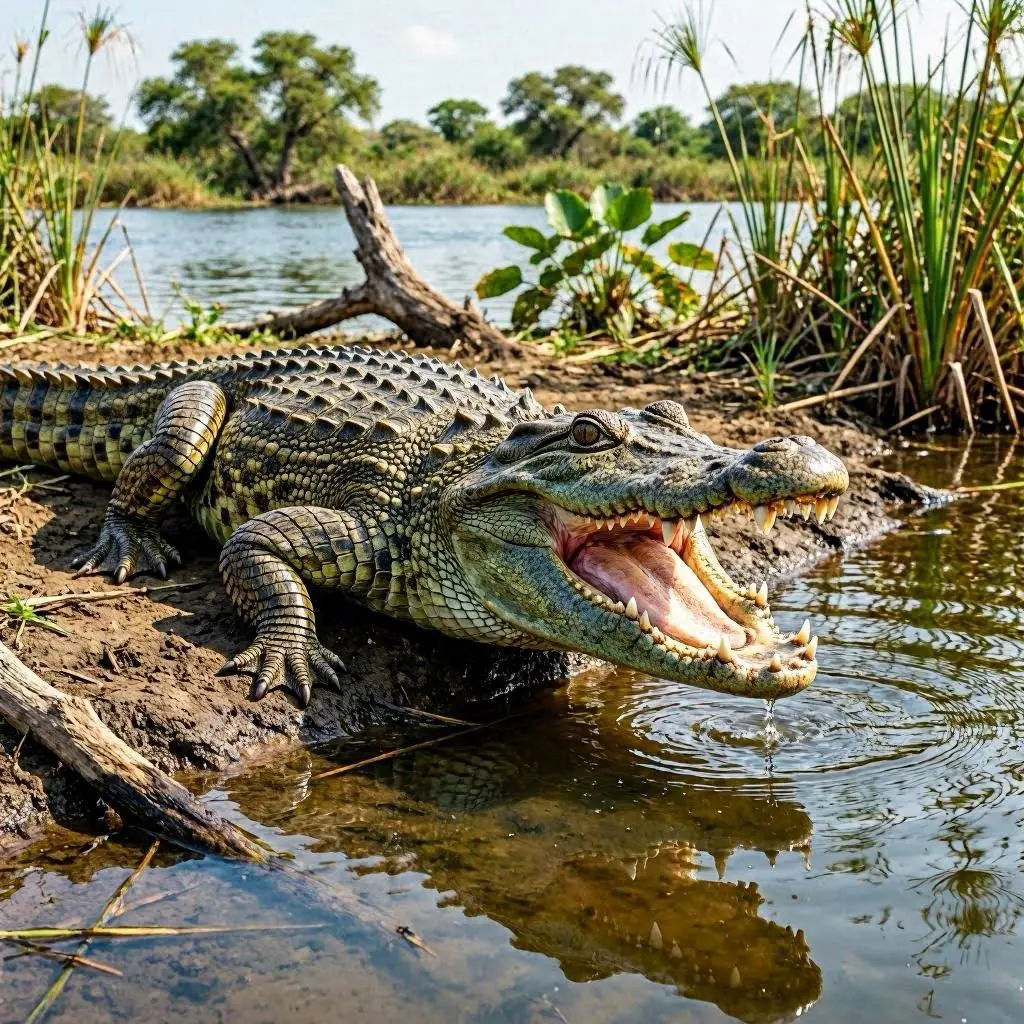
- Species of Crocodile: Between 14 and 17 species exist, depending on classification. The saltwater crocodile is the largest living reptile on Earth, found across India, Southeast Asia, and northern Australia, known for its size, aggression, and long ocean crossings. The Nile crocodile lives throughout sub-Saharan Africa and is responsible for a significant share of human attacks each year. The American crocodile lives in Florida, the Caribbean, Central America, and northern South America, and is generally shyer around people. Australia’s freshwater crocodile is smaller, mostly fish eating, and poses little threat to humans. The mugger crocodile of the Indian subcontinent has an unusually broad, alligator like snout.
- Physical Characteristics: Crocodiles have longer, narrower snouts than alligators and 60 to 68 teeth on average, continuously replaced throughout life. Bony scutes cover the skin, and sensory pits, especially around the jaw, detect vibrations in water. A powerful, flattened tail makes them fast, efficient swimmers.
- Diet and Hunting Style: Smaller species eat fish and crustaceans. Larger species, like the Nile crocodile, can take down wildebeest, zebra, and young hippos. They hunt by ambush and often use a death roll to disorient and dismember prey.
- Behavior and Social Structure: Behavior varies by species. Nile crocodiles tolerate close contact at food rich gathering spots like river crossings. Saltwater crocodiles, especially large males, are solitary and highly territorial.
- Reproduction: Some species build mound nests, others dig into riverbanks. Clutch sizes range from about 10 to over 90 eggs. Mothers typically guard nests closely and often carry hatchlings to water.
- Lifespan: 50 to 70 years in the wild, sometimes past 100 in captivity.
- Conservation Status: Saltwater and Nile crocodiles are Least Concern. The Philippine, Cuban, and Orinoco crocodiles are Critically Endangered due to habitat loss, hunting, and illegal trade.
Similarities Between Alligators and Crocodiles
Despite all the differences above, alligators and crocodiles share far more in common than most people realize, which is exactly why they get confused so often. Here are the key traits they share.
Shared ancestry: Both belong to the order Crocodilia, along with caimans and gharials, and trace back to a common ancestor that lived tens of millions of years ago alongside the dinosaurs.
Semi-aquatic lifestyle: Both spend the majority of their lives in or near water, relying on it for hunting, temperature regulation, and escape from predators, while still being fully capable of moving on land when needed.
Cold-blooded physiology: Both are ectotherms, meaning they rely on external sources like sunlight to regulate their body temperature, which is why both species are frequently seen basking on riverbanks and logs.
Ambush predators: Both hunt using the same basic strategy, lying motionless and nearly invisible in water before launching an explosive, high speed strike at unsuspecting prey.
Armored skin: Both have thick, bony plated skin covered in scutes that acts as natural armor against predators and rival males during territorial disputes.
Continuous tooth replacement: Both alligators and crocodiles shed and regrow teeth throughout their entire lives, going through thousands of teeth over a lifetime rather than having a single permanent set.
Egg laying and nest guarding: Both lay eggs on land and display unusually high parental care for reptiles, with females guarding nests and, in many species, actively helping hatchlings reach water after birth.
Temperature dependent sex determination: In both groups, the incubation temperature of the nest determines whether hatchlings develop as male or female, rather than sex being fixed genetically at fertilization.
Long lifespans: Both alligators and crocodiles are long lived animals, commonly reaching 35 to 70 years or more in the wild, far exceeding the lifespan of most other reptiles.
Apex predator status: Both sit at or near the top of their respective food chains, with few natural predators once they reach adulthood, aside from humans and, occasionally, other large crocodilians.
Powerful bite, weak jaw opening muscles: Both have an extraordinarily strong bite force used to clamp down on prey, but comparatively weak muscles for opening the jaw, which is why a person can often hold an adult alligator or crocodile’s mouth shut with surprising ease, though this should never be attempted without professional training.
Alligator vs Crocodile Attacks on Humans
Crocodile attacks on humans are significantly more frequent and more often fatal than alligator attacks, largely due to the aggressive nature and large size of species like the Nile crocodile and saltwater crocodile, both of which are responsible for dozens to hundreds of reported attacks annually across Africa, Asia, and Australia. American alligator attacks are far less common and rarely fatal, with the United States averaging a small number of serious incidents per year, most of which involve people swimming in known alligator habitats or pets and small children near the water’s edge.
Where Alligators and Crocodiles Overlap
In most of the world, alligator and crocodile ranges never overlap, since their habitat preferences differ so significantly. However, there is one famous exception: South Florida, particularly the Everglades, is the only place on Earth where American alligators and American crocodiles naturally coexist in the wild. The brackish coastal waters suit crocodiles, while the freshwater interior suits alligators, allowing both species to share the same broader ecosystem without directly competing for the same territory.
How to Identify One From a Distance
If you spot one in the wild and cannot get close enough to check the snout or teeth, a few general clues can help. Location is often the biggest hint. If you are in the southeastern United States away from brackish coastal water, it is almost certainly an alligator. If you are in Africa, Asia, Australia, or a coastal saltwater area, it is more likely a crocodile. Overall body color can also help from a distance, since alligators tend to look darker and blend into murky freshwater, while crocodiles often appear lighter and more olive or tan toned.
Can You Keep Alligators or Crocodiles as Pets?
In most places, no, and it is generally not recommended even where legally permitted. Both animals grow extremely large, require highly specialized enclosures, and pose serious safety risks as they mature. Some jurisdictions in the United States allow licensed ownership of smaller crocodilian species under strict permitting requirements, but wildlife experts strongly discourage keeping either alligators or crocodiles as pets due to the danger and the specialized, expensive care they require throughout their multi decade lifespans.
Common Myths About Alligators and Crocodiles
Myth 1: Alligators and crocodiles are the same species. False. They belong to entirely separate families within the order Crocodilia and have distinct physical and behavioral traits.
Myth 2: All crocodiles are more dangerous than all alligators. Not entirely accurate. While species like the saltwater and Nile crocodile are extremely dangerous, other crocodile species, such as the freshwater crocodile of Australia, pose little threat to humans and are considerably less aggressive than commonly assumed.
Myth 3: Alligators can outrun a human on land over long distances. False. While alligators can move quickly in short bursts, they cannot sustain high speed over distance and tire quickly on land.
Alligator vs Crocodile: Which Is Bigger, Faster, and Smarter?
On average, crocodiles are bigger. The saltwater crocodile is the largest living reptile on Earth, with mature males regularly reaching 14 to 17 feet and exceptional individuals surpassing 20 feet and 2,000 pounds. The American alligator, the largest alligator species, typically tops out around 13 to 15 feet, with the largest verified individuals approaching 1,000 pounds. So while some alligators are genuinely massive, the upper size ceiling clearly belongs to crocodiles, specifically the saltwater species.
In water, both are strong swimmers capable of short bursts around 15 to 20 miles per hour, powered by their large, muscular tails. On land, alligators and crocodiles both rely mainly on a slow, belly dragging walk, but both are capable of a much faster movement called the high walk, where the body lifts off the ground, and in short bursts some individuals of both species have been observed reaching speeds of 10 to 11 miles per hour. Neither animal can sustain high speed on land for long distances, and both tire quickly outside of water.
Both alligators and crocodiles show more complex behavior than most people expect from reptiles. Researchers have documented tool use in some crocodilians, including balancing sticks on their snouts to lure nest building birds within striking range. Crocodiles, with their larger and more varied prey base, are often considered slightly more behaviorally flexible and better at coordinated hunting strategies, but both animals demonstrate strong memory, spatial awareness, and the ability to learn from repeated experiences.
Do Alligators and Crocodiles Attack Boats?
Both animals can bump or bite boats, though true attacks are uncommon and usually defensive rather than predatory. This behavior is more frequently reported with large, territorial crocodiles, particularly saltwater and Nile crocodiles defending territory during breeding season, or in situations where animals have become habituated to human feeding and associate boats with an easy meal.
Symbolism and Cultural Significance
Alligators and crocodiles have held cultural significance across many civilizations. In ancient Egypt, the crocodile was associated with the god Sobek, representing both the danger of the Nile River and the fertility it provided. In the southeastern United States, the American alligator is a prominent regional symbol, appearing in state emblems, sports team mascots, and local folklore. In parts of Africa, Asia, and Australia, crocodiles continue to feature prominently in indigenous mythology, often representing primal power, transformation, or the boundary between the human and natural worlds.
Final Thoughts
While alligators and crocodiles share a common evolutionary origin and a similar overall body plan, they are shaped by millions of years of separate adaptation. The fastest way to tell them apart is still the simplest: check the snout. A wide, rounded U shape signals alligator. A narrow, pointed V shape with a visible bottom tooth signals crocodile. From there, habitat, geography, size, and temperament fill in the rest of the picture, revealing two remarkable predators that, despite their similarities, have taken very different evolutionary paths.
FAQs
Generally speaking, crocodiles, particularly the saltwater and Nile species, are considered more dangerous to humans due to their aggression, size, and willingness to attack without provocation. American alligators are less aggressive but can still be dangerous, especially if approached, cornered, or fed by humans.
Not reliably. While the largest crocodile species tend to outsize the largest alligator species, there is enough overlap between individual animals that snout shape and visible teeth remain far more reliable identification methods.
Both are opportunistic carnivores that eat fish, birds, mammals, and other reptiles. Alligators, with their broader jaws, are especially well suited to crushing turtle shells, while some large crocodile species are capable of taking down much larger prey, including young hippos and wildebeest.
Both can live several decades in the wild, typically 35 to 70 years depending on species, and some individuals in captivity, particularly crocodiles, have lived past 100 years.
This unusual distribution is largely a result of evolutionary history and climate adaptation. Alligators evolved a higher tolerance for cooler temperatures than crocodiles, allowing them to survive in temperate wetland regions where most crocodile species cannot.
You May Also Like
- Difference Between Reptiles and Amphibians:
- Herbivores vs Carnivores vs Omnivores
- 50+ Nocturnal Animals Names with Pictures
Alligator vs Crocodile Quiz
Alligator vs Crocodile
Which one has a broad, rounded, U-shaped snout?
The wide snout suits crushing turtle shells and hard-bodied prey.
U-shaped snout means alligator; V-shaped means crocodile.
That broad U of a snout marks it as an alligator.
With the mouth shut, which one still shows a large lower tooth on each side?
The enlarged fourth lower tooth sits outside the upper jaw and stays visible.
Teeth showing when closed means crocodile.
Two lower teeth stayed visible, so a crocodile.
Which one copes better with saltwater?
Working salt glands on the tongue let crocodiles cross estuaries and open sea.
Salt glands are the reason crocodiles turn up on coasts.
Only the crocodile can hunt in brackish water for long.
Complete the sentence with the group name.
Alligators, crocodiles, caimans and gharials belong to the order ___.
Crocodilia covers all four families of living crocodilians.
Crocodilia is the order; alligator and crocodile are families within it.
Every crocodilian shares the same armoured skin and four-chambered heart.
Which one is generally darker, closer to blackish grey?
Alligators run dark, which suits the tannin-stained water they favour.
Dark suggests alligator; pale olive suggests crocodile.
The near-black back pointed to an alligator.
How many alligator species exist?
Only the American and Chinese alligators survive, and the Chinese one is critically endangered.
Alligators are a small group; crocodiles are far more diverse.
Two alligator species remain, one in America and one in China.
Turn on JavaScript for the interactive quiz. The full practice set is shown above.