Animals and Their Body Parts names are specially adapted to help them move, eat, breathe, sense their surroundings, and survive in different environments. While many animals share basic body parts with humans, such as eyes, ears, legs, and noses, they also have unique features like trunks, tusks, gills, shells, wings, and fins that humans do not have.
Learning animals and their body parts names is valuable for kids, ESL learners, students, teachers, and anyone looking to expand their English vocabulary. In this article, you’ll explore the body parts of common animals, learn the name of each body part, understand its function, and discover how it helps the animal survive and thrive in its habitat.
Why Learning Animal Body Parts Matters?
Every animal body part exists for a reason. It has developed over time to help that animal survive in its specific habitat. Wings help birds fly to escape danger and find food. Gills let fish pull oxygen out of water instead of air. Hooves let horses run across hard, rocky ground without hurting their feet. When you learn a body part, you are really learning how that animal survives.
Below, we break down the full set of body parts of animals, from common pets and farm animals to birds, reptiles, and insects.
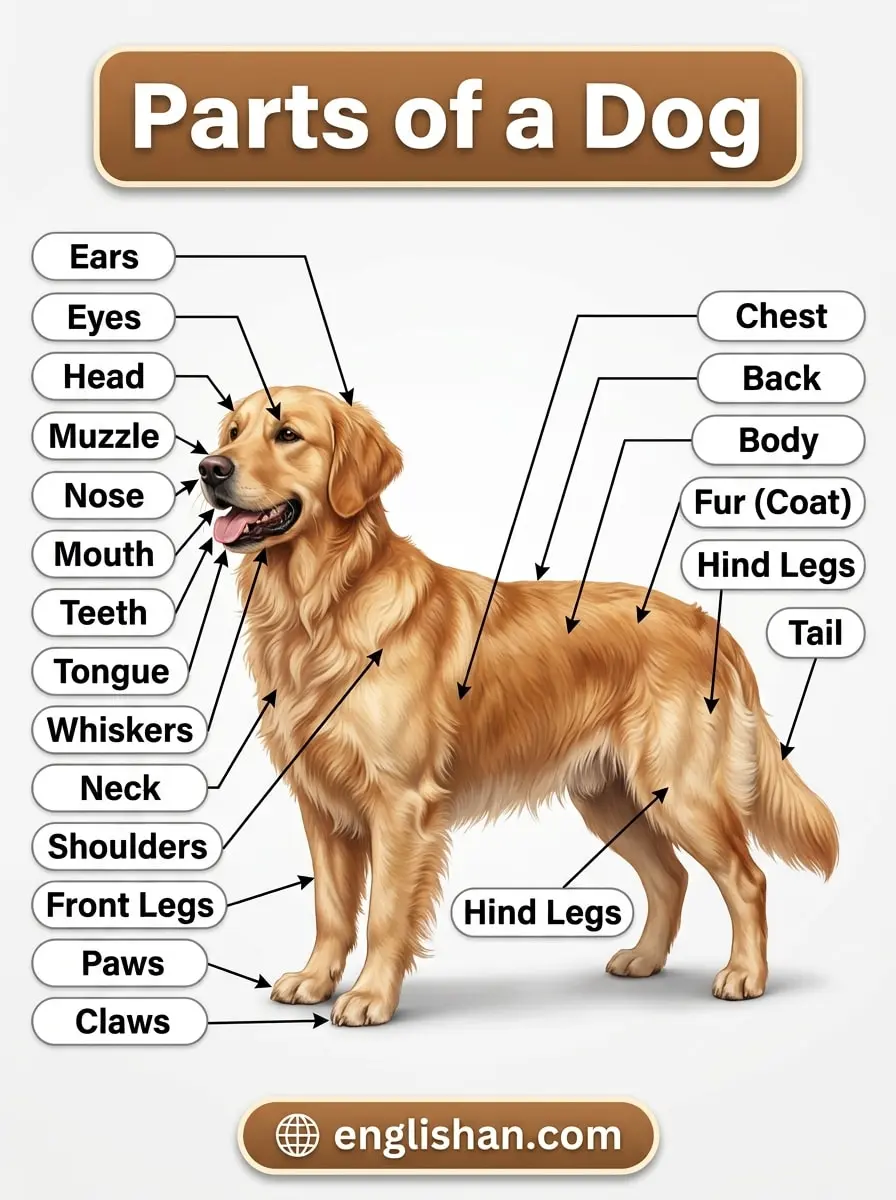
Parts of a Dog
- Head: Contains the brain and most sensory organs, including the eyes, ears, and nose. It is the control center for everything the dog does.
- Muzzle/Snout: The nose and mouth area. Dogs rely heavily on smell, and the snout houses a nose with far more scent receptors than a human nose.
- Nose: The tip of the snout, usually moist, which helps the dog absorb and process scent particles from the air.
- Eyes: Provide vision, though dogs see fewer colors than humans and rely more on movement and low light detection.
- Ears: Used for hearing. Dogs hear a wider range of frequencies than humans, and ear shape varies from floppy to upright depending on breed.
- Whiskers: Stiff hairs near the muzzle and above the eyes that help the dog sense nearby objects, especially in low light.
- Teeth: Used for chewing, tearing food, and gripping objects. Dogs have sharp canine teeth for tearing and flatter molars for grinding.
- Tongue: Used for tasting, drinking, and regulating body temperature through panting, since dogs do not sweat like humans.
- Neck: Connects the head to the body and allows the dog to turn and lower its head.
- Shoulders: Support the front legs and allow a wide range of movement for running and jumping.
- Chest: Houses the heart and lungs, protected by the ribcage.
- Back: Runs along the spine and supports the overall posture and movement of the body.
- Front Legs: Used for walking, running, and digging, along with bearing much of the dog’s weight.
- Hind Legs: Provide the main power for running and jumping, generating propulsion from the rear.
- Paws: Padded feet with claws, used for walking and gripping surfaces.
- Claws (Nails): Hard growths on each toe used for traction and digging.
- Paw Pads: Thick, cushioned skin on the bottom of the paws that absorbs shock and protects against rough ground.
- Dewclaw: A small, higher claw on the inner leg that does not touch the ground, sometimes used for gripping objects.
- Tail: Used for balance while running or jumping, and also for communicating mood through wagging or tucking.
- Fur/Coat: Covers the skin, providing insulation and protection from sun and minor scrapes.
- Skin: Lies beneath the fur and contains sweat glands mainly in the paw pads.
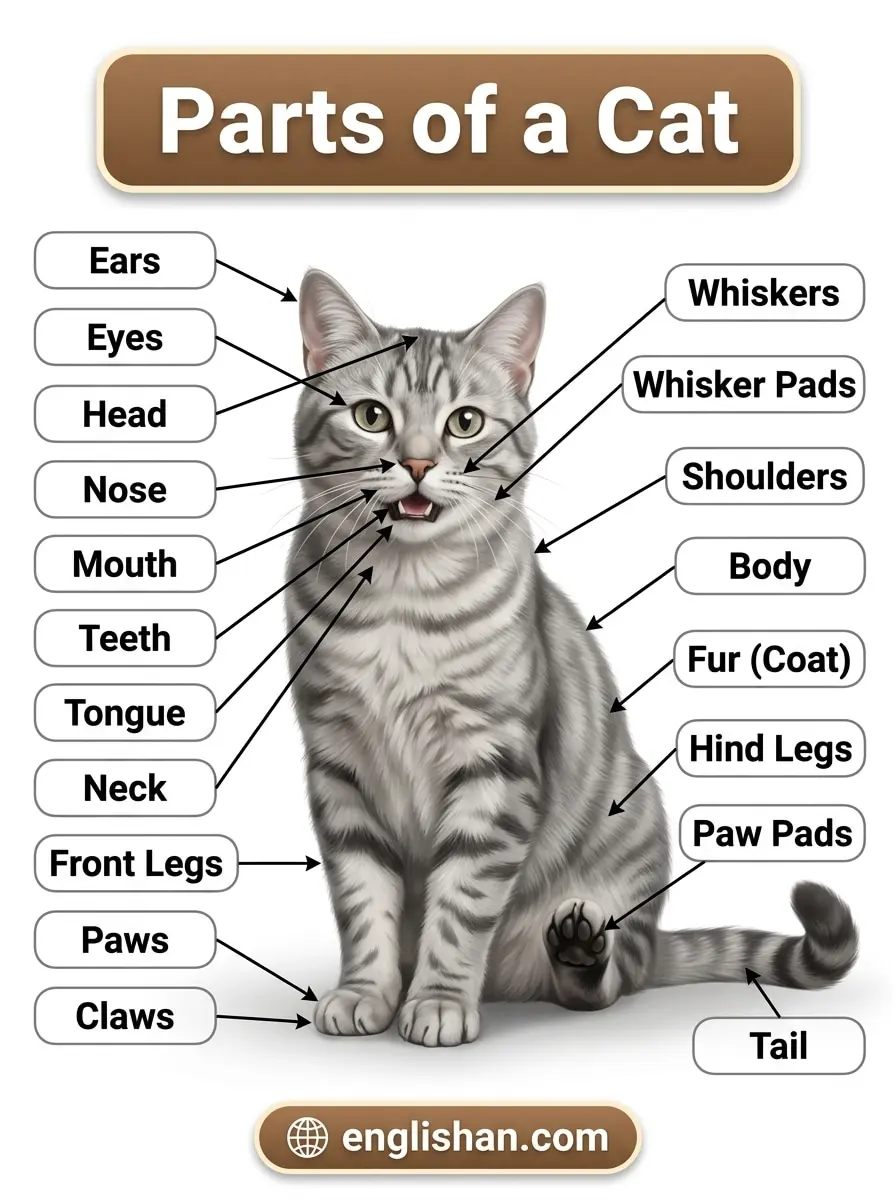
Parts of a Cat
- Head: Houses the brain and major sense organs.
- Whiskers: Long, sensitive hairs on the face that detect changes in air movement, helping the cat sense objects in the dark.
- Eyes: Adapted for excellent night vision, with a reflective layer that helps the cat see in low light.
- Ears: Highly mobile and able to rotate toward sound, helping the cat pinpoint where a noise is coming from.
- Nose: Used for smelling and identifying scents, including marking territory.
- Mouth: Contains sharp teeth suited for a purely carnivorous diet.
- Teeth: Include long canine teeth for gripping prey and sharp molars for cutting meat.
- Tongue: Covered in tiny backward-facing barbs called papillae, used for grooming fur and scraping meat from bones.
- Neck: Connects the head to the body and allows quick turning while hunting.
- Shoulders: Flexible joints that allow the cat’s front legs to rotate more freely than a dog’s, aiding in climbing.
- Front Legs: Used for walking, climbing, and striking prey.
- Hind Legs: Powerful and muscular, giving cats the ability to jump several times their own body length.
- Paws: Soft, padded feet that allow near silent movement.
- Claws: Sharp and retractable, kept sheathed when not in use to stay sharp for climbing and hunting.
- Paw Pads: Cushioned pads that absorb shock and help with grip.
- Whisker Pads: The area on the muzzle where the whiskers are rooted.
- Tail: Acts as a counterbalance, helping the cat stay steady while jumping or walking on narrow surfaces.
- Fur/Coat: Provides insulation and protection, and can also stand up (piloerection) when the cat feels threatened.
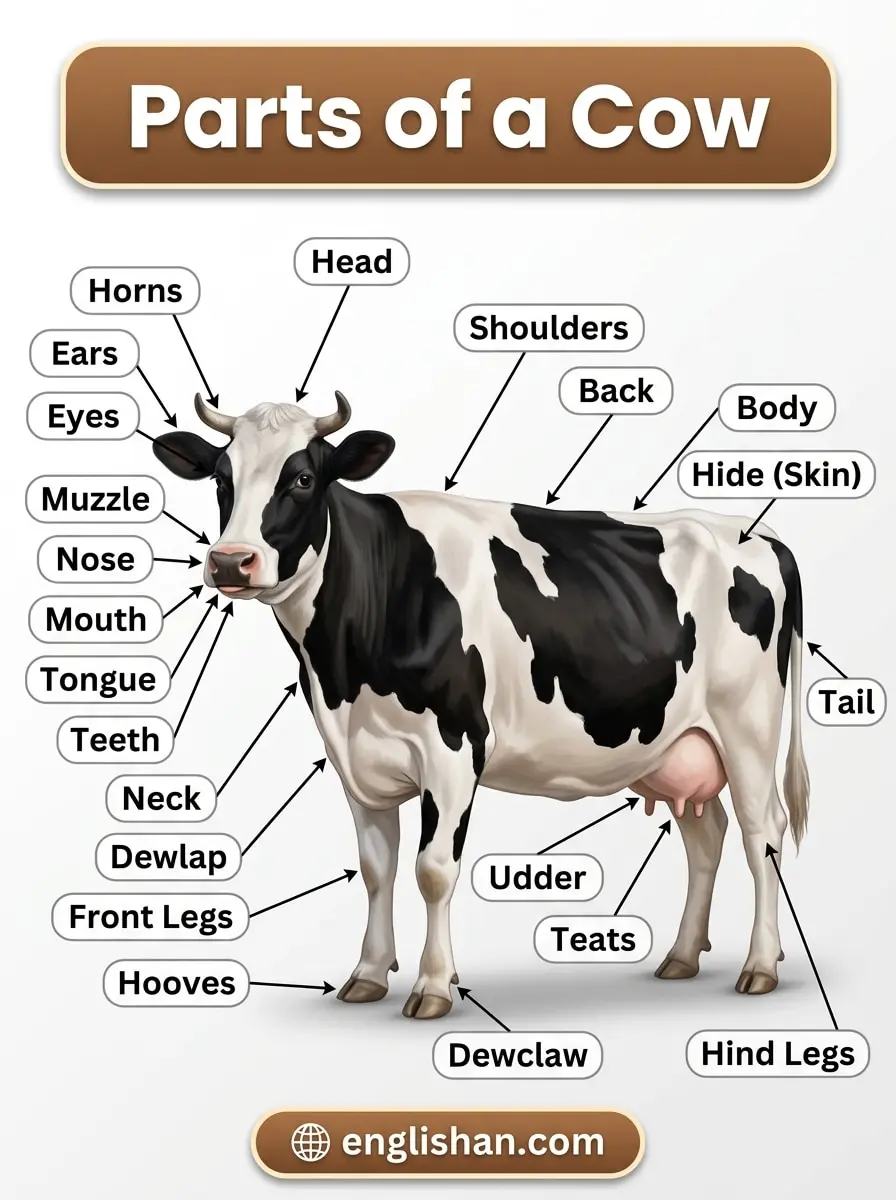
Parts of a Cow
- Head: Supports the horns, eyes, ears, and muzzle.
- Horns: Hard, permanent growths on the head used for defense and for establishing dominance within a herd.
- Muzzle: The nose and mouth area, moist and highly sensitive to smell.
- Eyes: Positioned on the sides of the head, giving cows a wide field of vision to watch for predators.
- Ears: Used for hearing and can rotate slightly to detect the direction of sound.
- Mouth: Contains a tongue and teeth suited for grazing on grass.
- Tongue: Long and rough, used to pull grass into the mouth.
- Teeth: Cows have no upper front teeth, only a hard dental pad, paired with lower incisors for cutting grass.
- Neck: Long and flexible, allowing the cow to lower its head to graze.
- Dewlap: The loose fold of skin hanging under the neck, which helps release body heat.
- Shoulders: Support the front legs and connect to the back through the spine.
- Back: Supports the body weight and connects the front and hind legs.
- Udder: The organ that produces and stores milk, used to feed the calf.
- Teats: Four tube-like structures on the udder through which milk is released.
- Front Legs: Support much of the body’s weight while standing and walking.
- Hind Legs: Provide power for walking and kicking.
- Hooves: Tough, hard coverings on the feet that protect the toes on rough ground.
- Dewclaw: A small extra toe above the hoof that can help with grip on soft or muddy ground.
- Tail: A long, thin tail ending in a tuft of hair, used mainly to swat away flies and insects.
- Hide (Skin): The tough outer skin, often used to make leather.
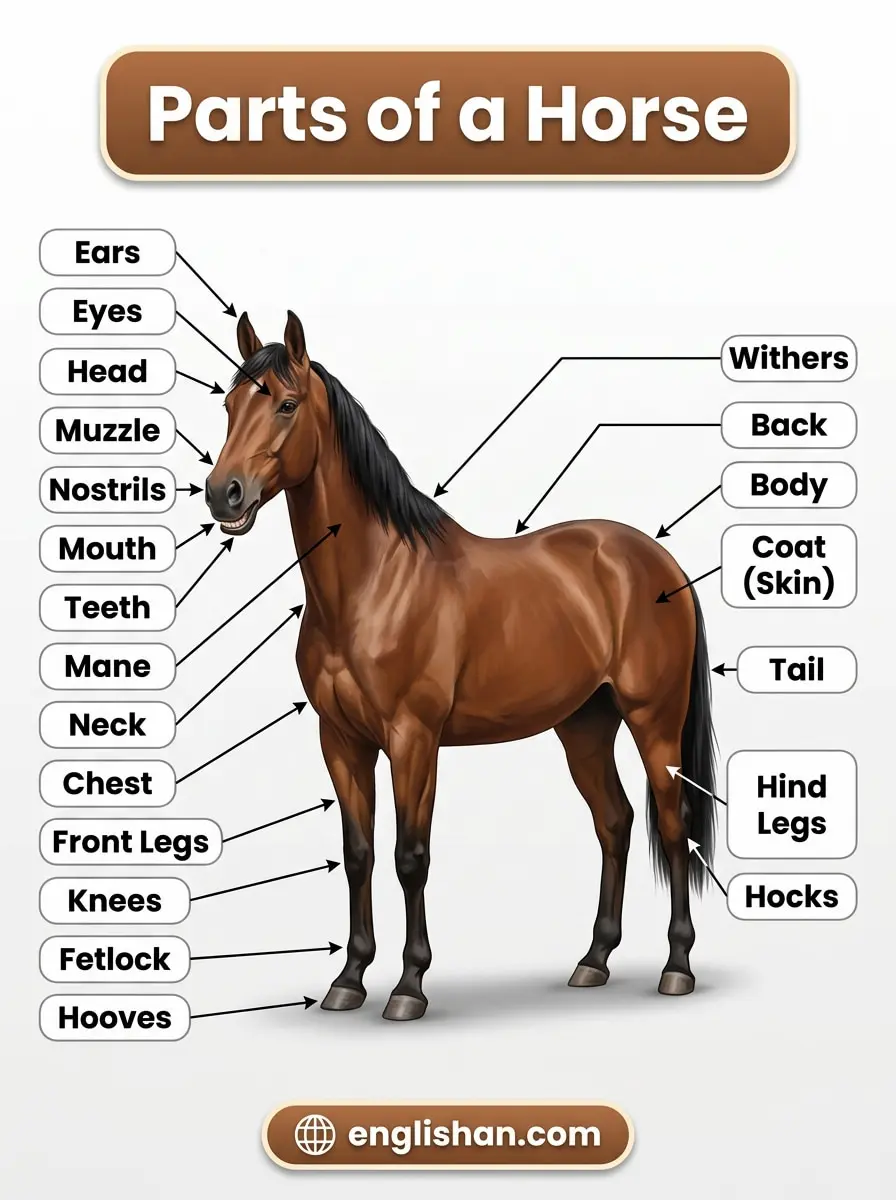
Parts of a Horse
- Head: Supports the eyes, ears, muzzle, and mouth.
- Ears: Highly mobile and used to detect sound direction, often reflecting the horse’s mood.
- Eyes: Positioned on the sides of the head, giving horses a very wide field of vision.
- Muzzle: The nose and mouth area, used for eating, drinking, and exploring objects.
- Nostrils: Large openings that allow the horse to take in a large amount of air quickly during exercise.
- Mouth: Contains teeth and a tongue suited for grazing.
- Teeth: Continuously growing and used for grinding tough grasses and grains.
- Mane: Long hair growing along the top of the neck, which can protect against insects and sun.
- Neck: Long and muscular, helping the horse balance its head while running.
- Withers: The ridge between the shoulder blades, used as a reference point for measuring the horse’s height.
- Back: Supports the rider’s weight if the horse is used for riding.
- Chest: Houses the heart and lungs, key to the horse’s stamina.
- Front Legs: Bear a large portion of the horse’s weight and absorb impact while running.
- Hind Legs: Provide the main propulsion for running and jumping.
- Knees and Hocks: Joints in the front and hind legs that allow flexible movement.
- Hooves: Hard, single-toed coverings that protect the feet and absorb shock.
- Fetlock: The joint located just above the hoof, similar in position to an ankle.
- Tail: Long, thick hair used to swat insects and signal mood.
- Coat/Skin: Covers the body, providing protection and helping regulate temperature.
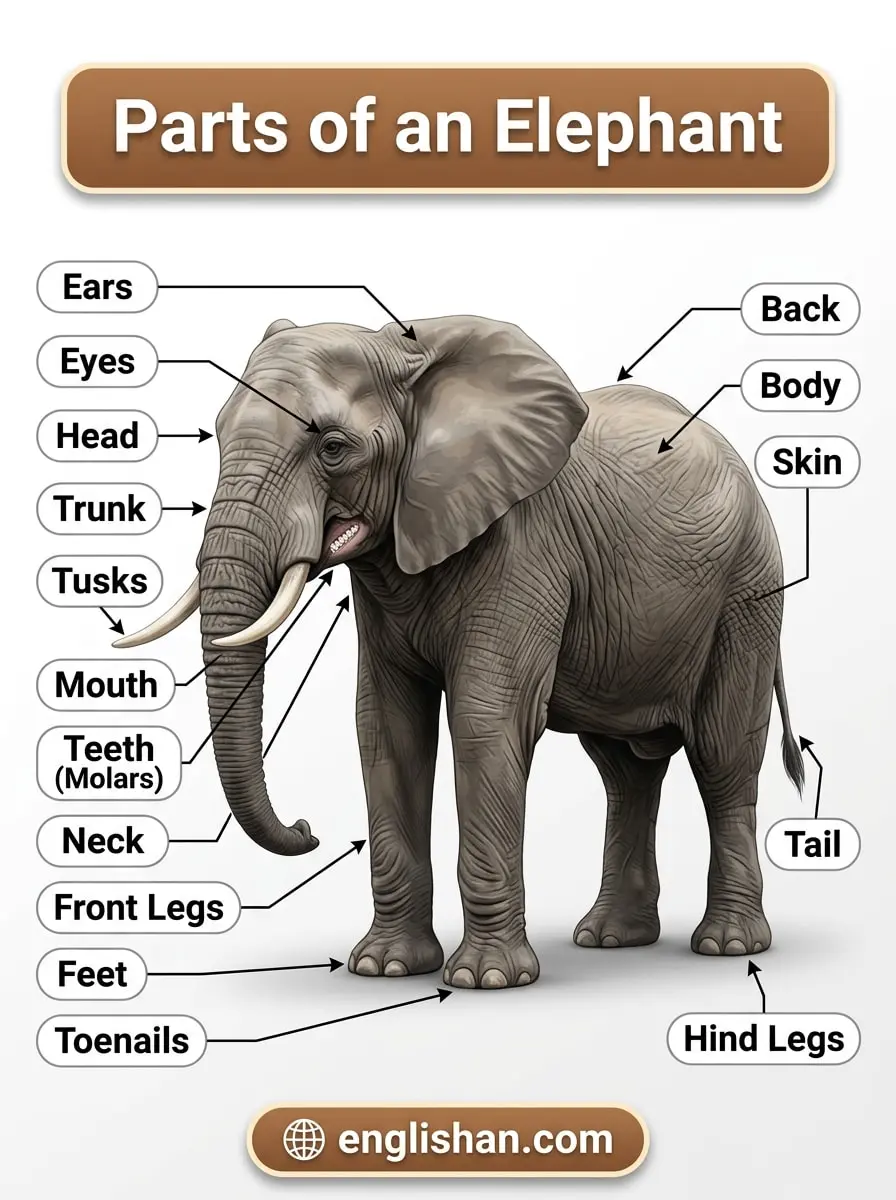
Parts of an Elephant
- Head: Large and supports the tusks, trunk, ears, and eyes.
- Trunk: A long, muscular extension of the nose and upper lip, used for breathing, smelling, drinking, grabbing food, and touching other elephants.
- Tusks: Long, pointed teeth that grow continuously throughout life, used for digging, stripping bark, and defense.
- Ears: Very large, thin flaps filled with blood vessels, used to release excess body heat by flapping.
- Eyes: Relatively small compared to the size of the head, with limited color vision.
- Mouth: Located beneath the trunk, containing large flat teeth used for grinding plant matter.
- Teeth (Molars): Massive, ridged teeth used to grind tough vegetation, replaced several times over the elephant’s life.
- Neck: Short and thick, supporting the heavy head and trunk.
- Back: Broad and strong, supporting the body’s large frame.
- Legs: Thick and column-like, built to support the elephant’s massive body weight.
- Feet: Large and round, with a cushioned pad that helps absorb the impact of each step.
- Toenails: Small, flattened nails on each foot.
- Tail: Long and thin with a tuft of coarse hair at the end, used mostly to swat insects.
- Skin: Thick and wrinkled, helping to retain moisture and regulate body temperature.
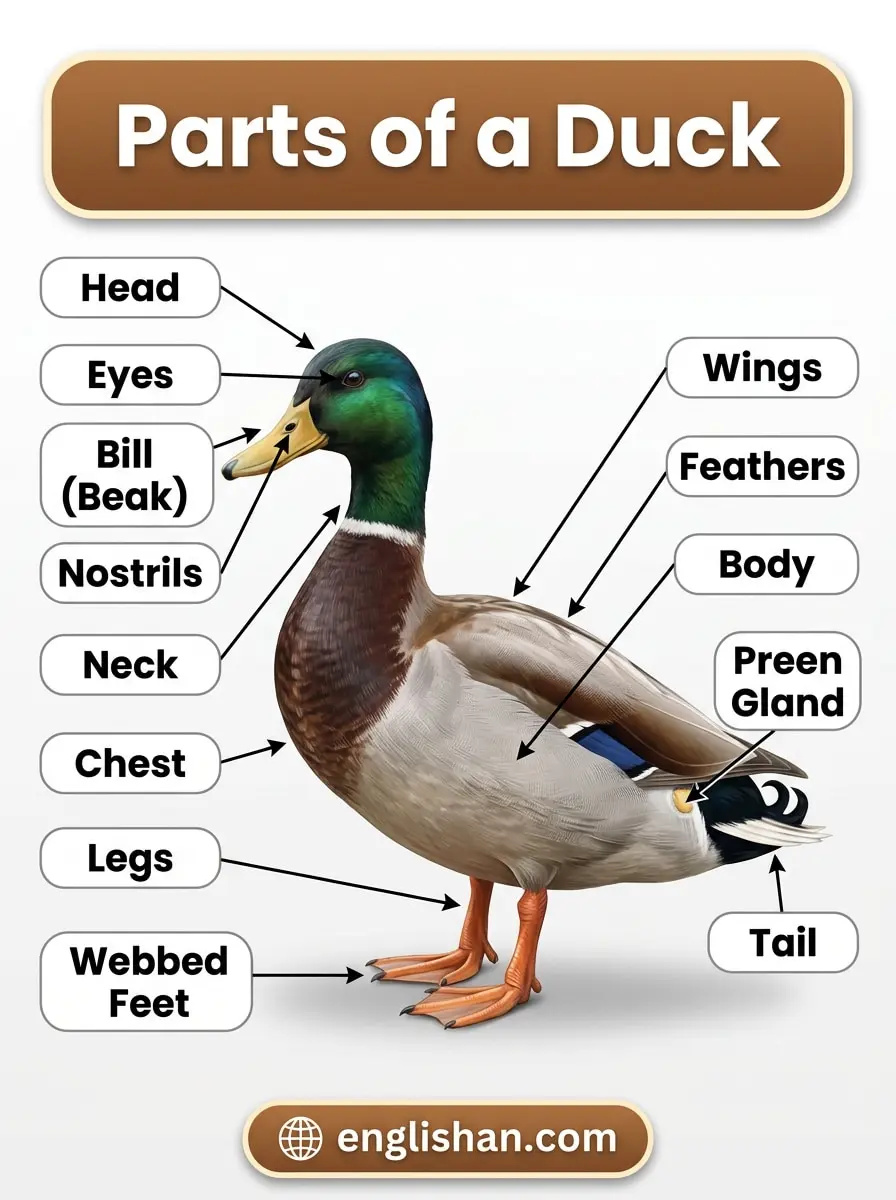
Parts of a Duck
- Head: Supports the eyes and bill.
- Bill (Beak): Flat and rounded, with comb-like ridges inside called lamellae, used to filter food out of water and mud.
- Eyes: Positioned on the sides of the head for a wide field of vision.
- Nostrils: Located on the bill, used for breathing and smelling.
- Neck: Long and flexible, allowing the duck to reach underwater for food.
- Wings: Used for flying, including long migratory flights between seasons.
- Feathers: Coated with natural oil, making them waterproof and keeping the duck dry while swimming.
- Preen Gland: Located near the base of the tail, produces the oil the duck spreads on its feathers with its bill.
- Body: Streamlined for efficient swimming and floating.
- Webbed Feet: Feet with skin stretched between the toes, acting as small paddles in water.
- Legs: Positioned toward the rear of the body, suited for swimming more than walking.
- Tail: Short, made of stiff feathers, used to help steer while swimming.
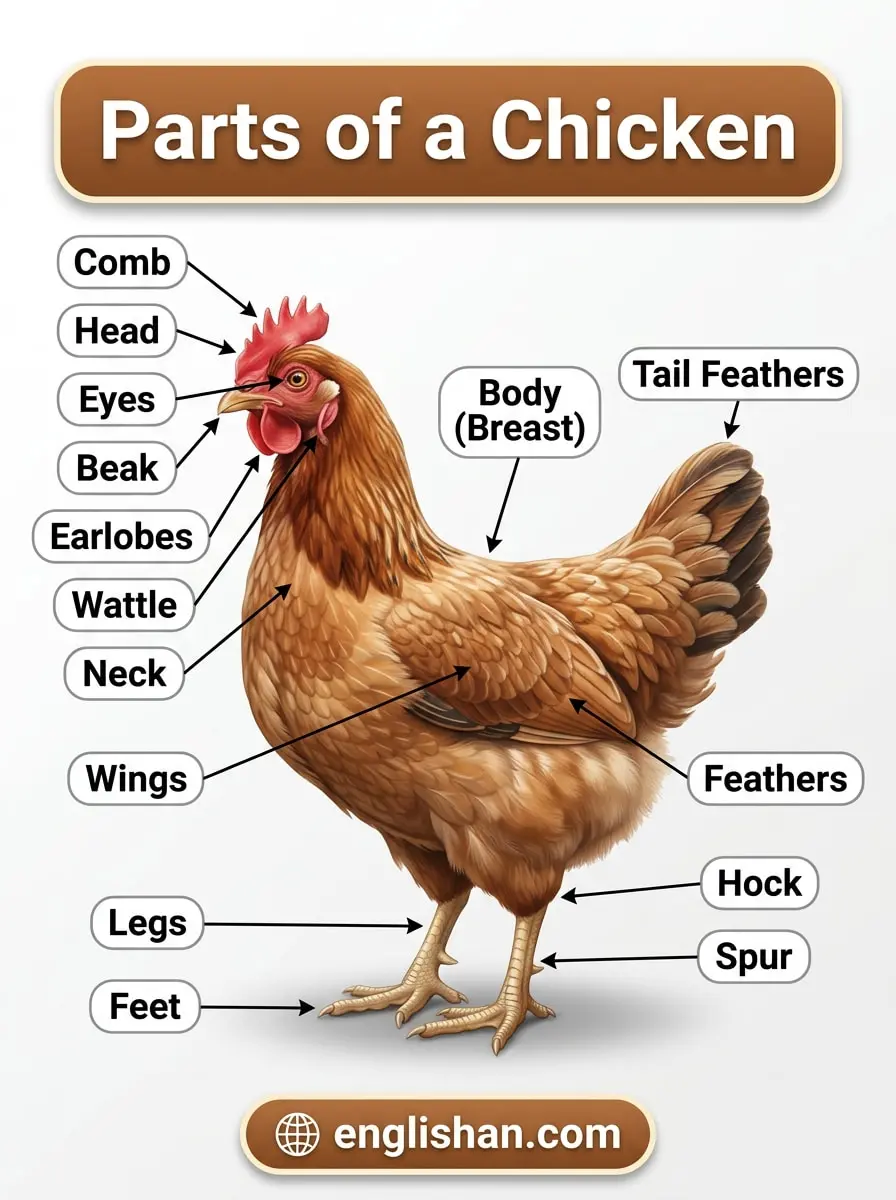
Parts of a Chicken
- Head: Supports the comb, wattle, eyes, and beak.
- Comb: The soft, red, fleshy growth on top of the head, which can indicate health and reproductive condition.
- Wattle: The flap of skin hanging below the chin, which helps regulate body temperature.
- Eyes: Positioned on the sides of the head, giving nearly all-around vision.
- Beak: Hard and pointed, used for pecking at seeds, insects, and other small food.
- Earlobes: Small patches of skin near the ears, whose color can indicate the color of eggs the hen lays.
- Neck: Covered in hackle feathers, allowing the head to move independently while the body stays still.
- Wings: Feathered but generally used for short bursts of flight rather than sustained flying.
- Body/Breast: Contains the main flight and leg muscles.
- Tail Feathers: Long, curved feathers, especially prominent in roosters.
- Legs: Covered in scales, used for walking, running, and scratching at the ground for food.
- Feet: Have sharp claws used for scratching the ground and defense.
- Spur: A pointed growth on the leg, more common in roosters, used in fighting and defense.
- Hock: The joint located between the drumstick and the foot, similar in position to a human ankle.
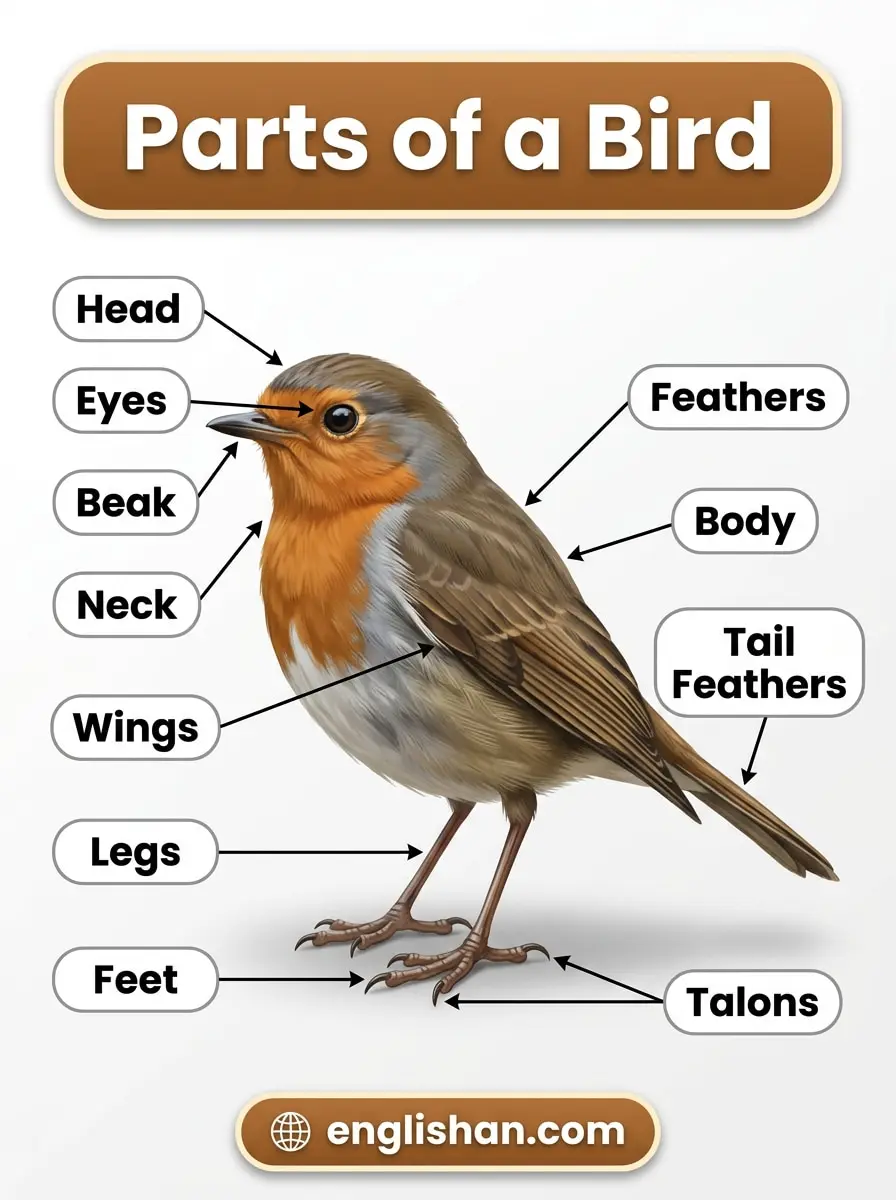
Parts of a Bird (General)
- Head: Supports the eyes and beak.
- Beak: Shape depends on diet; hooked beaks belong to meat eaters, while short, cone-shaped beaks belong to seed eaters.
- Eyes: Usually positioned on the sides of the head, giving a wide field of view.
- Neck: Flexible, allowing the head to turn and reach in many directions.
- Wings: Covered in flight feathers, shaped to create lift for flying, gliding, and changing direction.
- Feathers: Provide insulation, repel water, and shape the wings and tail for flight.
- Body: Lightweight and streamlined, with hollow bones that reduce weight for flying.
- Tail Feathers: Help the bird steer and balance during flight.
- Legs: Vary in length depending on species, used for walking, perching, or wading.
- Feet: Shaped for the bird’s lifestyle, such as webbed for swimming or clawed for perching.
- Talons: Sharp, curved claws used by birds of prey to grip and hunt other animals.
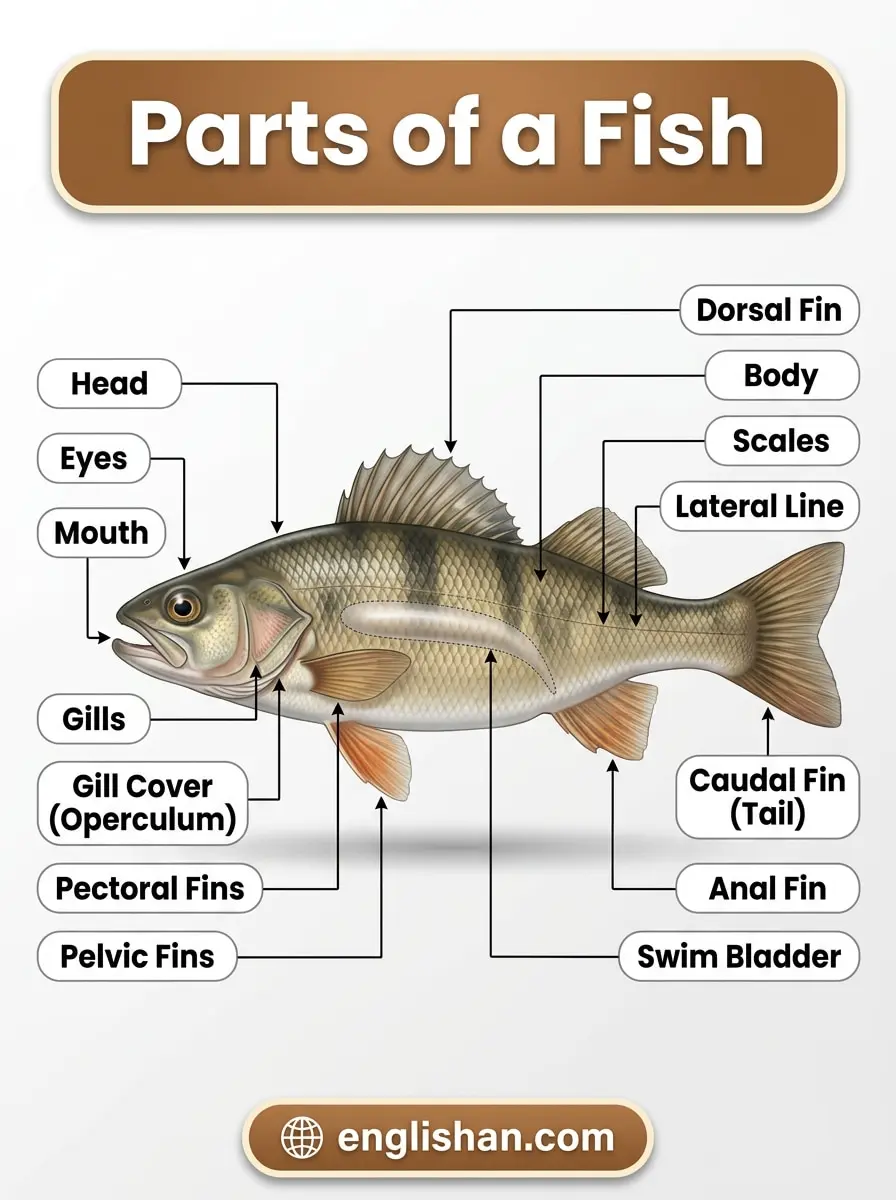
Parts of a Fish
- Head: Contains the eyes, mouth, and gills.
- Eyes: Positioned on the sides of the head, usually without eyelids.
- Mouth: Used for feeding, with shape and size varying based on diet.
- Gills: Located on either side of the head, used to absorb oxygen directly from water.
- Gill Cover (Operculum): A hard flap protecting the gills and helping pump water over them.
- Body: Streamlined to reduce resistance while swimming.
- Scales: Small, overlapping plates that cover and protect the skin while reducing drag.
- Lateral Line: A row of sensory organs along the side of the body that detects vibrations and movement in the water.
- Dorsal Fin: Located on the back, helps keep the fish upright and stable.
- Pectoral Fins: A pair located near the head, used for steering and balance.
- Pelvic Fins: A pair located on the underside, used for stability and slow maneuvering.
- Anal Fin: Located on the underside near the tail, helps with stability while swimming.
- Caudal Fin (Tail): The main fin at the back, used to push the fish forward through side-to-side movement.
- Swim Bladder: An internal gas-filled organ that helps the fish control its buoyancy in the water.
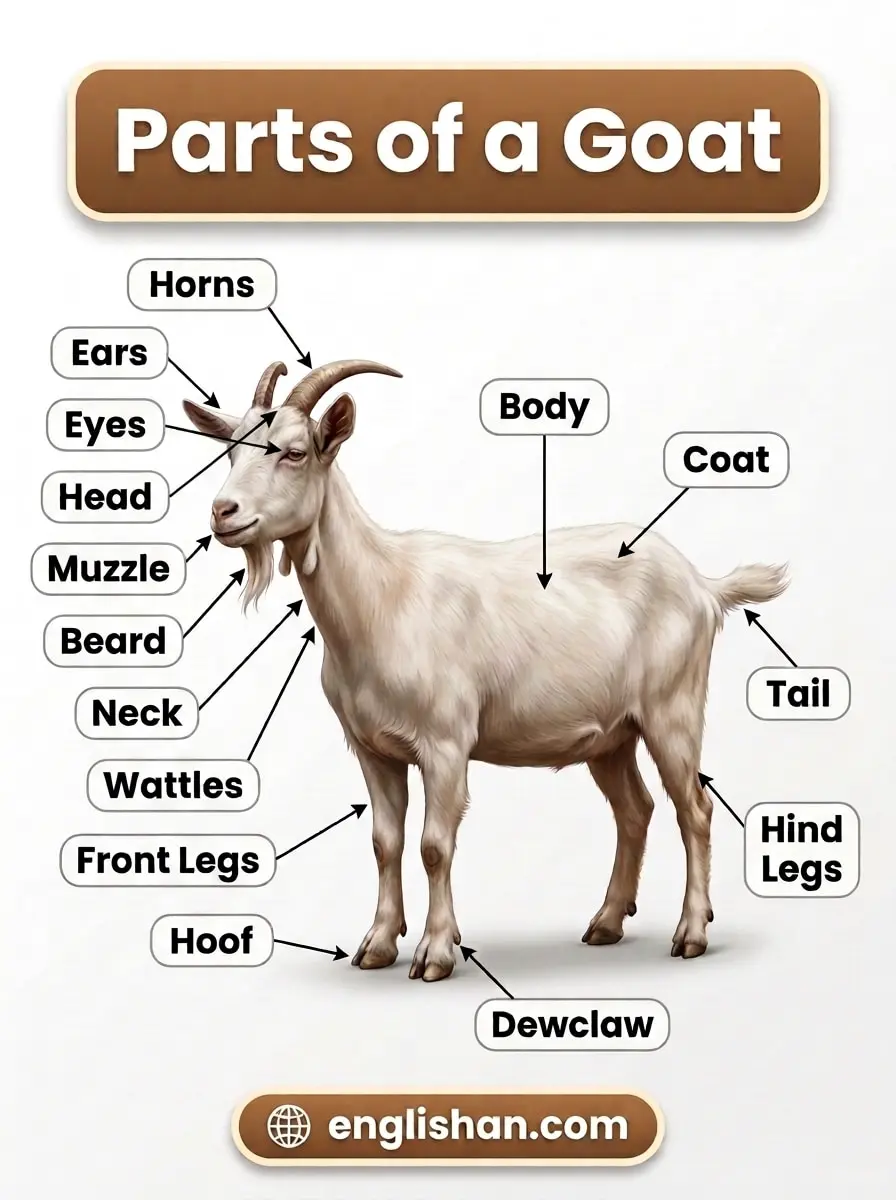
Parts of a Goat
- Head: Supports the horns, eyes, and muzzle.
- Horns: Bony growths on the head used for defense and establishing rank through head-butting.
- Eyes: Have rectangular pupils, giving goats a wide field of vision to watch for predators.
- Ears: Used for hearing, with shape varying by breed, from upright to floppy.
- Muzzle: The nose and mouth area, used for grazing and browsing on plants.
- Beard: A patch of longer hair under the chin, more pronounced in males.
- Neck: Flexible, allowing the goat to reach up to browse on leaves and shrubs.
- Wattles: Small, skin flaps sometimes found hanging from the neck in certain breeds, without a known specific function.
- Body: Compact and muscular, suited for climbing.
- Front Legs and Hind Legs: Strong and agile, allowing goats to climb steep, rocky terrain.
- Hooves: Hard, split coverings on the feet that allow excellent grip and balance.
- Dewclaw: A small extra toe above the main hoof, which can provide extra grip on steep or slippery ground.
- Tail: Short, often held upright, used minimally for balance.
- Coat: Can range from short and smooth to long and coarse, depending on the breed.
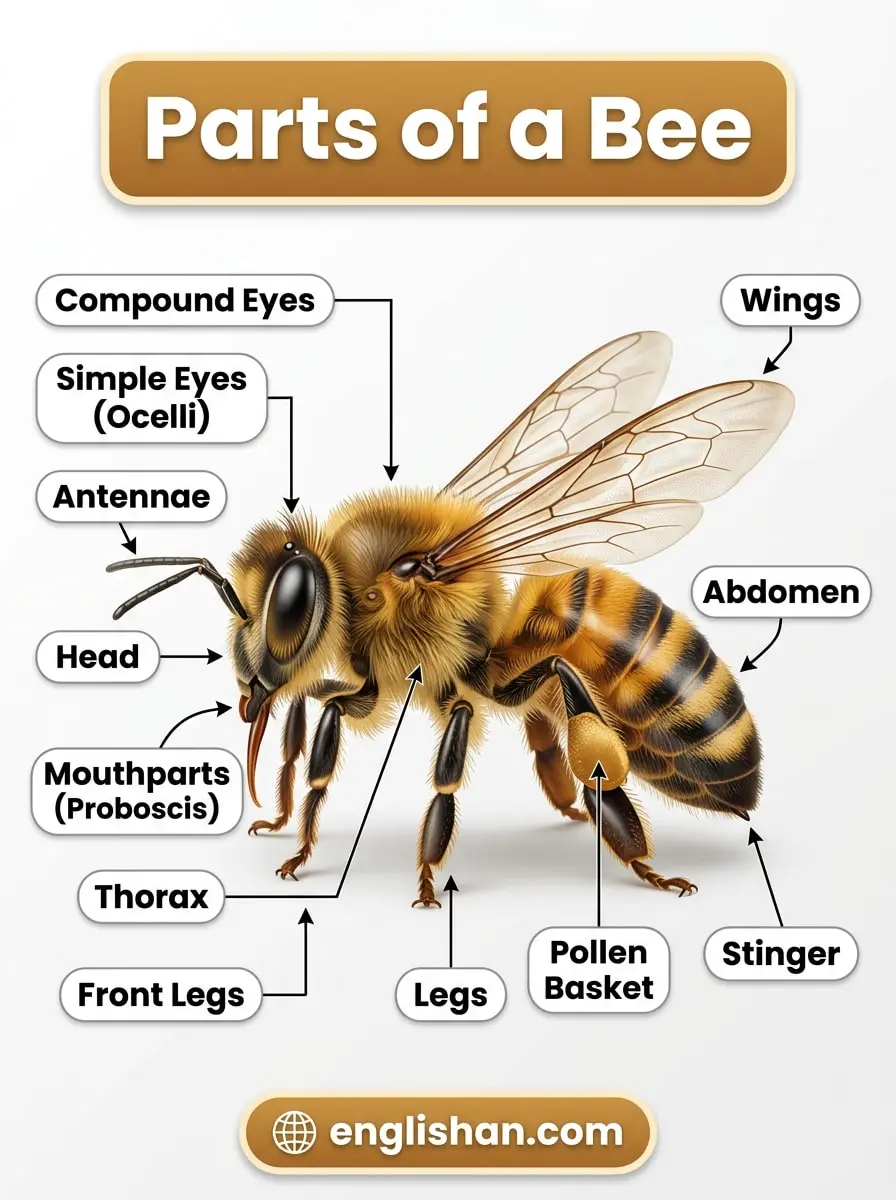
Parts of a Bee
- Head: Contains the eyes, antennae, and mouthparts.
- Compound Eyes: Two large eyes made of thousands of tiny lenses, used to detect movement and color, including ultraviolet light.
- Simple Eyes (Ocelli): Three small eyes on top of the head that detect light intensity, helping with navigation.
- Antennae: Two long sensory organs used for smell and touch, helping the bee find flowers and communicate.
- Mouthparts: Includes a straw-like tongue called a proboscis, used to suck nectar from flowers.
- Thorax: The middle section of the body, where the wings and legs attach.
- Wings: Two pairs of thin, transparent wings that beat very fast, allowing flight between flowers.
- Legs: Six legs total, with the hind legs on worker bees having a special structure called a pollen basket used to carry pollen.
- Abdomen: The rear body segment, containing organs for digestion and, in worker bees, the wax glands used to build the honeycomb.
- Stinger: A sharp, needle-like defense structure found mainly on female bees, connected to a venom sac.
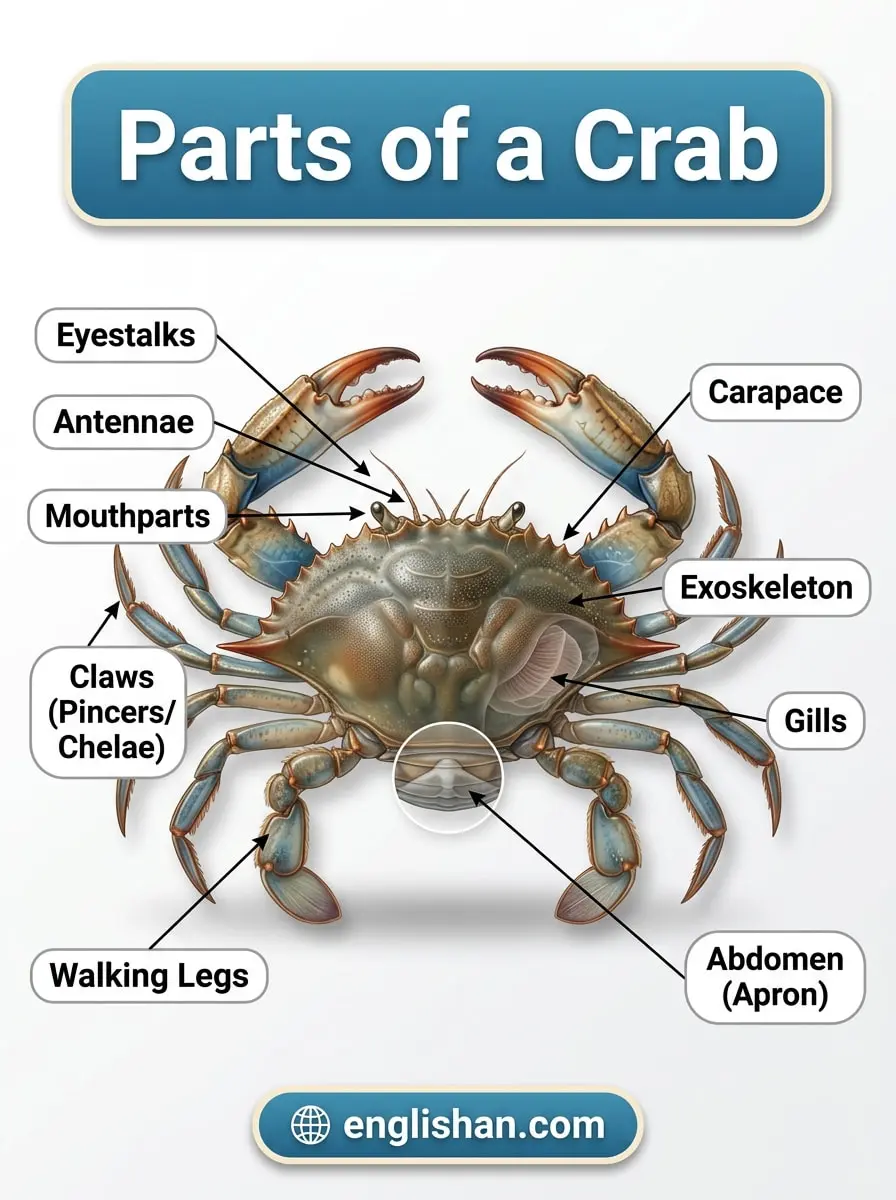
Parts of a Crab
- Carapace: The hard, shield-like upper shell covering the main body.
- Eyestalks: Eyes positioned on movable stalks, giving a wide field of vision.
- Antennae: Sensory structures used to detect touch, taste, and chemical signals in the water.
- Mouthparts: Small appendages near the mouth used to manipulate and break down food.
- Claws (Pincers/Chelae): The front pair of legs, modified into strong claws used to grab food, fight rivals, and defend against predators.
- Walking Legs: Several pairs of jointed legs used for walking, typically in a sideways direction.
- Exoskeleton: A hard outer shell made of chitin, protecting the crab’s soft internal organs, which must be shed and regrown as the crab grows.
- Abdomen: Folded underneath the body, often called the “apron,” and used to identify the sex of the crab.
- Gills: Located under the carapace, used to breathe by extracting oxygen from water.
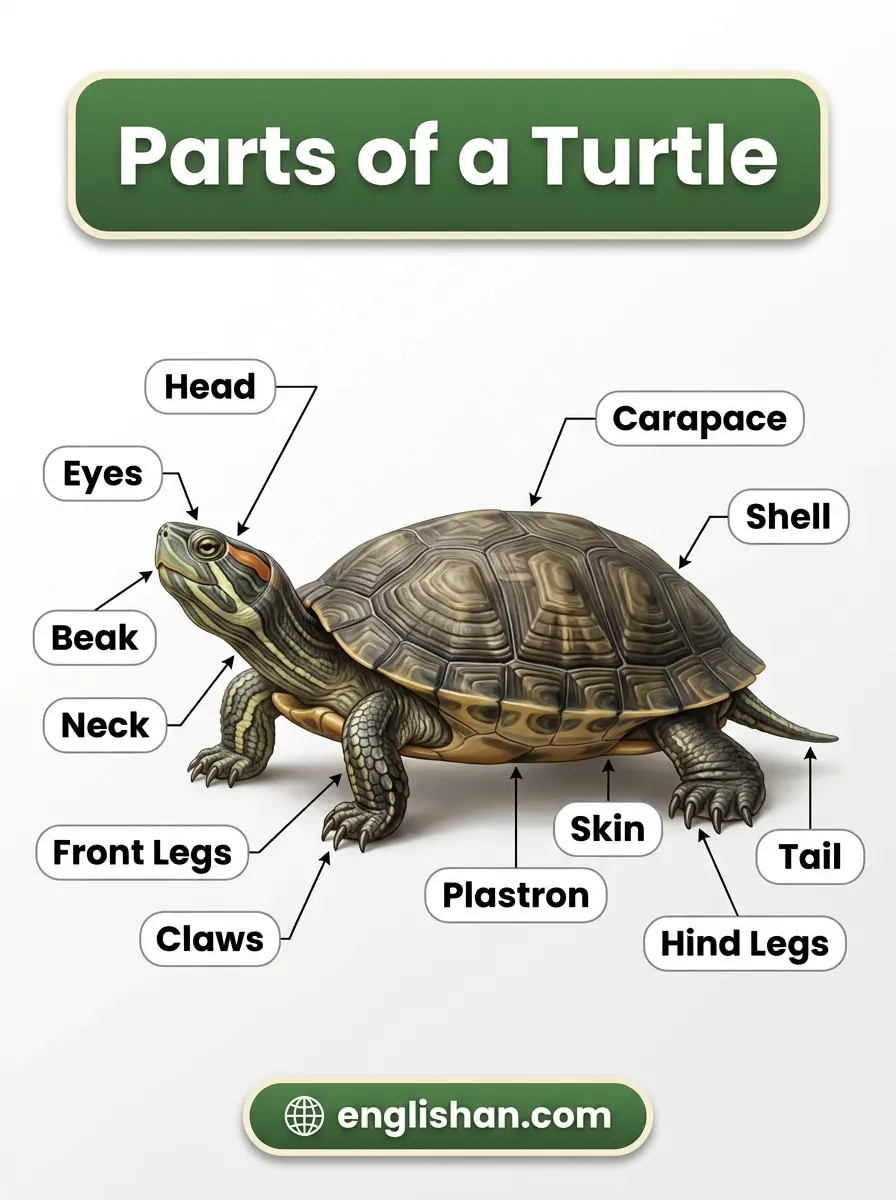
Parts of a Turtle
- Shell: A hard, bony covering fused to the turtle’s spine and ribs, providing strong protection from predators.
- Carapace: The top part of the shell, covering the back.
- Plastron: The bottom part of the shell, covering the belly.
- Head: Can usually be pulled partially or fully into the shell for protection.
- Eyes: Provide vision suited to the turtle’s environment, whether aquatic or land-based.
- Beak: A hard, toothless mouth structure used to bite and tear food.
- Neck: Flexible, allowing the head to extend out or retract into the shell.
- Legs or Flippers: Sea turtles have flat, paddle-like flippers for swimming, while land and freshwater turtles have shorter legs for walking or slow swimming.
- Claws: Found on the feet of many land and freshwater turtles, used for digging and gripping.
- Tail: Short in most species, sometimes used to help with balance or, in males, during mating.
- Skin: Covers the parts of the body not protected by the shell, often scaly in texture.
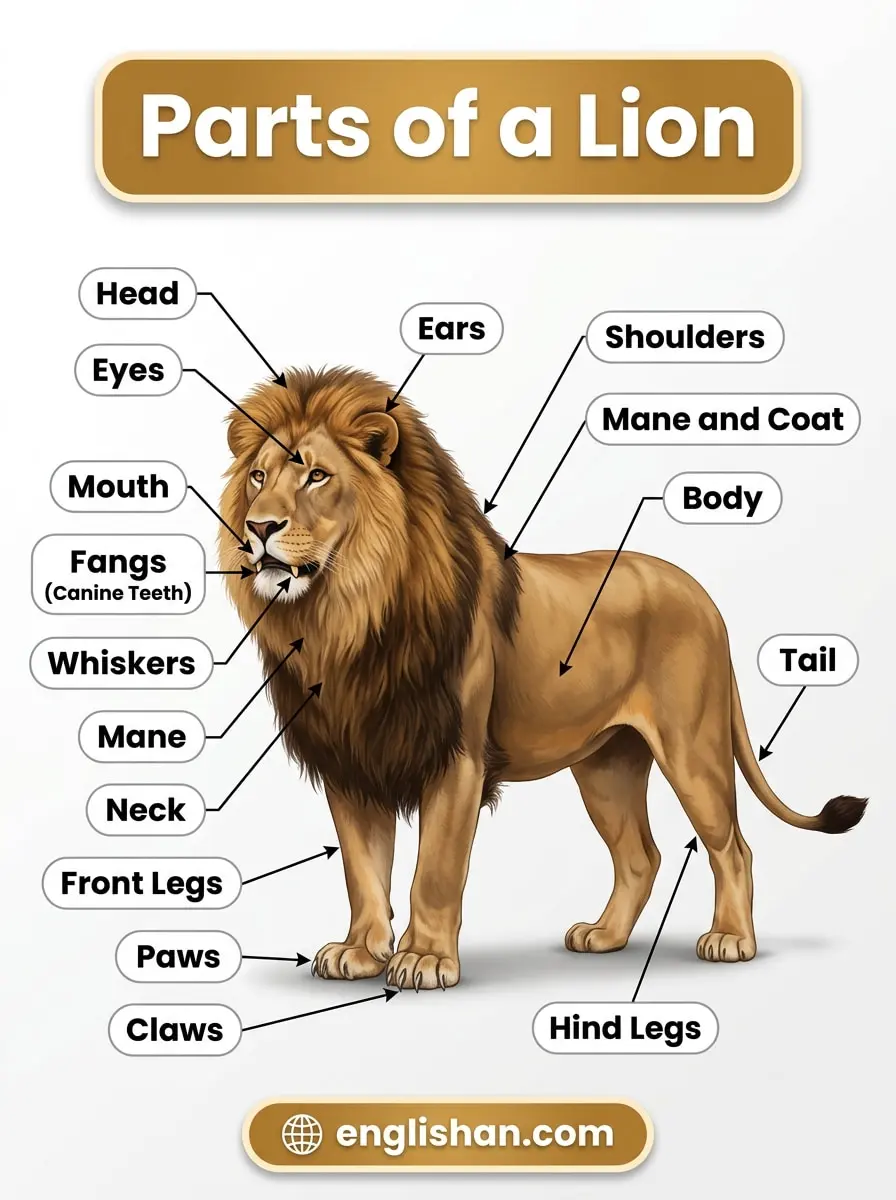
Parts of a Lion
- Head: Large and supports the mane, eyes, ears, and mouth.
- Mane: A thick ring of longer hair around the neck and shoulders, found mainly in adult males, signaling strength and health.
- Eyes: Adapted for good night vision, helpful since lions often hunt at dusk or during the night.
- Ears: Rounded and used for hearing, also expressive of the lion’s mood.
- Mouth: Contains powerful jaws and teeth suited for gripping and tearing prey.
- Fangs (Canine Teeth): Long, pointed teeth used to grip and kill prey and tear through meat.
- Whiskers: Stiff hairs on the face that help sense nearby objects and movement.
- Neck: Strong and muscular, supporting the head and helping subdue prey.
- Shoulders: Powerful and muscular, providing strength for running and takedowns.
- Front Legs: Muscular and used to grip and hold onto prey during a hunt.
- Hind Legs: Provide the explosive power needed for short bursts of speed while chasing prey.
- Paws: Large and padded, allowing quiet movement while stalking.
- Claws: Sharp and retractable, used to grip prey and climb when necessary.
- Tail: Long, ending in a dark tuft of fur, used for balance and communication with other lions.
- Mane and Coat: The coat is short and tawny colored, providing camouflage in dry grasslands.
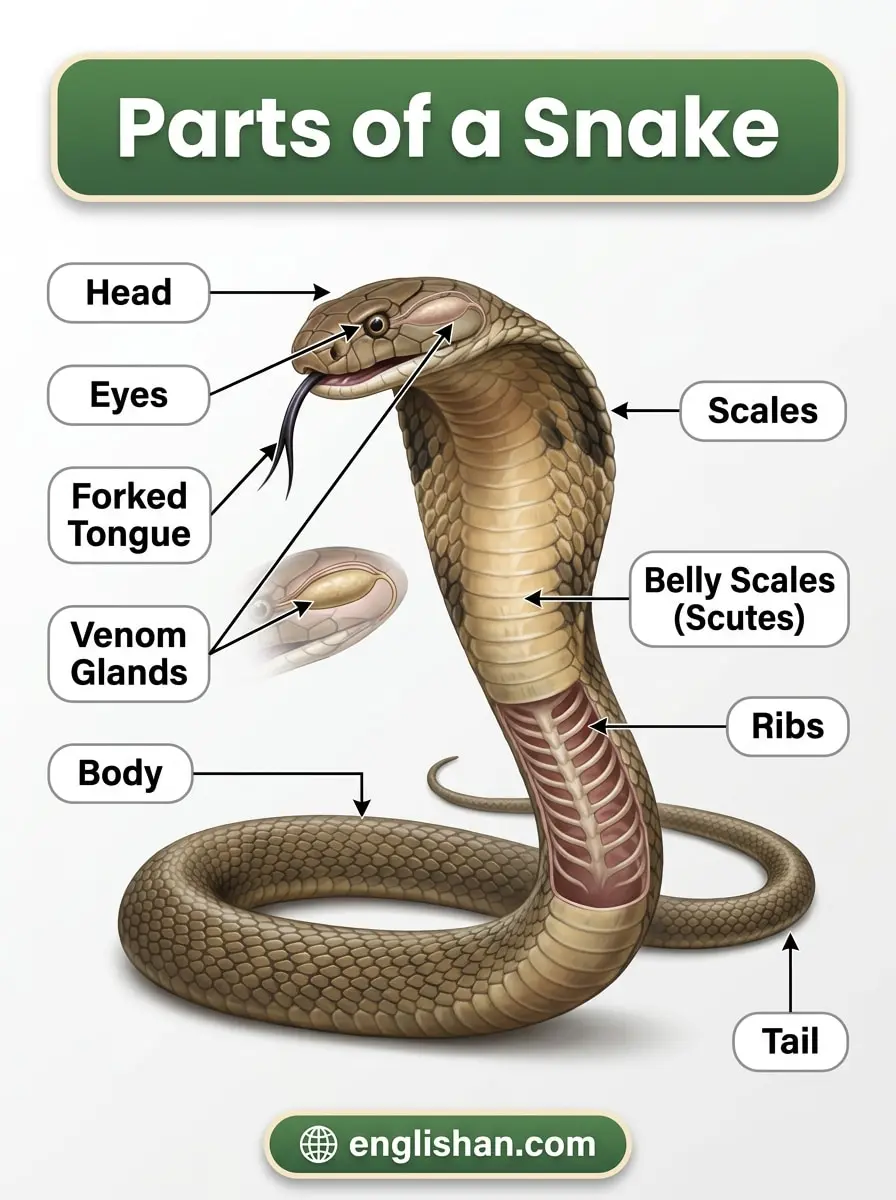
Parts of a Snake
- Head: Contains the eyes, mouth, and sensory organs.
- Eyes: Lack eyelids, so snakes cannot blink, and instead have a clear scale covering the eye.
- Forked Tongue: Flicked in and out to pick up scent particles from the air, processed using a special organ in the roof of the mouth to help track prey.
- Jaw: Highly flexible and able to unhinge, allowing the snake to swallow prey much larger than its own head.
- Fangs: Specialized teeth, hollow or grooved in venomous species, used to inject venom into prey or attackers.
- Venom Glands: Located behind the eyes in venomous species, producing the venom delivered through the fangs.
- Body: Long and flexible, made up of many vertebrae that allow extreme bending and coiling.
- Scales: Small, overlapping plates covering the entire body, providing protection and reducing friction during movement.
- Belly Scales (Scutes): Wide, flat scales on the underside of the body that grip the ground, giving the traction needed to move forward without legs.
- Ribs: Numerous pairs of ribs running the length of the body, aiding in movement and, in some species, allowing the body to flatten for defense.
- Tail: The section of the body after the vent, tapering to a point, and in some species used to make a warning sound or to grip branches.
Common Body Parts Across Multiple Animals
Some body parts appear in several animals but serve slightly different purposes depending on how that animal lives.
| Body Part | Found In | Main Function |
|---|---|---|
| Tail | Dog, Cat, Cow, Horse, Fish, Elephant, Lion, Snake | Balance, communication, defense against insects |
| Claws | Cat, Lion, Crab, Birds, Dog, Turtle | Hunting, climbing, gripping, defense |
| Horns | Cow, Goat | Defense and establishing rank in a herd |
| Hooves | Cow, Horse, Goat | Protecting feet and improving grip on uneven ground |
| Scales | Fish, Snake, Chicken (legs), Turtle (skin) | Protection of skin and reduced friction during movement |
| Whiskers | Dog, Cat, Lion | Sensing nearby objects and air movement |
| Fangs | Lion, Snake | Gripping, killing prey, and injecting venom |
Final Thoughts on Animals and Their Body Parts Names
UnderstandingAnimals and Their Body Parts Names is useful for building vocabulary, and it also helps explain how animals are suited to their environments. A trunk, a fin, or a pair of fangs is not just an interesting feature. Each one is a tool the animal relies on every day to find food, stay safe, and survive.
Keep exploring, and the next time you see an animal, try naming its body parts out loud. It is a simple way to strengthen both your vocabulary and your understanding of the animal world.
FAQs about Animals and Their Body Parts Names
Common external body parts include the head, eyes, ears, nose, mouth, legs, tail, and the outer covering of the body, such as fur, feathers, or scales. These parts vary depending on the species and its environment.
The elephant is best known for its trunk, which functions as a combined nose and hand. It is used for breathing, drinking, grabbing food, and communicating with other elephants.
A tusk is an elongated tooth, found in animals such as elephants and walruses, and it grows continuously throughout the animal’s life. A horn is a bony growth on the head, found in animals such as cows and goats, and it typically stops growing once the animal reaches maturity.
No. Many animals, including humans and some birds such as penguins, do not have a visible tail. Tails are more common in mammals, reptiles, and fish, where they assist with balance, movement, or communication.
The carapace protects the turtle’s back, while the plastron protects its belly. Together, the two parts form a complete shell that shields the turtle from predators on nearly all sides.
You May Also Like
- 50 Animals and Their Footprints
- 15 Animals and Their Camouflage with Pictures
- Animals and Their Eggs with Pictures
Animals and Their Body Parts Quiz
Animals and Their Body Parts
What is the projecting nose and mouth of a horse or cow called?
Snout suits a pig or a crocodile; muzzle suits a horse, dog or cow.
Muzzle, snout, beak and bill are not interchangeable.
She rubbed the horse's muzzle.
What separates a talon from a claw?
The word carries the sense of a hunting weapon rather than a general nail.
Talons on raptors, claws elsewhere.
The eagle's talons closed on the fish.
Name the part.
The long stiff hairs on a cat's face that sense nearby objects are ___.
Each one sits in a follicle packed with nerves, so contact is registered precisely.
Whiskers measure gaps as much as they feel surfaces.
A cat's whiskers span roughly its own body width.
What is an elephant's trunk, anatomically?
It has no bone at all, and runs on tens of thousands of muscle units.
The trunk is nose and lip, not an extra limb.
It can lift a log and pick up a single leaf.
What are an elephant's tusks?
Being teeth, they wear down and cannot regrow once broken.
Tusks are teeth; horns and antlers are not.
A broken tusk never grows back.
Turn on JavaScript for the interactive quiz. The full practice set is shown above.