Turtle vs Tortoise is a comparison that often causes confusion because people use the two words as if they mean the same thing. In casual conversation, that is usually fine. Biologically speaking, however, turtles and tortoises are not identical. A tortoise is technically a type of turtle, but not every turtle is a tortoise. Understanding the real difference comes down to where each one lives, how their bodies are built, and how millions of years of evolution have shaped them for very different lifestyles.
This article breaks down every meaningful difference between turtles and tortoises before taking a closer look at each animal individually, covering their species, anatomy, diet, behavior, reproduction, and conservation status.
Turtle vs Tortoise: The Main Differences
Turtles are largely aquatic and spend most of their lives in or near water, with flatter, more streamlined shells and webbed or flipper like feet built for swimming. Tortoises are land dwelling animals that rarely enter water except to drink or soak, with domed, heavier shells and stumpy, elephant like feet built for walking. Tortoises also tend to live far longer than turtles and eat a much more plant heavy diet.
Now let’s go through every difference in detail before taking a closer look at each animal individually.
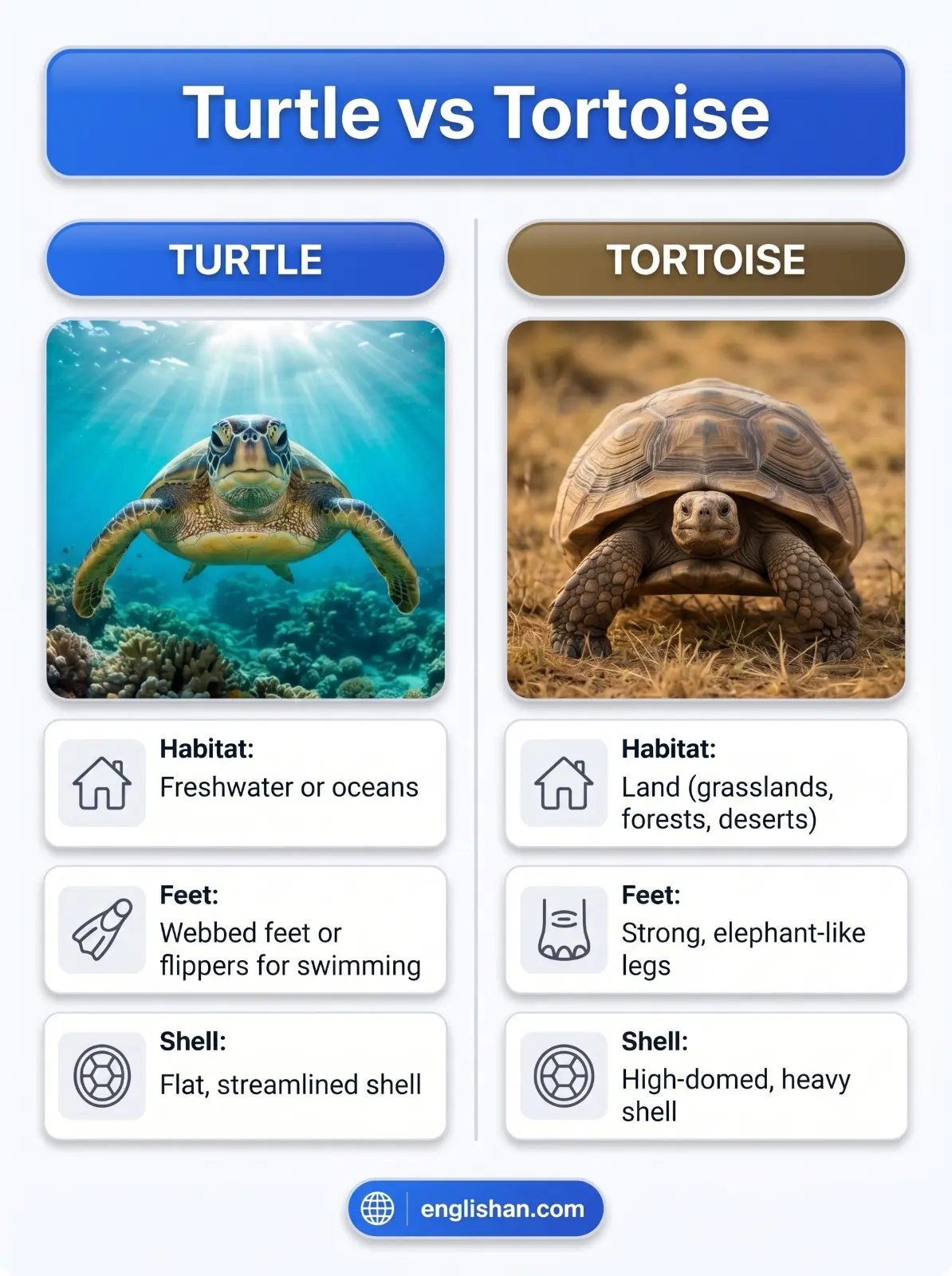
Detailed Differences Between Turtles and Tortoises
The Umbrella Term Problem
Technically, all tortoises are turtles. Both belong to the order Testudines, which covers every turtle, tortoise, and terrapin alive today. Within that order, tortoises sit in their own family, Testudinidae, defined almost entirely by one trait: they never go in the water.
So the real distinction isn’t “turtle vs. tortoise” — it’s “aquatic turtle vs. land-dwelling turtle.” In everyday language, most people sort them this way:
- Turtle — spends most of its life in water, freshwater or marine
- Tortoise — spends its entire life on land
- Terrapin — lives in brackish or freshwater wetlands, a middle ground between the two
Habitat: The Clearest Divide
Turtles are built for water. Freshwater species live in ponds, rivers, and lakes; sea turtles spend nearly their whole lives in the ocean, coming ashore only to nest. Even turtles seen basking on a log are never far from the water they depend on for food, mating, and escape from predators.
Tortoises live exclusively on land, in deserts, grasslands, scrubland, forest edges, and many are highly adapted to conserve water in arid conditions. Put a tortoise in a swimming pool and you’re not giving it a treat; you’re putting it at real risk. Their heavy shells and stumpy legs aren’t built for swimming, and tortoises can and do drown in water they can’t stand up in.
Shell, Feet, and Body Design
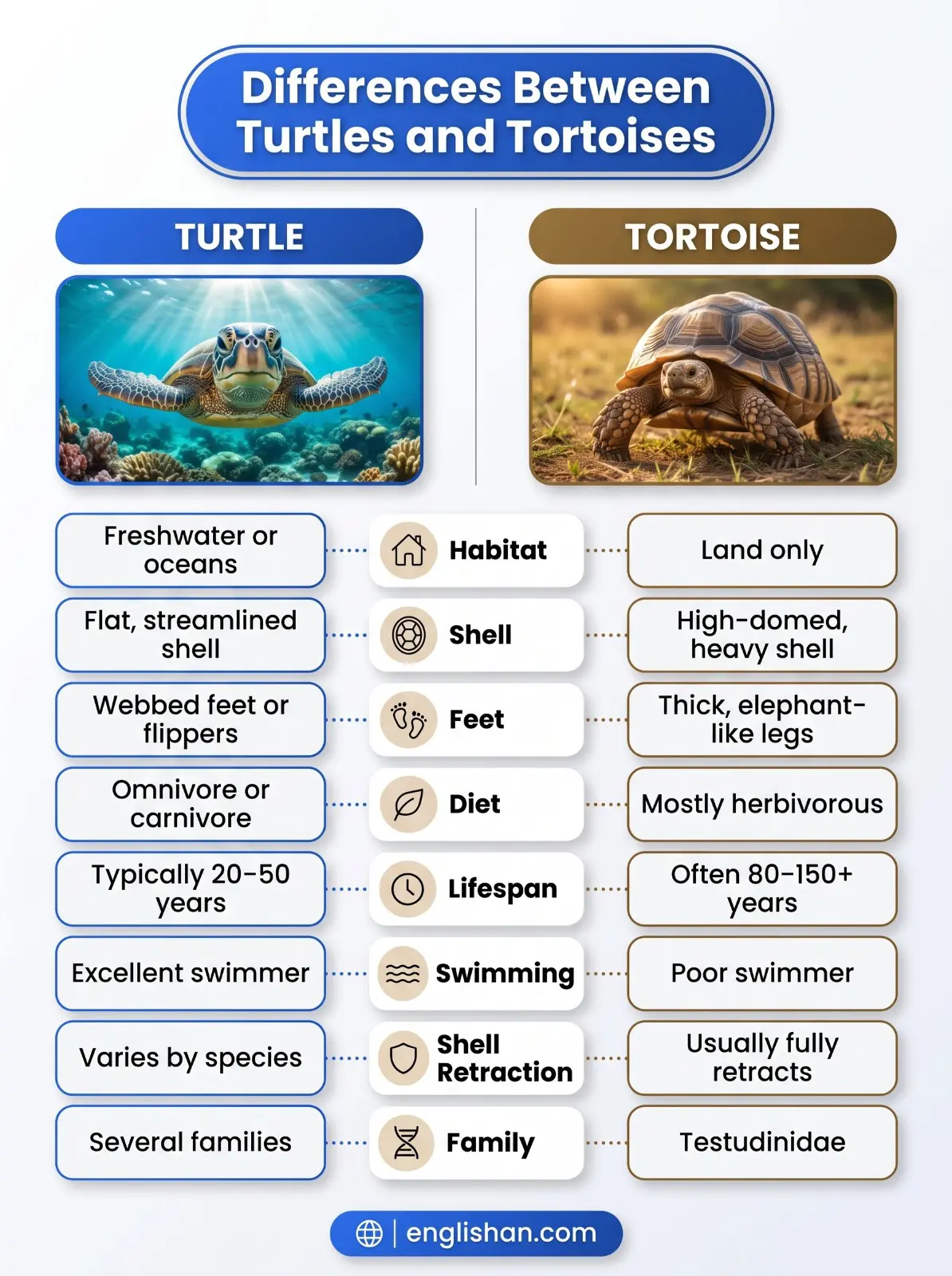
| Feature | Turtle | Tortoise |
|---|---|---|
| Habitat | Freshwater or marine | Land only |
| Shell | Flat and streamlined | Domed and heavy |
| Feet | Webbed feet or flippers | Thick, elephant-like feet |
| Diet | Mostly omnivorous or carnivorous | Mostly herbivorous |
| Lifespan | 20–50 years (typical) | 80–150+ years |
| Swimming | Excellent swimmers | Poor swimmers |
| Shell Retraction | Varies by species | Usually complete |
| Scientific Family | Several families | Testudinidae |
A turtle’s shell is low and hydrodynamic, cutting drag as it moves through water. Sea turtles in particular, have shells shaped almost like a wing. A tortoise’s shell is the opposite: thick, domed, and heavy, which is a liability in water but a serious advantage on land, where it’s much harder for a predator to flip or crush.
Feet tell the same story. Turtles have webbed feet or, in sea turtles, true paddle-like flippers for propulsion and steering. Tortoises have short, thick legs and claw-tipped, column-shaped feet, built to carry a heavy shell, dig burrows, and push through soil or dense vegetation, not to swim.
Diet
Most turtles are omnivorous or carnivorous, especially aquatic species — fish, insects, crustaceans, aquatic plants, and the occasional carrion. Sea turtle diets vary sharply by species, from jellyfish and sponges to sea grasses and algae.
- Tortoises are overwhelmingly herbivorous: grasses, weeds, leafy greens, flowers, cacti, and fruit make up the bulk of a typical diet, with only occasional insects, snails, or carrion in some species.
- Turtles typically eat: fish and small aquatic animals, insects and worms, aquatic plants and algae, crustaceans and mollusks, and occasionally carrion.
- Tortoises typically eat: leafy greens like dandelion and collard greens, grasses and hay, flowers and edible weeds, small amounts of fruit, and — especially in desert species — cacti and succulents.
Lifespan and Size
Tortoises are famous for their longevity. Many species commonly reach 80 to 150 years, and giant species like the Aldabra and Galapagos tortoise are reported to occasionally live past 150. One Aldabra tortoise, Jonathan, is widely cited as the oldest known living land animal, at an estimated age well over 190.
Turtles live long lives too, just shorter ones by comparison: freshwater species commonly reach 20 to 40 years, and some sea turtles are estimated to live 50 to 80 years, though verified ages that old are rare and hard to confirm in the wild.
Size doesn’t follow the same pattern. The largest tortoises, like the Galapagos giant tortoise, can weigh over 500 pounds with a shell around 4 feet long. But the largest turtle by far is the leatherback sea turtle, reported at up to 7 feet long and over 1,500 pounds in exceptional cases, bigger than any tortoise that has ever been recorded.
Reproduction and Nesting
Neither turtles nor tortoises give live birth. Every known species lays eggs on land, but the nesting process differs depending on habitat. Female sea turtles often return to the very beach where they hatched, sometimes traveling thousands of miles, to dig a nest and lay their eggs, a remarkable behavior known as natal homing. Tortoises, already living on land, simply dig nests within or near their home range and do not need to undertake long migrations.
In both groups, the incubation temperature of the eggs plays an important role in determining whether the hatchlings develop as male or female. Once the eggs are buried, parental care ends, and hatchlings must survive on their own from the moment they emerge.
Speed and Defense
Turtles are far more agile in water than tortoises are on land — some sea turtles are reported to reach short bursts of 15–20 mph while swimming. Tortoises, by contrast, are famously slow on land, often covering under half a mile per hour. It’s not a disadvantage so much as a fit: a low-energy, herbivorous lifestyle doesn’t need speed.
Most tortoises can fully withdraw their head, legs, and tail into their shell — their main defense against land predators they can’t outrun. Many turtles can do the same to varying degrees, but sea turtles are a notable exception: they cannot retract their heads or flippers at all, relying instead on size, speed, and open water for protection.
What They Have in Common: Turtle vs Tortoise
Although turtles and tortoises have adapted to very different lifestyles, they still share many important biological characteristics inherited from a common ancestor.
- Ancient lineage — both belong to the order Testudines, a reptile group that has existed for more than 220 million years.
- Protective shell — both have a shell made of two parts: the carapace (upper shell) and the plastron (lower shell), both fused directly to the spine and ribs.
- No teeth — instead of teeth, both use a sharp keratin beak to bite and tear food.
- Egg-laying reptiles — every turtle and tortoise lays eggs on land, including fully marine sea turtles.
- Cold-blooded (ectothermic) — both rely on sunlight and environmental heat to regulate body temperature.
- Slow metabolism — their naturally slow metabolism contributes to their remarkable longevity.
- Temperature-dependent sex determination — in many species, incubation temperature determines whether hatchlings become male or female.
- Limited parental care — adults leave the nest after laying eggs, and hatchlings receive virtually no parental protection.
- Long lifespan — both groups generally live much longer than most reptiles.
- Shell defense — most species can withdraw at least part of their head and limbs into their shell, although sea turtles have largely lost this ability.
A Closer Look at Turtles
Types. Turtles fall into three broad groups. Sea turtles — green, loggerhead, hawksbill, leatherback, and Kemp’s ridley — spend nearly their whole lives in the ocean and come ashore only to nest; all seven living species are considered threatened or endangered. Freshwater turtles, like the red-eared slider, painted turtle, and snapping turtle, live in ponds, rivers, and lakes. Terrapins, like the diamondback terrapin, occupy brackish coastal marshes in between.
Physical Characteristics: Turtles are built for life in the water. Their shells are flatter and more streamlined than those of tortoises, reducing drag while swimming. Most freshwater turtles have webbed feet, while sea turtles possess powerful flippers that allow them to travel thousands of miles across the ocean.
Like all members of the order Testudines, turtles lack teeth and instead use a sharp keratin beak to capture and process food. Many aquatic species also have relatively long necks that help them strike quickly at prey.
Diet varies by species. Snapping turtles eat fish, amphibians, birds, and carrion. Green sea turtles are largely herbivorous as adults, grazing on sea grass and algae. Loggerheads specialize in hard-shelled prey like crabs and mollusks.
Behavior. Mostly solitary, coming together mainly to mate or bask — sea turtles especially so, except during mass nesting events called arribadas, seen in species like the Kemp’s ridley and olive ridley.
Conservation. All seven sea turtle species are listed as Vulnerable, Endangered, or Critically Endangered, driven by habitat loss, plastic pollution, fishing bycatch, and egg poaching. Many freshwater species face pressure from habitat loss and the illegal pet trade.
A Closer Look at Tortoises
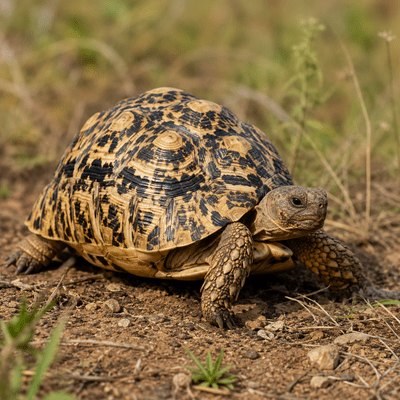
Types. Around 50 species exist. The Galapagos giant tortoise, studied by Darwin, and the Aldabra giant tortoise are among the largest and longest-lived. The sulcata tortoise, native to Africa’s Sahel, is the largest mainland species. The Russian tortoise is small, hardy, and popular with first-time owners. The desert tortoise, native to the U.S. Southwest, can survive long dry spells by drawing moisture from the plants it eats.
Physical Characteristics: Tortoises have thick, dome-shaped shells that provide exceptional protection against land predators. Their sturdy, column-like legs resemble those of elephants and are adapted for supporting heavy body weight, digging burrows, and walking across rough terrain.
Unlike aquatic turtles, tortoises lack webbed feet or flippers because they are fully terrestrial. Their powerful beak is designed primarily for cropping grasses, leaves, flowers, and other plant material.
Behavior. Slow-paced and mostly solitary, spending the day grazing, basking, or resting in burrows — many of which other wildlife also use. During breeding season, males sometimes ram shells to compete for mates.
Conservation. Galapagos giant tortoises were hunted nearly to extinction but have recovered significantly, though some subspecies remain endangered. The pancake tortoise and several Madagascar species, including the ploughshare tortoise, are Critically Endangered due to habitat loss and the illegal pet trade.
Common Myths About Turtles vs Tortoises
Myth: Turtles and tortoises are completely different animal groups. False. Tortoises are technically a specialized branch within the broader turtle order, Testudines, adapted specifically for life on land.
Myth: All turtles can retract completely into their shells. Not accurate. Sea turtles cannot retract their heads or flippers at all, and even among species that can retract, the degree of retraction varies significantly.
Myth: Tortoises can survive being placed in a swimming pool or pond. False, and potentially dangerous. Most tortoises cannot swim effectively and can drown in water deeper than they can stand in.
Is a Box Turtle a Turtle or a Tortoise?
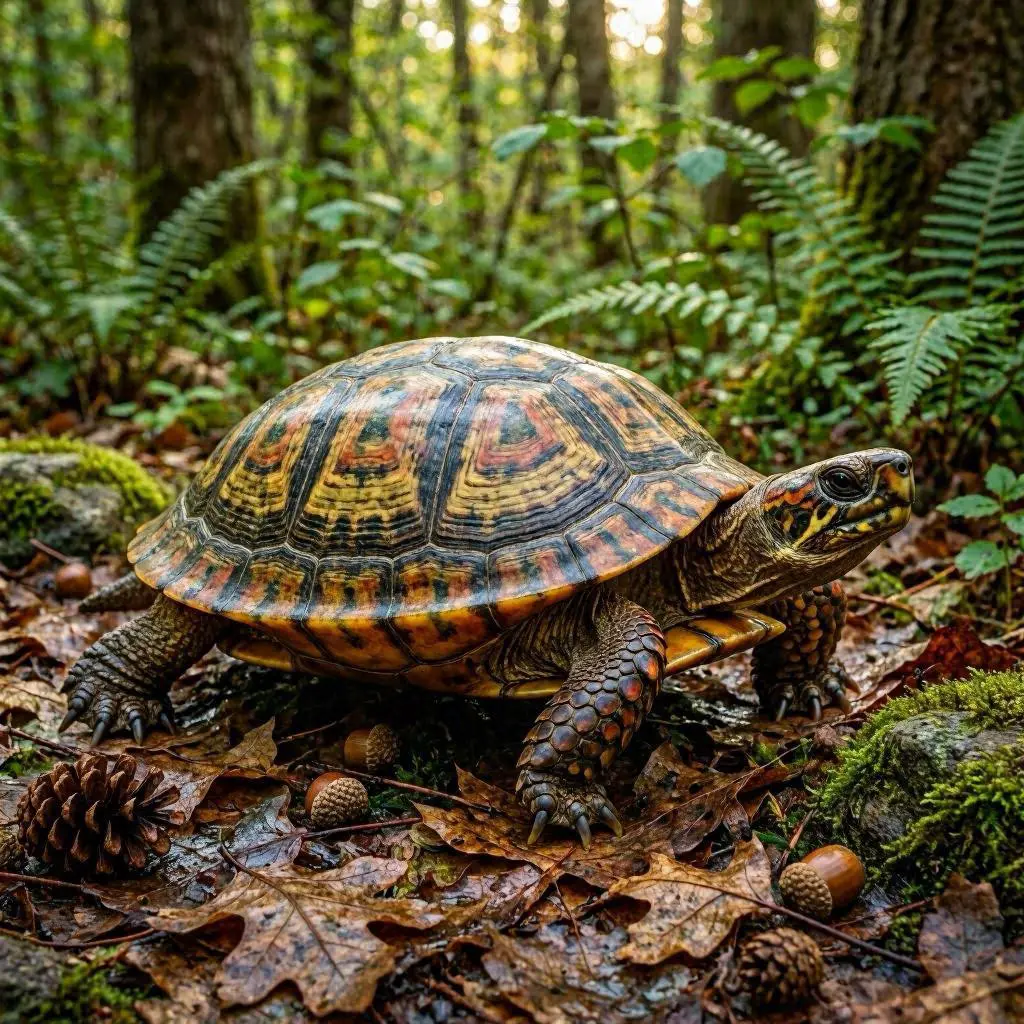
This trips up more people than almost any other question on the topic. Despite living mostly on land and having a domed, tortoise-like shell, the box turtle is classified as a turtle; it belongs to the pond turtle family, Emydidae, not Testudinidae. It’s a good reminder that habitat alone doesn’t determine classification, even though a box turtle behaves much more like a tortoise day to day than like a typical aquatic turtle.
Which Makes an Easier Pet?
Tortoises are generally considered friendlier for first-time reptile owners: a dry enclosure, a basking light, UVB lighting, and a diet of fresh greens covers most of the setup. Turtles need more: a filtered aquatic or semi-aquatic tank, a water heater, and regular water-quality monitoring, all of which add cost and upkeep.
That said, tortoises can outgrow their space fast, and giant species are not realistic pets for most households. Smaller species like the Russian tortoise are commonly recommended for beginners, while the red-eared slider is one of the most popular starter turtles.
Do Tortoises Bite?
Yes, though it’s uncommon and rarely serious given their herbivorous diet and slow movement. Bites usually happen when a tortoise mistakes a finger for food or feels threatened. Their beak isn’t designed to tear flesh, but in larger species it can still deliver a surprisingly firm pinch.
Which Is Bigger — the Biggest Turtle or the Biggest Tortoise?
The leatherback sea turtle holds the record for the whole order Testudines, reported at up to 7 feet long and over 1,500 pounds in exceptional cases. The largest tortoises — Galapagos and Aldabra giants — reach roughly 4 to 5 feet in shell length and up to 500–600 pounds. Massive for land animals, but still smaller than the biggest sea turtles.
Growth Rate
Tortoises grow slowly and steadily, often taking 10 to 20 years to reach maturity, consistent with their long lifespans. Turtles, especially smaller freshwater species, tend to mature faster, sometimes in 2 to 8 years, though larger sea turtles can take 20 to 30 years to reach sexual maturity despite living, on average, shorter overall lives than giant tortoises.
Symbolism and Cultural Significance
Turtle vs tortoise carries weight far beyond biology. In Hindu mythology, the tortoise avatar Kurma is said to have supported the world during a pivotal cosmic event. Across East Asian traditions, the tortoise is closely tied to longevity, wisdom, and patient, steady progress, the same idea at the heart of the fable of the tortoise and the hare. Indigenous cultures across the Americas and the Pacific Islands have their own creation stories built around a turtle carrying the Earth on its back.
Fun Facts about Turtle vs Tortoise
- Sea turtles have existed in roughly their current form for over 100 million years.
- Leatherback sea turtles are reported to dive deeper than 3,000 feet — deeper than most marine mammals.
- A turtle’s shell is fused to its spine and rib cage; it’s not something the animal could leave behind even if it wanted to.
- Some freshwater turtles can go dormant underwater for months without surfacing to breathe.
- Growth rings on a tortoise’s shell can give a rough age estimate, though this becomes less reliable as the animal gets older.
- Some tortoise species show measurable long-term memory and spatial learning ability.
Final Thoughts
The turtle vs tortoise comparison really comes down to one core idea: habitat shapes anatomy. Turtles evolved for a life in water, giving them flatter shells and webbed feet or flippers built for swimming. Tortoises evolved for a life on land, giving them domed, heavy shells and sturdy legs built for walking and digging. Once you know what to look for, whether it is the shape of the shell, the type of feet, or the environment the animal calls home, telling a turtle from a tortoise becomes second nature.
FAQs
In casual language, yes, that is a fair way to describe it. Scientifically, tortoises are a specific family within the broader turtle order, defined by their fully terrestrial lifestyle.
Most tortoises cannot swim well and can drown in deep water. They may wade in shallow water to drink or cool off, but they are not built for swimming the way turtles are.
Yes. Freshwater turtles regularly bask on logs and rocks, and all female turtles, including sea turtles, must come ashore to lay their eggs.
Tortoises generally hold the record for longevity, with some giant tortoise species living well over 150 years, making them among the longest living land animals on the planet.
Terrapins are turtles that live in brackish or freshwater wetland environments, occupying a middle ground between fully aquatic turtles and fully terrestrial tortoises.
Both can make long term pets, but they have very different care requirements. Tortoises need dry land enclosures with UVB lighting and a plant heavy diet, while turtles need aquatic or semi aquatic setups with filtered water and a mixed diet. Both commit an owner to decades of care given their long lifespans.
You May Also Like
- Alligator vs Crocodile
- Difference Between Reptiles and Amphibians
- Herbivores vs Carnivores vs Omnivores
Turtle vs Tortoise Quiz
Turtle vs Tortoise
Which one has a high, domed shell?
A tall dome is hard for a predator's jaws to grip, and weight costs nothing on land.
Domed shell means tortoise; flattened shell means turtle.
The high domed shell marked it as a tortoise.
Which one has stumpy, elephant-like feet?
Short columnar legs carry a heavy shell over dry ground.
Stumpy legs mean land; webbed feet or flippers mean water.
Those columnar hind feet belong to a tortoise.
Which one is a herbivore in almost every species?
Tortoises graze on grasses, leaves and fruit.
Land tortoises graze; aquatic turtles are more often mixed feeders.
The tortoise worked steadily through a patch of clover.
Complete the sentence with the shell part.
The upper half of the shell is called the ___.
The carapace is the domed upper shell; the flat underside is the plastron.
Carapace above, plastron below.
Growth rings showed clearly across the carapace.
What is the underside of the shell called?
The plastron joins the carapace at a bony bridge along each side.
Scutes are the plates; carapace and plastron are the halves.
A hinge across the plastron let it close up completely.
In American usage, how do the two terms relate?
American English uses turtle for the whole order Testudines, with tortoise as the land-living branch.
Usage differs by variety, so name the habitat if precision matters.
In American English every tortoise is also a turtle.
Turn on JavaScript for the interactive quiz. The full practice set is shown above.