Types of snakes are incredibly diverse, ranging from harmless garden species to highly venomous predators. Snakes are among the most misunderstood animals on Earth, feared by many yet admired by those who take the time to learn about them. They play a vital ecological role by controlling rodent populations, serving as prey for birds and mammals, and helping maintain balance in ecosystems worldwide.
There are nearly 3,000 species of snakes distributed across every continent except Antarctica. They range from the tiny Barbados threadsnake, no longer than a pencil, to the reticulated python, which can exceed 23 feet in length and weigh more than 300 pounds. Snakes inhabit jungles, deserts, forests, grasslands, wetlands, oceans, and even urban environments.
This article explores the major types of snakes, including venomous and nonvenomous species, constrictors, sea snakes, and popular pet snakes. You’ll discover snake names, characteristics, habitats, and the differences that make each group unique.
How Snakes Are Classified
Snakes belong to the suborder Serpentes within the class Reptilia. They are organized into families, genera, and species. The major snake families include:
- Colubridae: the largest family, containing about two-thirds of all snake species. Most are nonvenomous.
- Viperidae: vipers and pit vipers. All venomous.
- Elapidae: cobras, mambas, kraits, coral snakes, sea snakes. Highly venomous.
- Pythonidae: pythons. Nonvenomous constrictors.
- Boidae: boas and anacondas. Nonvenomous constrictors.
- Typhlopidae: blind snakes. Small, burrowing, nonvenomous.
Explore more animals that start with different letters:
A | B | C | D | E | F | G | H | I | J | K | L | M | N | O | P | Q | R | S | T | U | V | W | X | Y | Z
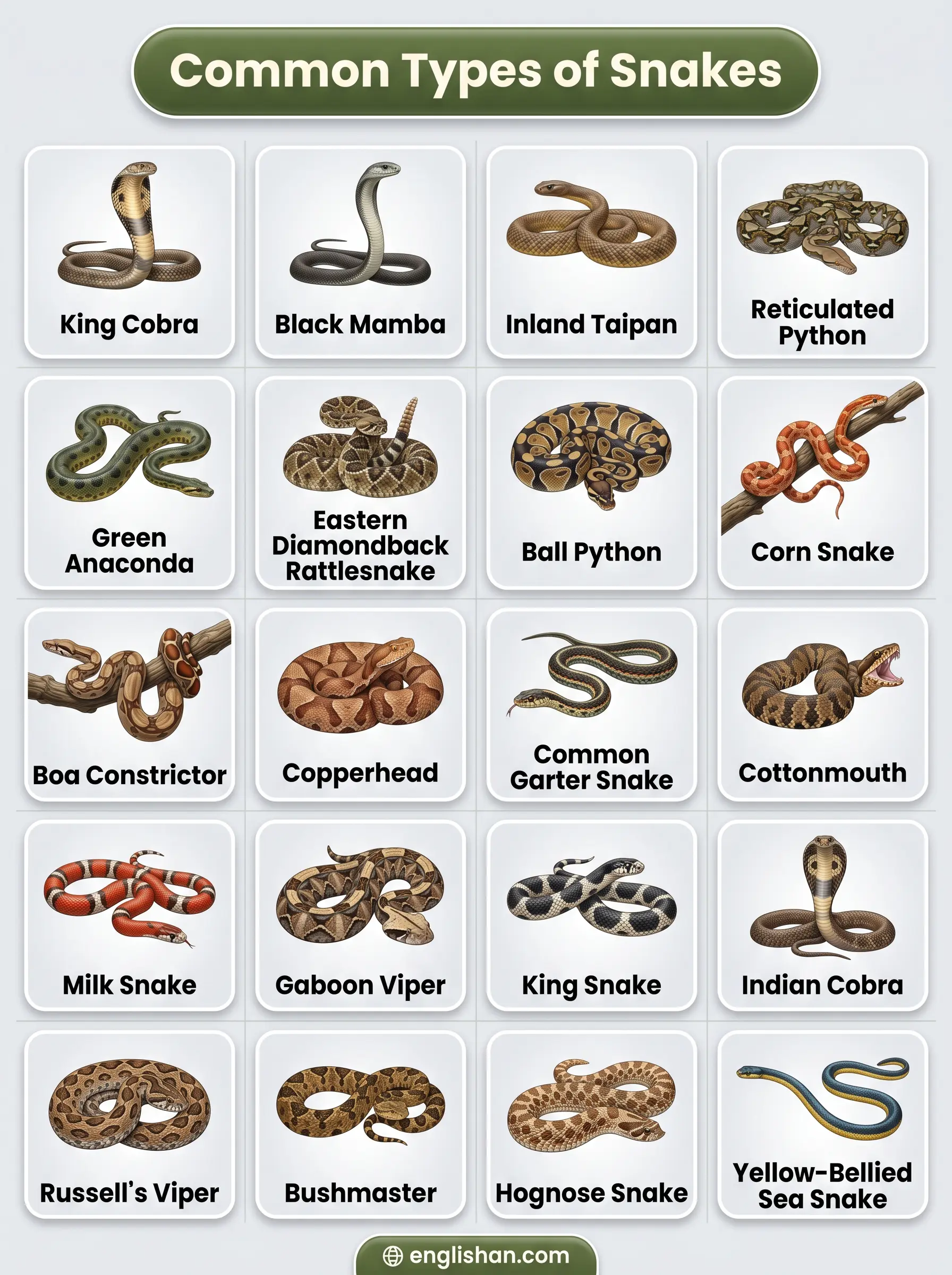
Types of Snakes: 35 Species Names at a Glance
Before diving into detailed descriptions, here is a quick master list of 35 notable snake species from around the world, spanning every major family and habitat:
- King Cobra
- Black Mamba
- Inland Taipan
- Reticulated Python
- Green Anaconda
- Eastern Diamondback Rattlesnake
- Western Diamondback Rattlesnake
- Gaboon Viper
- Puff Adder
- Russell’s Viper
- Saw-Scaled Viper
- Copperhead
- Cottonmouth (Water Moccasin)
- Timber Rattlesnake
- Mojave Rattlesnake
- Indian Cobra (Spectacled Cobra)
- Egyptian Cobra
- Green Mamba
- Common Krait
- Coastal Taipan
- Eastern Coral Snake
- Burmese Python
- Ball Python
- Corn Snake
- California Kingsnake
- Boa Constrictor
- Emerald Tree Boa
- Green Tree Python
- Northern Water Snake
- Eastern Hognose Snake
- Common Garter Snake
- Milk Snake
- Eastern Rat Snake
- Yellow-Bellied Sea Snake
- Brahminy Blind Snake
Common Types of Snakes: Detailed Descriptions
Below are the most well-known snake species in the world, each described in depth:
❶ King Cobra (Ophiophagus hannah)
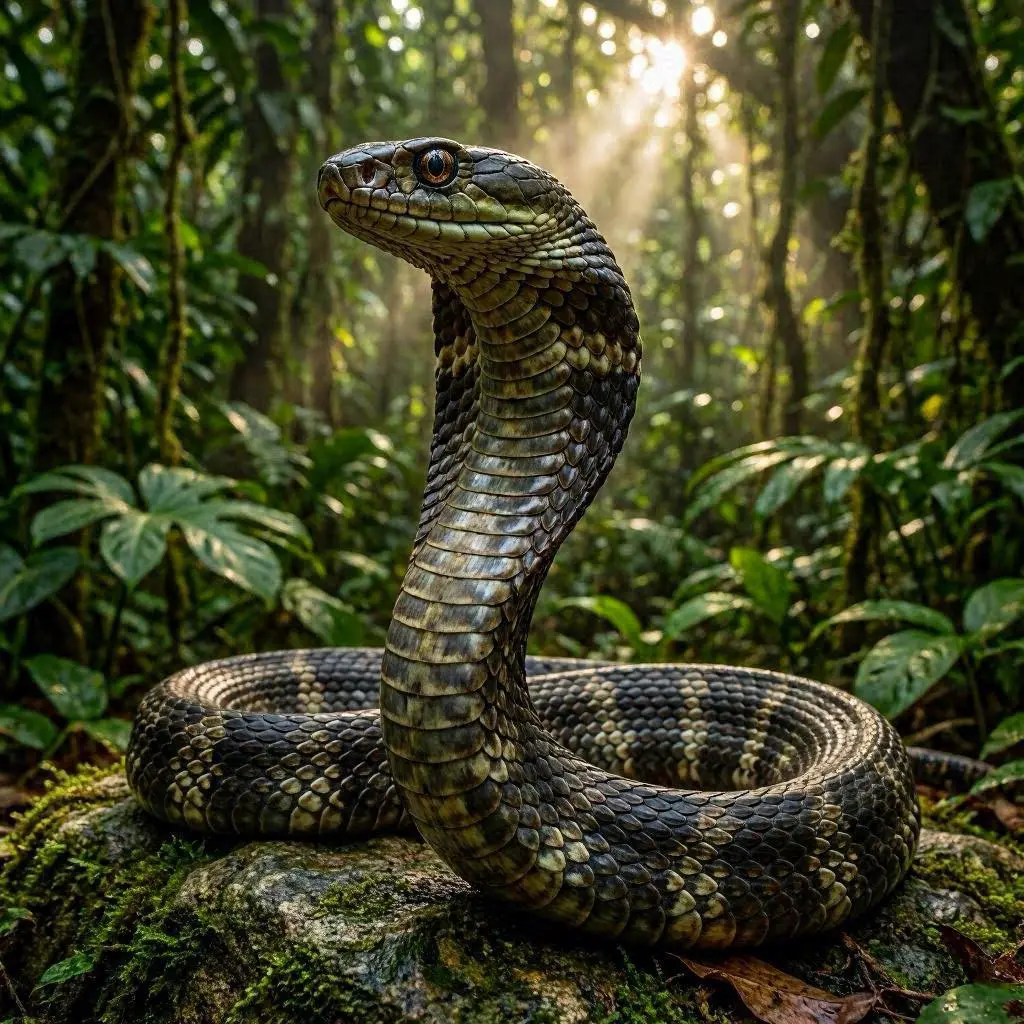
The King Cobra is the world’s longest venomous snake, growing up to 18 feet long. It is famous for raising the front part of its body and spreading its hood when threatened. Found in forests across South and Southeast Asia, it mainly feeds on other snakes and is generally shy around humans.
❷ Black Mamba (Dendroaspis polylepis)
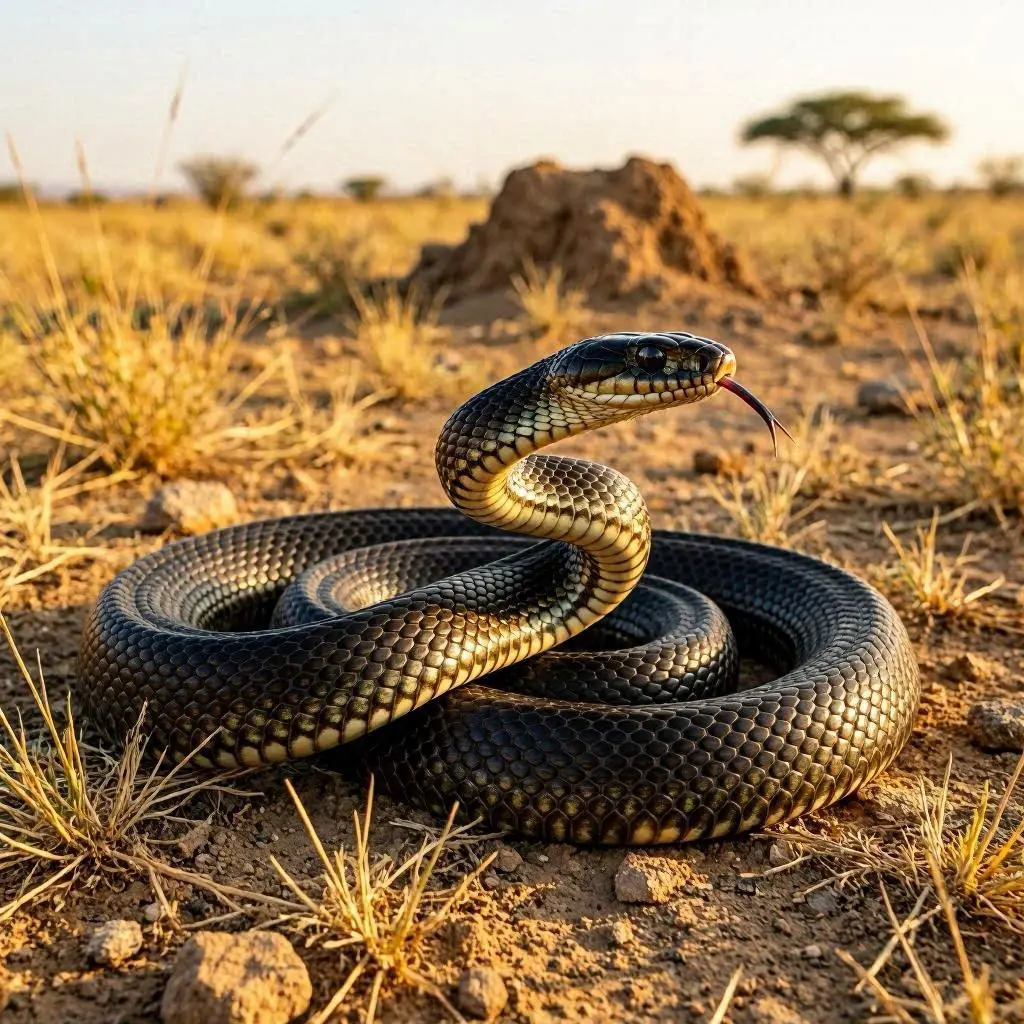
The Black Mamba is one of Africa’s most feared snakes due to its speed and highly potent venom. Despite its name, its body is usually gray or brown, while the inside of its mouth is black. It lives in savannas and woodlands, hunting birds and small mammals.
❸ Inland Taipan (Oxyuranus microlepidotus)
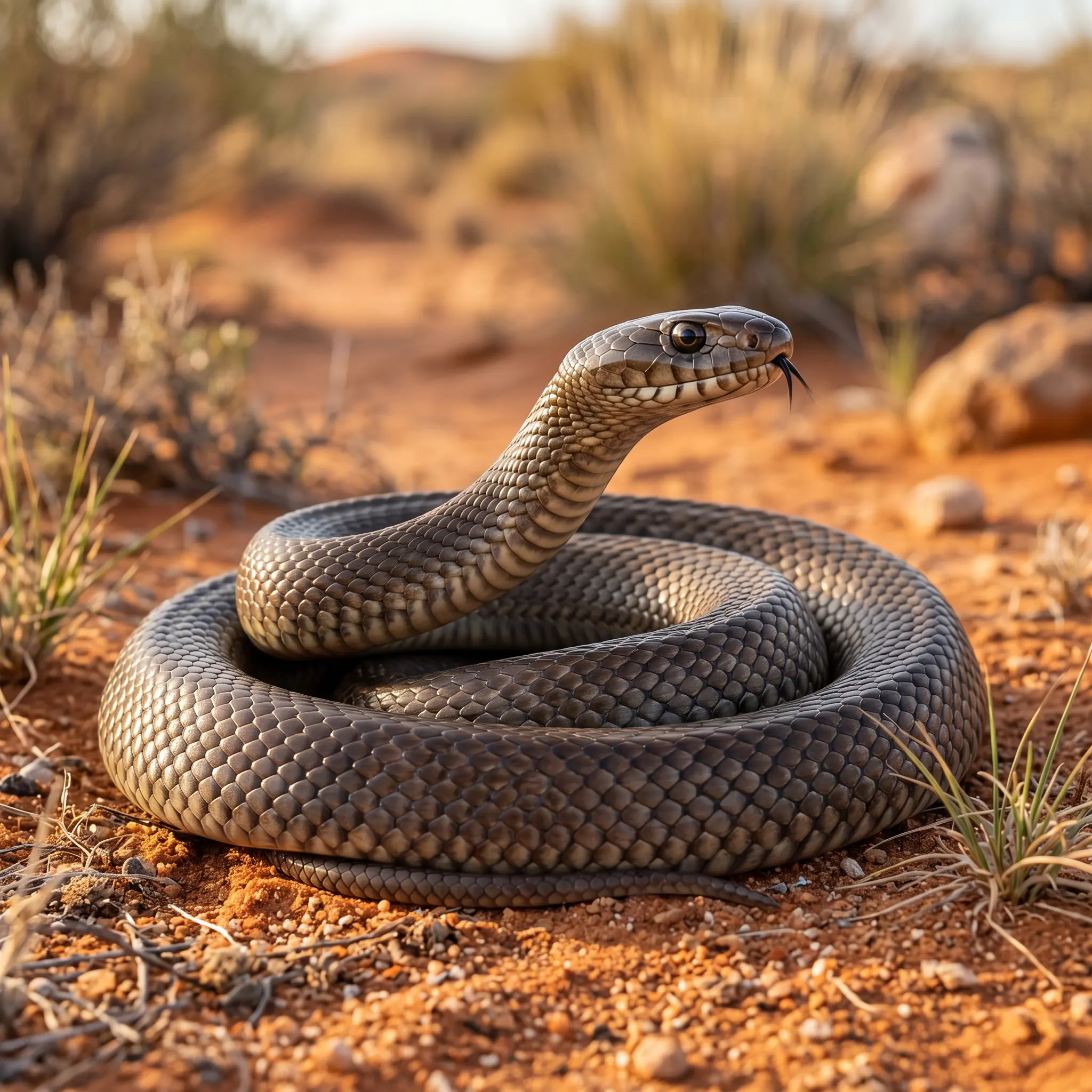
Often called the world’s most venomous land snake, the Inland Taipan lives in remote regions of Australia. It has a slender body that changes color slightly with the seasons. Although its venom is extremely powerful, it is rarely seen and prefers to avoid confrontation.
❹ Reticulated Python (Malayopython reticulatus)
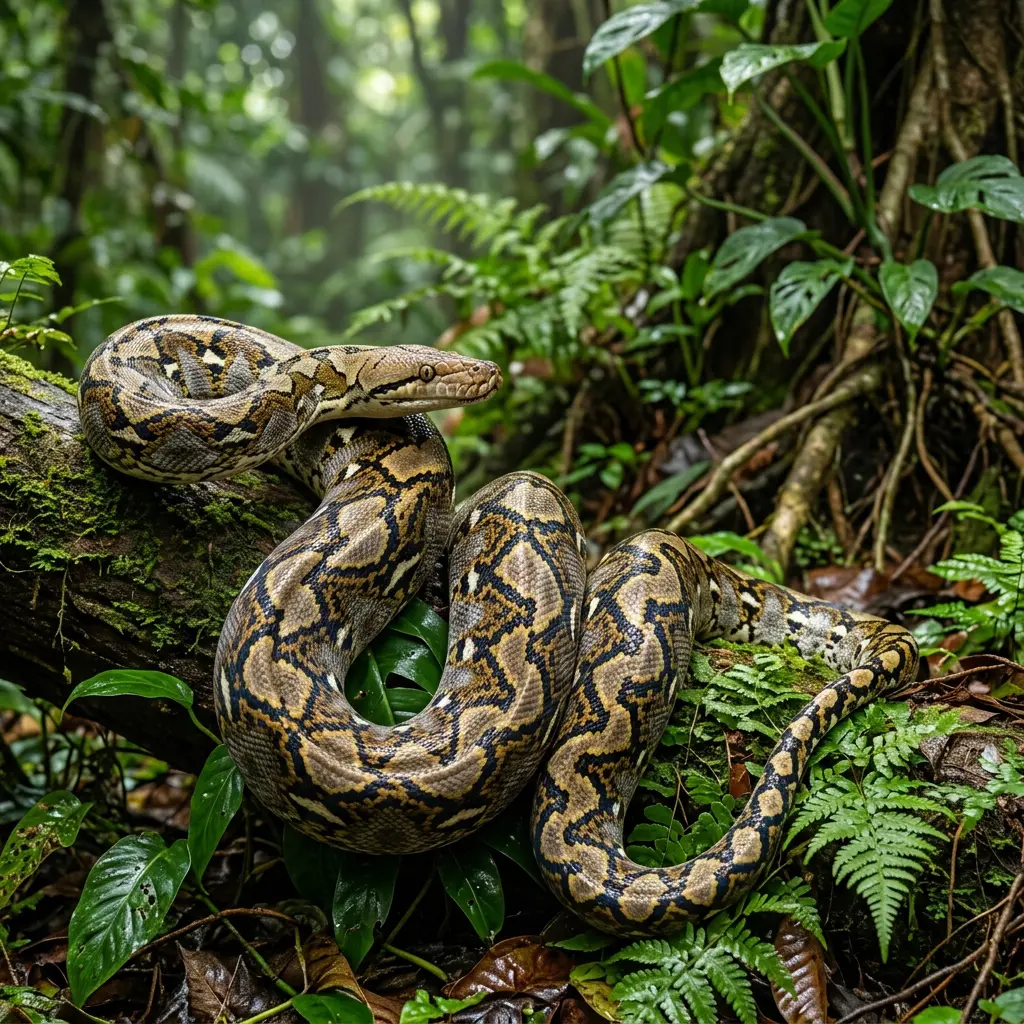
The Reticulated Python is the longest snake species on Earth, sometimes exceeding 20 feet in length. Its body is covered in beautiful net-like patterns that help it blend into its surroundings. It kills prey by constriction and feeds on mammals, birds, and reptiles.
❺ Green Anaconda (Eunectes murinus)
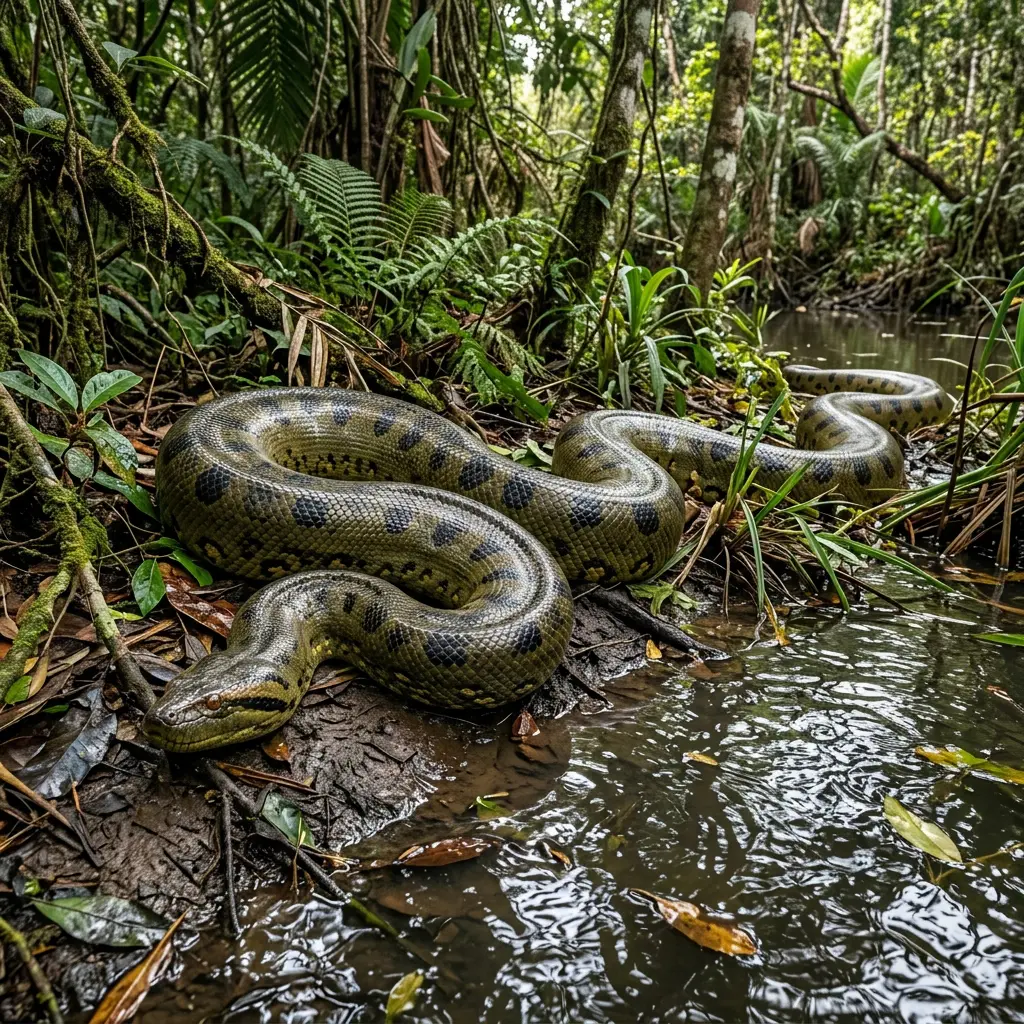
The Green Anaconda is the heaviest snake in the world and one of the largest reptiles alive. It inhabits rivers, swamps, and flooded forests in South America. Its massive body and excellent swimming ability make it a powerful predator of large animals.
❻ Eastern Diamondback Rattlesnake (Crotalus adamanteus)
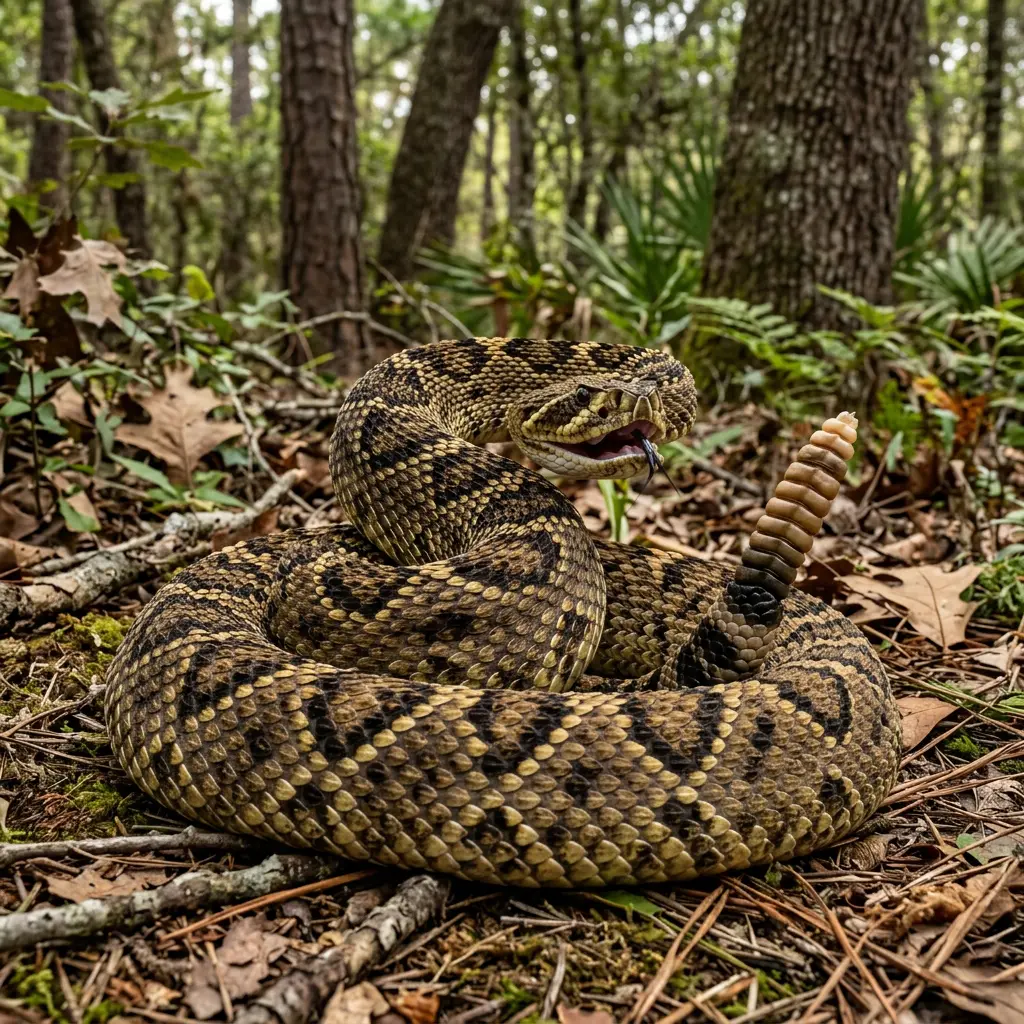
This is the largest venomous snake in North America. It is easily recognized by the dark diamond-shaped markings on its back and the rattle at the tip of its tail. When disturbed, it often rattles as a warning before striking.
❼ Ball Python (Python regius)
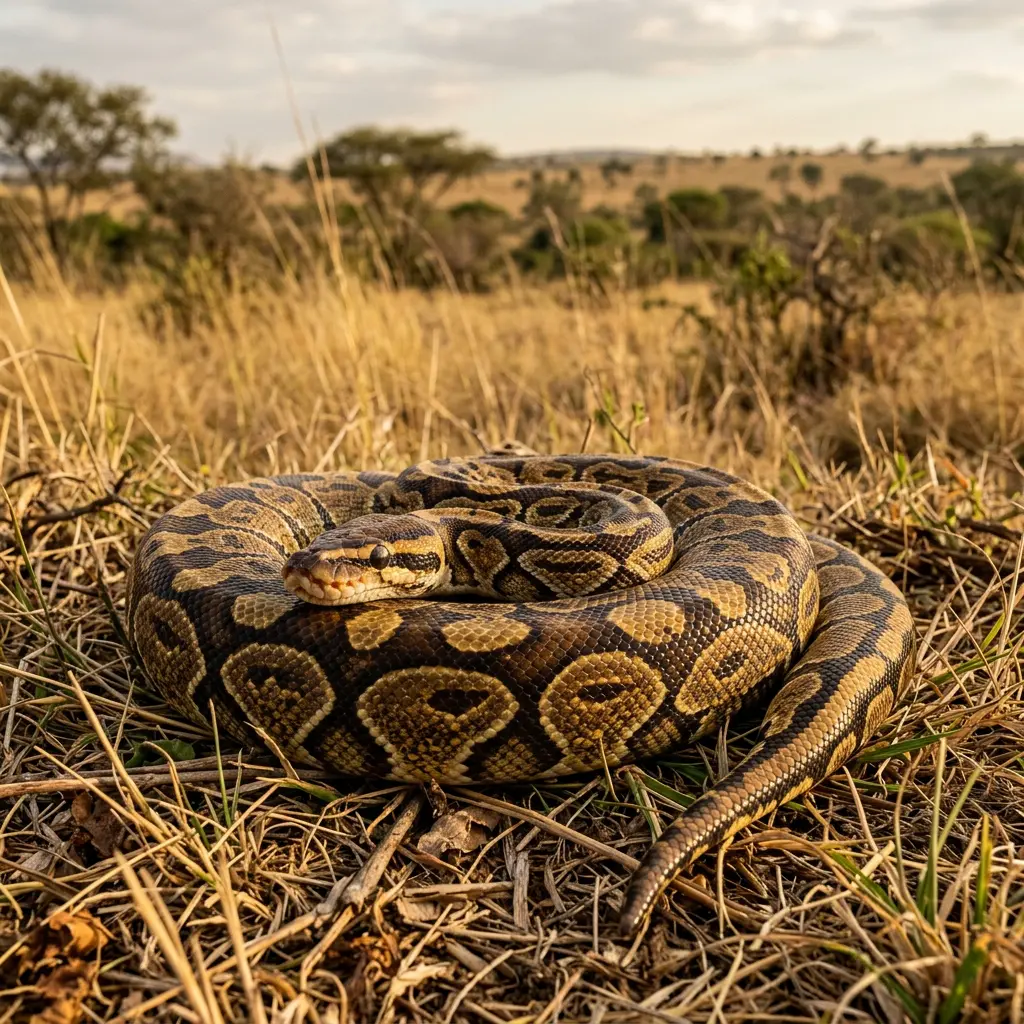
he Ball Python is a small, nonvenomous snake native to Africa. It gets its name from its habit of curling into a tight ball when frightened. Known for its calm nature and beautiful patterns, it is one of the most popular pet snakes worldwide.
❽ Corn Snake (Pantherophis guttatus)
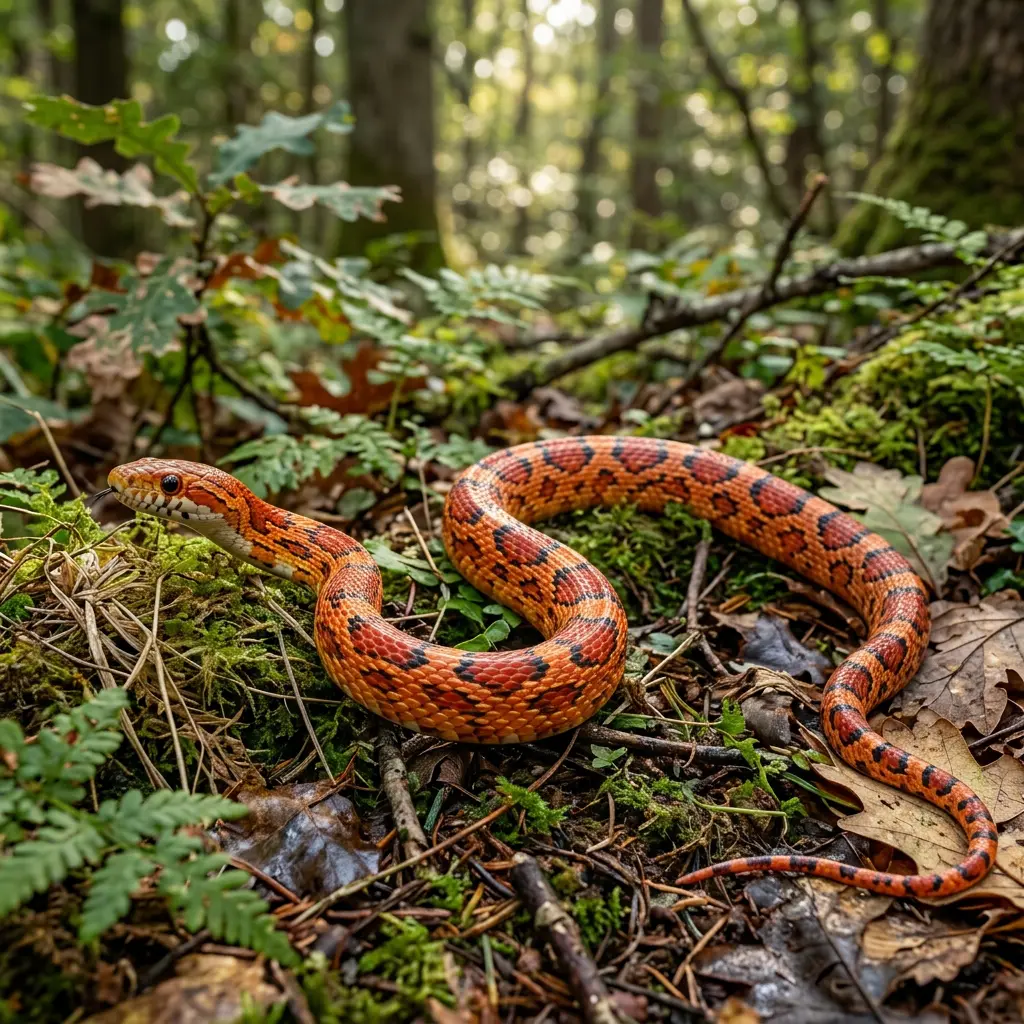
The Corn Snake is a colorful, harmless snake commonly found in the southeastern United States. Its bright orange, red, and black markings make it easy to identify. It is an excellent climber and helps control rodent populations.
❾ Boa Constrictor (Boa constrictor)
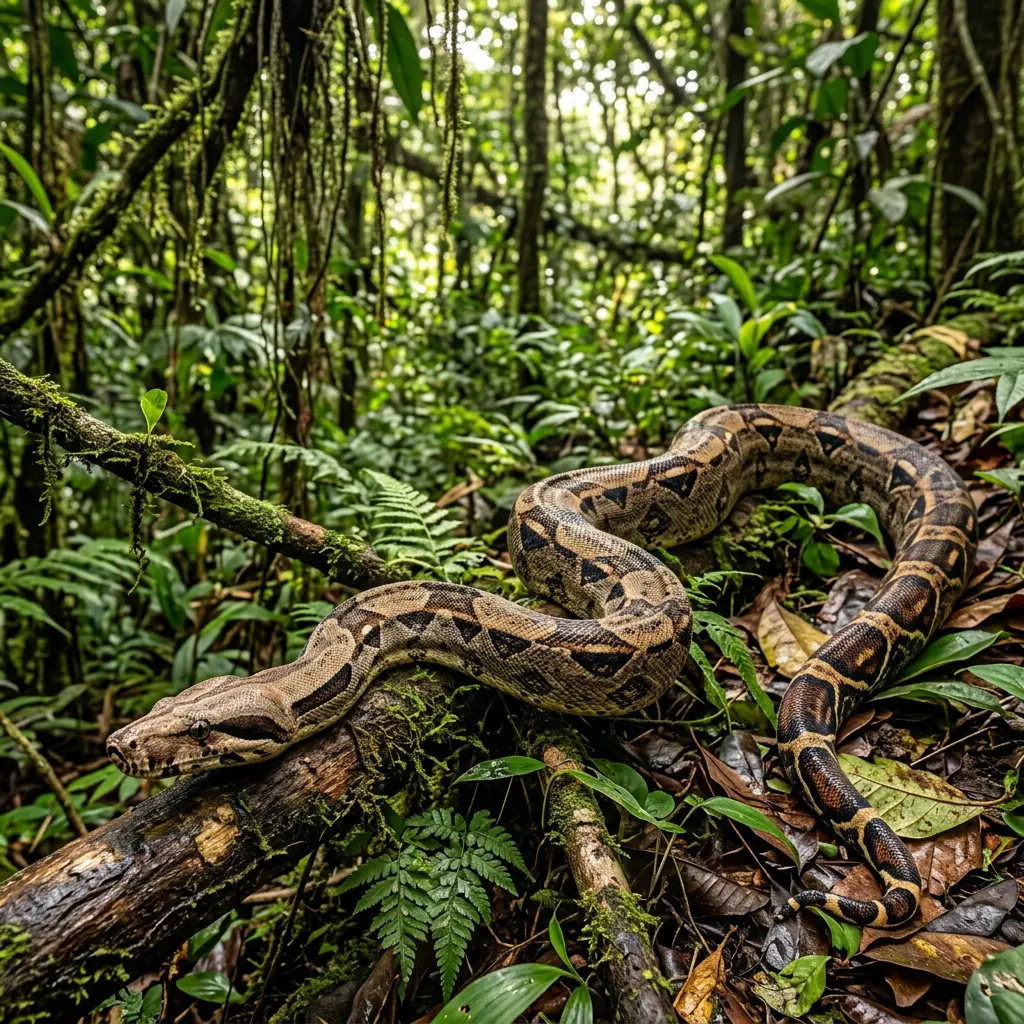
The Boa Constrictor is a large, muscular snake found throughout Central and South America. It uses its powerful body to squeeze prey before swallowing it whole. Its attractive patterns and manageable temperament make it a popular reptile in captivity.
❿ Copperhead (Agkistrodon contortrix)
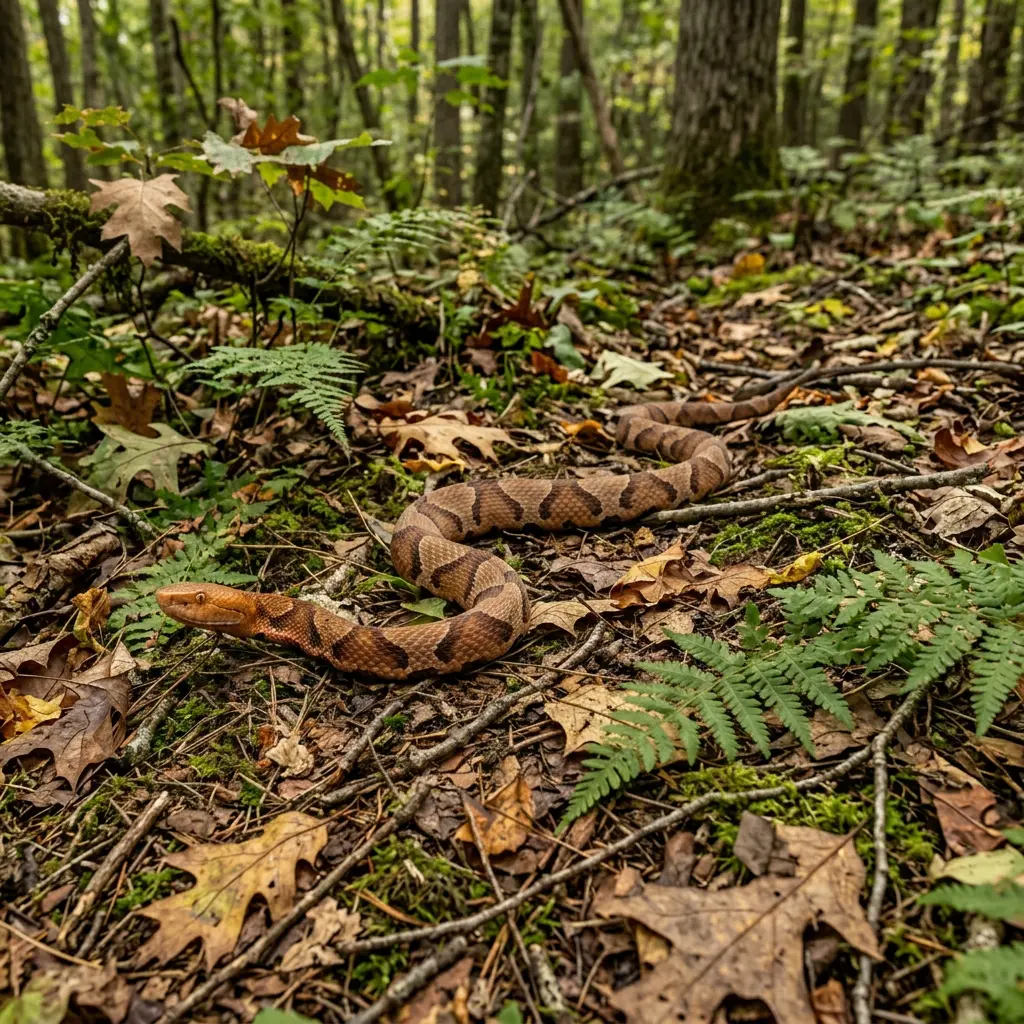
The Copperhead is a venomous snake known for its copper-colored head and distinctive hourglass-shaped markings. Its camouflage allows it to blend perfectly with fallen leaves, making it difficult to spot in forests and woodlands.
⓫ Common Garter Snake (Thamnophis sirtalis)
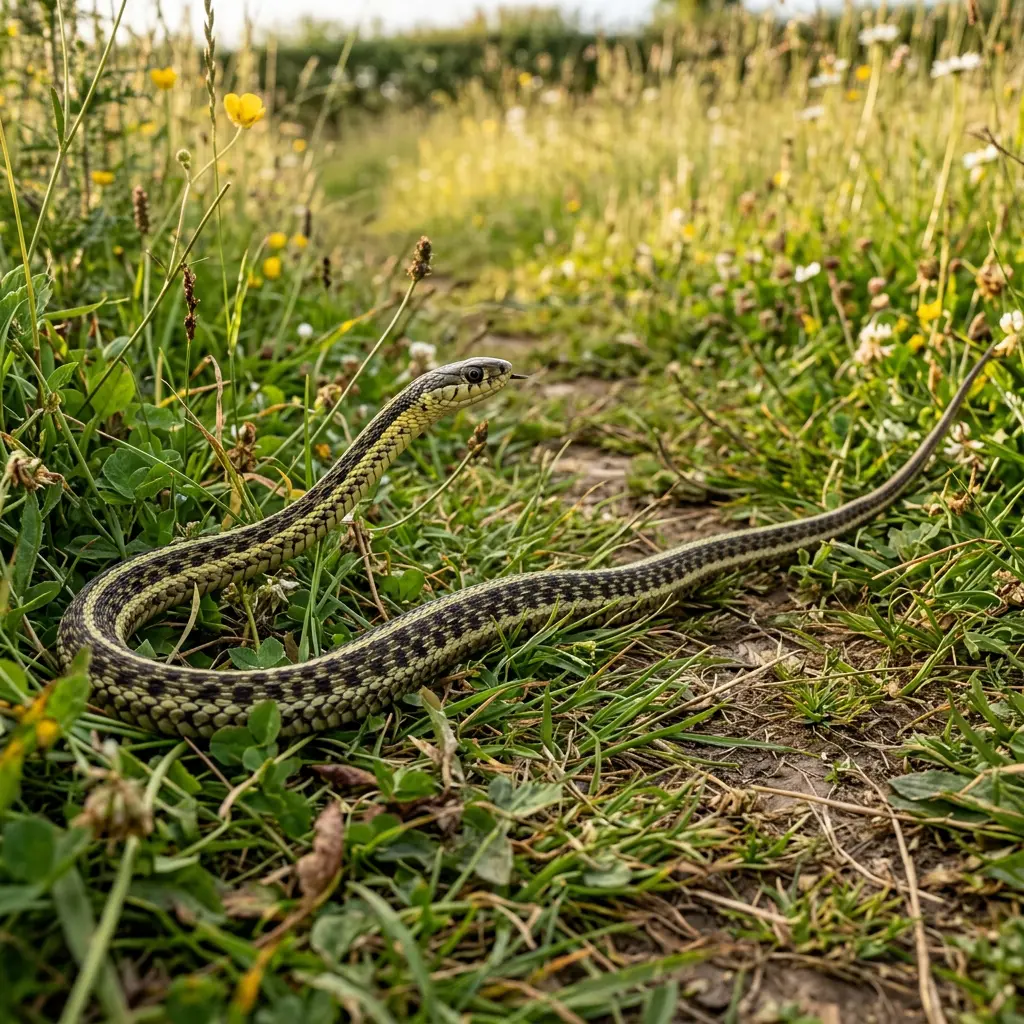
One of the most widespread snakes in North America, the Garter Snake is harmless and highly adaptable. It is usually recognized by the light-colored stripes running along its body and is commonly found near ponds, gardens, and grassy areas.
⓬ Cottonmouth (Agkistrodon piscivorus)
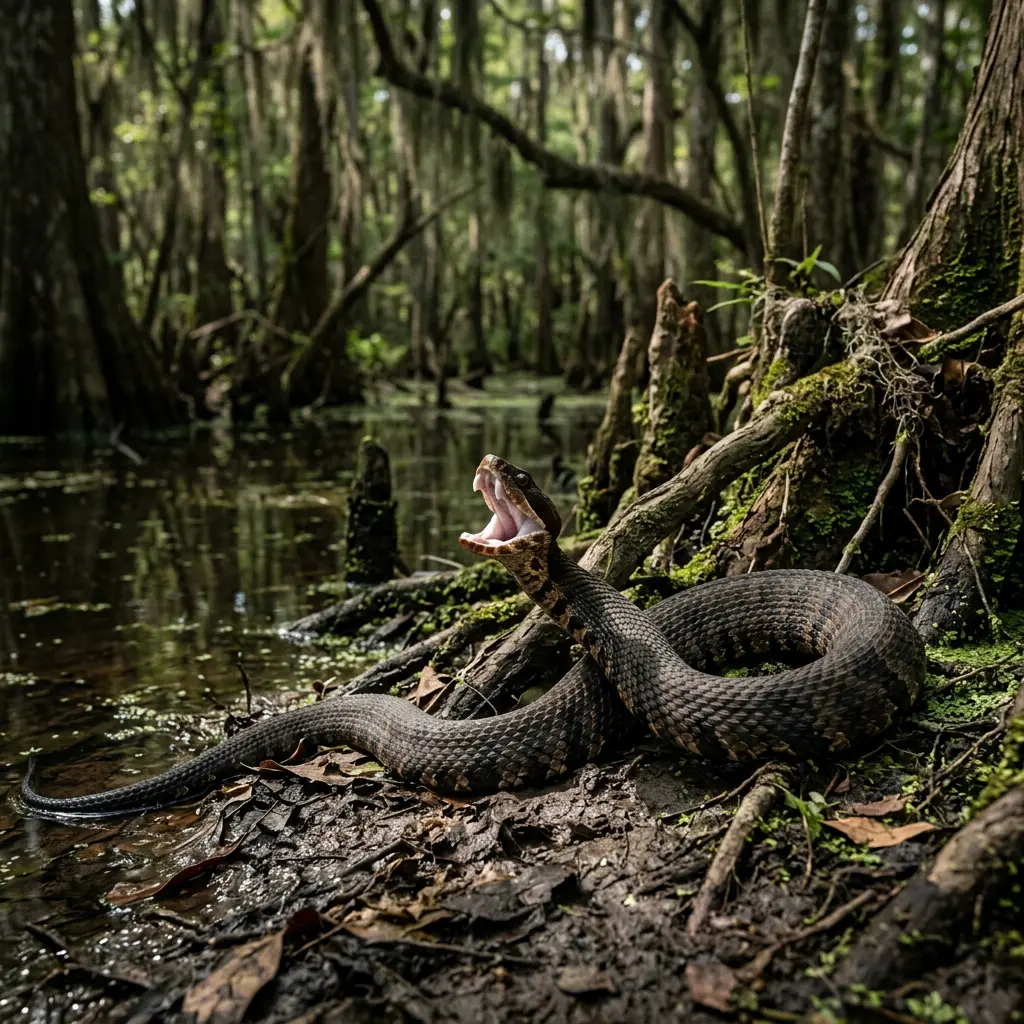
Also known as the Water Moccasin, the Cottonmouth is a semiaquatic venomous snake found near rivers, lakes, and swamps. When threatened, it opens its mouth wide to display its bright white interior, giving the species its common name.
⓭ Milk Snake (Lampropeltis triangulum)
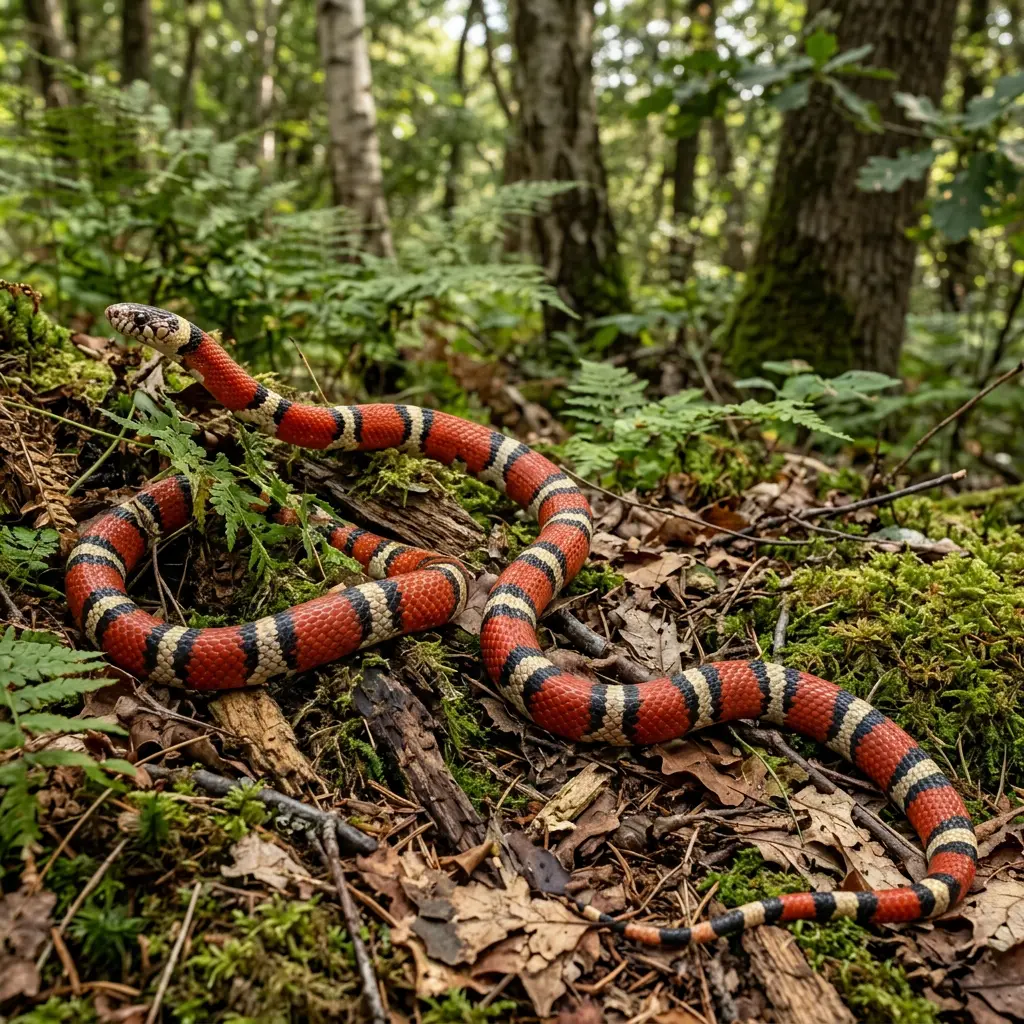
The Milk Snake is a colorful nonvenomous species famous for its resemblance to the venomous Coral Snake. It is found across much of North and Central America and feeds on rodents, birds, lizards, and even other snakes.
⓮ Gaboon Viper (Bitis gabonica)
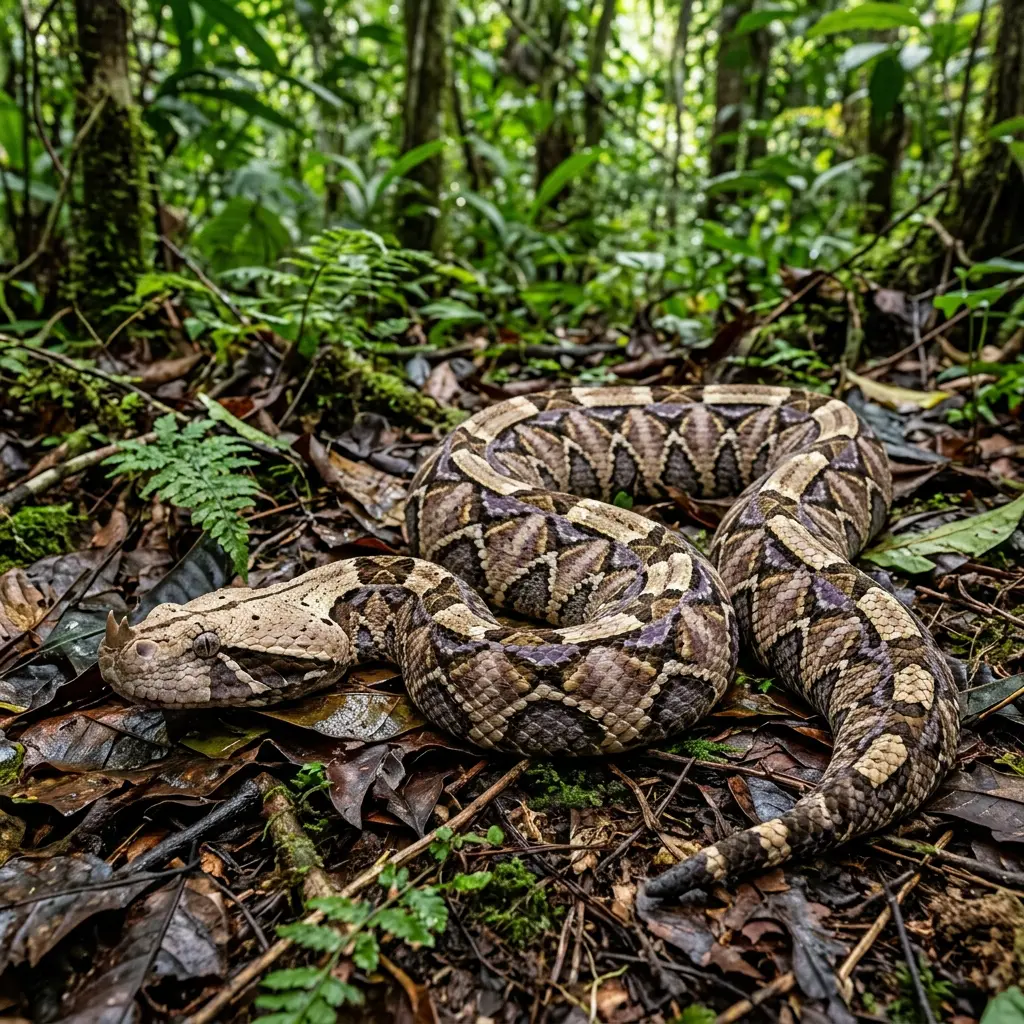
The Gaboon Viper is a large African snake known for its incredible camouflage and exceptionally long fangs. Its beautifully patterned scales help it disappear among fallen leaves while it waits patiently for prey to approach.
⓯ King Snake (Lampropeltis getula)
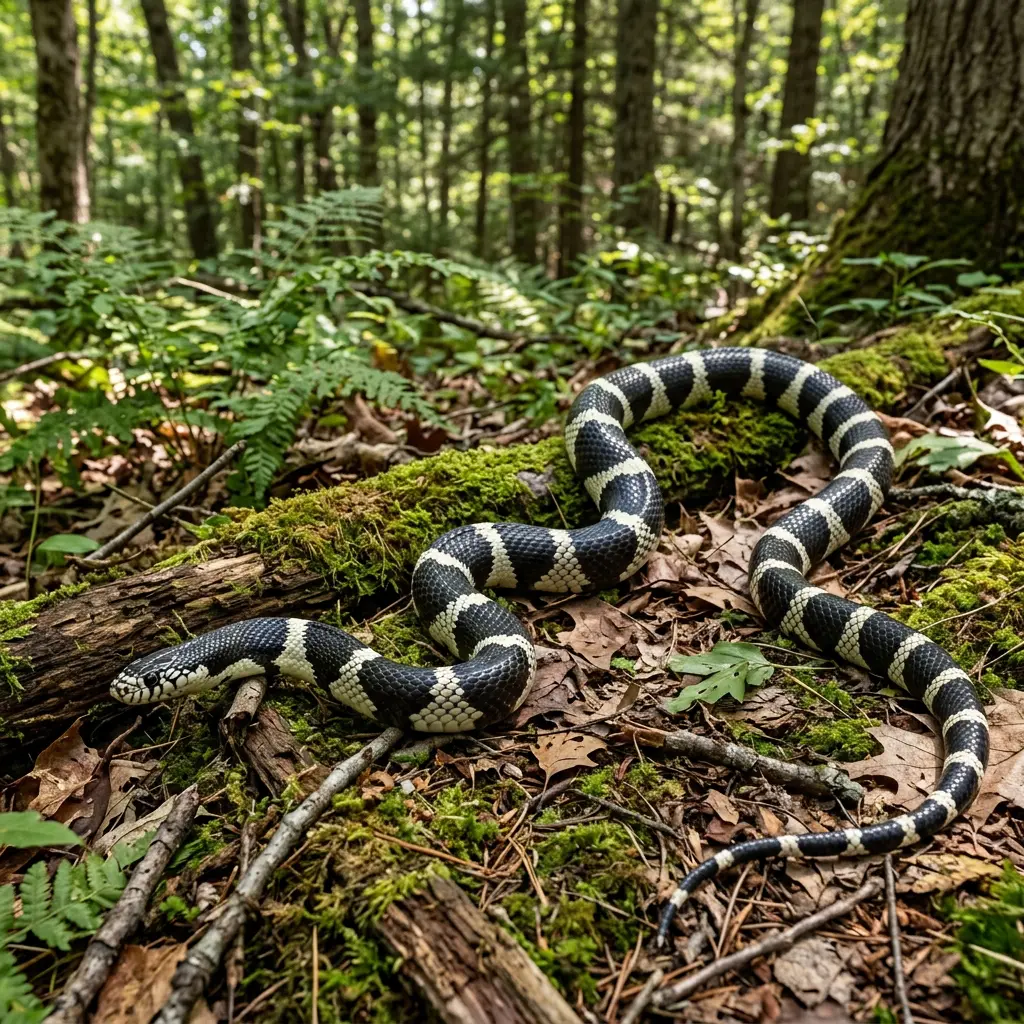
King Snakes are powerful nonvenomous hunters that often prey on other snakes, including venomous species. They are known for their striking patterns, adaptability, and natural resistance to snake venom.
⓰ Indian Cobra (Naja naja)
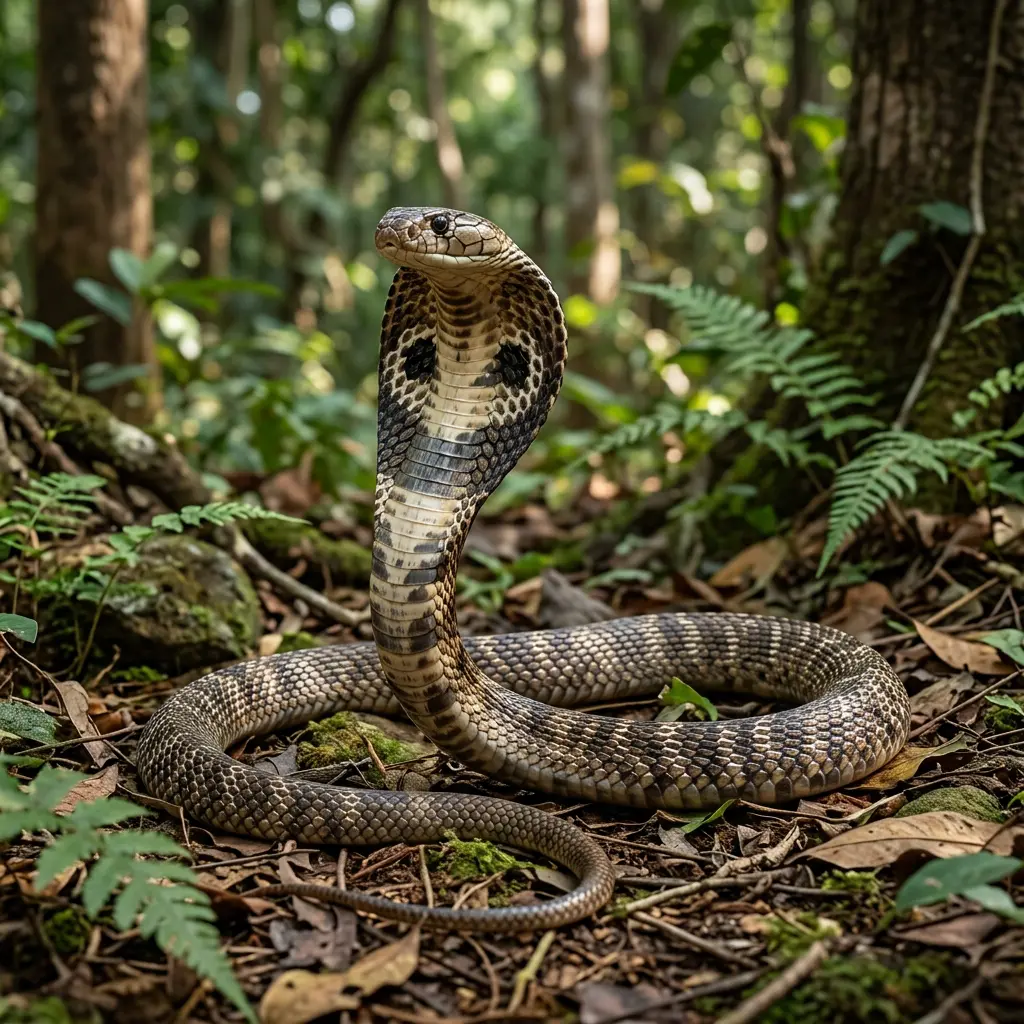
The Indian Cobra is one of the most iconic snakes in Asia. It is recognized by the hood it spreads when threatened and the spectacle-like marking often seen on its back. It plays an important role in the culture and folklore of the Indian subcontinent.
⓱ Russell’s Viper (Daboia russelii)
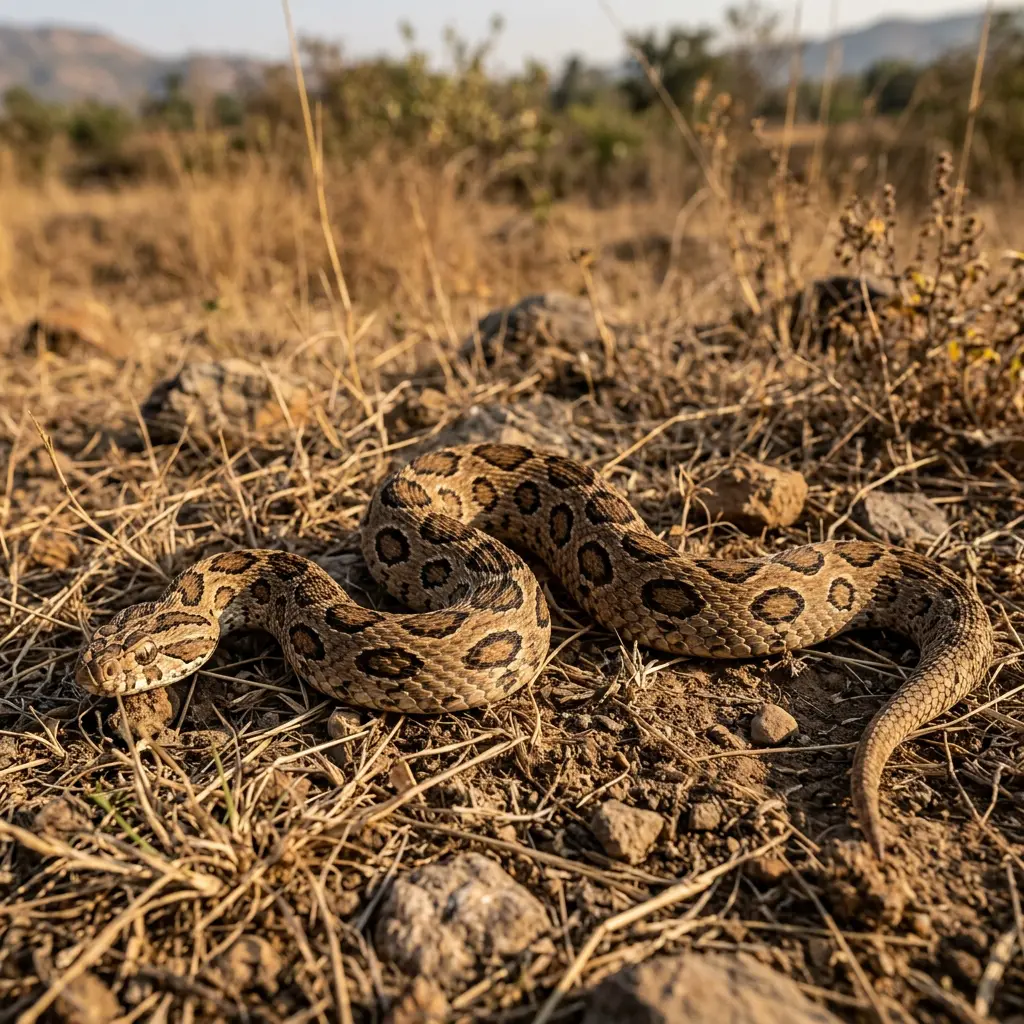
Russell’s Viper is a thick-bodied venomous snake with rows of dark oval spots along its body. Found across South Asia, it is one of the region’s most medically significant snakes due to the number of bites it causes each year.
⓲ Bushmaster (Lachesis muta)
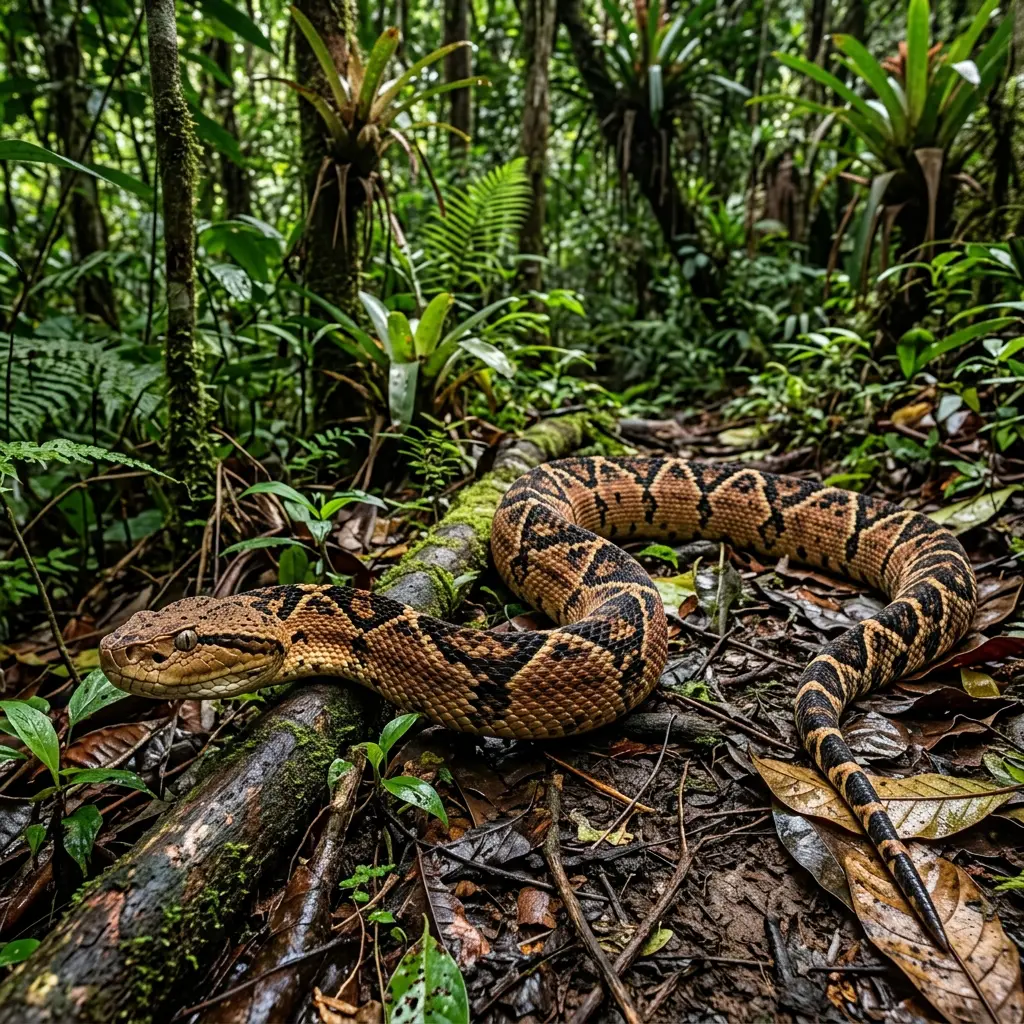
The Bushmaster is the largest venomous snake in the Americas, capable of reaching impressive lengths. It inhabits dense tropical rainforests and is mainly active at night, hunting small mammals and birds.
⓳ Hognose Snake (Heterodon platirhinos)
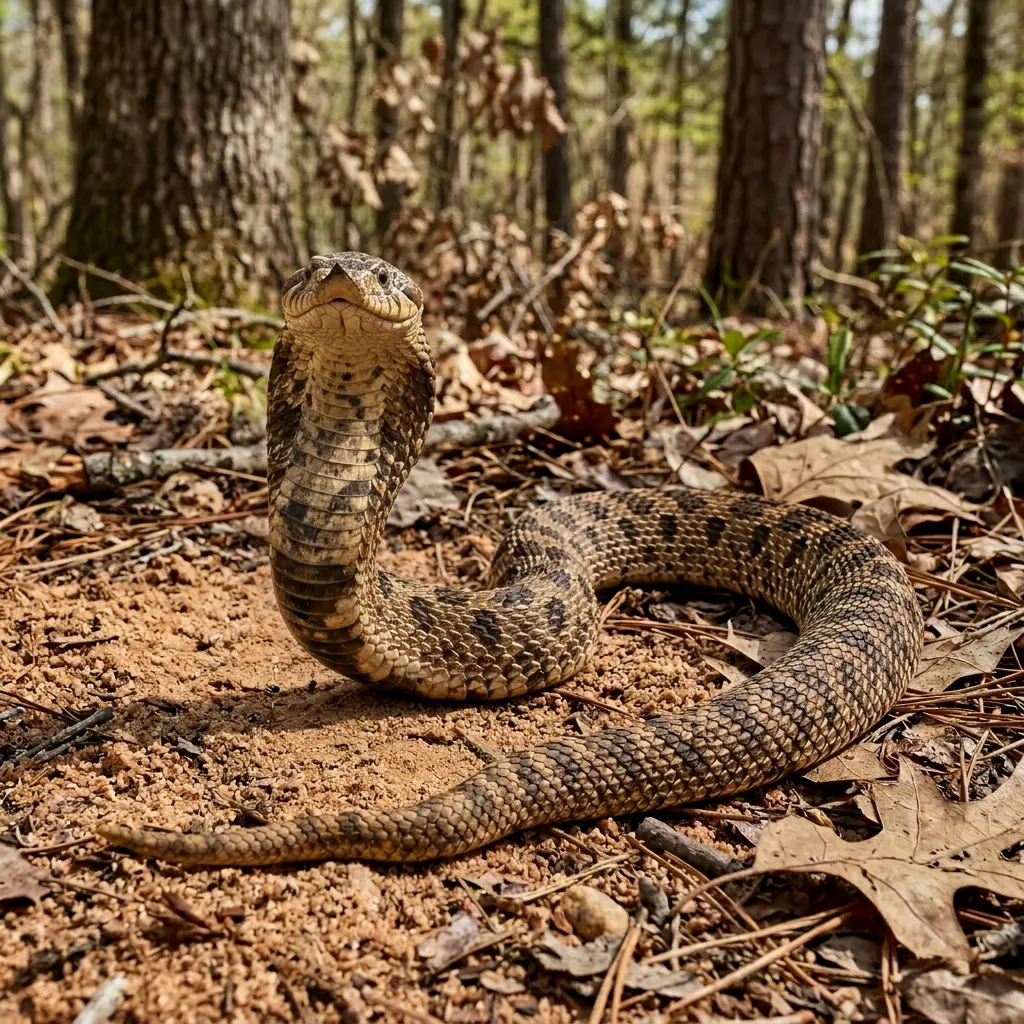
he Hognose Snake is famous for its dramatic defensive behavior. If threatened, it may hiss, flatten its neck like a cobra, or even roll over and pretend to be dead. Despite its performance, it is harmless to humans.
⓴ Yellow-Bellied Sea Snake (Hydrophis platurus)
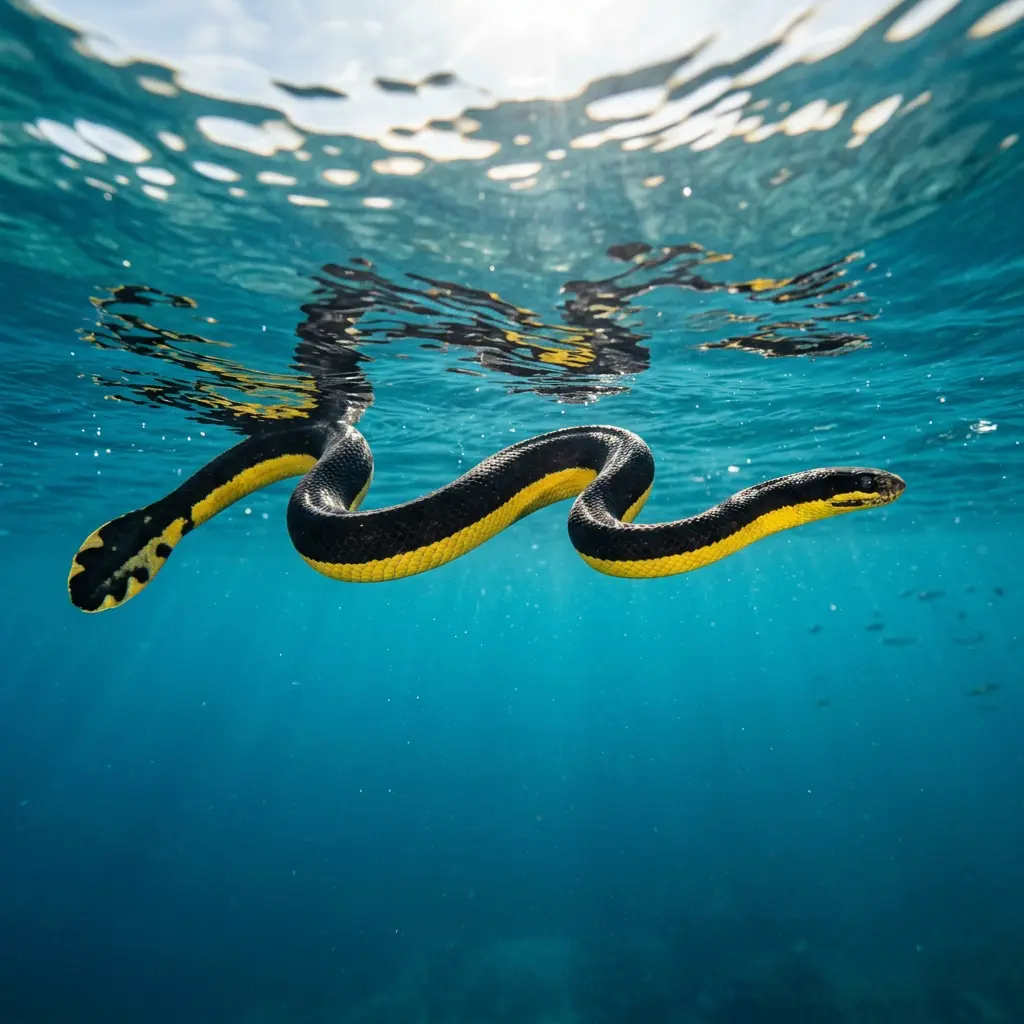
The Yellow-Bellied Sea Snake spends its entire life in the ocean and is found across tropical waters of the Pacific and Indian Oceans. Its flattened tail acts like a paddle, allowing it to swim efficiently while hunting fish near the surface.
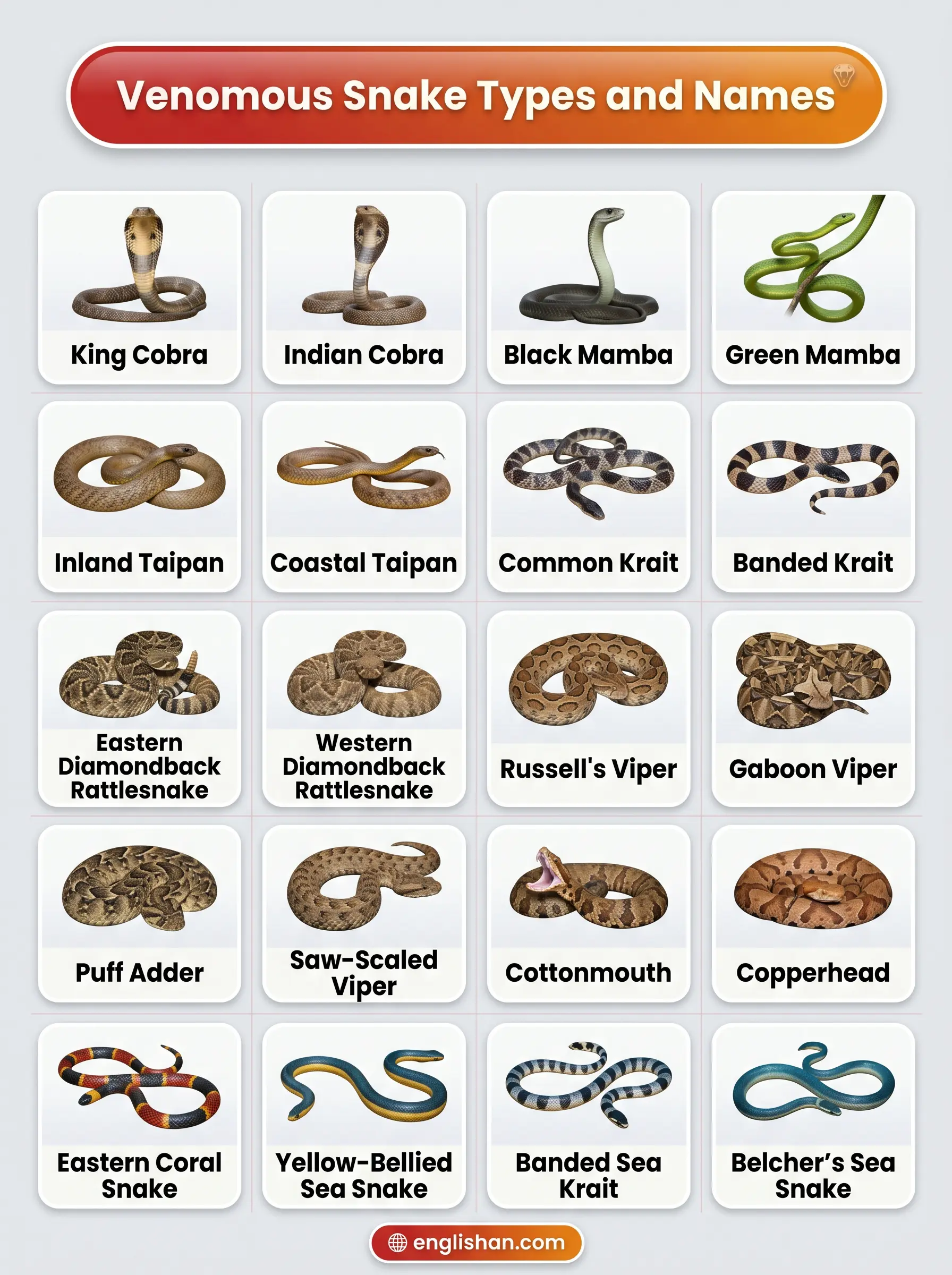
Venomous Snake Types and Names
Venomous snakes deliver venom through fangs, either fixed (as in cobras and mambas) or hinged fangs that fold back when the mouth is closed (as in vipers). Snake venom has two main types of toxicity:
Neurotoxic venom attacks the nervous system, causing paralysis and respiratory failure. Found in cobras, mambas, coral snakes, taipans, and kraits.
Hemotoxic venom attacks blood cells and tissue, causing internal bleeding and tissue death. Found in most vipers and rattlesnakes.
Some species have both.
Vipers
Vipers are among the most dangerous snakes on Earth. All are venomous, all have long, hinged fangs, and most have a triangular head and heat-sensing pit organs (in pit vipers) that detect warm-blooded prey in total darkness.
- Eastern Diamondback Rattlesnake (Crotalus adamanteus)
The largest venomous snake in the United States, recognized by its diamond-shaped markings and powerful hemotoxic venom. - Western Diamondback Rattlesnake (Crotalus atrox)
A common North American rattlesnake known for its black-and-white banded tail and defensive rattling behavior. - Timber Rattlesnake (Crotalus horridus)
A large forest-dwelling rattlesnake with dark crossbands that provide excellent camouflage among trees and leaf litter. - Mojave Rattlesnake (Crotalus scutulatus)
A desert species famous for having one of the most potent rattlesnake venoms, combining neurotoxic and hemotoxic effects. - Sidewinder Rattlesnake (Crotalus cerastes)
A small desert rattlesnake that moves sideways across sand, leaving distinctive J-shaped tracks. - Western Rattlesnake (Crotalus oreganus)
A widespread rattlesnake found across western North America in habitats ranging from forests to deserts. - Eastern Massasauga (Sistrurus catenatus)
A small rattlesnake native to wetlands and grasslands, known for its secretive nature and mild temperament. - Copperhead (Agkistrodon contortrix)
A venomous snake with a copper-colored head and hourglass-shaped markings that blend perfectly with fallen leaves. - Cottonmouth / Water Moccasin (Agkistrodon piscivorus)
North America’s only truly aquatic venomous snake, commonly found in swamps, rivers, and marshes. - Russell’s Viper (Daboia russelii)
One of Asia’s most dangerous snakes, responsible for many snakebite cases due to its wide distribution near human settlements. - Saw-Scaled Viper (Echis carinatus)
A small but highly dangerous viper that produces a rasping sound by rubbing its scales together before striking. - Gaboon Viper (Bitis gabonica)
Africa’s largest viper, famous for its exceptionally long fangs and remarkable camouflage. - Puff Adder (Bitis arietans)
A thick-bodied African viper responsible for more snakebite fatalities in Africa than any other snake species.
Elapids (Family: Elapidae)
Elapids have fixed front fangs and predominantly neurotoxic venom. This family includes some of the world’s most feared and fastest-acting venomous snakes.
Cobras
Cobras are famous for their hood-spreading display, which makes them appear larger and more intimidating when threatened.
- Indian Cobra (Naja naja)
One of India’s “Big Four” venomous snakes. Recognized by the spectacle-shaped marking on its hood and known for its powerful neurotoxic venom. - King Cobra (Ophiophagus hannah)
The world’s longest venomous snake, reaching up to 18 feet. It mainly feeds on other snakes and is the only snake known to build a nest for its eggs. - Egyptian Cobra (Naja haje)
A large, highly venomous cobra found across Africa and the Middle East. It is often associated with ancient Egyptian history and symbolism. - Monocled Cobra (Naja kaouthia)
Named for the circular “monocle” marking on its hood. It is common in South and Southeast Asia and is responsible for many snakebite cases. - Spitting Cobras (Various Naja species)
Several cobra species can accurately spray venom into an attacker’s eyes from several feet away, causing intense pain and possible blindness.
Mambas
Mambas are fast, agile, and highly venomous snakes native to Africa.
- Black Mamba (Dendroaspis polylepis)
Africa’s longest venomous snake and one of the fastest in the world. Its venom acts rapidly and can be fatal without prompt treatment. - Green Mamba (Dendroaspis angusticeps)
A bright green, tree-dwelling snake found in East Africa. It is less aggressive than the Black Mamba but equally venomous. - Western Green Mamba (Dendroaspis viridis)
Found in West Africa, this slender green snake spends most of its life in trees and feeds on birds and small mammals. - Jameson’s Mamba (Dendroaspis jamesoni)
A rainforest species known for its agility and potent neurotoxic venom.
Kraits
Kraits are nocturnal snakes found throughout South and Southeast Asia. Their venom is among the most potent of all elapids.
- Common Krait (Bungarus caeruleus)
One of India’s deadliest snakes. Many bites occur at night while people are sleeping. - Banded Krait (Bungarus fasciatus)
Easily identified by its bold black-and-yellow bands. It is generally shy but possesses powerful neurotoxic venom. - Malayan Krait (Bungarus candidus)
A highly venomous species found across Southeast Asia and considered medically significant.
Taipans
Taipans are large Australian snakes known for their extremely potent venom.
- Inland Taipan (Oxyuranus microlepidotus)
Widely regarded as the most venomous land snake in the world. Despite its deadly venom, it is shy and rarely encountered. - Coastal Taipan (Oxyuranus scutellatus)
A large, fast-moving snake found in northeastern Australia and Papua New Guinea. It is considered one of the most dangerous snakes in the region.
Coral Snakes
Coral snakes are brightly colored elapids recognized for their red, yellow, and black banding patterns.
- Eastern Coral Snake (Micrurus fulvius)
Found in the southeastern United States. Its powerful neurotoxic venom makes it one of North America’s most dangerous snakes. - Texas Coral Snake (Micrurus tener)
Similar in appearance to the Eastern Coral Snake and commonly found in the southern United States. - Arizona Coral Snake (Micruroides euryxanthus)
A smaller desert species with potent venom but a very secretive nature.
Sea Snakes
Sea snakes are highly adapted to marine life, with paddle-shaped tails and the ability to remain underwater for long periods.
- Yellow-Bellied Sea Snake (Hydrophis platurus)
The most widespread sea snake, recognized by its black upper body and bright yellow underside. - Banded Sea Krait (Laticauda colubrina)
A semi-aquatic species that regularly comes ashore to rest, drink freshwater, and lay eggs. - Belcher’s Sea Snake (Hydrophis belcheri)
Possesses extremely potent venom but is generally docile and rarely bites humans.
Nonvenomous Snake Types and Names
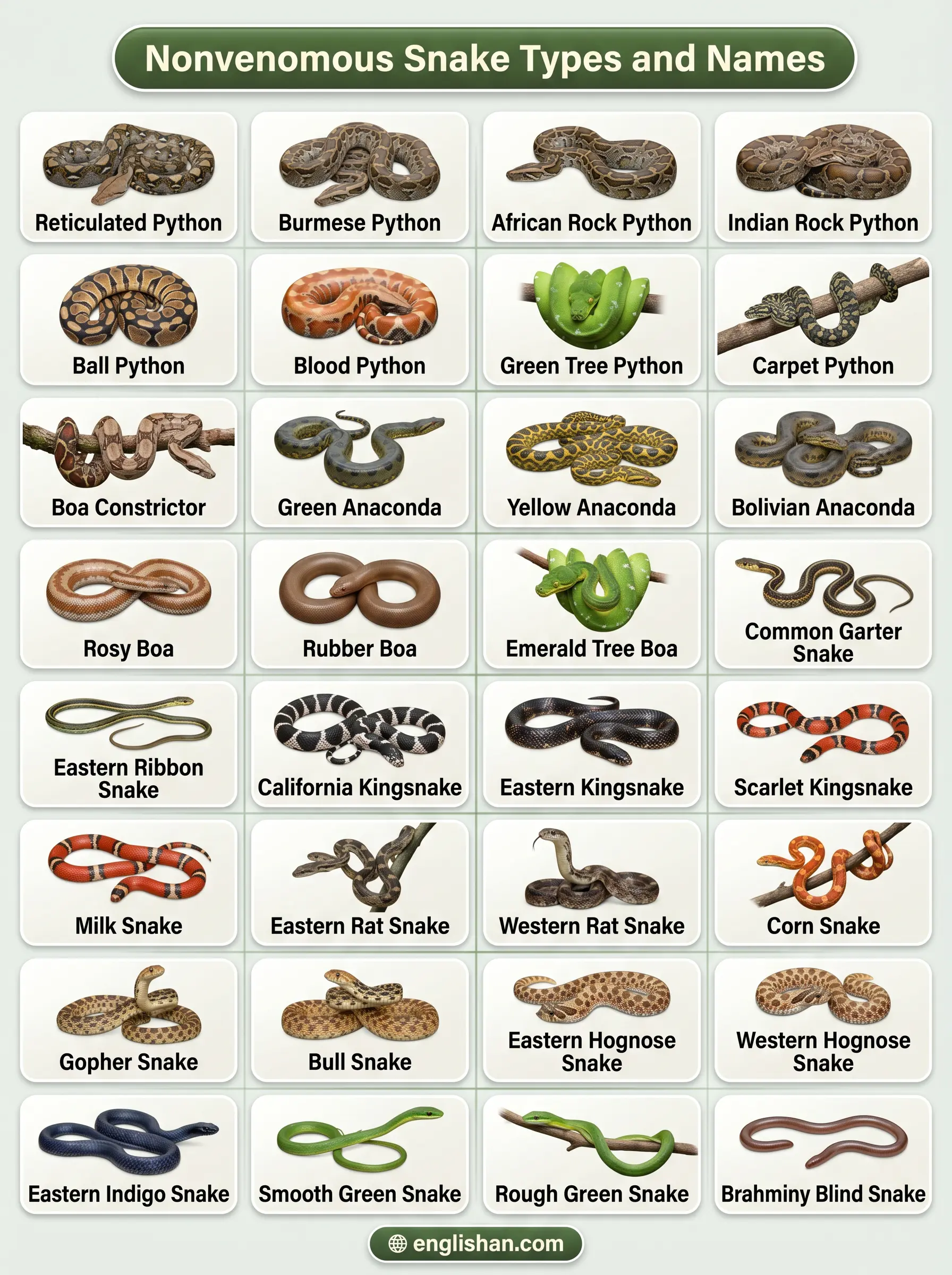
The vast majority of snakes, roughly 85% of all species, are nonvenomous and completely harmless to humans. Many are beneficial, controlling pest rodent populations naturally.
Pythons
Pythons are nonvenomous constrictors. They kill by coiling around prey and squeezing until the animal can no longer breathe, then swallowing it whole. Found in Africa, Asia, and Australia, pythons are among the world’s largest snakes.
Pythons are large, nonvenomous snakes that kill prey through constriction. Found across Africa, Asia, and Australia, they are known for their strength, impressive size, and diverse patterns.
- Reticulated Python (Malayopython reticulatus)
The world’s longest snake, often exceeding 20 feet in length. Native to Southeast Asia, it is recognized by its beautiful net-like scale pattern and powerful constricting ability. - Burmese Python (Python bivittatus)
One of the largest snakes on Earth, capable of reaching over 18 feet. Native to Asia, it has also become an invasive species in Florida, where it has severely impacted local wildlife. - African Rock Python (Python sebae)
Africa’s largest snake and a powerful predator. It inhabits grasslands, forests, and areas near water, feeding on a wide variety of animals. - Indian Rock Python (Python molurus)
A large python native to the Indian subcontinent and Southeast Asia. It is known for its calm nature and distinctive blotched pattern. - Ball Python (Python regius)
The most popular pet snake in the world. Small, gentle, and easy to care for, it curls into a tight ball when threatened. - Blood Python (Python brongersmai)
A heavy-bodied python famous for its striking red, orange, and brown coloration. It is native to Southeast Asia and has become increasingly popular among reptile keepers. - Green Tree Python (Morelia viridis)
A stunning tree-dwelling snake found in New Guinea and northern Australia. Adults are bright green and spend much of their lives coiled around branches. - Carpet Python (Morelia spilota)
A highly adaptable Australian python with beautiful patterned scales. It thrives in a variety of habitats, from forests and grasslands to suburban areas.
Boas
Like pythons, boas are nonvenomous constrictors. Unlike most pythons, boas give birth to live young rather than laying eggs. Found primarily in the Americas, with some species in Africa and Madagascar.
- Boa Constrictor (Boa constrictor)
One of the world’s most recognizable snakes, native to Central and South America. It typically grows 6–13 feet long and captures birds and mammals by wrapping its body around them. - Green Anaconda (Eunectes murinus)
The heaviest snake in the world and one of the largest reptiles alive. Found in South American swamps and rivers, it can exceed 20 feet in length and prey on animals such as capybaras, deer, and caimans. - Yellow Anaconda (Eunectes notaeus)
A smaller relative of the Green Anaconda, usually reaching 10–15 feet. It is found in the wetlands of Paraguay, Bolivia, and Argentina and is recognized by its yellowish body covered with dark blotches. - Bolivian Anaconda (Eunectes beniensis)
A lesser-known anaconda species native to Bolivia. Closely related to the Green Anaconda, it is smaller and remains relatively understudied. - Rosy Boa (Lichanura trivirgata)
A small, gentle boa found in the deserts of the southwestern United States and Baja California. Its attractive striped pattern and calm temperament make it a popular pet snake. - Rubber Boa (Charina bottae)
One of North America’s smallest boa species, known for its smooth, rubber-like skin. It inhabits forests and grasslands and is considered one of the most docile snakes in the world. - Emerald Tree Boa (Corallus caninus)
A striking tree-dwelling snake of the Amazon rainforest. Its bright green color and elegant coiled resting posture make it one of the most beautiful boa species.
Colubrid Snakes
The Colubrids are the largest snake family, containing roughly two-thirds of all snake species. Most are completely nonvenomous; a small number have mild rear-fanged venom that is harmless to humans.
Garter Snakes
Garter snakes are among the most common and widespread snakes in North America. They are small, active during the day, and completely harmless to humans.
- Common Garter Snake (Thamnophis sirtalis)
The most widespread snake in North America, found in habitats ranging from forests and meadows to gardens and wetlands. It is easily recognized by the three light-colored stripes running along its body. - Eastern Ribbon Snake (Thamnophis saurita)
A slender relative of the garter snake that prefers wetlands and marshes. It is fast-moving and primarily feeds on frogs and other amphibians.
King Snakes and Milk Snakes
King snakes are powerful constrictors famous for their ability to hunt and eat venomous snakes, including rattlesnakes and copperheads.
- California Kingsnake (Lampropeltis californiae)
A popular pet snake known for its striking black-and-white bands or stripes. It is adaptable, hardy, and found throughout the western United States. - Eastern Kingsnake (Lampropeltis getula)
A glossy black snake with white or yellow chain-like markings. It is an active hunter that frequently preys on other snakes. - Scarlet Kingsnake (Lampropeltis elapsoides)
A colorful snake that closely resembles the venomous coral snake. Despite its appearance, it is completely harmless. - Milk Snake (Lampropeltis triangulum)
A highly variable species found across much of North and Central America. Many subspecies display bright red, black, and yellow patterns that mimic coral snakes.
Rat Snakes
Rat snakes are excellent climbers and highly beneficial because they help control rodent populations.
- Eastern Rat Snake (Pantherophis alleghaniensis)
A large snake that can reach up to 8 feet in length. It is an excellent climber and often searches trees for bird eggs and small mammals. - Western Rat Snake (Pantherophis obsoletus)
Common in central North America, this species is an important natural predator of rats and mice around farms and rural areas. - Corn Snake (Pantherophis guttatus)
One of the most popular pet snakes in the world. Its colorful orange and red pattern, manageable size, and gentle temperament make it ideal for beginners.
Bull Snakes and Gopher Snakes
These large nonvenomous snakes are powerful constrictors that specialize in hunting rodents.
- Gopher Snake (Pituophis catenifer)
A large snake often mistaken for a rattlesnake because of its loud hiss and defensive tail-shaking behavior. It is harmless and highly beneficial to farmers. - Bull Snake (Pituophis catenifer sayi)
A Great Plains subspecies of the Gopher Snake known for its size, strength, and effectiveness at controlling rodent populations.
Hognose Snakes
Hognose snakes are famous for their dramatic defensive displays, including hissing, flattening their necks, and pretending to be dead.
- Eastern Hognose Snake (Heterodon platirhinos)
A harmless snake with an upturned snout used for digging. It specializes in eating toads and is known for its theatrical bluffing behavior. - Western Hognose Snake (Heterodon nasicus)
Smaller than its eastern cousin, this species is popular in captivity due to its manageable size and unique personality.
Indigo Snake
- Eastern Indigo Snake (Drymarchon couperi)
The largest native snake in the United States, reaching over 8 feet long. Its glossy blue-black body and immunity to rattlesnake venom make it one of North America’s most impressive snakes.
Green Snakes
Green snakes are slender, brightly colored insect-eating snakes that blend perfectly into vegetation.
- Smooth Green Snake (Opheodrys vernalis)
A small, bright green snake found in meadows and grassy habitats. It feeds mainly on insects and spiders and is completely harmless. - Rough Green Snake (Opheodrys aestivus)
A slender tree-dwelling species with rough-textured scales. Its vibrant green color provides excellent camouflage among leaves and branches.
Blind Snakes
Blind snakes are small, burrowing snakes that spend their lives underground. They look more like earthworms than snakes, with small eyes covered by scales, no visible neck, and a smooth, uniform body.
- Brahminy Blind Snake (Indotyphlops braminus)
The smallest snake in the world by some measures (under 7 inches) and the only all-female snake species in the world. It reproduces by parthenogenesis (without males). Introduced worldwide through the horticultural trade, it is now found on every inhabited continent. Also known as the “flowerpot snake.”
Types of Snakes by Habitat
Snakes live in a wide range of habitats, including forests, deserts, wetlands, grasslands, mountains, and oceans. Each habitat supports species with unique adaptations that help them hunt, hide, and survive in their environment.
Forest and Jungle Snakes
- Emerald Tree Boa – A bright green, tree-dwelling constrictor from South American rainforests that ambushes birds and small mammals from branches.
- Green Tree Python – An arboreal python native to New Guinea and northern Australia, famous for its vivid green color and coiled resting posture.
- King Cobra – The world’s longest venomous snake, found in Asian forests and known for feeding primarily on other snakes.
- Green Mamba – A fast, highly venomous snake that spends much of its life in trees across East and Southern Africa.
- Carpet Python – A large nonvenomous python from Australia that thrives in forests, woodlands, and tropical habitats.
- Vine Snakes – Extremely slender, camouflage experts that blend into foliage while hunting lizards and small prey.
Desert Snakes
- Sidewinder – A rattlesnake adapted to sandy deserts, moving with a distinctive sideways motion to reduce contact with hot sand.
- Mojave Rattlesnake – A highly venomous desert rattlesnake found in the southwestern United States and northern Mexico.
- Horned Viper – A desert viper recognized by the horn-like scales above its eyes and excellent sand camouflage.
- Sand Boa – A burrowing constrictor that spends most of its time hidden beneath loose desert soil.
- Rosy Boa – A gentle, nonvenomous snake of rocky deserts and scrublands in the southwestern United States and Mexico.
Wetland and Water Snakes
- Green Anaconda – The heaviest snake in the world, spending much of its life in South American swamps, rivers, and marshes.
- Cottonmouth – Also called the water moccasin, this venomous North American snake is commonly found near wetlands and slow-moving water.
- Northern Water Snake – A nonvenomous aquatic snake that feeds on fish and amphibians in lakes, rivers, and ponds.
- Sea Kraits – Venomous marine snakes that split their time between coastal waters and land, where they lay eggs.
- Grass Snake – A harmless European species often seen near ponds and streams, feeding mainly on amphibians.
Grassland and Prairie Snakes
- Bull Snake – A large, powerful constrictor of North American prairies that helps control rodent populations.
- Eastern Diamondback Rattlesnake – The largest rattlesnake species, inhabiting grasslands, pine forests, and coastal plains.
- Gopher Snake – A nonvenomous snake commonly found in grasslands and open habitats throughout western North America.
- Plains Garter Snake – A small, adaptable snake that thrives in prairies, meadows, and agricultural areas.
Mountain and Alpine Snakes
- Timber Rattlesnake – A venomous rattlesnake found in forests and mountainous regions of eastern North America.
- Copperhead – A well-camouflaged pit viper that inhabits rocky hillsides, forests, and mountain foothills.
- Smooth Snake – A rare European snake often found in heathlands and mountainous habitats, feeding mainly on reptiles.
Ocean and Sea Snakes
- Olive Sea Snake – A large sea snake commonly found around coral reefs in Australian and Indo-Pacific waters, feeding on fish and crustaceans.
- Yellow-Bellied Sea Snake – One of the most widespread snakes on Earth, spending its entire life in tropical ocean waters.
- Banded Sea Krait – A striking black-and-white marine snake that hunts fish in coral reefs but returns to land to rest and breed.
How to Identify a Venomous Snake
While no single feature perfectly identifies all venomous snakes worldwide, these clues help in North America:
- Head shape: Most North American pit vipers have a broad, triangular head distinctly wider than the neck. Nonvenomous snakes tend to have a narrower, more oval head. This is not reliable globally, as many harmless colubrids flatten their heads when threatened.
- Pupils: Pit vipers in North America have vertical, elliptical pupils like a cat’s eye. Most nonvenomous North American snakes have round pupils. Coral snakes, however, are venomous with round pupils, so this is not a universal rule.
- Heat-sensing pits: Pit vipers have a small pit between the eye and nostril on each side of the head. No nonvenomous snake in North America has these.
- Body pattern: Coral snakes follow the red-yellow-black rule (in the Americas): “Red touches yellow, kill a fellow.”
- Rattle: If it has a rattle, it is a rattlesnake. Always venomous.
- Behavior: When in doubt, leave any snake alone. Even nonvenomous snakes can deliver painful bites. Never try to pick up or kill a snake, as most bites occur when people attempt to handle or kill them.
Pet Snake Species
Some snakes are commonly kept as pets and are legal in most jurisdictions. These are all nonvenomous species:
- Ball Python: Most popular pet snake. Docile, compact (3–5 feet), long-lived (20+ years). Hundreds of color morphs. Feed on frozen/thawed mice.
- Corn Snake: Ideal beginner snake. Colorful, manageable, easy to care for. Active and curious.
- California Kingsnake: Hardy, robust, and attractive. Active feeder and easy keeper.
- Boa Constrictor: Larger (6–10 feet), requires more space. Long-lived (20–30 years). Docile when well-handled.
- Hognose Snake: Small (2–3 feet), entertaining personality, dramatic bluffing behavior. Increasingly popular.
- Garter Snake: Small, active, and fascinating. Easiest snake to keep from the wild but better obtained captive-bred.
- Green Tree Python / Emerald Tree Boa: Stunning display animals for experienced keepers. Not typically handleable.
Types of Snake Key Facts
- There are approximately 3,000 known snake species on Earth
- Around 600 species are venomous
- Of those, only about 200 species can kill or seriously injure a human
- Roughly 85% of all snake species are completely nonvenomous
- Snakes are found on every continent except Antarctica
- The shortest snake is the Barbados threadsnake at just 4 inches long
- The longest snake is the reticulated python, reaching over 23 feet
- The heaviest snake is the green anaconda, weighing up to 550 pounds
- The most venomous land snake is the inland taipan of Australia
- Snakes have no eyelids, no external ears, and no legs, yet they are among evolution’s great success stories
Snakes are venomous, not poisonous. Venom must be injected into the body (through a bite); poison is harmful when swallowed or absorbed. Saying a snake is “poisonous” is scientifically inaccurate. A small number of snake species are both, as garter snakes from Oregon, for example, can sequester toxins from the newts they eat.
Conclusion
Snakes are far more than the dangerous, mysterious creatures of legend and folklore. They are among the most evolutionarily successful animals on Earth, having diversified into nearly 3,000 species that fill ecological roles across every continent except Antarctica. From the record-setting reticulated python of Southeast Asian forests to the hair-thin Barbados threadsnake feeding on ant larvae underground, from the astonishing neurotoxic speed of the black mamba to the gentle docility of a captive-bred ball python, snakes represent one of nature’s most extraordinary experiments in form and function.
Understanding snakes means letting go of fear rooted in myth and replacing it with knowledge rooted in biology. Most snakes want nothing to do with humans. The vast majority are nonvenomous and beneficial, quietly controlling rodent and pest populations in every ecosystem they inhabit. Even the truly venomous species, though deserving of deep respect, are not the mindless aggressors of popular imagination. They bite in defense, not aggression, and their venom evolved to subdue prey, not to harm humans who wander too close.
Whether you are a lifelong herpetology enthusiast, a curious beginner, someone planning to keep a first pet snake, or simply a person who crossed paths with a snake in the garden and wants to know what it was, the world of snakes rewards exploration. The more you learn, the more remarkable these animals become. This guide is your starting point. The 3,000 species are waiting to be discovered.
FAQs
There are approximately 3,000 recognized species, with new species still being discovered, particularly in remote tropical regions and deep ocean surveys.
Approximately 15 to 25 percent of all snake species are venomous, and of those, only about 200 are medically significant to humans. The remaining 75 to 85 percent are entirely harmless.
Poison is harmful when ingested or absorbed through the skin. Venom is harmful when injected into the body, as through a bite or sting. Snakes are venomous, not poisonous, with rare exceptions like certain Oregon garter snakes that sequester toxins from the newts they consume.
It depends on how you define “deadliest.” By raw venom toxicity in laboratory tests, the inland taipan of Australia holds the record. By actual number of human deaths caused each year, the saw-scaled viper, Indian cobra, and Russell’s viper collectively account for the highest death tolls, primarily in South and Southeast Asia.
Yes, and the majority of snakebite victims do survive with proper treatment. Antivenom exists for most medically significant snake species. The single most important action after a bite is to reach a hospital as quickly as possible. Cutting, sucking, applying tourniquets, and electric shock treatments are all ineffective and often make the situation worse.
No. Snakes are entirely absent from Antarctica. They are also naturally absent from Iceland, Ireland, Greenland, New Zealand, and Hawaii, though Hawaii does have one oceanic sea snake species present in surrounding waters.
The Black Mamba of sub-Saharan Africa is the fastest land snake, capable of reaching speeds of up to 12 mph over short distances. This is faster than most people can run in a panic over open ground.
Yes. Snakes have highly flexible skeletons made up of hundreds of vertebrae and ribs, sometimes over 400 vertebrae in longer species. This skeletal flexibility is what allows them to move in their characteristic fluid, wave-like manner.
The Barbados Threadsnake (Leptotyphlops carlae) holds the record, with adults measuring just 3.9 to 4 inches long. It is thinner than a standard spaghetti noodle and feeds on ant and termite larvae underground.
Snakes use their forked tongue to collect chemical particles from the air and ground. These particles are then transferred to the Jacobson’s organ (vomeronasal organ) in the roof of the mouth, which analyzes scent information. The fork in the tongue allows snakes to detect the direction a scent is coming from, functioning as a directional smell detector.
Snakes have extremely flexible lower jaws that are not fused at the chin. The two halves of the lower jaw can spread independently, allowing the mouth to open wide enough to engulf prey many times the width of the snake’s own head. The snake then uses alternating movements of each jaw half to “walk” prey down its throat.
Stay calm and back away slowly. Do not attempt to pick up, handle, or kill the snake. Most snake bites occur when people try to interact with or eliminate snakes they encounter. Give the snake space and it will almost always retreat on its own. If it is in your home, contact a local wildlife removal professional.
You May Also Like
- 34+ Poisonous Animals Names In English
- 50+ Nocturnal Animals Names with Pictures
- Omnivores Animals Name in English
Types of Snakes Quiz
Types of Snakes
Which snake does the picture show?
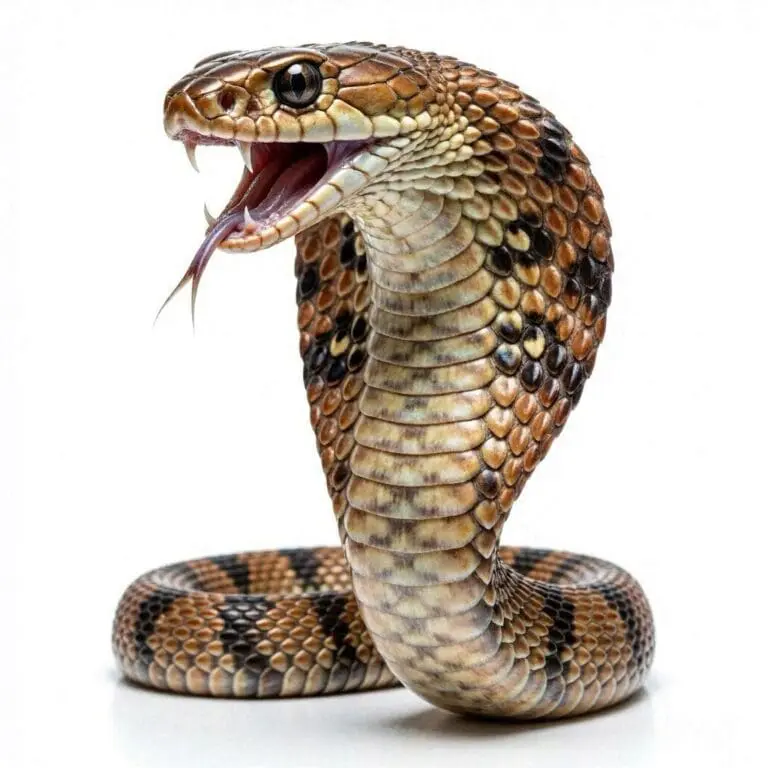
The picture shows a cobra.
Read the picture before reading the options.
The picture shows a cobra.
How does a constrictor kill?
The grip tightens as the prey exhales, cutting off blood flow.
Constriction stops blood flow rather than breathing alone.
Pythons and boas are constrictors.
Which family has long hinged fangs that fold back when not in use?
Folding fangs allow a longer fang than the mouth could otherwise hold.
Viper fangs fold; elapid fangs are fixed.
The viper's fangs swing forward as the mouth opens.
Name the organ.
The organ in the roof of a snake's mouth that reads scent from the tongue is the ___ organ.
The forked tongue collects particles and delivers them to two openings, giving a directional sense of smell.
The fork is what makes the sense directional.
The tongue flicks and the Jacobson's organ does the rest.
What are the heat-sensing pits on a pit viper for?
The pits form a crude thermal image, accurate enough to strike blind.
Pit vipers hunt by heat as much as by sight.
A rattlesnake can strike accurately in complete darkness.
How can a snake swallow prey wider than its own head?
They are joined by an elastic ligament rather than fused at the front.
The jaw is not unhinged; it was never hinged in one piece.
Each side of the lower jaw walks the prey inward in turn.
Three of these are venomous. Which is not?
Boas kill by constriction and produce no venom.
Constrictor and venomous are two different strategies.
Boas and pythons rely entirely on their grip.
Turn on JavaScript for the interactive quiz. The full practice set is shown above.