Every autumn, European eels leave the rivers they grew up in and swim four thousand miles to the Sargasso Sea to spawn. Their young drift back on the Gulf Stream, taking three years to arrive.
Animals that start with E run to extremes like that. The elephant outweighs every other land animal, and the echidna lays eggs despite being a mammal. The electric eel generates 800 volts without being an eel at all.
List Of Animals That Start With E
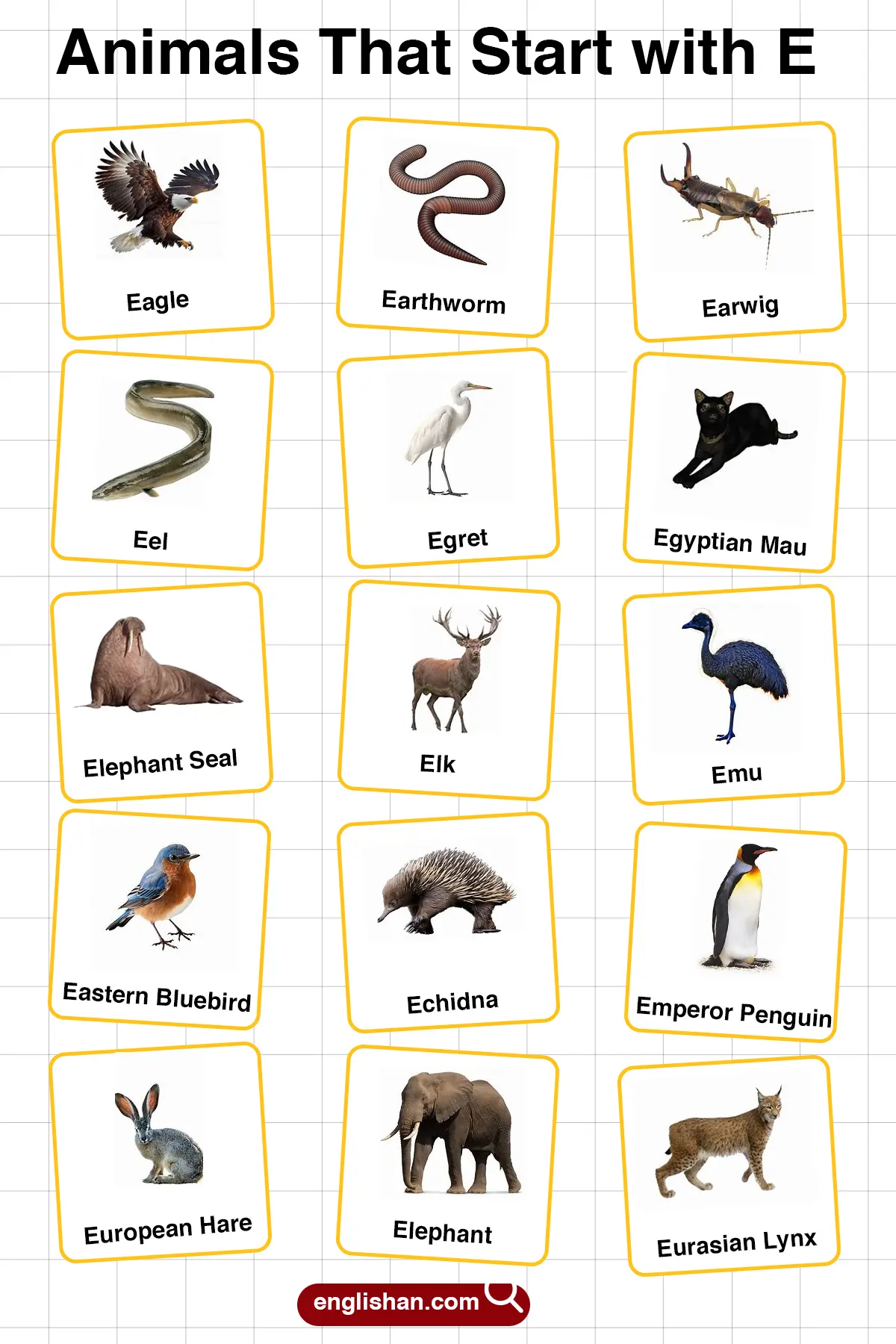
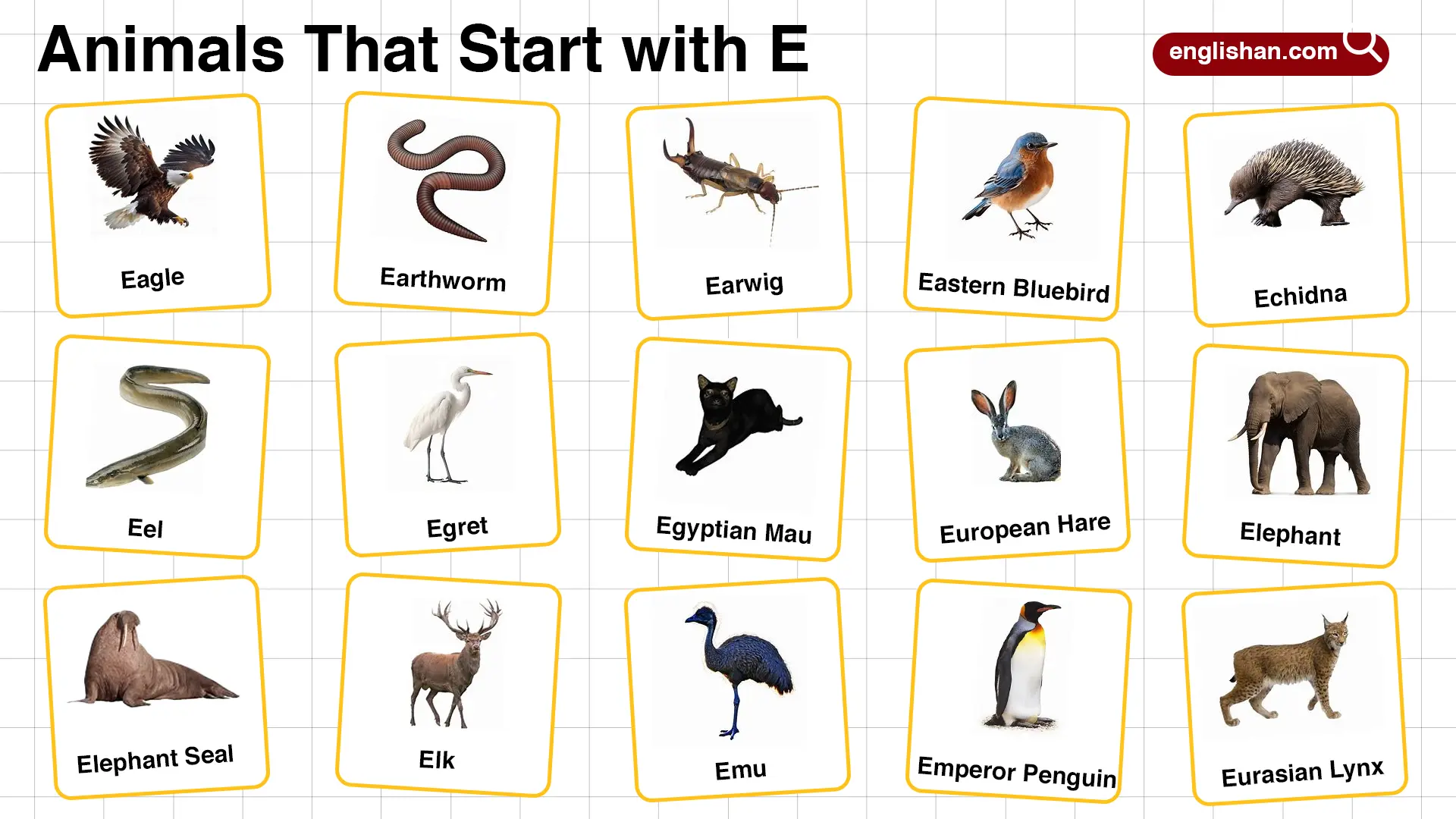
Every name here is a real animal rather than a colour or a place attached to one. Species, subspecies, breeds and family names all qualify, so both the elephant and the English pointer appear.
| Eagle | Eagle owl | Eagle ray |
| Eared grebe | Eared seal | Earless lizard |
| Earless monitor lizard | Eartheater | Earthworm |
| Earwig | East Siberian laika | Eastern barred bandicoot |
| Eastern bettong | Eastern bluebird | Eastern box turtle |
| Eastern bristlebird | Eastern brown snake | Eastern chanting goshawk |
| Eastern chipmunk | Eastern coral snake | Eastern cottontail |
| Eastern curlew | Eastern diamondback rattlesnake | Eastern dobsonfly |
| Eastern fence lizard | Eastern glass lizard | Eastern gorilla |
| Eastern gray squirrel | Eastern green mamba | Eastern grey kangaroo |
| Eastern hognose snake | Eastern imperial eagle | Eastern indigo snake |
| Eastern kingbird | Eastern long-necked turtle | Eastern lowland gorilla |
| Eastern meadowlark | Eastern mole | Eastern newt |
| Eastern osprey | Eastern phoebe | Eastern pygmy possum |
| Eastern quoll | Eastern racer | Eastern rat snake |
| Eastern red bat | Eastern reef egret | Eastern rosella |
| Eastern screech owl | Eastern spadefoot toad | Eastern spinebill |
| Eastern spotted skunk | Eastern tiger snake | Eastern towhee |
| Eastern turkey | Eastern water dragon | Eastern whipbird |
| Eastern wood pewee | Eastern woodrat | Eastern yellow robin |
| Echidna | Echinoderm | Eclectus parrot |
| Edible dormouse | Edible frog | Eel |
| Eel catfish | Eelpout | Eft |
| Egret | Egyptian cobra | Egyptian fruit bat |
| Egyptian goose | Egyptian jackal | Egyptian jerboa |
| Egyptian mau | Egyptian nightjar | Egyptian plover |
| Egyptian spiny mouse | Egyptian tortoise | Egyptian vulture |
| Egyptian weasel | Eider | Eland |
| Electric catfish | Electric eel | Electric ray |
| Elegant crested tinamou | Elegant tern | Elepaio |
| Elephant | Elephant beetle | Elephant fish |
| Elephant hawk-moth | Elephant seal | Elephant shrew |
| Elephant trunk snake | Elf owl | Elk |
| Ember tetra | Emerald dove | Emerald swift |
| Emerald toucanet | Emerald tree boa | Emerald tree monitor |
| Emperor angelfish | Emperor boa | Emperor dragonfly |
| Emperor goose | Emperor penguin | Emperor scorpion |
| Emperor shrimp | Emperor tamarin | Emu |
| Emu wren | Enchi ball python | English angora rabbit |
| English bulldog | English cocker spaniel | English foxhound |
| English longhorn cattle | English pointer | English setter |
| English shepherd | English springer spaniel | English toy terrier |
| Ensatina | Entlebucher mountain dog | Epagneul Pont Audemer |
| Epaulette shark | Epauletted fruit bat | Equatorial spitting cobra |
| Ermine | Erne | Escolar |
| Eskimo dog | Estrela mountain dog | Estuarine crocodile |
| Ethiopian highland hare | Ethiopian wolf | Etruscan shrew |
| Eucalyptus longhorn beetle | Eulachon | Eurasian badger |
| Eurasian beaver | Eurasian bullfinch | Eurasian collared dove |
| Eurasian coot | Eurasian curlew | Eurasian eagle-owl |
| Eurasian hoopoe | Eurasian jay | Eurasian lynx |
| Eurasian magpie | Eurasian nuthatch | Eurasian otter |
| Eurasian pygmy owl | Eurasian red squirrel | Eurasian siskin |
| Eurasian skylark | Eurasian sparrowhawk | Eurasian teal |
| Eurasian treecreeper | Eurasian wolf | Eurasian woodcock |
| Eurasian wryneck | Eurasier | Euro kangaroo |
| European badger | European bee-eater | European bison |
| European catfish | European chameleon | European common frog |
| European conger | European corn borer | European crayfish |
| European eel | European fire salamander | European flounder |
| European goldfinch | European grass snake | European green woodpecker |
| European hare | European hedgehog | European honey buzzard |
| European lobster | European mink | European mole |
| European nightjar | European polecat | European pond turtle |
| European rabbit | European robin | European roller |
| European seabass | European starling | European stonechat |
| European turtle dove | European wildcat | Evening bat |
| Evening grosbeak | Executioner wasp | Eyed lizard |
| Eyelash viper | Eyra |
Common Animals That Start With E
Twelve of these need no introduction. Behind each reputation is something visible: a trunk, a set of spines, a bugling call, or a dive past a thousand metres.
Elephant
Three species carry the name rather than two, after the IUCN separated the African forest elephant from the African bush elephant in 2021. Bush elephants reach four metres at the shoulder and six tonnes, which makes them the largest land animals alive.
Echidna
Only two kinds of mammal on earth lay eggs, and this spine-covered monotreme is one of them. A female lays a single leathery egg straight into her pouch, and electroreceptors in the snout pick up ants and termites moving underground.
Elk
Ask for an elk in Colorado and a wapiti arrives; ask in Sweden and a moose does. Cows and calves live in herds through most of the year, and bulls join them only for the autumn rut, when the bugling call sounds the length of a valley.
Emu
Second only to the ostrich among living birds, this Australian ratite stands close to two metres and runs at 50 km/h. The male incubates the dark green eggs for eight weeks without eating or drinking, losing a third of his body weight, then raises the chicks alone for eighteen months.
Eagle
Over seventy species share the name, all of them large raptors with hooked bills and heavy talons. Eyesight several times sharper than a human’s lets a golden eagle pick out a hare two kilometres off.
Eel
Long snake-bodied fish of the order Anguilliformes number more than 900 species across sixteen families. Freshwater eels hatch in the Sargasso Sea, then drift across the Atlantic for years before entering European rivers.
Egret
A white heron that hunts by standing still in shallow water until a fish comes within reach. Plume hunting for the millinery trade nearly wiped the species out by 1900, and the recovery drove some of the first bird protection laws.
Emperor Penguin
The largest penguin alive at a metre tall and 45 kilograms, and the only bird that breeds through the Antarctic winter. Thousands huddle together at minus 40 degrees while males incubate the eggs, and the species dives deeper than any other bird. Near Threatened
Elephant Seal
Bulls reach four tonnes, which makes them the largest carnivorans on earth and the largest marine mammals that are not whales. A single dive passes 1,500 metres on one breath lasting two hours.
Eurasian Lynx
Europe’s largest wild cat stands ear-tufted and short-tailed, hunting roe deer alone through forest. Several countries have put the species back after shooting it out, and the reintroductions have mostly held.
Eland
The largest antelope alive, with spiral horns and a dewlap that hangs from the throat. A bull weighing a tonne still clears a two-metre fence from standing, and herds cover long distances across savanna and open woodland.
Ermine
The stoat in its winter coat, white from nose to flank except for a black tail tip that stays black all year. That black tip breaks up the outline against snow and draws a hawk’s strike away from the body.
Mammals That Start With E
Half the mammals under this letter carry a Eurasian- or European- prefix, because European naturalists named the species on their own doorstep first. The rest come mostly from Australia and Africa.
Elephant Shrew
Neither an elephant nor a shrew, this long-nosed African insectivore falls within Afrotheria, which puts it closer in ancestry to elephants than to any shrew. Fifteen species run the same trapline paths through leaf litter, clearing them daily.
Eastern Gorilla
The largest living primate ranges across the highlands of the eastern Congo, darker-furred and heavier than its western counterpart. Decades of conflict and poaching have driven it to Critically Endangered, with mountain gorillas numbering around a thousand.
Eastern Grey Kangaroo
A large grazing marsupial that moves in mobs across eastern Australia. Hopping costs it less energy at speed than at a walk, which is why it moves faster at speed than at a walk.
Eastern Chipmunk
A striped ground squirrel of North American woodland, storing seed in cheek pouches that stretch the head to twice its width. Everything gathered goes underground into a larder rather than into fat.
Eastern Cottontail
North America’s most widespread rabbit takes its name from the white underside of its tail. Breeding through most of the year absorbs heavy predation, and a doe can raise several litters in one season.
Eastern Mole
A North American burrower with eyelids fused shut and forelimbs turned into shovels. Fifteen metres of tunnel an hour is normal work, and a sensitive snout replaces the sight it does not have.
Eastern Quoll
A spotted marsupial carnivore, this quoll went extinct on mainland Australia in 1963 and survived only in Tasmania. Fenced reintroductions have since put small populations back on the mainland. Endangered
Eastern Spotted Skunk
A small striped-and-spotted skunk that performs a handstand before spraying, forelegs off the ground and tail straight up. The display warns a predator and improves the aim at the same time.
Eastern Pygmy Possum
Small enough to fit inside a matchbox, this Australian marsupial feeds on nectar and pollen and moves pollen between banksia flowers as it does. Cold nights send it into torpor for days at a time.
Eastern Bettong
A rabbit-sized rat-kangaroo that digs for underground fungi and turns over tonnes of soil a year doing it. Mainland Australia lost it to foxes, and Tasmania kept it.
Eastern Barred Bandicoot
A striped digging marsupial declared extinct in the wild across Victoria, then returned through fenced sanctuaries. Populations now breed outside the fences, which makes it one of very few mammals to reverse that status.
Eurasian Beaver
Hunted down to roughly 1,200 animals by 1900, this keystone rodent is back across Europe in the hundreds of thousands. Its dams create wetland that supports species far beyond itself. Least Concern
Eurasian Otter
A river mustelid, the Eurasian otter hunts by touch, using stiff whiskers to detect fish in water too dark to see through. Britain lost most of its otters to organochlorine pesticides, and the population recovered once those were banned.
Eurasian Red Squirrel
Chestnut-red with ear tufts that grow in for winter, this tree squirrel gnaws pinecones down to a core that marks its presence. Grey squirrels introduced from North America have pushed it out of much of Britain.
Eurasian Badger
A heavy black-and-white mustelid that digs setts passing down through generations, some of them running to thirty chambers. Clans of a dozen share one sett and forage alone at night, mostly for earthworms.
European Bison
Europe’s heaviest land mammal, rebuilt from twelve captive animals after the last wild one died in 1927. Herds now range across Poland, Belarus and Romania. Near Threatened
European Hedgehog
Around 5,000 spines cover the back of this nocturnal insectivore, which rolls into a ball no fox can open. Hibernation runs from November to March, and a hedgehog too light in autumn will not survive it.
European Hare
Longer-legged and longer-eared than a rabbit, the European hare lives above ground in a form rather than a burrow. Spring boxing is a doe fighting off an unwanted buck, not two bucks fighting each other.
European Rabbit
Native only to Iberia and southern France, this rabbit fathered every domestic breed. Warrens run to hundreds of animals, and myxomatosis cut European populations by more than 90 percent from 1953.
European Mink
Rarer than the giant panda and still declining, this semi-aquatic mustelid has lost most of its range to habitat loss and to the introduced American mink. Critically Endangered
European Polecat
The wild ancestor of the domestic ferret, masked across the face and mostly nocturnal. British populations were nearly shot out by gamekeepers, then spread back east from a Welsh refuge.
European Wildcat
Heavier and blunter-tailed than a domestic tabby, with a thick ringed tail that ends square rather than tapering. Interbreeding with feral cats has genetically swamped it across much of its range.
Edible Dormouse
A grey squirrel-tailed rodent that sleeps seven months a year, longer than almost any other mammal. Romans fattened it in earthenware jars for the table, which is where the name comes from.
Epauletted Fruit Bat
Males flash white shoulder patches and call all night to attract a mate, a lek system rare among bats. Fig and guava trees across sub-Saharan Africa depend on the species to move seed.
Egyptian Jerboa
A desert rodent that hops on hind legs twice its body length, crossing loose sand without sinking. Long ears shed heat, and it takes all the water it needs from the seeds and insects it eats.
Birds That Start With E
Birds beginning with E range from a 40-gram owl that nests in cactus to a two-metre-winged owl that takes foxes. Emperors lent their name to several, and one is named for a Hawaiian canoe-building belief.
Elf Owl
At 40 grams, roughly a golf ball, this is the smallest owl on earth. Nesting happens in old woodpecker holes drilled into saguaro cactus, and the diet runs to moths, scorpions and beetles.
Eider
This large Arctic sea duck grows breast down that insulates better than any other natural material. To line the nest, females pluck their own down, and Icelandic farms have harvested it sustainably for centuries. Near Threatened
Eagle Owl
A two-metre wingspan and burning orange eyes mark out one of the heaviest owls alive. Prey runs as large as a young fox, and pairs hold the same cliff territory for decades.
Egyptian Vulture
One of very few birds to work with a tool, cracking ostrich eggs by throwing stones at them until the shell breaks. The yellow face comes from carotenoids in the droppings it feeds on. Endangered
Egyptian Goose
Ancient Egyptians painted this russet-eyed waterfowl on tomb walls three thousand years ago. Escaped birds now breed wild across southern England and the Netherlands.
Emerald Toucanet
A small green toucan of Central American cloud forest grows no bigger than a jay. The oversized bill weighs almost nothing, since it is a honeycomb of bone struts rather than solid.
Eclectus Parrot
Males are bright green and females deep red and blue, a difference so extreme that ornithologists described them as two separate species for a century. Females hold nest hollows and rarely leave them.
Eurasian Eagle-Owl
Among the largest owls alive, this one takes hares, herons and other owls. Nests go on bare cliff ledges with no lining at all, and the pair returns to the same ledge year after year.
Eurasian Hoopoe
A fan of black-tipped crest feathers goes up the moment this bird lands. Chicks spray an oily deterrent from the preen gland when threatened, which makes the nest smell strongly enough to turn a predator away.
Eurasian Skylark
Song comes continuously while the bird climbs, and a single flight song runs to half an hour without a pause. Farmland intensification has cut British populations sharply since the 1970s.
Eurasian Jay
Several thousand acorns go into the ground each autumn from one bird, and the ones never retrieved become oak trees. No forester plants oaks at that rate.
European Robin
Unlike most songbirds, this one defends a winter territory as fiercely as a breeding one, and both sexes sing. Street lighting keeps some birds singing through the night.
European Bee-Eater
Bees taken in flight get rubbed against a branch until the sting is discharged before the bird swallows them. Colonies nest in tunnels a metre deep, dug into sandy riverbanks.
Elegant Tern
Almost the entire world population nests on a handful of islands in the Gulf of California. That concentration makes the species unusually exposed to a single bad season. Near Threatened
Elepaio
A Hawaiian flycatcher that canoe builders once watched closely, since a bird pecking at a felled trunk meant the wood was already rotten. Three island subspecies survive, one of them barely.
Eastern Bluebird
A cavity nester of North American open country, the eastern bluebird came back from steep decline through volunteer nest-box trails. Vision sharp enough to spot an insect from 40 metres drives the hunting.
Eastern Meadowlark
A yellow-breasted grassland bird with a black V across the chest sings from fenceposts across the American Midwest. Grassland loss has driven a decline steeper than almost any other North American songbird.
Eastern Rosella
A red-headed Australian parrot wears a white cheek patch above a mosaic back. Feeding happens mostly on the ground, which separates it from most parrots.
European Goldfinch
A red face and broad gold wing bars mark this finch, which feeds on teasel and thistle seed few other birds can reach. In flight, a flock goes by the collective name of a charm.
Emperor Goose
A grey scaled-looking goose of coastal Alaska and eastern Siberia winters on ice-free shorelines rather than inland. The population fell sharply through the 1980s and has recovered slowly since. Near Threatened
Sea Animals That Start With E
Fish dominate the ocean side of this letter, and the most famous of them is misnamed. Freshwater species appear alongside marine ones, since the eels move between the two.
Electric Eel
The electric eel is not an eel at all, but a knifefish of the order Gymnotiformes, closer to catfish and carp. Three organs down the body discharge up to 800 volts, and the fish must surface for air every ten minutes or so.
Eagle Ray
Broad pectoral fins beat rather than glide, and a spotted eagle ray clears the surface in a full jump. The common eagle ray of the eastern Atlantic has been fished down hard. Critically Endangered
Epaulette Shark
A reef shark that walks across dry rock on its fins between tide pools and survives an hour without oxygen. Two dark shoulder spots give the species its name.
Emperor Angelfish
Juveniles wear blue and white concentric rings and look nothing like the yellow-and-blue striped adult. That change confused early taxonomists into naming them separately.
Emperor Shrimp
A tiny commensal shrimp that lives on the back of a sea cucumber or nudibranch and rides wherever the host goes. Feeding happens on scraps the host disturbs.
Escolar
Wax esters in the flesh pass straight through the human gut, which is why Japan and Italy ban the sale outright. The taste is rich enough that it still turns up on menus elsewhere under other names.
Eulachon
So oily that dried fish were once threaded with a wick and burned as candles along the Pacific Northwest coast. Grease trails inland carried the rendered oil as a trade good for centuries.
European Eel
Numbers have fallen by more than 90 percent since 1980, driven by dams, parasites and the glass eel trade. A single spawning migration crosses the Atlantic to the Sargasso Sea and ends in death. Critically Endangered
European Conger
Three metres of true eel live in Atlantic wrecks and rock crevices, making this the heaviest eel in any European water. Nothing is known about where it spawns beyond a deep Atlantic estimate.
European Lobster
Blue in the water and red only after cooking, since heat destroys every pigment except the red one. Individuals pass fifty years, and the largest recorded weighed over nine kilograms.
European Seabass
Silver, slow-growing and heavily targeted, which is why stocks recover badly once fished down. Juveniles grow up in estuaries before moving offshore.
Electric Ray
A flattened ray that stuns prey with a shock from paired organs behind the eyes. Roman physicians pressed one against a patient’s head to treat headache, which is the earliest recorded electrotherapy.
Eelpout
Antifreeze glycoproteins in the blood keep this cold-water fish from freezing solid at temperatures below zero. Live young emerge fully formed rather than as eggs.
Echinoderm
An echinoderm is any member of the phylum Echinodermata, the group holding starfish, sea urchins and sea cucumbers. All 11,000 species are marine, built on five-part symmetry, and able to regrow lost limbs.
European Flounder
Both eyes migrate to one side of the head as the young fish settles flat on the seabed. Unlike most flatfish, adults move far up rivers into fresh water.
Eel Catfish
Hunting happens on land as well as in water, with the body arched to pin a beetle against the ground outside the water entirely. Within the catfish family, nothing else does this.
Electric Catfish
African freshwater catfish that discharge up to 350 volts from a sheath of modified muscle wrapping the whole body. Ancient Egyptian tomb reliefs show the fish clearly enough to identify.
Ember Tetra
A small orange freshwater fish from the Araguaia basin in Brazil grows barely two centimetres long. Shoals of twenty or more hold together in soft acidic blackwater.
Eared Seal
Eared seals are the family Otariidae, holding fur seals and sea lions, and the visible ear flaps separate them from true seals. Hind flippers rotate forward, which lets them walk on land rather than haul.
European Crayfish
Europe’s native white-clawed crayfish has lost most of its range to crayfish plague carried by introduced American signal crayfish. Cold clean streams are the last strongholds. Endangered
Elephant Fish
A ploughshare snout probes sediment for shellfish off southern Australia and New Zealand. The fish is a chimaera rather than a shark, with a skeleton of cartilage and a single gill opening.
Eartheater
South American cichlids that take mouthfuls of sand, sift out invertebrates through the gills, and spit the grit back. The genus name Geophagus translates as earth eater.
Reptiles And Amphibians That Start With E
Two of the most dangerous snakes in Australia and North America begin with E, and so do a salamander that breathes through its skin and a tortoise the size of a fist.
Eastern Brown Snake
Responsible for most snakebite deaths in Australia, and fast enough across open ground to close distance before a person reacts. The venom acts on blood clotting rather than on nerves.
Eastern Diamondback Rattlesnake
The heaviest venomous snake in the Americas passes four kilograms, marked with dark diamonds edged in cream. Habitat loss across the longleaf pine belt has cut numbers sharply.
Eastern Coral Snake
Red bands touching yellow separate this elapid from the harmless kingsnakes that mimic it. Neurotoxic venom acts on nerve tissue rather than on flesh, and bites stay extremely rare.
Eyelash Viper
Raised scales above each eye form the lashes the name describes. Colour runs from gold through green to pink, and the snake waits motionless on a branch for hummingbirds and frogs.
Emerald Tree Boa
Coils drape over a branch in even loops with the head resting in the middle, and the strike goes downward at birds passing beneath. Heat pits along the lips locate warm prey in darkness.
Estuarine Crocodile
The largest living reptile at over six metres, and the only crocodilian that swims open ocean between islands. Bite force is the highest measured in any living animal.
Egyptian Tortoise
One of the smallest tortoises alive measures ten centimetres, and it is all but gone from Egypt itself. Removal for the pet trade and grazing pressure did most of the damage. Critically Endangered
Eastern Box Turtle
A hinged plastron closes the shell completely front and back, sealing the animal away from a predator. Wild individuals pass a century, and each stays within a few hectares for life.
Edible Frog
A fertile hybrid of the pool frog and the marsh frog, which is unusual enough among vertebrates to complicate its taxonomy. France cooks the hind legs in the traditional dish behind the name.
Eastern Newt
A middle stage called the red eft leaves the water entirely and walks about on land for up to three years, bright orange and toxic to eat. Adults return to the pond and turn olive green.
European Fire Salamander
Black skin blotched with yellow warns of alkaloid glands behind the eyes. Females give birth to live larvae straight into a cold running stream rather than laying eggs.
Ensatina
A lungless salamander that breathes entirely through its skin and the lining of its mouth. Around California’s Central Valley the subspecies form a classic ring species.
Insects And Spiders That Start With E
Invertebrates beginning with E deliver the most painful sting recorded anywhere and the tightest wing folding known in any insect. Among them is one that is not an insect at all.
Earwig
Hindwings fold forty times over to fit beneath wing cases a quarter of their open span, which is the tightest wing folding known in any insect. At the rear, the pincers threaten and grip rather than pinch hard.
Earthworm
Tonnes of soil per hectare pass through these annelids every year, which is why Darwin spent his last forty years on them rather than on finches. Through the skin comes all the oxygen, and bristles called setae anchor the body as it pushes forward.
Executioner Wasp
The sting rates among the most painful recorded anywhere in the insect world, above the tarantula hawk on most accounts. Nests hang from branches across Central and South America.
Emperor Scorpion
One of the largest scorpions alive at twenty centimetres, and the sting is mild despite the size, closer to a bee than to anything dangerous. Ultraviolet light makes the cuticle glow blue-green.
Emperor Dragonfly
Butterflies and other dragonflies get taken in mid-air by one of Europe’s largest and fastest dragonflies. Eating happens on the wing, and the larva spends two years underwater before emerging.
Elephant Hawk-Moth
Pink and olive-green adults fly at dusk to honeysuckle, and the caterpillar rears up with four false eyespots to bluff a bird into leaving. The trunk-like snout of that caterpillar gave the moth its name.
Elephant Beetle
A horned rhinoceros beetle from Central American rainforest grows to twelve centimetres including the horn. Males lever rivals off a feeding site with the horn rather than fighting head on.
Eastern Dobsonfly
Males grow mandibles longer than the head, too weak to bite and used entirely for display and for holding the female. The aquatic larva, called a hellgrammite, spends up to three years in a stream.
European Corn Borer
A moth larva that tunnels into maize stems and costs North American growers around a billion dollars a year. It arrived from Europe in broom corn shipments before 1920.
Eucalyptus Longhorn Beetle
Larvae bore into drought-stressed eucalyptus and ring the tree from the inside. The beetle has followed eucalyptus plantations onto every continent where the trees were planted.
Wild Animals That Start With E
The rarest dog on earth begins with E, and so does the largest gorilla subspecies. Most of these ten survive in single mountain ranges or single forests rather than across a continent.
Ethiopian Wolf
Fewer than 500 survive, which makes this the rarest canid on earth, all of them above 3,000 metres in six isolated pockets of the Ethiopian highlands. Hunting happens alone through the day for giant molerats, and rabies carried by domestic dogs kills more of them than anything else. Endangered
Eastern Lowland Gorilla
The largest gorilla subspecies keeps to lowland rainforest in the eastern Democratic Republic of the Congo. Thirty years of conflict, mining and bushmeat hunting have cut the population to a few thousand. Critically Endangered
Emperor Tamarin
A white moustache long enough to drape past the shoulders names this small Amazonian monkey, after a resemblance to Kaiser Wilhelm II. In groups of up to fifteen they move through the canopy, and many travel alongside saddleback tamarins.
Eurasian Wolf
The most widespread of all grey wolf subspecies ranges from Portugal to the Russian far east. In western Europe the packs stay smaller than North American ones, because the prey is smaller.
Egyptian Jackal
Genetic work in 2011 reclassified this animal as the African golden wolf, closer to grey wolves than to any jackal. The old name has stayed current anyway.
Euro Kangaroo
The common wallaroo is stockier and shorter-limbed than a grey kangaroo, and suited to rocky escarpment rather than open plain. Through the heat of the day it shelters in caves and overhangs, which keeps water loss down.
Ethiopian Highland Hare
Only a handful of specimens exist, all from the Ethiopian highlands, and almost no field study has followed them. Even its range boundaries remain uncertain.
Eastern Imperial Eagle
A large brown eagle with pale shoulder patches breeds on lowland steppe and farmland rather than mountains. Electrocution on power lines is the leading cause of death across its European range. Vulnerable
Eyra
A slender long-bodied wild cat of Central and South America goes better known as the jaguarundi, in a coat of plain grey or rich red. Unusually for a cat it hunts by day and mostly on the ground.
Eastern Turkey
The most numerous wild turkey subspecies spread across eastern North America, and it drove the recovery from around 30,000 birds in the 1930s to millions today. Males fan the tail and gobble in spring, audible more than a kilometre off.
Small Animals That Start With E
The smallest mammal alive begins with E, at under two grams. Five more animals under this letter weigh less than a chocolate bar, and one of them regrows its own skin.
Etruscan Shrew
The smallest mammal on earth weighs under two grams, lighter than a five-pence coin. The heart beats up to 1,500 times a minute, and it eats twice its body weight daily to keep that going.
Eft
The land-living middle stage of a newt walks about in damp woodland for as long as three years, bright orange and rough-skinned. Toxins in the skin make the colour a warning signal rather than camouflage.
Egyptian Spiny Mouse
Stiff guard hairs across the back give this desert rodent its name. Skin tears away under a predator’s grip and regrows completely, scar-free, which almost no other mammal manages.
Eastern Red Bat
A rust-coloured North American bat that roosts alone in foliage rather than in caves, hanging by one foot and looking like a dead leaf. Migration south in autumn happens by night, and part of the route crosses open sea.
Eurasian Pygmy Owl
Europe’s smallest owl weighs 60 grams and hunts songbirds and voles in daylight through northern conifer forest. Surplus prey goes into tree-hole larders through the winter.
Eurasian Siskin
A small yellow-green finch that feeds upside down on alder and birch cones. Flocks wander widely between winters depending on where the seed crop failed.
Farm And Pet Animals With E
Out of England come eight of the ten domestic breeds beginning with E, most of them working dogs bred for a single job in the field. Switzerland and Greenland supply the other two.
English Springer Spaniel
Breeders shaped this spaniel to flush game from thick cover, working ahead of the gun in a zigzag rather than behind it. Field and show lines have diverged far enough to look like separate breeds.
English Cocker Spaniel
Smaller than the springer, this spaniel took its name from flushing woodcock, and the docked-tail tradition is now restricted across much of Europe. The coat needs work around the ears, where mats form first.
English Bulldog
Flattened faces bring breathing trouble, and breed standards in the UK and Netherlands have shifted to require a longer muzzle. Nineteenth-century bulldogs were taller and longer-nosed than the modern dog.
English Setter
A freckled coat called belton speckles this gundog in blue, orange or liver. On finding game it freezes on point with one foreleg raised and stays there.
English Pointer
Speed across open ground defines this gundog, which quarters a field faster than any other. The breed freezes on point instinctively as a puppy, before any training begins.
English Foxhound
Breeders built this hound to run in a pack at a steady pace for hours rather than to sprint. Studbooks for the breed go back further than for almost any other dog.
English Longhorn Cattle
Curved horns sweep down beside the face rather than upward, and a white line runs along the spine. By 1980 the breed had fallen to a few hundred animals, and conservation grazing has brought it back.
English Angora Rabbit
Grooming every few days is the minimum, because the wool grows fast enough to mat solid within a week. Around the ears, face furnishings separate this from the other three angora breeds.
Eskimo Dog
Greenland and the Canadian Arctic bred this sled dog for hauling rather than speed, under a dense double coat. Once snowmobiles replaced dog teams in the 1960s, numbers fell sharply.
Entlebucher Mountain Dog
The smallest of the four Swiss mountain dogs was bred to drive cattle down from alpine pasture. Look for a naturally short tail and tricolour markings.
E Animals Around The World
Nearly half the mammals under this letter come out of Eurasia and Europe. Australia contributes the marsupials and the ratite, while South America contributes the electric fish.
| Continent | Animals that start with E |
|---|---|
| Africa | Eland, elephant shrew, Egyptian vulture, Ethiopian wolf, epauletted fruit bat, Egyptian jerboa |
| Australia | Emu, echidna, eastern grey kangaroo, eastern quoll, eastern barred bandicoot, euro kangaroo, eastern brown snake |
| Europe and Eurasia | European bison, Eurasian lynx, Eurasian beaver, European hedgehog, Eurasian jay, European eel, Eurasian otter |
| North America | Eastern chipmunk, eastern mole, eastern bluebird, eastern diamondback rattlesnake, elf owl, eastern turkey |
| South and Central America | Electric eel, emperor tamarin, elephant beetle, eyelash viper, eyra, ember tetra |
| Asia | Estuarine crocodile, Egyptian fruit bat, Eurasian wolf, emerald tree monitor |
| Antarctica and the poles | Emperor penguin, eider, elephant seal, Eskimo dog |
How To Pronounce E Animal Names
Stress lands where you would not expect it in several of these names, which catches people out on sight. Say the capitalised part louder.
| Animal | Say it as |
|---|---|
| Echidna | ih-KID-nuh |
| Eft | EFT |
| Egret | EE-gret |
| Eider | EYE-der |
| Eland | EE-land |
| Elepaio | eh-leh-PIE-oh |
| Ensatina | en-suh-TEE-nuh |
| Escolar | ESS-koh-lar |
| Eulachon | YOO-luh-kon |
| Eurasier | yoo-RAY-zee-er |
| Epaulette shark | EP-uh-let |
| Eyra | AY-ruh |
| Eartheater | URTH-ee-ter |
| Etruscan shrew | ih-TRUSK-un |
Two of these catch almost everybody. Echidna drops its opening E to a short i, so it starts like itch. And egret takes a long first vowel, which is why EE-gret is right and EGG-ret is not.
Names borrowed whole from another language give the most trouble across the alphabet. That is why okapi and oryx catch people out among the animals with O.
Surprising Facts About E Animals
Each figure below rests on a published measurement rather than an estimate.
- Largest land animal: African bush elephants reach four metres at the shoulder and six tonnes.
- Highest voltage: electric eels discharge up to 800 volts, more than any other animal.
- Smallest mammal: the Etruscan shrew weighs under two grams and its heart beats 1,500 times a minute.
- Only egg-laying mammals: echidnas and the platypus, and nothing else.
- Deepest seal dive: elephant seals work past 1,500 metres on a single breath lasting two hours.
- Rarest dog: fewer than 500 Ethiopian wolves survive, all of them above 3,000 metres.
- Smallest owl: elf owls weigh 40 grams.
- Longest fast: male emus sit on the nest for eight weeks without eating or drinking, losing a third of their weight.
- Tightest wing folding: an earwig folds its hindwings forty times over.
- Warmest natural insulation: eider down.
- Longest migration for a fish: European eels cross the Atlantic from the Sargasso Sea and back to spawn once.
Endangered Animals That Start With E
Six species under this letter carry a threatened assessment, and one of them has moved in the right direction. Each status shown is the current Red List assessment.
| Animal | Status | Where it stands |
|---|---|---|
| Ethiopian wolf | Endangered | Fewer than 500 across six mountain pockets, with rabies from domestic dogs the leading killer |
| Eastern gorilla | Critically Endangered | Decades of conflict and poaching across the eastern Congo |
| European eel | Critically Endangered | Numbers down more than 90 percent since 1980 |
| Egyptian tortoise | Critically Endangered | All but gone from Egypt itself |
| European mink | Critically Endangered | Rarer than the giant panda and still declining |
| Eastern barred bandicoot | Recovered from Extinct in the Wild | Brought back by fenced sanctuaries in Victoria and now breeding outside the fences |
E Animals For Kids
Younger children learn a letter fastest through animals they can already picture. These eight need no explaining beyond one line each.
- Elephant: the biggest animal on land, with a long trunk and big flappy ears.
- Eagle: flies high and sees a long way.
- Emu: a tall bird from Australia that runs fast and cannot fly.
- Eel: long and wriggly like a snake, but it is a fish.
- Echidna: covered in spines, and it lays an egg like a bird does even though it is a mammal.
- Egret: a tall white bird that stands very still in the water and waits for a fish to swim past its feet.
- Earthworm: it burrows in the soil and helps the garden grow.
- Earwig: little pincers on the back.
Say each name out loud and press the E at the front. Eagle and elephant come easiest to a young ear, since both name an animal a child has already met in a picture book.
You May Also Like
FAQs
Animals that start with E open with the elephant, eagle, elk, emu, eel and echidna among the familiar names. Rarer ones add the Ethiopian wolf, the Elepaio, the eulachon and the eland. More than 200 turn up regularly enough to recognise across every animal group.
The African bush elephant is the largest, and the largest land animal alive, reaching four metres at the shoulder and six tonnes. At sea the elephant seal takes the title, with bulls past four tonnes. Among birds the emu stands second only to the ostrich.
The eel, eagle ray, elephant seal and epaulette shark all live in the ocean. Smaller ones are the emperor shrimp and the emperor angelfish. The echinoderms are a whole group rather than one animal, made up of starfish, sea urchins and sea cucumbers.
No, the electric eel is not an eel. Taxonomists place it in the knifefish order Gymnotiformes, closer to catfish and carp than to any true eel. The body shape is what earned it the name, and it discharges up to 800 volts.
The Eurasian lynx is the wild cat that starts with E, and it is the largest cat in Europe. Ear tufts, a short black-tipped tail and a spotted summer coat identify it. The European wildcat is the other, and it looks like a heavy tabby with a blunt ringed tail.
The eel is the three-letter animal starting with E, and the only common one. Alongside it comes eft, the land-living middle stage of a newt. Both are short enough to turn up regularly in crosswords and word games.
Elephants, eagles, emus, elands and emperor tamarins are the zoo animals starting with E you will meet first. Larger collections add echidnas, elephant seals and eastern gorillas. The Ethiopian wolf turns up in almost none, since it has never bred well in captivity.
The Ethiopian wolf, eastern gorilla, European eel and Egyptian tortoise are the endangered animals that start with E. Three of those four rank as Critically Endangered. The eastern barred bandicoot went the other way, recovering from extinct in the wild.
Plenty do, and the eagle, emu, eel, elk and echidna are the easiest to reach for. Among the large ones, the eland is the biggest antelope alive and the elephant seal outweighs a car. For something nobody expects, the eyra is a wild cat and the eulachon is a fish oily enough to burn as a candle.
Spanish animal names beginning with E are elefante, erizo, escorpión, estrella de mar and escarabajo. Those translate as elephant, hedgehog, scorpion, starfish and beetle. Only elefante matches its English name letter for letter.
You May Also Like
Animals That Start With E Quiz
Animals That Start With E
Two of these animals begin with E. Which one does not?
Zebu begins with Z, so it is the one that does not belong.
Check each first letter before reading further.
Zebu is the odd one out.
Which of these animals begins with the letter E?
One of only two mammal groups that lay eggs.
Read the first letter before anything else.
Echidna begins with E.
Name an animal beginning with this letter.
An animal whose name begins with E is ___.
Accepted here: Echidna, Electric eel, Emu.
More than one answer is right; any animal starting with the letter counts.
Echidna begins with E.
Which animal does this describe? Flightless, fast, and the second tallest bird after the ostrich.
Flightless, fast, and the second tallest bird after the ostrich.
Match the description to the fruit rather than to the letter.
Flightless, fast, and the second tallest bird after the ostrich.
Which of these is a mammal?
Echidna is a mammal. One of only two mammal groups that lay eggs.
Group by what the thing actually is, not by where it turns up.
Echidna is a mammal.
Turn on JavaScript for the interactive quiz. The full practice set is shown above.