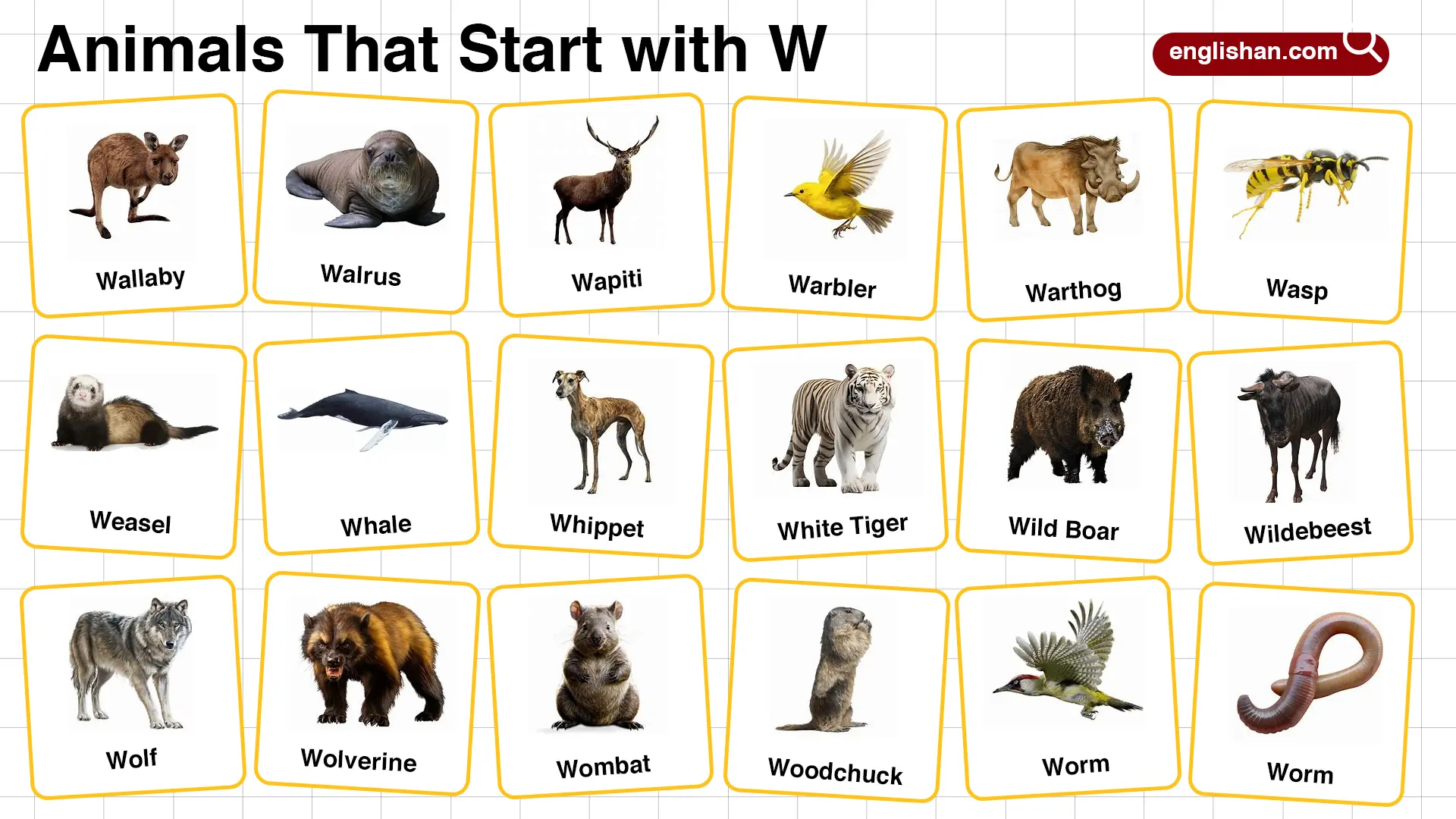
Twenty-six letters, and W is the one that hides its best animals behind a prefix. Water-, white-, western-, wild- and wood- open more than half the list of animals that start with w. A page that stops at the wolf and the walrus misses most of it.
Animals that start with W reach from a shark the length of a bus down to a New Zealand cricket that outweighs a sparrow. Some of them nobody outside one country has ever heard of.
The familiar names come first, and the strange ones follow from there.
List Of Animals That Start With W
| Wahoo | Welsh corgi | Whooper swan |
| Walking catfish | Welsh springer spaniel | Whooping crane |
| Walking stick insect | Welsh terrier | Whydah |
| Wall lizard | West Highland terrier | Wigeon |
| Wallaby | West Indian manatee | Wild ass |
| Wallago | West Siberian laika | Wild Bactrian camel |
| Wallcreeper | Western blind snake | Wild boar |
| Walleye | Western bluebird | Wild dog |
| Walnut orb-weaver | Western diamondback rattlesnake | Wild horse |
| Walrus | Western gorilla | Wild turkey |
| Wandering albatross | Western green mamba | Wild yak |
| Wandering spider | Western hognose snake | Wildcat |
| Wapiti | Western kingbird | Wildebeest |
| Warbler | Western lowland gorilla | Willet |
| Warbling vireo | Western meadowlark | Willow ptarmigan |
| Wart-biter | Western rat snake | Willow tit |
| Warthog | Western sandpiper | Willow warbler |
| Wasp | Western screech owl | Winter moth |
| Wasp spider | Western spadefoot toad | Wire fox terrier |
| Water bear | Western tanager | Wireworm |
| Water beetle | Western tarsier | Wisent |
| Water boatman | Western toad | Wobbegong |
| Water buffalo | Weta | Wolf |
| Water deer | Whale | Wolf eel |
| Water dragon | Whale louse | Wolf spider |
| Water moccasin | Whale shark | Wolffish |
| Water python | Wheatear | Wolverine |
| Water rail | Wheaten terrier | Woma python |
| Water scorpion | Wheel bug | Wombat |
| Water shrew | Whimbrel | Wood ant |
| Water snake | Whinchat | Wood bison |
| Water strider | Whip scorpion | Wood duck |
| Water vole | Whip snake | Wood frog |
| Waterbuck | Whippet | Wood mouse |
| Waterthrush | Whiptail lizard | Wood pigeon |
| Wattlebird | Whiskered tern | Wood stork |
| Wattled crane | Whistling duck | Wood turtle |
| Wattled jacana | White bass | Woodchat shrike |
| Waved albatross | White crappie | Woodchuck |
| Wax moth | White ibis | Woodcock |
| Waxwing | White marlin | Woodlark |
| Weasel | White rhinoceros | Woodlouse |
| Weaver ant | White shark | Woodpecker |
| Weaver bird | White stork | Woodrat |
| Weddell seal | White-bellied pangolin | Woolly aphid |
| Wedge-billed woodcreeper | White-eye | Woolly bear caterpillar |
| Wedge-tailed eagle | White-faced capuchin | Woolly monkey |
| Wedgefish | White-lipped deer | Worm snake |
| Weedy sea dragon | White-tailed deer | Woylie |
| Weeper capuchin | White-tailed eagle | Wrasse |
| Weever fish | White-throated sparrow | Wren |
| Weevil | White-winged duck | Wrentit |
| Weimaraner | Whitefish | Wryneck |
| Wels catfish | Whitefly | Wunderpus |
| Welsh Black cattle | Whiting | Wyoming toad |
Common Animals That Start With W
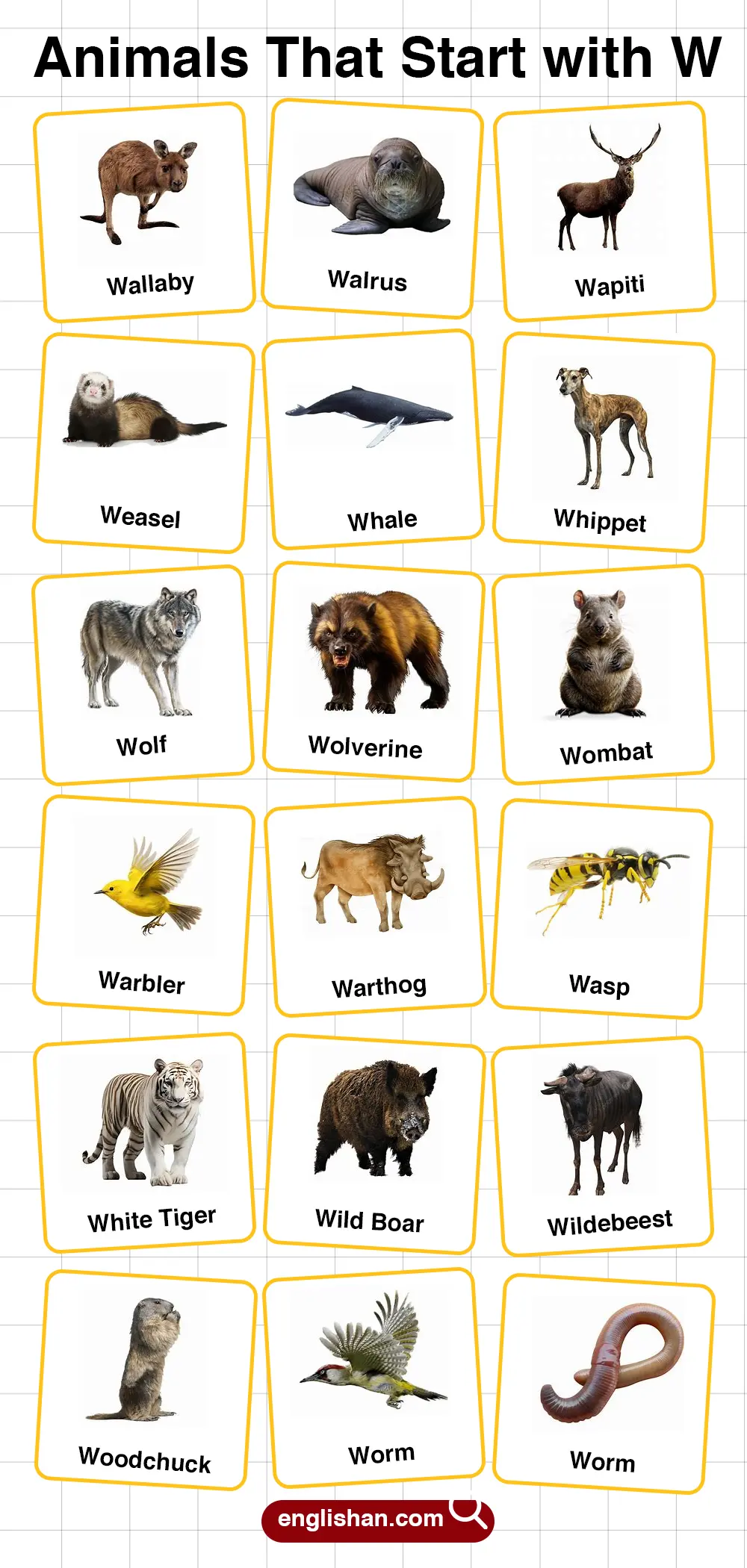
Twelve of these you already know. Each earns its place through something you can watch it do, which makes them the quickest way into the letter.
Wolf
Grey wolves range across more of the northern hemisphere than any other wild land mammal, and a pack is a family rather than a hierarchy of strangers. The breeding pair are the parents. The rest are their offspring from two or three years of litters.
A howl travels ten kilometres over open ground and does two jobs at once, holding a scattered pack together and warning neighbouring packs off the territory.
Walrus
Both sexes grow tusks, and those tusks are elongated canine teeth that reach a metre in a large male. They haul the animal out onto ice, which is where the scientific name meaning tooth-walker came from.
A walrus finds clams in the dark by sweeping the seabed with roughly 700 whiskers, then sucks the flesh out with a piston-like tongue. It leaves the shells behind.
Wombat
Wombat droppings come out cube-shaped, and the wombat is the only animal on earth that does this. Georgia Tech researchers dissected the gut and found the answer in the intestine. Ten metres of it, with rigid and elastic sections contracting at different speeds through around 40,000 contractions.
The cubes stack without rolling away, which is what makes them work as scent markers on a rock or a log. One wombat can leave a hundred a night.
Wolverine
The largest land-dwelling member of the weasel family looks like a small bear and behaves like nothing else its size. It crosses mountain ranges alone, and a single animal patrols hundreds of square kilometres of northern forest.
Its jaws and teeth open frozen carcasses that wolves and bears abandon, which is how it survives a winter with no live prey available.
- Wallaby: smaller than a kangaroo and built for scrub rather than open plain, which is why the hind legs are shorter and the tail thicker.
- Whale: ninety species, from the 2-metre dwarf sperm whale to the blue whale.
- Warthog: kneels on padded wrists to graze, and reverses into its burrow so the tusks face whatever follows.
- Wildebeest: over a million cross the Serengeti each year in the largest land migration on earth.
- Weasel: small enough to follow a vole down its own tunnel, and it takes prey several times its own weight.
- Wasp: paper nests, chewed wood pulp, one queen.
- Woodpecker: drums at twenty beats a second, cushioned by a skull built to absorb the shock.
- Wren: Britain’s most numerous breeding bird, tiny, loud, and far easier to hear than to see.
Mammals That Start With W
Eighteen more mammals begin with W, and the water- prefix alone accounts for a third of them.
- Water buffalo: domesticated across Asia for three thousand years, and more milk is drunk from this animal worldwide than from any cow breed.
- Waterbuck: white ring on the rump marks it out, and the greasy coat smells strong enough to put a predator off.
- Water vole: Britain’s fastest-declining mammal, lost from most rivers since the American mink arrived.
- Water deer: no antlers at all. Both sexes grow downward tusks instead.
- Water shrew: venomous saliva, a rarity in mammals, and it hunts underwater with a silver bubble of air trapped in its fur.
- Wapiti: North America’s second-largest deer, bugling across valleys each autumn in a call audible for miles.
- Weddell seal: breathes through holes it grinds in Antarctic sea ice with its teeth, and dives 600 metres under it.
- West Indian manatee: grazes seagrass at walking pace, and its closest living relative on land is the elephant.
- Western gorilla: the most numerous gorilla, though logging and Ebola have still driven it to Critically Endangered.
- White rhinoceros: its wide square lip crops grass, which is where the name came from rather than the colour.
- White-tailed deer: flags the white underside of its tail when it runs, which is how a fawn follows its mother through cover.
- Wild boar: ancestor of every domestic pig.
- Wild Bactrian camel: fewer than a thousand survive in the Gobi, drinking salt water that would kill a domestic camel.
- Wild yak: grazes at 6,000 metres, higher than almost any other large mammal on earth.
- Wildcat: the Scottish population fell so low that every survivor now shows domestic cat ancestry.
- Woodchuck: the groundhog under another name, and a true marmot.
- Woolly monkey: prehensile tail with a bare gripping pad underneath, used as a fifth limb.
- Woylie: a rat-kangaroo that gathers nest material with its curled tail, and it plants truffle spores wherever it digs.
The wapiti causes more naming trouble than any other animal here. North Americans call it an elk, Europeans use elk for the moose, and the two deer look nothing alike.
Calling the North American wapiti an elk while speaking to a European ❌
Keeping wapiti for the American deer and elk for the moose ✅
Birds That Start With W
Fourteen birds begin with W, and one of them owns a record no living bird comes close to.
Wandering albatross
No living bird spreads wider wings. The average adult measures 2.5 to 3.5 metres from tip to tip, and the largest ever recorded reached 3.63 metres.
Those wings suit gliding rather than flapping. Locking its shoulder joints, a wandering albatross rides the wind gradient above Southern Ocean waves, and crosses hundreds of kilometres a day at almost no muscular cost. Some birds circle Antarctica in six weeks.
- Warbler: fifty-odd species in Europe alone, most identified by song rather than by sight.
- Waxwing: red waxy tips on the wing feathers, and flocks arrive in Britain only when the northern berry crop fails.
- Weaver bird: knots a hanging nest from grass strips, and the female rejects any male whose work comes loose.
- Wedge-tailed eagle: Australia’s largest raptor, wings past 2.3 metres.
- Whimbrel: a long down-curved bill for probing mud, and seven whistled notes that name the bird in most languages it turns up in.
- White stork: returns to the same rooftop nest year after year, which is why European villages count them as residents.
- White-tailed eagle: Britain’s largest bird of prey, reintroduced to Scotland after being shot out by 1918.
- Whooper swan: flies from Iceland to Britain each autumn, and it calls in flight where the mute swan stays silent.
- Whooping crane: down to fifteen birds in 1941, and every wild whooping crane alive descends from them.
- Wild turkey: nearly wiped out by 1900, now back across North America in the millions.
- Willet: plain grey on the ground, then startling black and white the moment it opens its wings.
- Wood duck: males wear the most elaborate plumage of any North American duck.
- Woodcock: eyes set so far back on the skull that it sees a full circle without turning its head.
Sea Animals That Start With W
Sixteen sea animals begin with W, and several of them are the largest, strangest or best hidden of their kind.
Whale shark
The largest fish alive reaches 12 metres and more, and it eats plankton. Cruising with its mouth open, a whale shark filters water through its gill rakers. The pattern of white spots across its back works as an identifier that researchers photograph and log.
It poses no threat to anyone. Divers swim alongside them off Western Australia, the Philippines and Mexico, and the IUCN lists the species as Endangered.
- Wobbegong: carpet shark fringed with skin tassels, lying flat until something swims close enough.
- Wunderpus: each octopus wears a stripe pattern as individual as a fingerprint, which lets researchers track single animals.
- Wahoo: one of the fastest fish in the sea, clocked past 75 km/h.
- Walleye: mirrored eye layer for hunting at dusk, and North American anglers prize it above almost any freshwater fish.
- Weedy sea dragon: leaf-shaped flaps disguise it among kelp, and the male broods the eggs on his tail.
- Weever fish: buries itself in shallow sand off European beaches, and the dorsal spines deliver the most painful sting in British waters.
- Wels catfish: Europe’s largest freshwater fish, past 2.5 metres in the Danube and the Ebro.
- Wedgefish: shaped between shark and ray, and among the most endangered marine fish alive.
- White marlin: the bill stuns prey, and few billfish match it for open-ocean speed.
- Whiting: North Sea fish, mild, flaky.
- Wolf eel: not an eel but a fish, and its crushing jaws open sea urchins whole.
- Wolffish: antifreeze proteins in the blood keep it hunting in water below freezing.
- Wrasse: many species change sex, and the cleaner wrasse runs a queue at a reef station.
- Whale louse: a crustacean rather than a louse, and it rides the calluses on a right whale’s head.
- White shark: warm-blooded, breaching, and larger than every other predatory fish.
Reptiles And Amphibians With W
Ten cold-blooded species begin with W, and the first spends more time underwater than most reptiles manage.
- Water dragon: basks over Australian creeks and drops straight in, staying under for ninety minutes when threatened.
- Water moccasin: the cottonmouth gapes to show a white mouth lining before it strikes.
- Water python: hunts dusky rats across Australian floodplains, and it moves with the rats when the water rises.
- Western diamondback rattlesnake: responsible for more serious snakebites in the United States than any other species.
- Western green mamba: a tree snake of West Africa, fast, slender, and rarely seen at ground level.
- Western hognose snake: plays dead convincingly, rolling belly-up with its tongue out, and it will flip back over if you right it.
- Whiptail lizard: several species are all female and reproduce without males at all.
- Woma python: kills without constricting fully, pressing prey against a burrow wall in the Australian desert.
- Wood frog: freezes solid each winter.
- Wood turtle: stamps its feet on the ground to bring earthworms up, which is a learned trick rather than an instinct.
Insects And Spiders With W
Ten invertebrates beginning with W show how far the letter reaches at the small end.
- Weta: New Zealand’s giant cricket reaches 70 grams, heavier than a sparrow.
- Wart-biter: this bush-cricket was once used to bite warts off skin in Sweden, which is exactly where the name came from.
- Wasp spider: yellow and black bands, plus a zigzag of white silk written across the web.
- Wolf spider: hunts on foot rather than in a web, and the female ferries her spiderlings on her back.
- Whip scorpion: sprays acetic acid when handled, which is why it goes by vinegaroon.
- Water boatman: the loudest animal on earth for its size, singing by rubbing a ridge against its abdomen.
- Water strider: stands on the surface film.
- Water bear: the tardigrade survives boiling, freezing, and the vacuum of space.
- Woodlouse: land crustacean, closer to a crab than to any insect.
- Wheel bug: a cogwheel crest on the back, and a bite most people rate worse than a hornet’s.
Wild Animals That Start With W
Ten larger wild animals begin with W, and four of them came back from the edge.
- Wild dog: African painted dogs hunt in coordinated packs with a kill rate no big cat comes close to matching.
- Wild ass: the African wild ass is down to a few hundred animals, and every domestic donkey alive descends from it.
- Wild horse: Przewalski’s horse went extinct in the wild, then returned to Mongolia from zoo stock.
- Wisent: Europe’s largest land mammal, rebuilt from twelve captive animals after 1927.
- Wood bison: heavier than the plains bison, and it survives across Canada’s northern forests.
- Western tarsier: eyes each as large as its brain, fixed in the skull so the whole head swivels instead of the eyeballs.
- White-faced capuchin: rubs crushed plants through its fur, which works as an insect repellent.
- White-bellied pangolin: the most trafficked mammal on earth, curling into a ball of keratin scales.
- White-lipped deer: grazes Tibetan plateau grassland above 4,000 metres.
- Weeper capuchin: named for its call.
Farm And Pet Animals With W
Eight domestic animals begin with W, and Wales supplies four of them.
- Welsh corgi: bred to drive cattle by nipping heels, and the low body kept it under the kick.
- Welsh terrier: black and tan, wiry, and originally sent underground after badger and fox.
- Welsh springer spaniel: red and white, and older as a breed than the English springer.
- West Highland terrier: the white coat was bred in so it would not be mistaken for a fox on a Scottish hillside during a shoot.
- Weimaraner: grey coat, blue eyes as a puppy, and a nose developed in Germany for hunting large game.
- Whippet: quicker off the mark than a greyhound.
- Wire fox terrier: a dense harsh coat that a show ring demands be stripped by hand.
- Welsh Black cattle: hardy enough to winter outdoors on Welsh hills, and raised for both milk and beef.
How To Pronounce W Animal Names
Several of these names trip you up on first reading, because the stress lands where you would not expect it. Say the capitalised part louder.
| Animal | Say it as |
|---|---|
| Wahoo | wah-HOO |
| Wapiti | WAP-ih-tee |
| Weta | WET-uh |
| Whimbrel | WHIM-brul |
| Whydah | WID-uh |
| Wigeon | WIJ-un |
| Wildebeest | WIL-duh-beest |
| Wisent | VEE-zent |
| Wobbegong | WOB-ee-gong |
| Woma | WOH-mah |
| Woylie | WOY-lee |
| Wrasse | RASS |
| Wryneck | RY-neck |
| Wunderpus | WUN-der-pus |
Three of these catch almost everybody. In wrasse the W disappears entirely, so it rhymes with pass. Wryneck does the same and opens on an R sound. And wisent keeps its German pronunciation, which turns the W into a V.
The same problem turns up wherever a letter borrows heavily from other languages. That is why animals with O gives learners the same trouble with okapi and oryx.
Surprising Facts About W Animals
Every figure here comes from a documented measurement rather than an estimate.
- Largest wingspan: the wandering albatross averages 2.5 to 3.5 metres, and the largest ever measured reached 3.63.
- Largest fish: whale sharks pass 12 metres and filter plankton through their gill rakers while cruising with the mouth open.
- Cube droppings: wombats are the only animal that produces them, up to a hundred a night.
- Longest gut for its size: ten metres of wombat intestine squeezes food through around 40,000 contractions.
- Strongest bite for its size: wolverines crush frozen bone and open carcasses no other scavenger can.
- Heaviest insect: giant weta reach 70 grams.
- Loudest for its size: water boatmen sing at 99 decibels by rubbing a ridge against the abdomen.
- Deepest seal dive: Weddell seals work 600 metres down under Antarctic ice, holding one breath for over an hour.
- Closest call: whooping cranes fell to fifteen birds in 1941, and every wild one alive descends from those.
- Most trafficked mammal: pangolins, including the white-bellied, are taken from the wild in greater numbers than any other mammal on earth, scales and meat both driving it.
Endangered Animals That Start With W
Five of these species are threatened, and the status behind each comes from its current Red List assessment.
- Wyoming toad: Extinct in the Wild since 1991, and every toad alive descends from a captive-bred population released back into Laramie Basin ponds.
- Wild Bactrian camel: Critically Endangered, fewer than a thousand left.
- Whooping crane: back to roughly 800 birds from a low of fifteen in 1941, which keeps it Endangered.
- White-bellied pangolin: trafficking for scales and meat drives the decline faster than habitat loss does, and the Red List keeps it at Endangered.
- Woylie: a 90 percent crash in the 1990s left it Critically Endangered, and fenced sanctuaries in Western Australia now shelter most of what survives.
Two of the five have already come back once. Whooping cranes and Przewalski’s horses both passed through numbers small enough to fit in one room, which is worth knowing before writing any of these off.
Animals That Start With W For Kids
Younger children learn the letter fastest through animals they can picture straight away. Start with these eight.
- Wolf: it howls, and it stays with its family.
- Whale: the biggest animal there has ever been, and it swims in the sea.
- Walrus: two long white tusks and a face full of whiskers.
- Wombat: furry Australian animal that digs a burrow and poops little cubes.
- Woodpecker: knocks on trees with its beak to find insects underneath.
- Wren: a tiny brown bird with a very loud voice for its size, and it hides in hedges where you can hear it without ever seeing it.
- Wasp: black and yellow, and it builds a paper nest.
- Wallaby: like a small kangaroo, and it hops.
Say each name out loud and press the W at the front. Wolf and whale come easiest to a young ear. Both take one short syllable, and both name an animal a child has already met in a picture book.
FAQs
Animals that start with W open with the wolf, walrus, whale, wombat and wildebeest among the familiar names. Rarer W names add the woylie, the wobbegong, the weta and the wunderpus. More than 160 of them turn up regularly enough to recognise across every animal group.
The whale shark is the best-known sea animal starting with W, and it is the largest fish alive. The group also takes in the walrus, wobbegong, wolf eel, wrasse and wahoo. Smaller ones are the whale louse and the weedy sea dragon.
The wandering albatross leads every list of birds beginning with W, since no living bird spreads wider wings. Behind it come the woodpecker, wren, warbler, whooper swan and wild turkey. The whooping crane is the rarest of them.
No, the white tiger is not a separate species or subspecies. The name describes a Bengal tiger that inherited two copies of a mutated SLC45A2 gene, which blocks the red-yellow pigment in its coat. Almost every one alive descends from a single captive line.
On land the wildebeest runs at 80 km/h over open savanna. In water the wahoo passes 75 km/h, faster than almost any other fish. In the air the wandering albatross wins on distance rather than on speed, riding wind gradients for hundreds of kilometres a day.
The whale takes that title, and the blue whale within it outgrows every animal that has ever lived. Among fish the whale shark leads at over 12 metres. On land the white rhinoceros is the heaviest W animal at around 2,300 kilograms.
Yes, the wapiti and the North American elk are one species. The confusion comes from Europe, where elk means the animal Americans call a moose. Using wapiti avoids the problem entirely, which is why field guides prefer it.
Wild animals that start with W cover the wolf, wolverine, warthog, wildebeest and wild boar. Less familiar species add the wisent, the wild yak, the wild Bactrian camel and the African wild dog. Most of them range across Africa, Asia or northern North America, and several came back from near extinction.
You May Also Like