A large part of the animal kingdom reproduces by laying eggs instead of giving birth to live young. This process is called oviparity, and it shows up in birds, reptiles, amphibians, fish, insects, and even a couple of unusual mammals. Each group has developed its own type of egg, shaped by where the animal lives, how it protects its young, and how many offspring it needs to produce to survive.
This article walks through every major egg laying group in detail, along with the specific questions people search for most.
What Is Oviparity
Oviparity means the female lays eggs that develop and hatch outside her body. This is one of three main reproductive strategies found across the animal kingdom:
- Oviparity, where eggs are laid and develop outside the mother’s body, as seen in birds, most reptiles, amphibians, most fish, and insects
- Viviparity, where offspring develop inside the mother and are born alive, as seen in most mammals
- Ovoviviparity, where eggs form and develop inside the mother but hatch right around the time they are laid, as seen in some sharks, snakes, and lizards
Egg laying is actually the older and more widespread strategy across the animal kingdom. Live birth evolved later and independently in several different groups, which is why you find pockets of live bearing species even among reptiles and fish that are usually thought of as egg layers.
Explore more animals that start with different letters:
A | B | C | D | E | F | G | H | I | J | K | L | M | N | O | P | Q | R | S | T | U | V | W | X | Y | Z
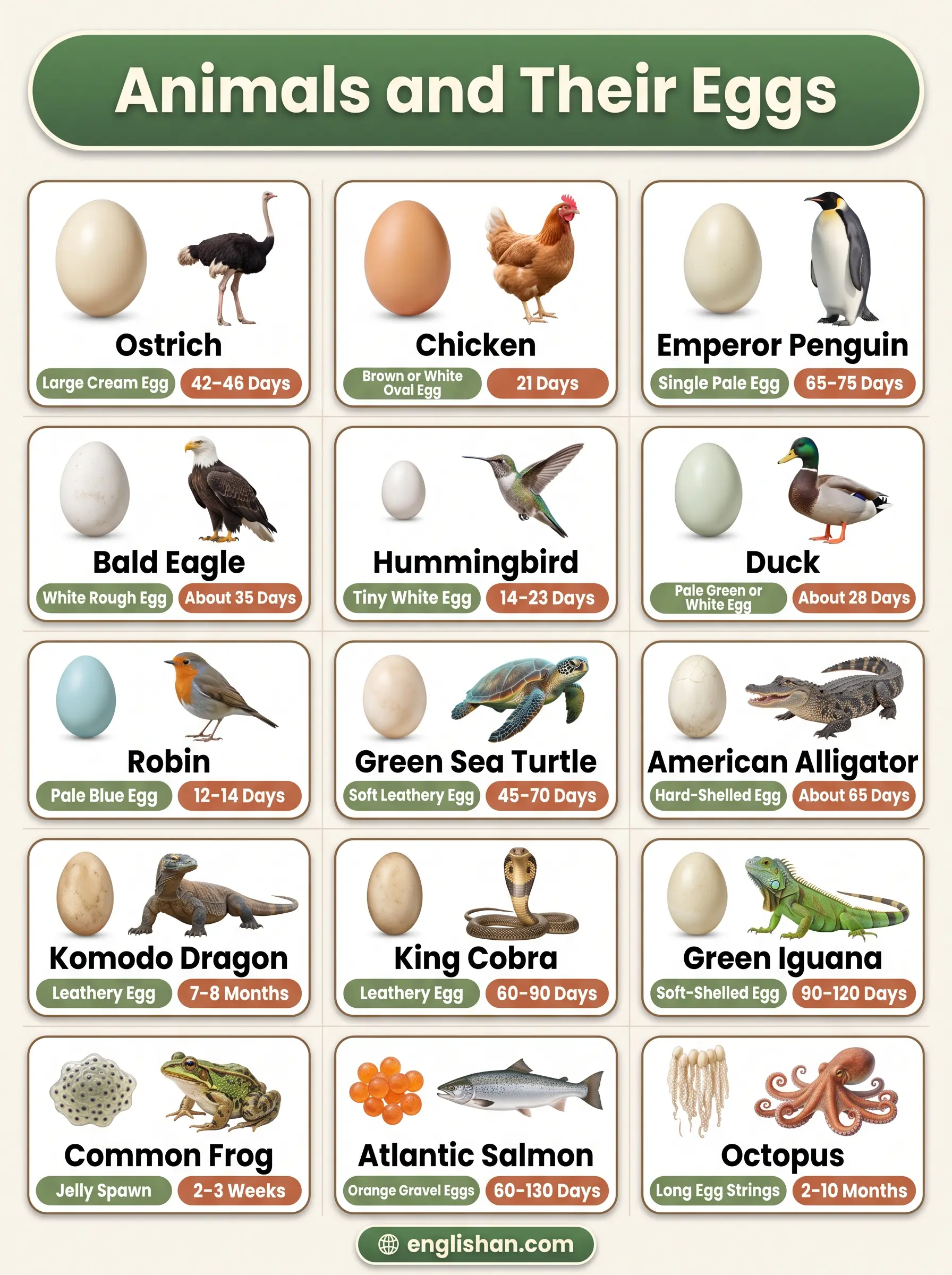
List of Animals and Their Eggs with Pictures
Here is a quick reference list covering 25 different animals across every major group, useful if you just want a fast overview without reading through each section in detail.
- Ostrich – large, cream colored egg, hatches in 42 to 46 days
- Chicken – oval, brown or white shell, hatches in 21 days
- Emperor penguin – single egg carried on the parent’s feet, hatches in 65 to 75 days
- Bald eagle – white and rough textured, hatches in about 35 days
- Hummingbird – tiny, about the size of a coffee bean, hatches in 14 to 23 days
- Duck – pale green or white, hatches in about 28 days
- Robin – pale blue, hatches in 12 to 14 days
- Green sea turtle – soft, leathery, buried in sand, hatches in 45 to 70 days
- American alligator – hard shelled, laid in a vegetation mound, hatches in about 65 days
- Komodo dragon – leathery, laid in a burrow, hatches in 7 to 8 months
- King cobra – leathery, guarded in a leaf nest, hatches in 60 to 90 days
- Green iguana – soft shelled, buried underground, hatches in 90 to 120 days
- Common frog – jelly like spawn clusters, hatches in 2 to 3 weeks
- Common toad – long jelly strings, hatches in 1 to 3 weeks
- Fire salamander – gel coated, laid in water, hatches after several weeks
- Atlantic salmon – orange eggs in gravel nests, hatches in 60 to 130 days
- Clownfish – small orange eggs near an anemone, hatches in 6 to 10 days
- Common goldfish – sticky, transparent, hatches in 2 to 7 days
- Honeybee – tiny and white, hatches in about 3 days
- Monarch butterfly – small and ridged, hatches in 3 to 5 days
- Praying mantis – laid in a foam like case, hatches in 3 to 6 weeks
- Garden spider – wrapped in a silk sac, hatches the following spring
- Octopus – long strings of eggs, hatches in 2 to 10 months
- Platypus – small and leathery, hatches in about 10 days
- Short beaked echidna – single egg in a pouch, hatches in about 10 days
Bird Eggs
Bird eggs are protected by a hard, calcium rich shell full of thousands of tiny pores that let air and moisture pass through while keeping bacteria out. Shell color and pattern often act as camouflage, helping protect the egg from predators while a parent is away searching for food. Some birds lay plain white eggs in enclosed nests where camouflage is not needed, while ground nesting birds tend to lay speckled or earth toned eggs that blend into their surroundings.
Notable species:
- Ostrich – the largest bird egg alive today, cream colored, weighing up to 3 pounds, hatches in 42 to 46 days
- Chicken – oval, brown or white shell, the most farmed egg in the world, hatches in 21 days
- Emperor penguin – single egg balanced on the parent’s feet to keep it off the Antarctic ice, hatches in 65 to 75 days
- Bald eagle – white, rough textured, one to three eggs per clutch, hatches in about 35 days
- Hummingbird – smallest bird egg, about the size of a coffee bean, hatches in 14 to 23 days
- Duck – larger than chicken eggs, often pale green or white, hatches in about 28 days
- Swan – large and off white, laid in ground nests near water, hatches in 35 to 42 days
- Robin – pale blue, a familiar sight in spring gardens, hatches in 12 to 14 days
Most songbirds lay one egg per day until the clutch is complete, then begin incubating only after the last egg is laid so that all the chicks hatch around the same time. Birds of prey, on the other hand, often start incubating immediately, which means their chicks hatch days apart and can vary noticeably in size.
Reptile Eggs
Most reptiles lay eggs with a soft, leathery shell rather than a hard one. This flexible shell lets the egg absorb moisture from the sand or soil it is buried in, which matters because most reptile parents do not sit on their eggs the way birds do. Instead, they rely on the surrounding environment to provide warmth and humidity.
Notable species:
- Green sea turtle – soft, round, leathery shell, buried in beach sand, over a hundred eggs per nest, hatches in 45 to 70 days
- American alligator – hard shelled, laid inside a mound of vegetation that generates heat as it decomposes, hatches in about 65 days
- Komodo dragon – leathery eggs laid in burrows, one of the longest reptile incubation periods at 7 to 8 months
- King cobra – leathery eggs guarded closely by the mother inside a nest built from leaves, hatches in 60 to 90 days
- Green iguana – soft shelled eggs buried underground in clutches of 20 to 40, hatches in 90 to 120 days
- Saltwater crocodile – hard shelled, laid in nests of sand or plant matter, hatches in 80 to 90 days
For many reptiles, the temperature inside the nest determines whether the hatchlings will be male or female, a process known as temperature dependent sex determination. Warmer nests tend to produce more females in turtles, while the opposite pattern often holds true in crocodiles and alligators. Not every reptile lays eggs, however. Some snakes, including certain vipers and boas, keep their eggs inside the body and give birth to live young instead, a strategy that can help protect eggs in colder climates.
Amphibian Eggs
Amphibian eggs have no shell at all. Instead, they are covered in a clear, jelly like coating that must stay moist to survive, which is why frogs, toads, and salamanders lay their eggs in or right next to water. Without a hard shell for protection, amphibians rely almost entirely on water and the sheer number of eggs laid to give at least some offspring a chance to survive.
Notable species:
- Common frog – eggs laid in clusters known as spawn, hatch in 2 to 3 weeks
- Common toad – long strings of jelly wrapped around underwater plants, hatch in 1 to 3 weeks
- Fire salamander – gel coated eggs laid directly in water, hatch after several weeks
- Axolotl – eggs attached individually to underwater plants, hatch in 2 to 3 weeks
Because amphibian eggs are so exposed to their environment, amphibians are often used by scientists as an early warning sign of pollution, drought, or habitat decline in an ecosystem. A drop in frog or salamander populations in a wetland is frequently one of the first visible signs that something in that environment has changed.
Fish Eggs
Fish usually lay far more eggs than birds or reptiles, since most species release their eggs directly into open water where survival depends on sheer numbers rather than parental protection. A single female fish can release anywhere from a few hundred to several million eggs in one spawning season, depending on the species.
Notable species:
- Atlantic salmon – orange eggs laid in gravel nests called redds, hatch in 60 to 130 days
- Clownfish – small orange eggs attached to rocks near a host anemone, guarded closely, hatch in 6 to 10 days
- Common goldfish – sticky, transparent eggs attached to plants, hatch in 2 to 7 days
- Catfish – sticky clusters of eggs attached to underwater surfaces, hatch in 5 to 10 days
A common question people ask is whether sharks lay eggs. The answer depends entirely on the species. Some sharks, like the catshark and horn shark, lay tough, leathery egg cases known as mermaid’s purses, which are often found washed up on beaches. Others, including the great white shark, keep their eggs inside the body and give birth to live pups through ovoviviparity.
Insect and Invertebrate Eggs
Insects lay some of the smallest eggs in the animal kingdom, but often in extremely large quantities to offset how vulnerable each individual egg is to predators and weather. Other invertebrates, including spiders, snails, and octopuses, also produce eggs with their own distinct structures and strategies.
Notable species:
- Honeybee – a queen can lay over a thousand tiny white eggs in a single day during peak season, hatching in about 3 days
- Monarch butterfly – small, ridged eggs laid on milkweed leaves, hatch within 3 to 5 days
- Praying mantis – eggs wrapped in a foam like case called an ootheca, which hardens to protect them, hatching in 3 to 6 weeks
- Desert locust – eggs laid in pods buried in soil, hatching in 10 to 65 days depending on conditions
- Garden spider – eggs wrapped in a silk sac in autumn, often overwinter before hatching the following spring
- Octopus – long strings of small eggs guarded closely by the mother for two to ten months, often without eating
- Snail – small, round eggs laid in soil in clusters, hatching in 2 to 4 weeks
Octopus mothers are especially notable for their dedication. A mother octopus will guard her eggs constantly, cleaning them and fanning water over them to keep them oxygenated, and in many species she dies shortly after her eggs finally hatch.
Egg Laying Mammals
A very small group of mammals, called monotremes, lay eggs instead of giving birth to live young, making them one of the more surprising exceptions in the animal kingdom.
Notable species:
- Platypus – small, leathery eggs, usually one to three per clutch, hatching in about 10 days
- Short beaked echidna – a single leathery egg, carried and incubated inside a pouch, hatching in about 10 days
The platypus and the echidna are the only egg laying mammals alive today. After laying her eggs, a mother platypus curls her body around them to keep them warm until they hatch. Once hatched, the young of both species drink milk that seeps directly through the mother’s skin, since monotremes lack the nipples found in other mammals.
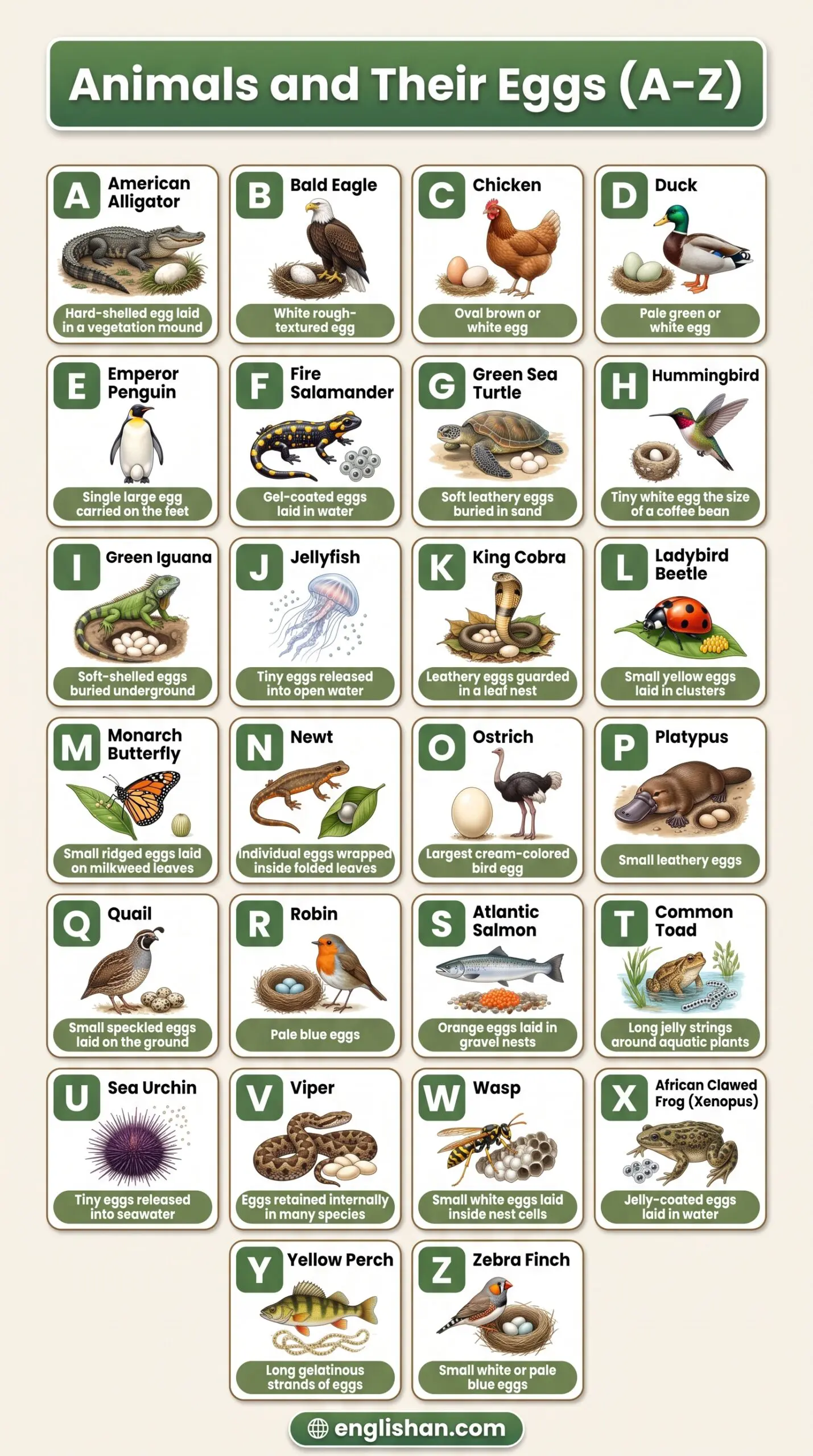
Animals and Their Eggs (A–Z)
For quick lookup, here is an alphabetical list of animals alongside a short description of their egg.
A
- Alligator, American: hard shelled, laid in a vegetation mound
- Axolotl: gel coated, attached to underwater plants
B
- Bald Eagle: white, rough textured shell
- Bee, Honeybee: tiny, white, laid in wax cells
C
- Chicken: oval, brown or white shell
- Clownfish: small, orange, attached to rocks
- Cobra, King: leathery, guarded in a leaf nest
- Crocodile, Saltwater: hard shelled, laid in sand or plant matter
D
- Desert Locust: laid in pods buried in soil
- Duck: pale green or white shell
E
- Echidna, Short Beaked: single leathery egg carried in a pouch
- Emperor Penguin: single large egg carried on the feet
F
- Fire Salamander: gel coated, laid directly in water
- Frog, Common: jelly like clusters called spawn
G
- Garden Spider: eggs wrapped in a silk sac
- Goldfish, Common: sticky, transparent eggs
- Great White Shark: retains eggs internally, gives birth to live young
H
- Honeybee: tiny, white, laid in wax cells
- Hummingbird: smallest bird egg, size of a coffee bean
I
- Iguana, Green: soft shelled, buried underground
J
- Jellyfish: tiny eggs released directly into open water
K
- King Cobra: leathery, guarded in a leaf nest
- Komodo Dragon: leathery, laid in a burrow
L
- Ladybird Beetle: small, yellow, laid in clusters on leaves
- Locust, Desert: laid in pods buried in soil
M
- Mantis, Praying: laid in a foam like case called an ootheca
- Monarch Butterfly: small, ridged, laid on milkweed leaves
N
- Newt: individually wrapped in folded leaves underwater
O
- Octopus: long strings of small eggs
- Ostrich: largest living bird egg, cream colored
P
- Platypus: small, leathery eggs
- Penguin, Emperor: single egg carried on the feet
- Python: leathery eggs, coiled around and guarded by the mother
Q
- Quail: small, speckled, laid directly on the ground
R
- Robin: pale blue shell
- Rattlesnake: retains eggs internally in most species
S
- Salmon, Atlantic: orange eggs laid in gravel nests
- Salamander, Fire: gel coated eggs laid in water
- Sea Turtle, Green: soft, leathery, buried in sand
- Spider, Garden: eggs wrapped in a silk sac
- Snail: small, round eggs laid in soil clusters
T
- Toad, Common: long jelly strings around water plants
- Turtle, Green Sea: soft, leathery, buried in sand
U
- Urchin, Sea: tiny eggs released into open water for external fertilization
V
- Viper: mostly retains eggs internally, gives birth to live young
W
- Wasp: small, white, laid inside a nest cell or host insect
X
- Xenopus, African Clawed Frog: jelly coated eggs laid in water
Y
- Yellow Perch: long gelatinous strands of eggs draped over underwater plants
Z
- Zebra Finch: small white or pale blue eggs laid in a clutch of four to six
Animals That Do Not Lay Eggs
For contrast, it helps to know which animals skip egg laying entirely. Nearly all mammals, aside from the platypus and echidna, give birth to live young. Live birth has also evolved independently in several reptile and fish lineages that are usually associated with eggs, including most sharks, many vipers and boas, and some skinks. This shows that while egg laying is extremely widespread, it is not a fixed rule even within groups that typically reproduce that way.
Record Breaking Eggs
A few animal eggs stand out for their extremes, and these are some of the most searched facts on the topic:
- Largest egg by a living animal: the ostrich, at up to 3 pounds
- Largest egg ever laid by any animal: the extinct elephant bird, whose eggs could hold the equivalent of about 150 chicken eggs
- Smallest bird egg: the bee hummingbird, whose egg is barely the size of a coffee bean
- Longest incubation among common reptiles: the Komodo dragon, at up to 8 months
- Most eggs laid at once by a vertebrate: some ocean sunfish are estimated to release around 300 million eggs in a single spawning event
How Animals Protect Their Eggs
Protecting eggs is one of the biggest challenges any egg laying species faces, and different animals have developed very different solutions. Birds build nests and incubate their eggs with body heat. Crocodiles and alligators build mounds of decaying vegetation that generate warmth naturally. Sea turtles bury their eggs deep in sand, relying on numbers and stealth rather than direct guarding, since the mother returns to the ocean shortly after laying. Octopuses and many insects guard their eggs constantly, sometimes at the cost of their own survival. Fish that release eggs into open water usually compensate for the lack of protection by producing eggs in the thousands or millions.
Final Thoughts
Egg laying is one of nature’s most reliable and enduring ways to reproduce, and it looks completely different depending on the animal doing it. From the hard shelled eggs of birds to the soft jelly clusters of frogs, and from the leathery eggs of a platypus to the millions of eggs released by a single fish, every type of egg reflects the environment and survival strategy of the species that produces it. Understanding these differences offers a much richer picture of just how varied and resourceful life on Earth really is.
FAQs
The ostrich lays the largest egg of any living animal, though the extinct elephant bird once laid even bigger ones.
No. Some snakes and lizards give birth to live young instead through a process called ovoviviparity.
Monotremes, which include the platypus and the echidna, are the only egg laying mammals alive today.
It depends on the species. Some sharks lay eggs in tough leathery cases, while others give birth to live young.
A healthy laying hen typically produces between 250 and 300 eggs a year.
Yes. Spiders wrap their eggs in a protective silk sac, with each sac holding anywhere from a few dozen to a few hundred eggs.
For many reptiles, the temperature of the nest during incubation determines whether the offspring will be male or female.
Fish eggs released into open water face far more predators and environmental risks, so species compensate by producing very large numbers of eggs to ensure enough offspring survive.
You May Also Like
Animals and Their Eggs Quiz
Animals and Their Eggs
What does 'oviparous' mean?
Birds, most reptiles, amphibians and fish are oviparous.
Oviparous, ovoviviparous, viviparous — outside, inside, live.
A hen is oviparous; a cow is viviparous.
Which mammals lay eggs?
They are monotremes, and they still feed their young on milk.
Egg-laying does not disqualify an animal from being a mammal.
Milk is the mammal test, not live birth.
Name the group.
The full set of eggs a bird lays in one nesting attempt is a ___.
Clutch size varies with food supply, so a poor year produces smaller clutches.
Clutch of eggs, brood of chicks.
She laid a clutch of five over five days.
Why are the eggs of cliff-nesting birds sharply pointed at one end?
A guillemot's egg pivots around its own point rather than rolling away.
Egg shape follows nesting site.
A round egg on a bare ledge would be lost.
What is an eggshell made of?
The pores let oxygen in and carbon dioxide out while holding moisture.
An eggshell breathes.
A hen's egg has around seven thousand pores.
Turn on JavaScript for the interactive quiz. The full practice set is shown above.