

Every animal on Earth has two names. One is the common name we use in everyday conversation, like “lion” or “elephant.” The other is its scientific name, a two part Latin term recognized by scientists and researchers all over the world, no matter what language they speak. This system is called binomial nomenclature, and it was introduced by the Swedish botanist Carl Linnaeus in the 18th century.
This article covers scientific names across every major animal group, along with common questions people ask about how the naming system works. Whether you are a student, a teacher, preparing for an exam, or simply curious, this article is built to be the only reference you need.
What Is a Scientific Name
A scientific name is the formal, universally accepted name given to a species under the rules of binomial nomenclature. It always has two parts:
- The genus, capitalized, which groups closely related species together
- The species, written in lowercase, which identifies the specific organism
Both words are italicized in formal writing. For example, the scientific name of the domestic dog is Canis lupus familiaris, showing that dogs belong to the genus Canis, which also includes wolves and coyotes.
Explore more animals that start with different letters:
A | B | C | D | E | F | G | H | I | J | K | L | M | N | O | P | Q | R | S | T | U | V | W | X | Y | Z
Why Scientific Names Are Used Instead of Common Names
Common names change from region to region and language to language. A single animal can have five or six different common names depending on where you live. Scientific names solve this problem by giving every species one fixed identity recognized worldwide. This is especially important in:
- Conservation and endangered species tracking
- Medical and pharmaceutical research
- International wildlife trade and customs regulation
- Academic publishing and taxonomy
- Zoos, aquariums, and museum records
The Classification System Behind Scientific Names
Scientific names sit inside a larger hierarchy called taxonomic classification. Every animal is placed into the following levels, from broadest to most specific:
- Kingdom
- Phylum
- Class
- Order
- Family
- Genus
- Species
Knowing where an animal sits in this hierarchy tells you a lot about its closest relatives. For example, humans belong to the order Primates, the family Hominidae, the genus Homo, and the species sapiens, giving the full scientific name Homo sapiens.
Scientific Names of Mammals
Mammals are warm blooded animals that nurse their young with milk. Below is a list covering wild mammals, domestic mammals, and marine mammals.
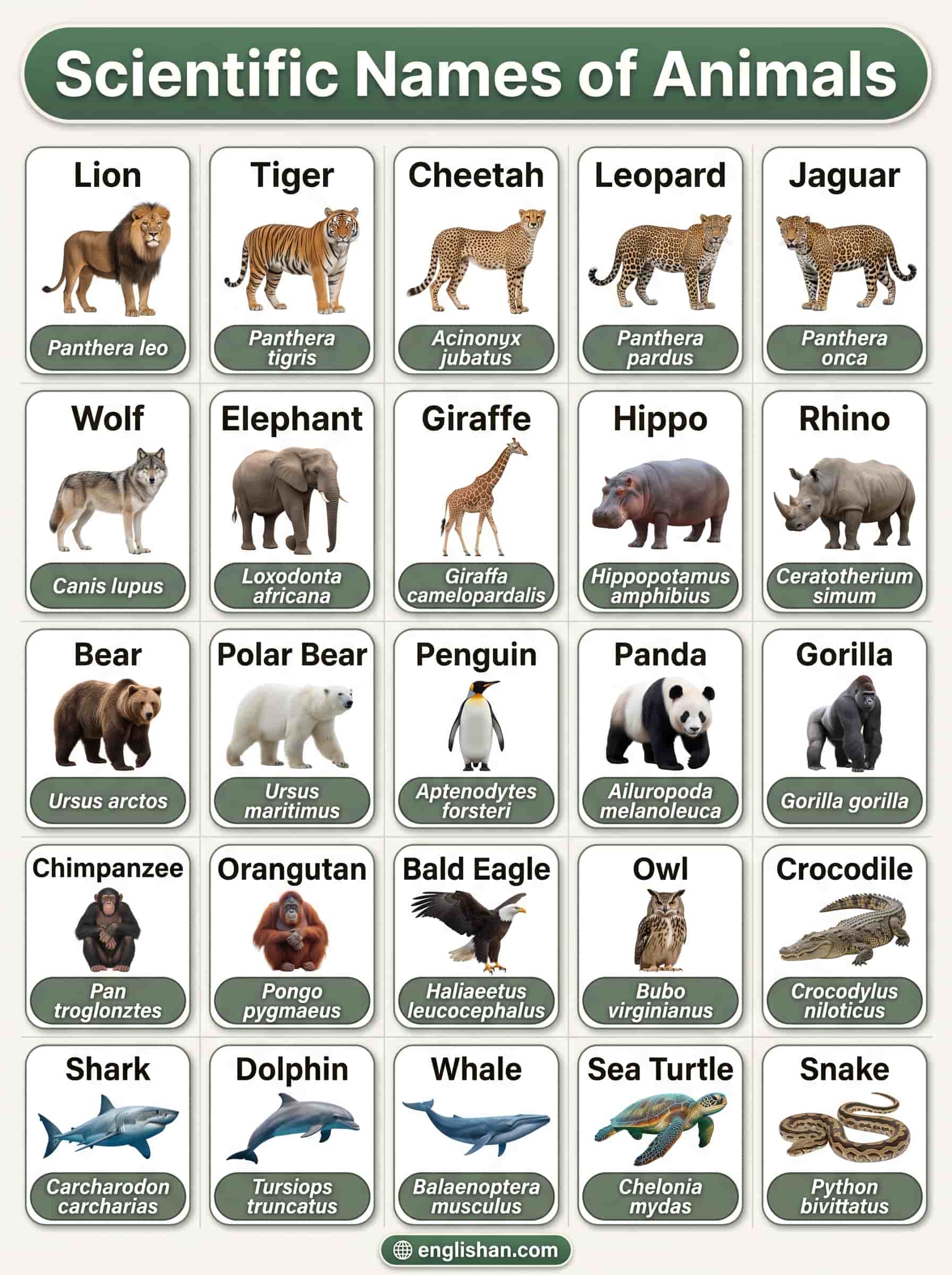
- Lion — Panthera leo
- Tiger — Panthera tigris
- African Elephant — Loxodonta africana
- Asian Elephant — Elephas maximus
- Gray Wolf — Canis lupus
- Domestic Dog — Canis lupus familiaris
- Domestic Cat — Felis catus
- Giant Panda — Ailuropoda melanoleuca
- Blue Whale — Balaenoptera musculus
- Bottlenose Dolphin — Tursiops truncatus
- Cheetah — Acinonyx jubatus
- Giraffe — Giraffa camelopardalis
- Red Fox — Vulpes vulpes
- Horse — Equus ferus caballus
- Cow — Bos taurus
- Goat — Capra aegagrus hircus
- Sheep — Ovis aries
- Pig — Sus scrofa domesticus
- Rabbit — Oryctolagus cuniculus
- House Mouse — Mus musculus
- Brown Rat — Rattus norvegicus
- Kangaroo — Macropus giganteus
- Koala — Phascolarctos cinereus
- Chimpanzee — Pan troglodytes
- Gorilla — Gorilla gorilla
- Polar Bear — Ursus maritimus
- Brown Bear — Ursus arctos
- Camel — Camelus dromedarius
- Hippopotamus — Hippopotamus amphibius
- Rhinoceros — Ceratotherium simum
The lion, known as Panthera leo, is often called the king of the jungle even though it actually lives on grasslands and savannas rather than dense forests. The domestic dog, Canis lupus familiaris, is classified as a subspecies of the gray wolf, reflecting its ancestry from wild wolf populations tens of thousands of years ago.
Scientific Names of Birds
Birds are found on every continent, and their scientific names often reflect a distinct physical trait or region of origin.
- Bald Eagle — Haliaeetus leucocephalus
- Peregrine Falcon — Falco peregrinus
- Ostrich — Struthio camelus
- Emperor Penguin — Aptenodytes forsteri
- Barn Owl — Tyto alba
- House Sparrow — Passer domesticus
- Common Kingfisher — Alcedo atthis
- Indian Peafowl — Pavo cristatus
- Great Horned Owl — Bubo virginianus
- Flamingo — Phoenicopterus roseus
- Domestic Chicken — Gallus gallus domesticus
- Domestic Duck — Anas platyrhynchos domesticus
- Crow — Corvus brachyrhynchos
- Pigeon — Columba livia
- Parrot — Psittacus erithacus
- Hummingbird — Trochilidae (family)
- Swan — Cygnus olor
- Woodpecker — Dryobates villosus
The peregrine falcon, Falco peregrinus, holds the record as the fastest animal on Earth, reaching diving speeds beyond 240 miles per hour. The emperor penguin, Aptenodytes forsteri, is the tallest and heaviest of all penguin species and breeds in the harsh conditions of Antarctica.
Scientific Names of Reptiles
Reptiles are cold blooded animals with scaly skin, and many have remained largely unchanged for millions of years.
- Komodo Dragon — Varanus komodoensis
- Green Anaconda — Eunectes murinus
- American Alligator — Alligator mississippiensis
- Saltwater Crocodile — Crocodylus porosus
- King Cobra — Ophiophagus hannah
- Galápagos Tortoise — Chelonoidis niger
- Green Sea Turtle — Chelonia mydas
- Chameleon — Chamaeleo chamaeleon
- Gecko — Gekko gecko
- Iguana — Iguana iguana
- Rattlesnake — Crotalus atrox
- Python — Python bivittatus
The Komodo dragon, Varanus komodoensis, is the largest living lizard species and is found only on a handful of Indonesian islands. The king cobra, Ophiophagus hannah, is the longest venomous snake in the world and can grow beyond 18 feet.
Scientific Names of Amphibians
Amphibians live a dual life, spending part of their existence in water and part on land.
- American Bullfrog — Lithobates catesbeianus
- Axolotl — Ambystoma mexicanum
- Poison Dart Frog — Dendrobates tinctorius
- Common Toad — Bufo bufo
- Fire Salamander — Salamandra salamandra
- Common Frog — Rana temporaria
The axolotl, Ambystoma mexicanum, is famous for its ability to regenerate lost limbs and even parts of its brain, which makes it a popular subject in medical research.
Scientific Names of Fish
Fish make up more than half of all known vertebrate species, ranging from tiny freshwater fish to massive ocean predators.
- Great White Shark — Carcharodon carcharias
- Clownfish — Amphiprion ocellaris
- Whale Shark — Rhincodon typus
- Atlantic Salmon — Salmo salar
- Common Goldfish — Carassius auratus
- Manta Ray — Mobula birostris
- Common Carp — Cyprinus carpio
- Piranha — Pygocentrus nattereri
- Seahorse — Hippocampus kuda
The whale shark, Rhincodon typus, is the largest fish species alive today, yet it feeds mainly on plankton and small fish rather than large prey.
Scientific Names of Insects and Other Invertebrates
Insects and invertebrates make up the most diverse group of animals on the planet, with over a million described species.
- Honeybee — Apis mellifera
- Monarch Butterfly — Danaus plexippus
- Praying Mantis — Mantis religiosa
- Ladybird Beetle — Coccinella septempunctata
- Desert Locust — Schistocerca gregaria
- House Fly — Musca domestica
- Ant — Formica rufa
- Spider — Araneus diadematus
- Scorpion — Pandinus imperator
- Octopus — Octopus vulgaris
- Earthworm — Lumbricus terrestris
The monarch butterfly, Danaus plexippus, is known for its extraordinary multi generation migration across North America, traveling thousands of miles between summer and winter habitats.
Scientific Names of Endangered Animals
Many people search specifically for the scientific names of endangered species for school projects and conservation awareness.
| Animal | Scientific Name | Conservation Status |
|---|---|---|
| Giant Panda | Ailuropoda melanoleuca | Vulnerable |
| Sumatran Tiger | Panthera tigris sumatrae | Critically Endangered |
| Mountain Gorilla | Gorilla beringei beringei | Endangered |
| Black Rhino | Diceros bicornis | Critically Endangered |
| Amur Leopard | Panthera pardus orientalis | Critically Endangered |
| Vaquita | Phocoena sinus | Critically Endangered |
Scientific Names of Farm and Domestic Animals
This section is one of the most searched categories, especially for students learning basic classification.
- Cow — Bos taurus
- Buffalo — Bubalus bubalis
- Goat — Capra aegagrus hircus
- Sheep — Ovis aries
- Horse — Equus ferus caballus
- Donkey — Equus africanus asinus
- Pig — Sus scrofa domesticus
- Chicken — Gallus gallus domesticus
- Duck — Anas platyrhynchos domesticus
- Cat — Felis catus
- Dog — Canis lupus familiaris
Animals and Their Scientific Names (A–Z)
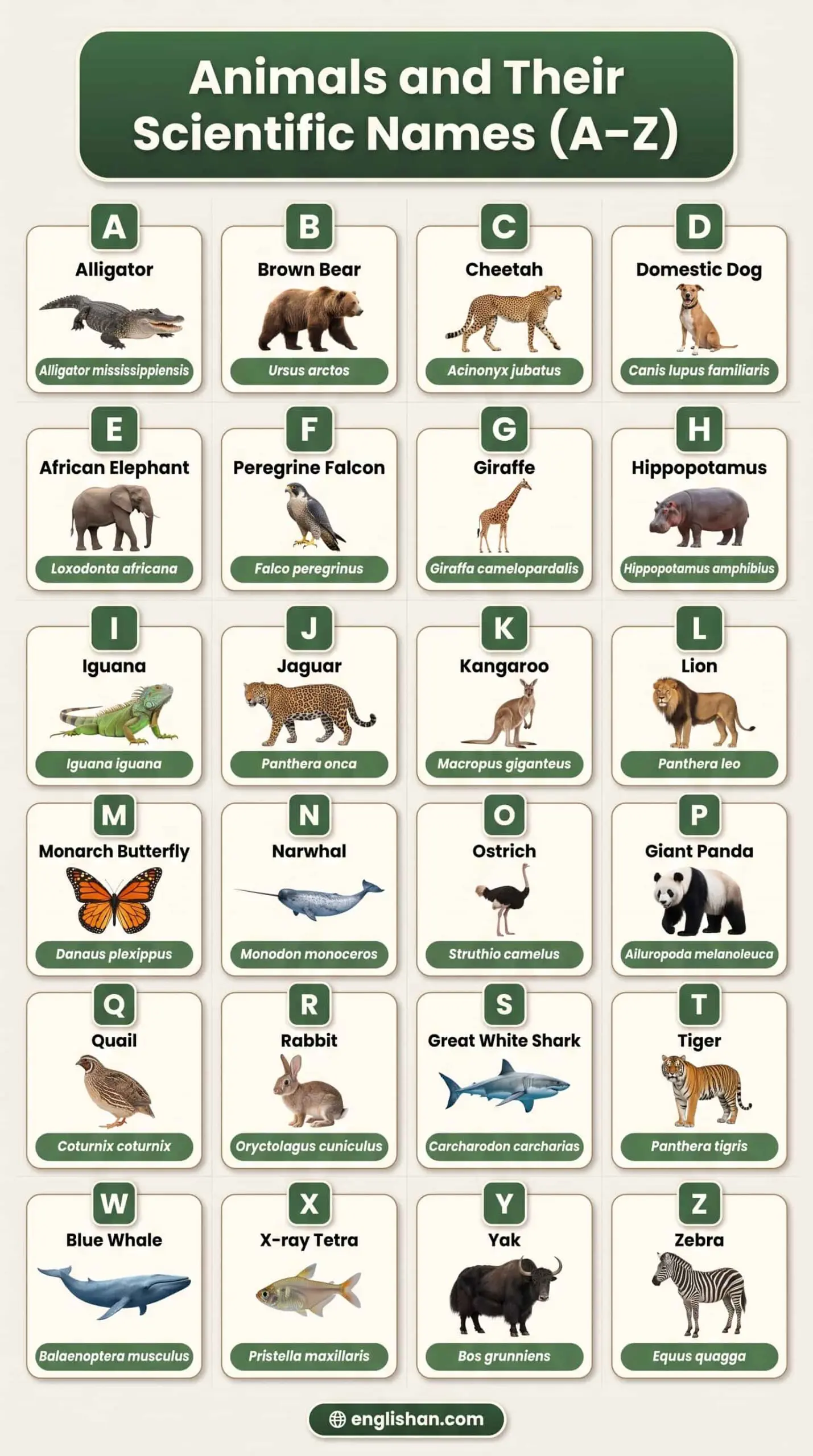
For quick reference, here is an alphabetical list covering a wide range of animals from across every group discussed above.
A
- Alligator, American: Alligator mississippiensis
- Ant: Formica rufa
- Axolotl: Ambystoma mexicanum
B
- Bald Eagle: Haliaeetus leucocephalus
- Bear, Brown: Ursus arctos
- Bear, Polar: Ursus maritimus
- Bee, Honeybee: Apis mellifera
- Bullfrog, American: Lithobates catesbeianus
- Butterfly, Monarch: Danaus plexippus
C
- Camel: Camelus dromedarius
- Carp, Common: Cyprinus carpio
- Cat, Domestic: Felis catus
- Cheetah: Acinonyx jubatus
- Chicken: Gallus gallus domesticus
- Chimpanzee: Pan troglodytes
- Cobra, King: Ophiophagus hannah
- Cow: Bos taurus
- Crocodile, Saltwater: Crocodylus porosus
- Crow: Corvus brachyrhynchos
D
- Dog, Domestic: Canis lupus familiaris
- Dolphin, Bottlenose: Tursiops truncatus
- Donkey: Equus africanus asinus
- Duck, Domestic: Anas platyrhynchos domesticus
E
- Eagle, Bald: Haliaeetus leucocephalus
- Earthworm: Lumbricus terrestris
- Elephant, African: Loxodonta africana
- Elephant, Asian: Elephas maximus
F
- Falcon, Peregrine: Falco peregrinus
- Fly, House: Musca domestica
- Fox, Red: Vulpes vulpes
- Frog, Common: Rana temporaria
- Frog, Poison Dart: Dendrobates tinctorius
G
- Gecko: Gekko gecko
- Giraffe: Giraffa camelopardalis
- Goat: Capra aegagrus hircus
- Goldfish, Common: Carassius auratus
- Gorilla: Gorilla gorilla
H
- Hippopotamus: Hippopotamus amphibius
- Horse: Equus ferus caballus
- Hummingbird: Trochilidae (family)
I
- Iguana: Iguana iguana
K
- Kangaroo: Macropus giganteus
- Kingfisher, Common: Alcedo atthis
- Koala: Phascolarctos cinereus
- Komodo Dragon: Varanus komodoensis
L
- Ladybird Beetle: Coccinella septempunctata
- Lion: Panthera leo
- Locust, Desert: Schistocerca gregaria
M
- Mantis, Praying: Mantis religiosa
- Manta Ray: Mobula birostris
- Mouse, House: Mus musculus
O
- Octopus, Common: Octopus vulgaris
- Ostrich: Struthio camelus
- Owl, Barn: Tyto alba
- Owl, Great Horned: Bubo virginianus
P
- Panda, Giant: Ailuropoda melanoleuca
- Parrot, African Grey: Psittacus erithacus
- Peafowl, Indian: Pavo cristatus
- Penguin, Emperor: Aptenodytes forsteri
- Pig: Sus scrofa domesticus
- Pigeon: Columba livia
- Piranha: Pygocentrus nattereri
- Python, Burmese: Python bivittatus
R
- Rabbit: Oryctolagus cuniculus
- Rat, Brown: Rattus norvegicus
- Rattlesnake, Western Diamondback: Crotalus atrox
- Rhinoceros, White: Ceratotherium simum
- Robin: Erithacus rubecula
S
- Salamander, Fire: Salamandra salamandra
- Salmon, Atlantic: Salmo salar
- Scorpion, Emperor: Pandinus imperator
- Seahorse: Hippocampus kuda
- Shark, Great White: Carcharodon carcharias
- Shark, Whale: Rhincodon typus
- Sheep: Ovis aries
- Sparrow, House: Passer domesticus
- Spider, Garden: Araneus diadematus
- Swan: Cygnus olor
T
- Tiger: Panthera tigris
- Toad, Common: Bufo bufo
- Tortoise, Galapagos: Chelonoidis niger
- Turtle, Green Sea: Chelonia mydas
W
- Whale, Blue: Balaenoptera musculus
- Wolf, Gray: Canis lupus
- Woodpecker, Hairy: Dryobates villosus
How Scientific Names Are Written Correctly
- Genus name first, always capitalized
- Species name second, always lowercase
- Both words italicized when typed or printed
- A subspecies name may follow for further classification, also lowercase
- After the first full mention in a text, the genus can be abbreviated to a single letter, for example P. leo for Panthera leo
Final Thoughts
Learning the scientific names of animals gives you a deeper appreciation for how living things are connected and classified. It also builds a foundation for anyone interested in biology, zoology, veterinary science, or wildlife conservation. Use this guide as a complete reference, and keep exploring the incredible diversity of life on our planet.
FAQs
The scientific name for humans is Homo sapiens.
Latin was the universal language of science for centuries in Europe, and it remains politically neutral since it is not tied to any single modern country or living language.
No, each species has only one accepted scientific name at a time, although names can occasionally be revised as new research reshapes classification.
No, the scientific name includes both the genus and the species. The genus alone is only the first part of the full name.
The scientific name of a domestic cat is Felis catus, and the scientific name of a domestic dog is Canis lupus familiaris.
Carl Linnaeus, a Swedish botanist, introduced the modern binomial naming system in the 18th century, and it is still used today with only minor modifications.
Yes, the same binomial nomenclature system used for animals applies to plants, fungi, and other living organisms.
You May Also Like
Animals and Their Scientific Names Quiz
Animals and Their Scientific Names
What are the two parts of a scientific name?
Panthera leo: Panthera is the genus, leo the species.
Binomial nomenclature: two names, in that order.
Panthera tigris is the tiger.
How is a scientific name written?
Homo sapiens follows the rule exactly.
One capital, always italic.
Canis familiaris, not canis Familiaris.
Name the scientist.
The two-part naming system was established by the Swedish naturalist Carl ___.
His system replaced long descriptive Latin phrases with a stable two-word label.
Linnaeus made the system consistent, not merely Latin.
He named his own species Homo sapiens.
Why use scientific names at all?
One animal may have a dozen local names, and one name may cover several species.
One species, one internationally recognised name.
Robin means different birds in Britain and America.
What is the correct order of the main taxonomic ranks?
Each rank sits inside the one before it.
Broad to narrow, kingdom down to species.
A lion is Animalia, Chordata, Mammalia, Carnivora, Felidae, Panthera, leo.
Turn on JavaScript for the interactive quiz. The full practice set is shown above.