Long before humans existed, Earth was home to an incredible range of creatures — massive dinosaurs, armored fish, flying reptiles, saber-toothed predators, and giant insects. One of the most fascinating parts of studying is learning these prehistoric animals names, since each one tells a story about size, appearance, behavior, habitat, or the scientist who found it.
This article covers dinosaurs, prehistoric mammals, marine reptiles, flying reptiles, ancient arthropods, early amphibians/reptiles, and more, distinct prehistoric animal species in total, each covered once, with no repeats.
Why Prehistoric Animals Have Such Unusual Names?
Almost every prehistoric animal name comes from Latin or Greek roots. Scientists follow binomial nomenclature, a naming system created by Carl Linnaeus in the 18th century that gives every organism a genus name and a species name.
Names are typically formed one of these ways:
- Descriptive — based on a physical feature, like Triceratops (“three-horned face”)
- Location-based — referencing where the fossil was found, like Argentinosaurus (Argentina)
- Tribute — honoring a paleontologist, historical figure, or institution
- Mythological — inspired by gods or legends, like Quetzalcoatlus, named for the Aztec feathered-serpent god
- Behavioral — describing movement or hunting style, like Velociraptor (“swift thief”)
- Cultural/pop-culture — a more recent trend, like Dracorex hogwartsia
Explore more animals that start with different letters:
A | B | C | D | E | F | G | H | I | J | K | L | M | N | O | P | Q | R | S | T | U | V | W | X | Y | Z
Prehistoric Time Periods Explained
- Precambrian Era — billions of years of the earliest simple life forms
- Paleozoic Era (Cambrian, Ordovician, Silurian, Devonian, Carboniferous, Permian) — early fish, giant insects, first reptiles
- Mesozoic Era (Triassic, Jurassic, Cretaceous) — the “Age of Reptiles,” when dinosaurs dominated
- Cenozoic Era — the current era, marked by the rise of mammals after the dinosaurs went extinct
Most Popular Prehistoric Animals Names
Here are the most popular prehistoric animal names:
- Ceratosaurus — “horned lizard.” A Jurassic predator with a distinctive nasal horn and bony ridges above its eyes.
- Baryonyx — “heavy claw.” A fish-eating theropod with a large curved claw on its thumb and a crocodile-like snout.
- Styracosaurus — “spiked lizard.” A horned dinosaur with a ring of long spikes radiating from its frill.
- Kentrosaurus — “spiky lizard.” An African relative of Stegosaurus with spikes running down its back and tail.
- Suchomimus — “crocodile mimic.” A spinosaurid with a long, narrow snout built for catching fish.
- Troodon — “wounding tooth.” A small, bird-like dinosaur believed to have been among the most intelligent non-avian dinosaurs.
- Ouranosaurus — a large herbivore with tall neural spines that may have supported a sail or a camel-like hump.
- Nigersaurus — a long-necked herbivore with hundreds of thin teeth arranged like a cutting rake for grazing close to the ground.
- Amargasaurus — named for the Argentine site La Amarga, notable for two parallel rows of tall spines running down its neck.
- Sarcosuchus — “flesh crocodile.” An enormous prehistoric crocodile relative nicknamed “SuperCroc,” among the largest crocodylians ever known.
- Purussaurus — a giant caiman relative from South America, one of the largest crocodilians known, rivaling Sarcosuchus in size.
- Deinosuchus — “terrible crocodile.” An enormous alligator relative capable of preying on dinosaurs that ventured too close to the water.
- Tylosaurus — a mosasaur with a long, blunt snout believed to have been used for ramming prey.
- Nothosaurus — an early marine reptile with a long body and webbed feet, considered an ancestor-like relative of the plesiosaurs.
- Placodus — an early marine reptile with flat, crushing teeth adapted for eating shellfish.
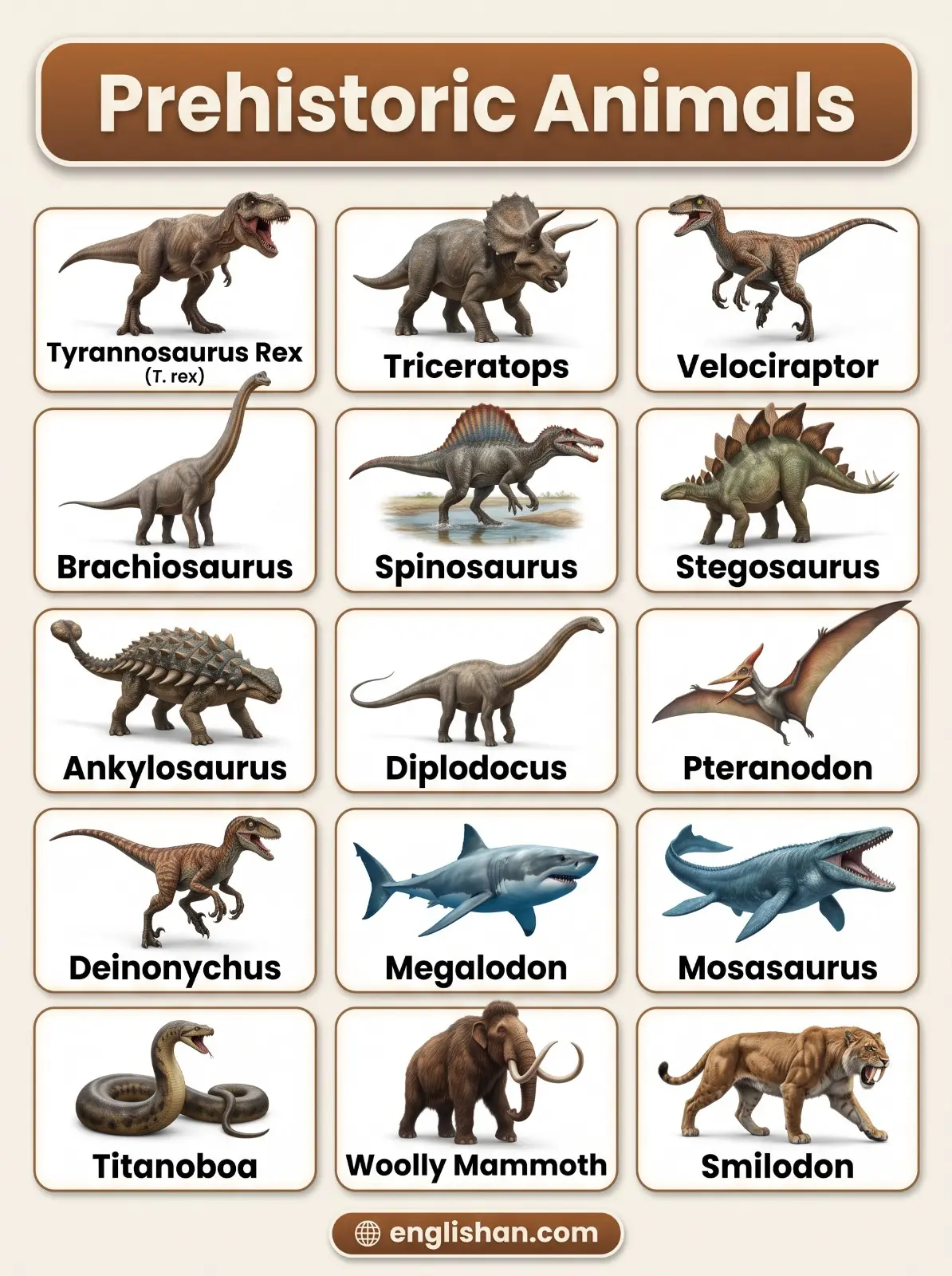
- Titanoboa — the largest snake ever known, estimated to have grown over 12 meters long during the Paleocene.
- Gigantopithecus — a giant ape and one of the largest primates known, living alongside early humans in Asia.
- Deinotherium — an early elephant relative known for unusual tusks that curved downward from its lower jaw.
- Chalicotherium — a horse relative with clawed feet instead of hooves, used for pulling down branches to feed.
- Entelodont (Daeodon) — a giant pig-like omnivore with a massive head, sometimes nicknamed the “terminator pig.”
Dinosaurs
- Tyrannosaurus rex — “tyrant lizard king.” One of the strongest bite forces ever measured in a land animal, strong enough to crush bone. Its tiny arms remain one of paleontology’s most debated features.
- Triceratops — “three-horned face.” Carried two brow horns, a nasal horn, and a wide bony frill likely used for defense, temperature regulation, or display. Fossil evidence suggests direct clashes with T. rex.
- Velociraptor — “swift thief.” Roughly turkey-sized in reality (far smaller than film depictions), feathered, fast, and armed with a sharp curved claw on each foot.
- Brachiosaurus — “arm lizard.” Front legs longer than back legs gave it a giraffe-like posture, letting it reach vegetation other herbivores couldn’t.
- Stegosaurus — “roofed lizard.” Famous for the upright back plates and a spiked tail (the “thagomizer”) likely swung defensively.
- Ankylosaurus — “fused lizard.” Armored head to tail, with a heavy club-like tail capable of a bone-breaking blow.
- Spinosaurus — “spine lizard.” A tall sail on its back and a crocodile-like snout; likely spent much of its life in and around water hunting large fish.
- Diplodocus — “double beam.” One of the longest dinosaurs ever found; its whip-like tail may have been cracked as a warning to predators.
- Giganotosaurus — “giant southern lizard.” Found in Argentina; rivaled or exceeded T. rex in length, hunting with speed and serrated teeth.
- Brontosaurus — “thunder lizard.” Once considered invalid, officially reinstated in 2015 after research confirmed skeletal differences from Apatosaurus.
- Allosaurus — “different lizard,” named for its unusual vertebrae. A dominant Jurassic predator that likely hunted in groups.
- Apatosaurus — “deceptive lizard,” so named because early fossils were confused with other species. A massive long-necked herbivore.
- Iguanodon — “iguana tooth.” One of the first dinosaurs ever formally named, identified from teeth resembling an iguana’s.
- Parasaurolophus — “near crested lizard.” Known for its long, curved cranial crest, likely used to make resonant calls.
- Pachycephalosaurus — “thick-headed lizard.” Had a domed, thickened skull possibly used in head-butting displays or contests.
- Compsognathus — “elegant jaw.” One of the smallest known dinosaurs, roughly chicken-sized, and a fast ground predator.
- Deinonychus — “terrible claw.” A mid-sized, highly agile predator whose discovery helped shape the modern “raptor” image.
- Carnotaurus — “meat-eating bull.” Named for the two horns above its eyes; had unusually short arms even by theropod standards.
- Therizinosaurus — “scythe lizard.” Possessed enormous curved claws, some of the longest of any known animal, likely used for foraging.
- Oviraptor — “egg thief.” Originally thought to steal eggs, later evidence showed it was likely brooding its own nest.
- Gallimimus — “chicken mimic.” A fast, ostrich-like omnivore with long legs built for running.
- Camarasaurus — “chambered lizard,” named for hollow chambers in its vertebrae that reduced skeletal weight.
- Corythosaurus — “helmet lizard.” A duck-billed dinosaur with a tall, rounded head crest.
- Maiasaura — “good mother lizard.” Fossil nesting sites suggest it cared for its young after hatching.
- Argentinosaurus — one of the largest land animals ever discovered, found in Argentina, estimated to have weighed as much as several elephants combined.
- Utahraptor — a large raptor discovered in Utah, bigger and more heavily built than its smaller Velociraptor relatives.
- Dracorex hogwartsia — named after the Harry Potter series for its dragon-like skull shape.
- Qianzhousaurus — nicknamed “Pinocchio rex” for its unusually long, narrow snout.
Prehistoric Mammals
- Woolly Mammoth — a close Ice Age relative of elephants, covered in thick fur with long curved tusks; frozen specimens have been found with preserved skin and stomach contents.
- Smilodon — the “saber-toothed cat.” Not closely related to modern tigers despite the popular nickname; its long canines likely delivered a precise killing bite.
- Megatherium — a giant ground sloth roughly the size of an elephant, using long claws to pull down branches.
- Woolly Rhinoceros — an Ice Age herbivore with a heavy coat and a large horn possibly used to clear snow from vegetation.
- Glyptodon — an armored mammal resembling a giant armadillo, protected by a solid domed shell.
- Megaloceros — the “Irish elk,” known for carrying some of the largest antlers of any mammal, likely used in mating displays.
- Andrewsarchus — known from a single enormous skull, thought to be one of the largest land-dwelling carnivorous mammals ever.
- Basilosaurus — “king lizard,” actually an early whale with a long, serpentine body, showing whales’ evolutionary transition from land to sea.
- Uintatherium — a large, plant-eating mammal with six bony knobs on its skull and saber-like canine teeth.
- Paraceratherium — one of the largest land mammals ever, a hornless relative of the rhinoceros that towered over most other herbivores.
- Doedicurus — a heavily armored glyptodont with a spiked, club-like tail similar in function to Ankylosaurus.
- Arsinoitherium — a rhinoceros-like mammal with two large, bony horns fused at the base.
Marine Reptiles and Prehistoric Sea Creatures
- Megalodon — “big tooth.” One of the largest predatory sharks ever known; its teeth alone could exceed the size of an adult human hand.
- Mosasaurus — a massive marine reptile (not a dinosaur) with a streamlined body and powerful jaws, an apex predator of ancient oceans.
- Plesiosaurus — known for its extremely long neck and four paddle-like limbs, likely used to strike quickly at schools of fish.
- Dunkleosteus — an armored prehistoric fish with self-sharpening bony plates instead of teeth, giving it one of the strongest bite forces ever recorded in a fish.
- Ichthyosaurus — a dolphin-like marine reptile built for speed, adapted to chase fast-moving prey.
- Elasmosaurus — a plesiosaur with one of the longest necks relative to body size of any known animal.
- Liopleurodon — a short-necked marine reptile (pliosaur) with an enormous skull and powerful bite.
- Kronosaurus — another massive pliosaur, named after the Greek Titan Kronos, with jaws built for crushing large prey.
- Helicoprion — an ancient shark relative famous for its bizarre spiral-shaped whorl of teeth.
- Xiphactinus — a large, aggressive predatory fish of the Cretaceous seas, sometimes found fossilized having swallowed prey nearly its own size.
Flying Reptiles
- Quetzalcoatlus — named after the Aztec feathered-serpent god. One of the largest flying animals ever, with a wingspan rivaling a small aircraft.
- Pteranodon — “wingless tooth,” despite having no teeth at all. Known for its long backward-pointing head crest.
- Archaeopteryx — “ancient wing.” A key transitional fossil combining feathered wings with reptilian features like teeth and a bony tail.
- Pterodactylus — “wing finger.” A smaller pterosaur and one of the first pterosaurs ever formally studied.
- Rhamphorhynchus — a pterosaur with a long tail ending in a diamond-shaped vane, likely used for stability in flight.
- Dimorphodon — an early pterosaur with a large, puffin-like head and two distinct tooth types, giving it its name (“two-form tooth”).
- Tapejara — a crested pterosaur known for its tall, sail-like head crest, likely used for display.
- Anhanguera — a fish-eating pterosaur with a bony crest on both its upper and lower jaw.
Prehistoric Insects and Arthropods
- Meganeura — a griffinfly with a wingspan close to 70 centimeters, among the largest flying insects ever known.
- Arthropleura — a massive millipede-like arthropod over two meters long, the largest known land-dwelling arthropod in Earth’s history.
- Eurypterus — a “sea scorpion,” an ancient marine arthropod predator with large pincers.
- Pulmonoscorpius — an early terrestrial scorpion far larger than any living today, likely an aggressive predator of small invertebrates.
- Jaekelopterus — the largest sea scorpion ever discovered, estimated at over two meters long.
- Mazothairos — an early giant insect from the Carboniferous, related to modern mayflies.
- Titanomyrma — a giant ant, roughly the size of a hummingbird, that lived during a warm period between Europe and North America.
- Palaeodictyoptera — an ancient winged insect group with no modern equivalent, notable for mouthparts adapted to piercing plants.
Early Amphibians and Reptiles
- Eryops — a large amphibian with a broad, flat skull, built more like a modern crocodile, likely an ambush predator near rivers and swamps.
- Diplocaulus — known for its unusual boomerang-shaped head, which may have aided swimming or deterred predators from swallowing it.
- Dimetrodon — often mistaken for a dinosaur, actually a synapsid more closely related to mammals, recognized by the large sail on its back.
- Edaphosaurus — another sail-backed synapsid, but a plant-eater with peg-like teeth suited for grinding vegetation.
- Prionosuchus — one of the largest amphibians ever known, resembling a giant crocodile in size and shape.
- Cotylorhynchus — a bulky, barrel-bodied synapsid with a disproportionately small head relative to its massive body.
- Scutosaurus — a heavily armored early reptile with bony knobs and spikes covering its body.
- Moschops — a stocky, thick-skulled synapsid believed to have used head-butting behavior similar to modern bighorn sheep.
Prehistoric Animals Names (A–Z)
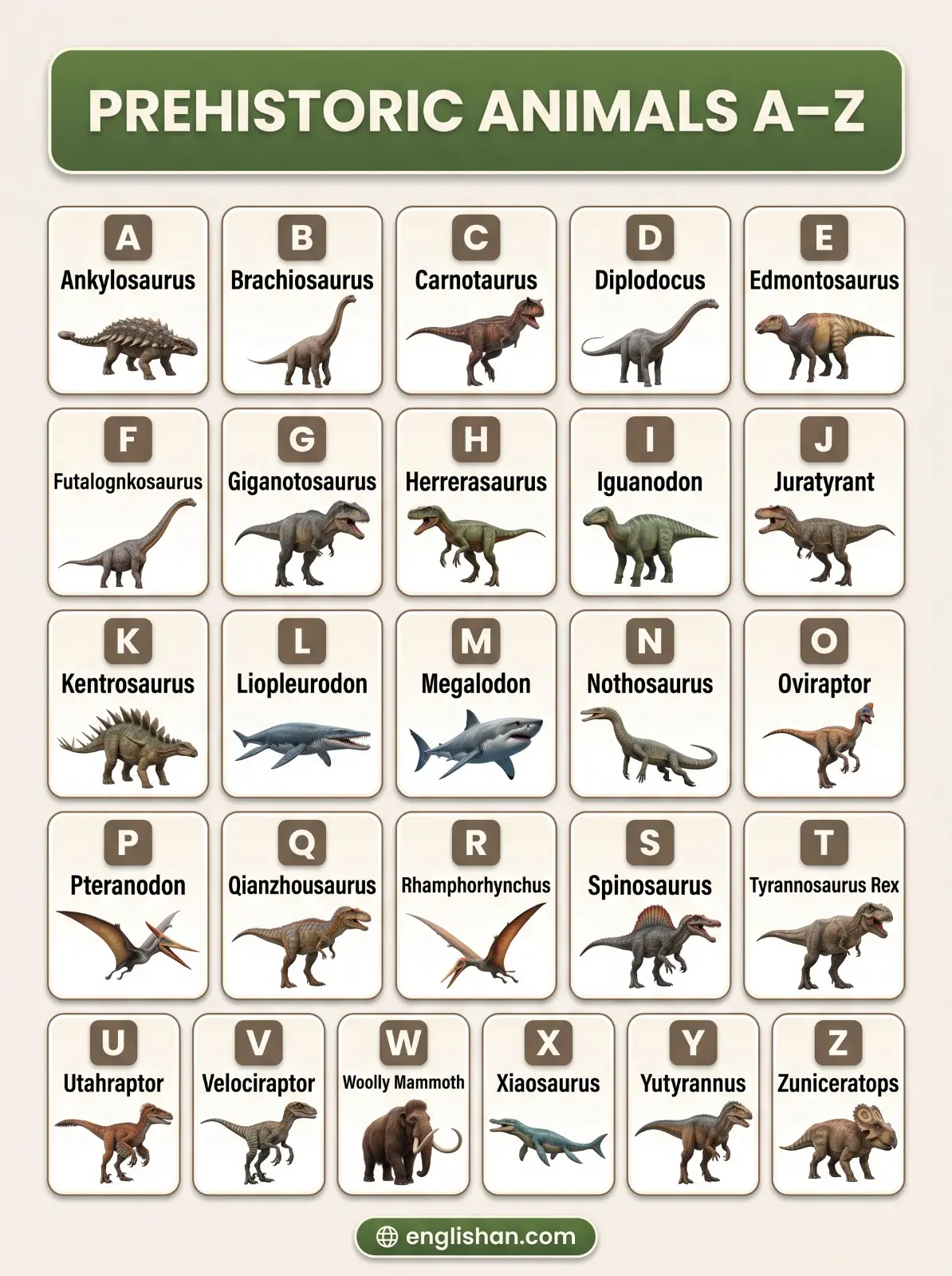
A full alphabetical reference to every species covered above, for quick lookup.
- A — Allosaurus, Amargasaurus, Andrewsarchus, Anhanguera, Ankylosaurus, Apatosaurus, Archaeopteryx, Argentinosaurus, Arsinoitherium, Arthropleura
- B — Baryonyx, Basilosaurus, Brachiosaurus, Brontosaurus
- C — Camarasaurus, Carnotaurus, Ceratosaurus, Chalicotherium, Compsognathus, Corythosaurus, Cotylorhynchus
- D — Deinonychus, Deinosuchus, Deinotherium, Dimetrodon, Dimorphodon, Diplocaulus, Diplodocus, Doedicurus, Dracorex hogwartsia, Dunkleosteus
- E — Edaphosaurus, Elasmosaurus, Entelodont (Daeodon), Eryops, Eurypterus
- G — Gallimimus, Giganotosaurus, Gigantopithecus, Glyptodon
- H — Helicoprion
- I — Ichthyosaurus, Iguanodon
- J — Jaekelopterus
- K — Kentrosaurus, Kronosaurus
- L — Liopleurodon
- M — Maiasaura, Mazothairos, Megalodon, Megaloceros, Megatherium, Meganeura, Moschops, Mosasaurus
- N — Nigersaurus, Nothosaurus
- O — Ouranosaurus, Oviraptor
- P — Pachycephalosaurus, Palaeodictyoptera, Paraceratherium, Parasaurolophus, Placodus, Plesiosaurus, Prionosuchus, Pteranodon, Pterodactylus, Pulmonoscorpius, Purussaurus
- Q — Qianzhousaurus, Quetzalcoatlus
- R — Rhamphorhynchus
- S — Sarcosuchus, Scutosaurus, Smilodon, Spinosaurus, Stegosaurus, Styracosaurus, Suchomimus
- T — Tapejara, Therizinosaurus, Titanoboa, Titanomyrma, Triceratops, Troodon, Tylosaurus, Tyrannosaurus rex
- U — Uintatherium, Utahraptor
- V — Velociraptor
- W — Woolly Mammoth, Woolly Rhinoceros
- X — Xiphactinus
(No species in this guide begin with F, Y, or Z.)
How Scientists Name Newly Discovered Prehistoric Animals
- Researchers study the fossil and compare it to previously known species.
- If it’s a new species, a name is created following Latin or Greek naming conventions.
- The name usually reflects a defining feature, discovery location, or notable individual.
- The name is submitted for review and published in a peer-reviewed scientific journal.
- Other scientists review the classification, and the name becomes permanently associated with that species.
This process lets scientists worldwide identify the same species using one universal name, regardless of language.
Interesting Facts about Prehistoric Animals Names
- The real Velociraptor was closer in size to a turkey and covered in feathers — nothing like its film depictions.
- Brontosaurus was considered an invalid name for over a century before a 2015 study reinstated it as its own genus, distinct from Apatosaurus.
- Dracorex hogwartsia‘s name is a direct tribute to the Harry Potter series, chosen for its dragon-like skull.
- Qianzhousaurus earned the nickname “Pinocchio rex” for its unusually long snout.
- New prehistoric species are still discovered and formally named every year — the list in this article is not close to exhaustive.
Final Thoughts
The world of prehistoric animals is filled with wonder, mystery, and constant discovery. New fossils are unearthed every year, and with them come new names that expand our understanding of ancient life across every era, from the earliest arthropods to the final generation of dinosaurs before their extinction. By learning the meanings behind these names, we gain deeper insight into how these remarkable creatures lived, hunted, adapted, and eventually vanished, leaving behind only fossils and the endless stories we continue to tell about them today.
FAQs
Tyrannosaurus rex is widely considered the most famous prehistoric animal name, recognized across the world due to its fearsome reputation and frequent appearances in books, films, and museums.
The suffix “saurus” comes from the Greek word for lizard, while “don” comes from the Greek word for tooth. These endings are commonly used because many early fossil discoveries were identified through jaw bones and teeth.
No. Dinosaurs are only one group among many prehistoric animals. Other categories include marine reptiles, flying reptiles, ancient mammals, giant insects, and early amphibians, none of which are technically classified as dinosaurs.
The scientist or research team that discovers and formally describes the fossil typically proposes the name, which is then reviewed and published in a recognized scientific journal before becoming official.
Yes. Names can change if new fossil evidence shows that a species was misclassified, if it turns out to be identical to an already named species, or if further research reveals it belongs to a different genus entirely.
Among land animals, Argentinosaurus is considered one of the largest ever found, while in the oceans, ancient whale ancestors and massive marine reptiles such as Mosasaurus reached enormous sizes as well.
Most do, since scientific naming conventions traditionally rely on Latin and Greek roots, though some modern names incorporate words from other languages, mythology, or even popular culture.
You May Also Like
- 90+ Dangerous Animals Names with Pictures
- 50+ Nocturnal Animals Names with Pictures
- 51+ Jungle Animals Names with Pictures
Prehistoric Animals Quiz
Prehistoric Animals
Which of these was NOT a dinosaur?
Pterosaurs were flying reptiles on a separate branch, not dinosaurs.
Flying and swimming reptiles of that era were not dinosaurs.
Plesiosaurs and mosasaurs were not dinosaurs either.
Did any dinosaurs survive?
Birds descend from theropods and sit inside the dinosaur group.
Non-avian dinosaurs went extinct; avian ones are on the bird table.
A sparrow is a dinosaur in the strict sense.
Name the animal.
The ice-age elephant relative with long curved tusks and a shaggy coat was the woolly ___.
It survived on Wrangel Island until around four thousand years ago, well after the pyramids were built.
Some ice-age animals overlapped with recorded history.
Mammoths were alive while Egypt was building.
What was Smilodon?
Its long canines were fragile and used precisely, not for crushing.
Sabre-toothed cats are ice-age mammals, not dinosaurs.
Smilodon and Tyrannosaurus never met.
How do we know the colour of some feathered dinosaurs?
Melanosome shape correlates with colour in living birds and can be matched.
Pigment structures, not pigment itself, are what survive.
Some small feathered dinosaurs had banded tails.
Turn on JavaScript for the interactive quiz. The full practice set is shown above.