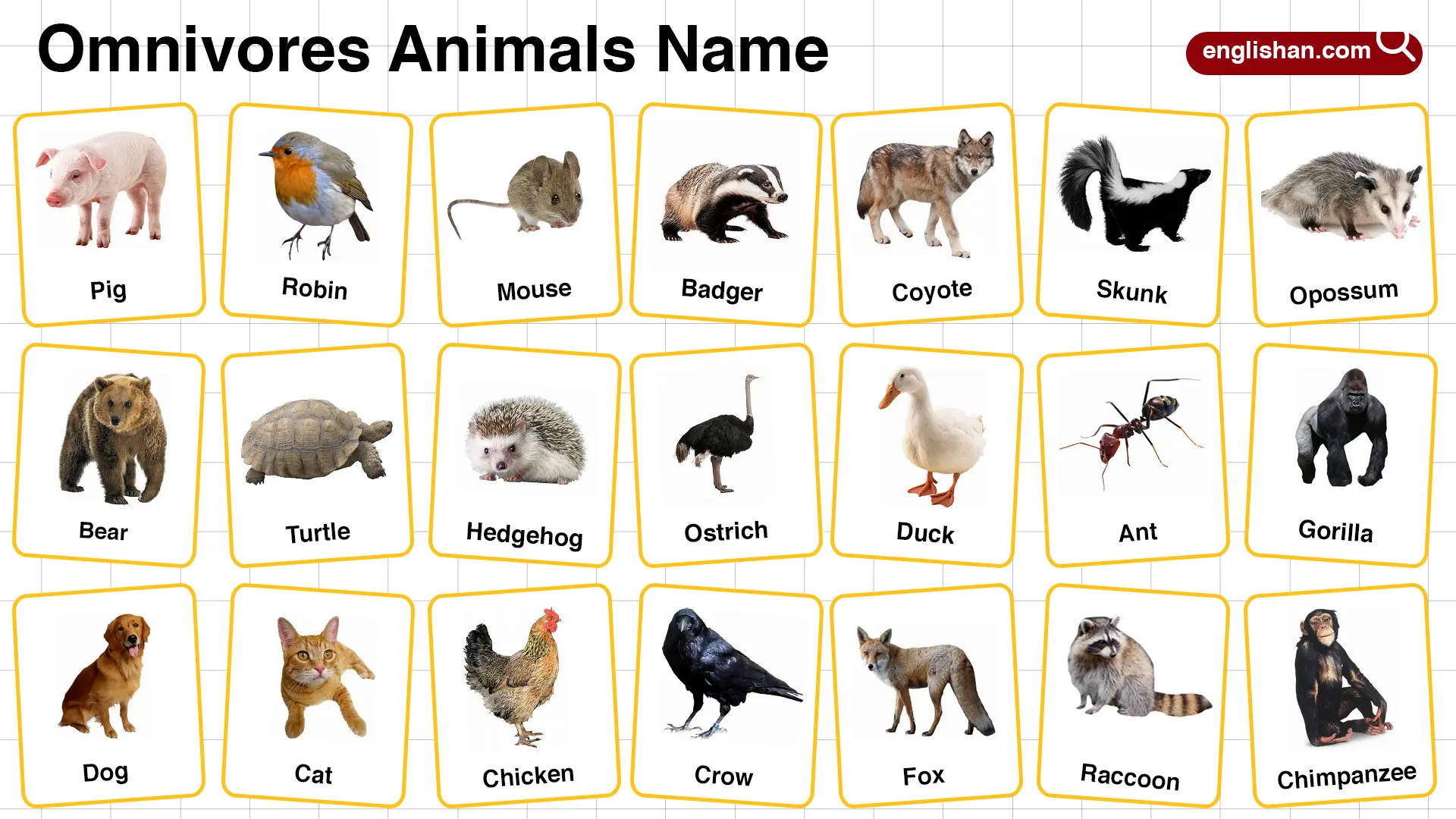
An animal’s teeth show what it eats long before you watch it feed. Flat molars grind plants, and pointed canines tear flesh. Omnivorous animals names are the ones that have both, from the brown bear to the common crow. Their diets shift with the season, so classifying them takes more than one meal.
Omnivorous Animals Names
Omnivorous animals eat both plant matter and animal matter. Their teeth and gut handle each one. Around 110 species are named in English lists, spread across mammals, birds, reptiles, fish and invertebrates. Bear, pig, raccoon, crow and human are the five you meet first. Each one is named in any list of animals names.
| Agouti | American Black Bear | Ant |
| Armadillo | Baboon | Badger |
| Bandicoot | Bearded Dragon | Binturong |
| Black-and-White Tegu | Blue Crab | Blue Jay |
| Blue-Tongued Skink | Bonnethead Shark | Bonobo |
| Box Turtle | Brown Bear | Capuchin Monkey |
| Carp | Catfish | Chicken |
| Chimpanzee | Chipmunk | Chough |
| Coati | Cockroach | Common Roach |
| Coyote | Crayfish | Cricket |
| Crow | Currawong | Diamondback Terrapin |
| Dog | Dove | Duck |
| Earwig | Emu | Fiddler Crab |
| Flamingo | Fox | Freshwater Drum |
| Goldfish | Goose | Gray’s Monitor |
| Grey Squirrel | Ground Beetle | Groundhog |
| Hamster | Hedgehog | Hermit Crab |
| Human | Hummingbird | Jackal |
| Jackdaw | Kea | Kinkajou |
| Koi | Lobster | Macaque |
| Magpie | Mongoose | Mouse |
| Mynah | Opaleye | Opossum |
| Orangutan | Oriole | Ostrich |
| Painted Turtle | Peccary | Pig |
| Pigeon | Piranha | Prairie Dog |
| Quail | Raccoon | Raccoon Dog |
| Rat | Raven | Red-Eared Slider |
| Rhea | Ring-Tailed Lemur | Ringtail |
| Roadrunner | Robin | Rudderfish |
| Sand Crab | Seagull | Shore Crab |
| Shrimp | Skunk | Sloth Bear |
| Snapping Turtle | Sparrow | Spider Monkey |
| Squirrel | Starling | Sugar Glider |
| Sun Bear | Tilapia | Triggerfish |
| Turkey | Vervet Monkey | Warthog |
| Wasp | Wild Boar | Wood Turtle |
| Woodpecker | Yellowjacket |
Omnivorous Animals Names With Pictures
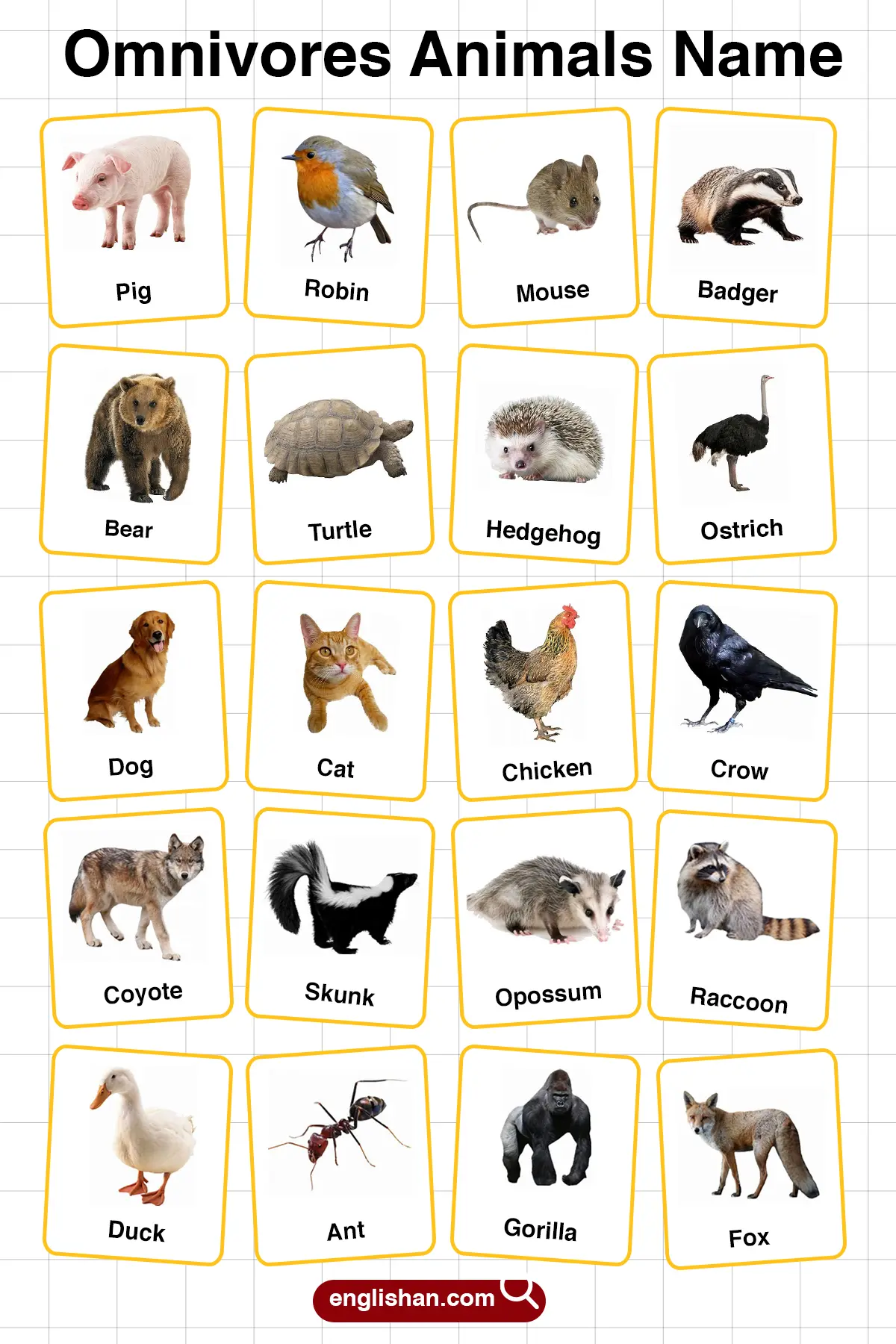
A name settles which group an animal is in. It does not show the animal eating, and that is where the classification is actually decided.
Brown Bear

The brown bear (Ursus arctos) is a big bear of northern forests and mountains. A hump of muscle rises over its shoulders, and on its hind legs it is taller than a man. Long front claws tear open the ground for roots and bulbs, and the same claws strip berry bushes bare. In autumn it wades into shallow rivers and pins salmon against the stones. Because both foods matter, the back teeth stayed flat for grinding while the front teeth stayed long for the fish.
American Black Bear
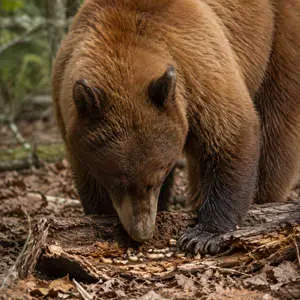
The American black bear (Ursus americanus) is the smaller of the two North American bears. It has no shoulder hump, and its coat runs anywhere from black to cinnamon. It stays a good climber into old age. Acorns, berries and grasses take up most of its feeding, so the grubs under a rolled-aside log count as a bonus rather than a meal. Suburban bears work the lids off wheelie bins.
Sloth Bear

The sloth bear (Melursus ursinus) is a shaggy black bear of the Indian subcontinent. Its claws curve like sickles, and it uses them to rip the top off a termite mound and blow out the dust. The insects go up through a gap in its front teeth, so the sucking is audible a long way through Indian forest. A pale, wrinkled muzzle seals against the mound while it works. Honey, mahua flowers and figs fill the plant half of its year.
Raccoon
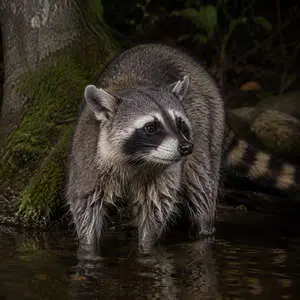
The raccoon (Procyon lotor) is a night animal about the size of a small dog. It has a black mask, a ringed tail, and front paws as sensitive as fingertips. Those paws feel along a stream bed for crayfish without any need to look down, which is why a raccoon hunts as well at night as by day. On land it strips sweetcorn cobs, gathers acorns and raids birds’ nests. City raccoons open bin latches with the same fingers.
Coati

The coati (Nasua nasua) is a raccoon relative from the forests of Central and South America. It walks with its long banded tail held straight up. Its snout is flexible enough to swing sideways, so it flips leaf litter over as it walks. Beetles, grubs, lizards and eggs come out from underneath. Fruit is taken from the branches above.
Kinkajou
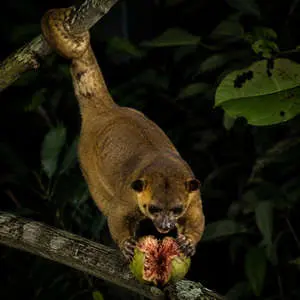
The kinkajou (Potos flavus) is a golden-brown rainforest animal that spends its life in the treetops. Round ears show clearly on a short face, and a gripping tail works as a fifth limb. It hangs by a prehensile tail with both hands free. A long tongue goes deep into figs and flowers for pulp and nectar. Insects and eggs are taken on the way past. Because it feeds at night, most people who live near kinkajous have never seen one.
Pig

The pig (Sus scrofa domesticus) is the farm animal most people name first when they hear the word omnivore. Its snout is a flat disc, stiffened by a small bone of its own, and it works as a shovel. It roots up grain, tubers and windfall fruit, and takes worms, eggs and carrion out of the same soil. Because both jobs fall to the same teeth, the molars behind are broad and ridged, much like a person’s. That resemblance runs deep enough for pig digestion to be used in medical research.
Wild Boar

The wild boar (Sus scrofa) is the wild ancestor of the farm pig. It is bristled and heavy across the shoulders, with tusks curving out from the lower jaw. It ploughs the woodland floor with its snout, turning up acorns, beech mast, tubers and fungi. Earthworms and larvae come up in the same soil. Because the ground is left broken open, boar-worked woodland grows back with different plants than before.
Warthog

The warthog (Phacochoerus africanus) is a grey wild pig of African grassland. Warts stud its face, and two pairs of tusks curve upward from the jaw. Short grass is too low for its neck, so it kneels on padded wrists and shuffles forward on them. Grass, roots and bulbs take most of the day. When the dry season bites, insects, eggs and carrion replace them. Both pairs of tusks stay in use for digging rather than fighting.
Chimpanzee

The chimpanzee (Pan troglodytes) is one of the two apes closest to us. It is black-haired and long-armed, with a face that shows every mood. Mornings go by in the fig trees. Harder food needs help, so it lays a nut on an exposed root and strikes it with a stone. Termites come out on a stripped twig pushed into the mound. Chimpanzees also hunt colobus monkeys, working as a group to cut off the escape route.
Orangutan
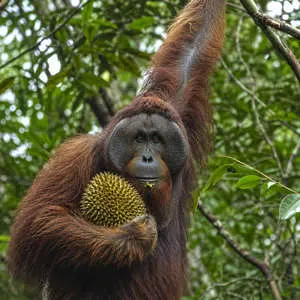
The orangutan (Pongo pygmaeus) is a red-haired ape of Borneo and Sumatra, so heavy-armed that it moves hand over hand rather than walking. Ripe fruit is what it looks for, and durian above all. When the fruiting season ends, it strips bark and chews young shoots instead. Termites, ants and birds’ eggs go down alongside. An adult male’s cheek pads grow wide enough to change the shape of his face.
Baboon

The olive baboon (Papio anubis) is a large ground monkey of the African savannah. Its long muzzle is more like a dog’s than a monkey’s, and it crosses open ground in troops of dozens. Hands dig tubers out of hard ground. Fingers strip seed heads from standing grass. Hares and young antelope are chased down when a troop finds them in the open. Baboons raid crops so well that farmers guard the fields against them.
Badger

The European badger (Meles meles) is a heavy digging animal of woodland and farmland. It is squat and grey, with a black and white striped face and thick front claws. It works wet grassland after dark, pulling earthworms out of the turf one at a time. A single badger takes hundreds in a night. Windfall fruit, cereals and bulbs round out the year. Its lower jaw locks into the skull, which is why the bite is so hard to break.
Skunk

The striped skunk (Mephitis mephitis) is a cat-sized North American animal best known for its spray. A white stripe splits over the shoulders and runs down to the tail, which it raises as a warning. It forages nose-down after dark, digging where the smell is strongest. Those neat cone-shaped holes in a lawn are how gardeners know it visited, since no other animal digs that shape. Grasshoppers and mice go down whole. Windfall fruit, berries and nuts feed it through autumn.
Opossum
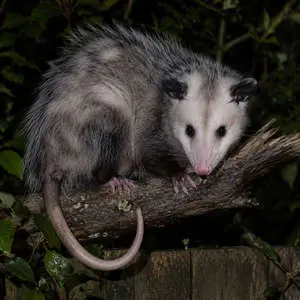
The Virginia opossum (Didelphis virginiana) is a marsupial with a pale pointed face and a bare, gripping tail. It eats almost anything it walks into, from carrion and snails to windfall fruit and grain. Threatened, it goes limp and lies still, because the collapse is involuntary rather than a decision. Opossums also groom ticks off themselves and swallow them, which lowers the tick load of a whole wood.
Hedgehog
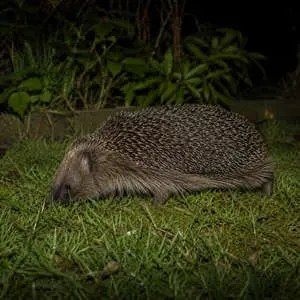
The European hedgehog (Erinaceus europaeus) is a small night animal covered in stiff spines. Its belly is soft and pale, so it rolls into a ball when threatened. Its eyesight is poor, so it hunts by smell, snuffling loudly as it goes. Beetles, caterpillars, earthworms, slugs and snails all end up in the same mouth. Fallen fruit and fungi go down less regularly. A hedgehog crosses several kilometres of hedge and garden in a single night.
Rat

The brown rat (Rattus norvegicus) is the common rat of cities, farms and sewers worldwide. Its fur is coarse, its nose blunt, and its scaly tail almost as long as its body. Its incisors never stop growing, so it gnaws constantly to wear them down. Grain, seeds, fruit and vegetables go first. Insects, eggs, fish and carrion follow. A rat tastes a small amount of anything new and waits a day before returning, which is why poisoned bait fails so much of the time.
Mouse
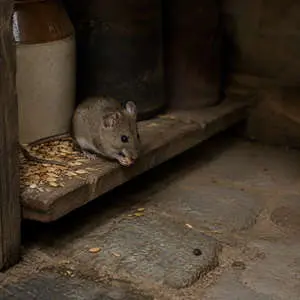
The house mouse (Mus musculus) is a small grey-brown rodent with large papery ears and a fine tail. It feeds in short bursts through the night rather than in one sitting. Seeds, grain and roots are the staple, with larvae, insects and meat scraps alongside. Because so much of that food is moist, a mouse can live without ever drinking.
Squirrel

The grey squirrel (Sciurus carolinensis) is the tree squirrel of parks and woodland. Its bushy tail works for balance in the branches and for signalling on the ground. Autumn goes on burying acorns and hickory nuts one at a time across a wide area. It finds them again by smell rather than memory, so a nut missed by the nose stays in the ground and grows. Buds, bark, flowers and fungi keep it going through late winter. In spring it raids birds’ nests for eggs and nestlings.
Chipmunk

The eastern chipmunk (Tamias striatus) is a small ground squirrel of North American woodland. Dark stripes run the length of its back, and its cheek pouches stretch to the shoulders. It packs those pouches until its head looks twice the normal width. Seeds, nuts, berries and fungi go into an underground larder rather than onto its body as fat. Worms, frogs and birds’ eggs are eaten where they are found. The larder is what gets it through winter.
Hamster

The Syrian hamster (Mesocricetus auratus) is a stocky, short-tailed rodent from the dry farmland of Turkey and Syria. Like the chipmunk, it moves food inside cheek pouches. Everything goes down into one burrow chamber, and a wild hamster fills it with enough seed and root to last a winter. Insects and larvae are eaten where the digging uncovers them. Because the tunnel runs deep, the store stays cool through summer.
Fox

The red fox (Vulpes vulpes) is the most widespread wild dog in the world. Its coat is rust red, its legs black, and its brush tipped with white. In winter it hunts rodents by sound, leaping high and coming down nose-first through snow. Rabbits, birds and earthworms are taken the same way. Once the hedgerows fruit, the diet swings across to blackberries and windfall apples. Urban foxes work bins and compost heaps instead.
Coyote
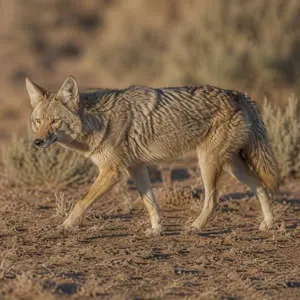
The coyote (Canis latrans) is a wild dog of North America, smaller and lighter than a wolf. It is slender and tall-eared under a grizzled grey coat. It hunts rabbits and rodents alone or in pairs, and scavenges whatever it finds dead. Through autumn it fills up instead on mesquite pods, juniper berries and melons. Because neither half of the diet is essential, coyotes now range across every American state but one. City coyotes hunt at night and lie up in parks by day.
Dog

The domestic dog (Canis familiaris) came from the wolf, but its gut did not stay the same. Domestication gave dogs extra copies of the amylase gene, so they break down starch in a way wolves cannot. A dog handles rice, grain, vegetables and fruit without trouble, while meat, fish and eggs remain the core of the diet. That genetic change is the strongest evidence for calling a dog an omnivore.
Human

The human (Homo sapiens) has the omnivore’s dentition, and you can check it with a mirror. The molars at the back are flat and broad for grinding. The canines at the front are short and blunt. We chew grain and fruit with the flat teeth and tear meat and fish with the front ones, and both go down the same throat. Cooking widened the range further, since heat softens what the jaw alone cannot manage.
Crow
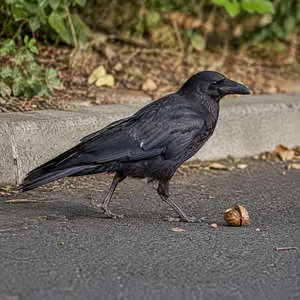
The carrion crow (Corvus corone) is a glossy black bird at home on farmland and in cities alike. Its bill is heavy, and on the ground it walks rather than hops. It eats grain, fruit, seeds and nuts, then switches to insects, worms, eggs and carrion without hesitation. Hard nuts are dropped onto roads for traffic to crack. Crows wait at pedestrian lights and step out for the pieces once the cars stop.
Raven

The common raven (Corvus corax) is the largest songbird alive. Its tail is wedge-shaped in flight, and its throat feathers hang shaggy. It follows wolf packs at a distance and feeds at the carcass once they leave. Acorns, berries and grain are eaten between kills. Eggs and small mammals fill the gap. A raven’s call is audible across a whole valley.
Magpie
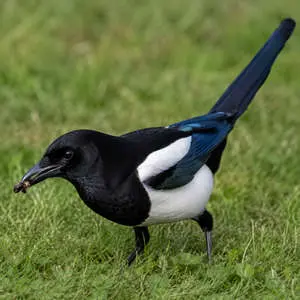
The Eurasian magpie (Pica pica) is a black and white bird of the crow family. Its dark feathers shine green-blue in sunlight, and its tail is longer than its body. It forages lawns in short runs, stopping to snatch beetles, caterpillars, worms and spiders. Once the ground hardens it moves onto grain, fruit and seeds. Magpies pass the mirror self-recognition test, which puts them alongside apes and dolphins.
Blue Jay

The blue jay (Cyanocitta cristata) is a crested blue bird of eastern North American woodland. A black necklace crosses its throat, and the crest goes up when it is alarmed. Autumn is spent hiding acorns, one bird burying thousands across a season. Beech mast, seeds and fruit go down between trips, and insects, eggs and nestlings follow in spring. Because so many buried acorns are never collected, oak woodland spread north after the last ice age on jay-planted trees.
Starling

The common starling (Sturnus vulgaris) is a glossy speckled bird that feeds and roosts in flocks. Its bill turns yellow in spring. That bill works by opening against the soil rather than closing, so it prises the turf apart instead of pinching it. Leatherjackets, worms and beetle larvae come out through the gap. After breeding it moves onto fruit, grain and seeds. Chicks are fed almost nothing but invertebrates.
Robin

The American robin (Turdus migratorius) has a grey back over a rust-red breast, and it splits its day in two. Mornings go on earthworms and insects, taken on open lawns. It hunts them by sight and sound, cocking its head to listen rather than to look. Afternoons move across to berries and fruit in the hedges. Once the ground freezes and the worms go deep, the diet swings almost entirely to fruit.
Chicken

The chicken (Gallus gallus domesticus) is the most numerous bird on earth. It has a comb, wattles and heavy feet, and it rakes the ground backwards then steps away to look at what it uncovered. Grain, seeds and grass go down first, with insects, worms, slugs and small lizards out of the same scrape. Because the scratching turns up so much of it, a free-range hen takes most of her protein this way.
Duck

The mallard (Anas platyrhynchos) is the wild duck behind almost every farm and park breed. The drake has a bottle-green head and a white ring at the neck. Its bill is fringed inside with fine plates that strain food out of water. Pondweed, seeds and algae come through the sieve, and insect larvae, snails and small fish come through with them. Because growing takes protein, ducklings eat almost nothing but insects for their first weeks.
Ostrich
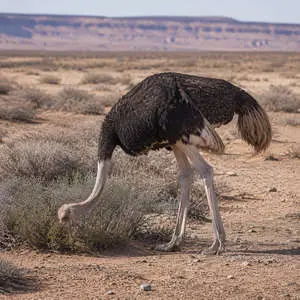
The ostrich (Struthio camelus) is the tallest and heaviest bird alive. It is also the only bird with two toes on each foot. It crops seeds, shrubs, grasses and succulents while walking. Locusts and small lizards are snapped up when they cross in front of it. Roots are pulled up with the bill. Swallowed pebbles grind the food inside the gizzard, since an ostrich has no teeth.
Seagull

The herring gull (Larus argentatus) is the large grey and white gull of northern coasts. A red spot marks the lower bill, and its chicks peck at that spot to be fed. It takes fish, crabs, molluscs, eggs and chicks along the coast. Inland it feeds on fields, taking grain and worms. A gull stamps on wet ground until the worms surface. Landfill and seaside chip shops now feed a large share of the population.
Box Turtle

The eastern box turtle (Terrapene carolina) is a land turtle of North American woodland. Its shell is high and domed, with a hinge at the front that shuts like a lid. What it eats changes as it grows, because a shell takes protein to build. Young turtles hunt insects, worms and slugs on the forest floor. Adults move onto berries, mushrooms, flowers and leaves. Box turtles eat fungi that would poison a person and show no sign of harm.
Bearded Dragon

The central bearded dragon (Pogona vitticeps) is a lizard of inland Australia. Spines run along its flanks, and it takes its name from a throat pouch it flares and darkens when threatened. Its diet reverses with age. Juveniles eat mostly crickets and roaches, since growing takes protein. Adults eat mostly leaves, flowers and fruit. No other reptile reverses its diet so plainly between hatching and adulthood.
Carp

The common carp (Cyprinus carpio) is a large freshwater fish of slow rivers and lakes. It is heavy-bodied, with two pairs of barbels at the corners of its mouth. It feeds by sucking a mouthful of sediment off the bottom, sorting the food out and blowing the mud back. Aquatic plants, seeds and algae go down that way. So do insect larvae, worms and molluscs. A large carp population clouds a lake so thoroughly that the plants below stop growing.
Bonnethead Shark
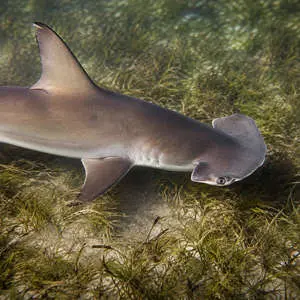
The bonnethead (Sphyrna tiburo) is the smallest of the hammerhead sharks. Its head is shaped like a rounded shovel rather than a bar. It hunts crabs, shrimp, molluscs and small fish across shallow seagrass beds, so a great deal of the seagrass goes down with them. Research published in 2018 showed that the shark digests that grass and takes nutrition from it. No other shark is known to do the same.
Ant
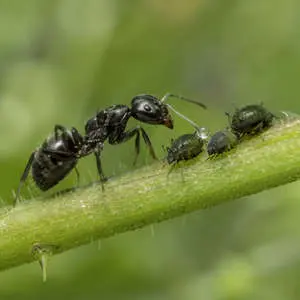
The black garden ant (Lasius niger) is the small dark ant that nests under paving stones across Europe. Workers collect nectar, seeds and fungi, and haul dead insects back to the nest whole. Aphid honeydew is the sweetest thing they gather, so they herd the aphids onto fresh stems and drive off the ladybirds. The whole colony runs on that arrangement.
Common Omnivorous Animals
Most omnivores keep their distance from people. A handful have gone the other way and now feed almost entirely around us. Dog, chicken, pig, rat, mouse and human need no introduction. Crow, seagull and fox complete the set for anyone living near a town. Every one of the nine takes at least part of its food from what people throw away.
Omnivorous Mammals
Grouping by animal class is how a biology lesson approaches this, and mammals come first for good reason. More omnivores are mammals than anything else, and the bear family alone contributes four. Their teeth make the case. Flat molars grind at the back, and pointed canines tear at the front.
- Bears: brown bear, American black bear, sun bear and sloth bear, all eating far more plant matter than their reputation suggests.
- Raccoon family: raccoon, coati, kinkajou and ringtail, built for climbing and probing.
- Primates: chimpanzee, bonobo, orangutan, baboon, macaque, capuchin, spider monkey, vervet monkey and ring-tailed lemur.
- Pigs: pig, wild boar, warthog and peccary, all rooting with a mobile snout.
- Rodents: rat, mouse, squirrel, grey squirrel, chipmunk, hamster, groundhog, prairie dog and agouti.
- Dog family: dog, fox, coyote, jackal and raccoon dog.
- Others: badger, skunk, opossum, hedgehog, armadillo, mongoose, binturong, bandicoot, sugar glider and human.
Omnivorous Birds
Where a mammal has mixed teeth, a bird has a general-purpose bill, and that does the same job. The crow family runs right through this group. A bird with a general-purpose bill can take insects in spring and seeds in winter, which is what most of these do.
- Crow family: crow, raven, magpie, jackdaw, blue jay, chough and currawong.
- Ground feeders: chicken, turkey, quail, ostrich, emu and rhea.
- Water birds: duck, goose and seagull.
- Garden and street birds: robin, starling, sparrow, pigeon, dove, mynah and oriole.
- Others: woodpecker, kea, roadrunner, flamingo and hummingbird.
Omnivorous Reptiles
Birds and reptiles share an ancestor, and several reptiles feed the same way. What sets them apart is that their diet changes as they grow. Several of these hatch as insect eaters and finish as plant eaters.
- Box Turtle: insects and worms as a juvenile, berries and mushrooms as an adult.
- Painted Turtle: aquatic plants, insect larvae and small fish.
- Red-Eared Slider: almost entirely carnivorous when young, then largely herbivorous.
- Snapping Turtle: fish, frogs and carrion alongside a large share of aquatic plants.
- Wood Turtle: berries, fungi, slugs and worms, foraged on land.
- Diamondback Terrapin: crabs, snails and marsh plants in brackish water.
- Bearded Dragon: crickets as a juvenile, greens and flowers as an adult.
- Blue-Tongued Skink: snails, insects, fruit and flowers.
- Black-and-White Tegu: eggs, insects, small mammals and a large amount of fruit.
- Gray’s Monitor: the one fruit-eating monitor lizard, alongside snails and crabs.
Omnivorous Fish
The same pattern continues under water, though most lists stop before they get there. Many freshwater species qualify without question.
- Carp: aquatic plants and algae alongside larvae, worms and molluscs.
- Koi: the ornamental carp, feeding the same way.
- Goldfish: plants, algae, insects and crustaceans.
- Catfish: plant matter, insects, small fish and detritus.
- Tilapia: algae and plants with small aquatic animals mixed in.
- Piranha: fish and insects, but also seeds and fruit that fall into the water.
- Common Roach: plants, algae, insect larvae and snails.
- Freshwater Drum: molluscs, crayfish and plant material from the bottom.
- Opaleye: a Pacific fish grazing seaweed while taking small invertebrates with it.
- Rudderfish: algae and drifting plant matter alongside plankton.
- Triggerfish: algae and seagrass alongside urchins and crustaceans.
- Bonnethead Shark: the only shark known to digest plant material.
Omnivorous Insects And Sea Creatures
Away from vertebrates altogether, the same feeding pattern continues on the shoreline. A scavenger that eats whatever the tide leaves is omnivorous almost by definition, and most of these are crabs.
- Ant: nectar, seeds and honeydew alongside dead insects.
- Cockroach: decaying plant matter, starch, grease and dead insects.
- Cricket: leaves, seeds and fruit alongside aphids and larvae.
- Earwig: flowers, fruit and leaves alongside aphids and insect eggs.
- Ground Beetle: seeds and plant matter alongside slugs and caterpillars.
- Wasp: nectar and fruit for adults, insect prey for the larvae.
- Yellowjacket: the same split, with a strong pull towards sugar in autumn.
- Blue Crab: seagrass, algae, clams, fish and carrion.
- Shore Crab: seaweed, molluscs and worms from the tideline.
- Fiddler Crab: algae and bacteria sifted from mud.
- Hermit Crab: algae, fruit fragments, carrion and small invertebrates.
- Sand Crab: plankton and organic matter sieved from the surf.
- Crayfish: water plants, snails, insect larvae and dead fish.
- Lobster: fish, crabs, molluscs and a small share of algae.
- Shrimp: algae, plant detritus, worms and tiny crustaceans.
Wild Omnivorous Animals
A badger and a bear share a class, yet one works wet turf for worms and the other wades a river for salmon. Where an animal feeds shapes what it takes. These ten stay entirely outside human care, and every one is counted among the wild animals of its region.
- Brown Bear: berries and roots through summer, salmon through autumn.
- Wild Boar: acorns, tubers and fungi turned up by the snout, with worms and eggs alongside.
- Raccoon: crayfish, frogs and eggs from water, fruit and nuts from land.
- Badger: several hundred earthworms in a night, plus fruit and cereals.
- Fox: rodents and birds in winter, blackberries and windfall apples in late summer.
- Coyote: rabbits and carrion alongside mesquite pods and melons.
- Skunk: grubs dug from lawns, with berries and windfall fruit.
- Opossum: carrion, snails and eggs, plus fruit and grain.
- Chimpanzee: figs and leaves, with termites and hunted monkeys.
- Baboon: grass seeds and tubers, with hares and young antelope.
Domestic Omnivorous Animals
The other side of that split is the farmyard and the kitchen. These six live alongside people, and every one eats a wider range in a home than its wild relatives do in the field.
- Dog: meat and fish alongside rice, grain and vegetables, digested with the help of extra amylase genes.
- Pig: grain, roots and peelings alongside insects, worms and eggs.
- Chicken: grain and grass alongside insects, worms and slugs.
- Duck: pondweed and grain alongside larvae, snails and small fish.
- Hamster: seeds and roots alongside insects and larvae.
- Human: grains, fruit and vegetables alongside meat, fish, eggs and dairy.
Omnivorous Animals For Kids
A younger reader does not need the whole set. Fifteen names are enough for the idea, and every one of them is drawn in picture books and school lessons.
Bear · Pig · Dog · Chicken · Duck · Crow · Rat · Mouse · Squirrel · Fox · Raccoon · Hedgehog · Turtle · Ant · Human
Each one is quick to picture eating both kinds of food. A squirrel with an acorn and a squirrel with a bird’s egg makes the point in two images.
Difference Between Herbivores Carnivores And Omnivores
Diet classification works from three groups, and the teeth show which is which before the stomach does. The other two are covered in full under herbivorous animals and carnivorous animals.
| Feature | Herbivore | Carnivore | Omnivore |
|---|---|---|---|
| Main food | Plants only | Animals only | Both |
| Front teeth | Flat or absent | Long pointed canines | Short canines |
| Back teeth | Broad ridged molars | Blade-like carnassials | Flat molars |
| Gut length | Very long | Short | Medium |
| Examples | Cow, deer, rabbit, elephant | Lion, eagle, shark, cat | Bear, pig, crow, human |
A cow has no upper front teeth at all, and a gut many times its body length. A lion has carnassials that shear like scissors and a gut barely three times its body length. A bear has both flat molars and long canines, and a gut in between.
Animals People Think Are Omnivorous
The teeth settle most cases, yet five species are called omnivores anyway and none of them qualifies. Each one is worth knowing, since these five are where the classification goes wrong more than anywhere else.
| Animal | Commonly listed as | Actual classification | Why |
|---|---|---|---|
| Cat | ❌ Omnivore | Obligate carnivore | It cannot make taurine, arachidonic acid or vitamin A from plants, and needs animal tissue to survive |
| Polar Bear | ❌ Omnivore | Hypercarnivore | Seal blubber is almost the whole diet, unlike every other bear |
| Giant Panda | ❌ Omnivore | Herbivore in practice | The gut is carnivoran, but bamboo is over ninety-nine percent of intake |
| Gorilla | ❌ Omnivore | Folivore | Insects are one to three percent of intake and taken incidentally |
| Green Iguana | ❌ Omnivore | Herbivore | Adults eat leaves and flowers, and animal protein damages the kidneys |
FAQs
Q1: What are the names of omnivorous animals?
Bear, pig, raccoon, crow, dog, rat, chicken and human are the eight best known. Around 110 species are named in English lists, spread across mammals, birds, reptiles, fish and invertebrates. Most of them are mammals, and the crow family accounts for most of the birds.
Q2: What are 10 examples of omnivorous animals?
Bear, pig, raccoon, crow, chicken, duck, fox, rat, box turtle and ant are ten to remember. Every one eats plant food and animal food as a normal part of its diet. Between them they cover mammals, birds, reptiles and insects.
Q3: Are omnivores common or rare?
Omnivores are common, and they outnumber strict carnivores across most habitats. A mixed diet lets an animal switch food sources when one runs short, which suits changing conditions. Bears, crows, pigs and rats have all spread widely on that flexibility.
Q4: Why are animals called omnivores?
The word joins the Latin omnis, meaning all, with vorare, meaning to devour. An animal takes the label by eating both plant matter and animal matter as a regular part of its diet. Eating one scrap of the other food type does not qualify.
Q5: Is a dog an omnivorous animal?
Yes, a dog is an omnivore, and genetics settles the point. Domestication gave dogs extra copies of the amylase gene, which lets them digest starch in a way wolves cannot. Meat remains central, but grain, rice and vegetables are handled without difficulty.
Q6: What animals are omnivores in a forest?
Bear, wild boar, badger, fox, raccoon, squirrel, chipmunk, crow, jay and box turtle are the forest omnivores you meet first. Acorns, berries, fungi and insects support all of them. The oak does more for this group than any other tree, since acorns feed bears, boar, squirrels and jays alike.
You May Also Like
- Herbivorous Animals Names
- Carnivorous Animals Names
- Crawl Animals Names In English
- Farm Animals Names In English
- Flying Animals Names In English
- Shy Animals Names In English
- Animals And Their Body Parts Names